Average Settlement Offers During Mediation 2026: Why No Single Number Exists, and What Insurers Actually Open With
Quick Answer
- Is it legit: Yes. Mediation is a real, non-binding negotiation process. Roughly 70% to 85% of personal injury cases settle through it .
- How much: No single average. Minor soft-tissue cases see offers of $10,000 to $35,000. Severe injuries start at $250,000 to $750,000 or more .
- Deadline: Mediation deadlines are set by the court or the parties. No consumer claim window exists because mediation is not a settlement fund.
If you searched for “average settlement offers during mediation,” you are probably preparing for a mediation session or wondering whether the number the insurer threw at you is normal. You want a benchmark. You want to know if you are being lowballed or if the offer is in the right zone.
Here is the honest answer: there is no single average, and anyone who gives you one is guessing . Mediation offers depend on your injury, your medical bills, the liability evidence, the venue, and how badly the insurer wants to avoid trial. The range is so wide that an average would be meaningless.
What does exist is a pattern. Insurers open low, often 20% to 50% of damages, and negotiate upward . A 2026 analysis puts the initial lowball at 40% to 60% below fair value . The number moves. That is the whole point of mediation.
This article covers the verified ranges by injury severity, the opening-offer tactics insurers use, and the one calculation that matters more than any “average.”
The Facts
| Item | Verified Detail |
|---|---|
| Claim Type | Individual negotiation, not a class action or public fund |
| Typical Opening Offer | 20% to 50% of claimed damages |
| 2026 Lowball Range | 40% to 60% below fair value |
| Settlement Rate | Roughly 70% to 85% in personal injury mediation |
| Minor Injury Offers | $10,000 to $35,000 |
| Moderate Injury Offers | $50,000 to $150,000 |
| Severe Injury Offers | $250,000 to $750,000+ |
Is Mediation a Real Settlement Process or a Scam?
Mediation is a real, court-recognized settlement process. It is a structured negotiation facilitated by a neutral third party. It is non-binding, meaning you can walk away if the offer is unacceptable .
The scam risk sits with anyone promising a specific mediation outcome before reviewing your case. No mediator can guarantee a number. No attorney can promise a settlement figure. The process is designed to produce a compromise, not a predetermined payout.
Mediation is not a claim form. It is not a settlement fund. It is a meeting, often a single day, where both sides present their positions and a mediator shuttles offers between rooms. The mediator does not decide the case. The parties do .
Key Takeaway: Mediation is a real negotiation, not a payout program. There is no average to look up, and no one can promise you a number before reviewing your evidence.
How Much Is the Average Settlement Offer During Mediation?
There is no verified national average for mediation settlement offers. The most commonly cited figure, 20% to 50% of damages, is an opening range, not a final outcome .
A 2026 practitioner analysis puts the initial insurance counteroffer at 40% to 60% below the claim’s actual fair value . That gap is deliberate. Insurers open low to test your resolve, gauge whether you are desperate, and see if your attorney is prepared to walk away.
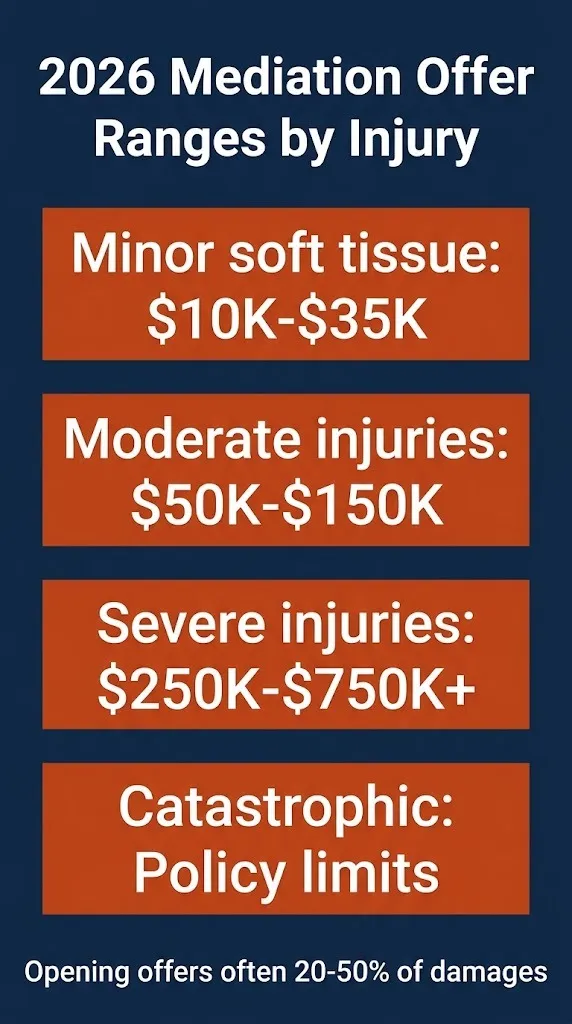
The table below reflects the verified ranges by injury severity from 2026 data. These are mediation offers, not final verdicts.
| Injury Severity | Typical Mediation Offer Range |
|---|---|
| Minor soft tissue (whiplash, strains) | $10,000 to $35,000 |
| Moderate (broken bones, minor concussions) | $50,000 to $150,000 |
| Severe (spinal trauma, TBI, surgery) | $250,000 to $750,000+ |
| Catastrophic (paralysis, wrongful death) | Policy limits, often multi-million |
Reality Check: No one texts you settlement money first. Mediation starts with your medical records and a demand letter. If someone promises a payout before seeing your evidence, it is a scam.
Why Is There No Single Average Settlement Offer?
There is no single average because mediation outcomes vary too widely to aggregate meaningfully. Liability strength, damages, venue, and the parties’ motivation all shift the number .
The first variable is liability. A clear rear-end collision with a police report is worth more than a disputed intersection crash with no witnesses. The insurer’s confidence in its defense drives the offer.
The second is damages. Hard medical bills and lost wages are documented. Pain and suffering are not. The multiplier applied to economic damages depends on the injury’s impact on your life, and that is argued, not calculated.
The third is venue. A consumer-friendly county produces higher offers than a conservative one. Insurers track verdicts by jurisdiction and adjust their budgets accordingly .
The fourth is timing. A case mediated before discovery is complete produces lower offers than one mediated on the courthouse steps. The insurer knows what it is facing at each stage.
| Factor | How It Moves the Offer |
|---|---|
| Clear liability | Higher offer |
| Disputed liability | Lower offer, or no offer |
| Documented surgery | Higher offer |
| Pre-existing condition | Lower offer |
| Consumer-friendly venue | Higher offer |
| Case close to trial | Higher offer |
What Tactics Do Insurers Use to Lower Mediation Offers?
Insurers use predictable tactics to lower mediation offers, and recognizing them is the first step to countering them. The most common is the lowball opening, typically 20% to 50% of damages or 40% to 60% below fair value .
The second tactic is causation denial. The adjuster argues your injuries were pre-existing, not caused by the crash, or exaggerated. This is why consistent medical treatment matters. Gaps in care give the insurer an argument.
The third is medical necessity challenges. The insurer questions whether the treatment was needed or whether the bills are inflated. This is common with chiropractic care and diagnostic imaging.
The fourth is delay. The insurer knows the statute of limitations is running. Some adjusters wait, hoping you will accept a low offer rather than risk missing the deadline .
The fifth is the mediator’s proposal. If the parties are stuck, the mediator may float a number. That number is not binding, but it often becomes the anchor for the final round .
Key Takeaway: Insurers open low, dispute causation, and wait you out. Recognizing the tactic does not make it fair, but it tells you the first offer is not the final one.
How Do You Prepare for a Mediation Settlement Offer?
You prepare for mediation by building a documented demand package, knowing your bottom number, and understanding the insurer’s likely opening. The preparation starts weeks before the session.
- Complete all medical treatment. Gaps in care weaken your claim. The insurer will use them.
- Gather every medical bill and record. Hard economic damages anchor the negotiation.
- Document lost wages. Pay stubs, tax returns, and employer letters.
- Get a clear liability picture. Police report, photos, witness statements.
- Calculate your bottom line. Know the minimum you will accept before you walk in.
- Understand the insurer’s opening. Expect 20% to 50% of damages, and do not react emotionally .
- Let the mediator work. The first offer is a starting point, not a verdict.
What Happens Next After a Mediation Offer?
The next steps depend on whether you accept the offer, counter, or walk away. Mediation is non-binding, so you are not obligated to accept a number you believe is unfair .
If you accept: The terms are documented in a written settlement agreement on the day of mediation. That agreement is binding once signed .
If you counter: The mediator carries the counteroffer to the insurer. Expect two to four rounds of offers and counteroffers.
If you reach an impasse: The mediator may issue a proposal, or the case proceeds toward trial. An impasse is not a failure. Sometimes the insurer’s true position is simply not acceptable .
If a lawsuit was filed: The settlement may need court approval, especially if a minor is involved.
If no settlement: Discovery continues, and the case moves closer to trial. The two-year or three-year statute of limitations remains the backstop.
Frequently Asked Questions
What is the average settlement offer during mediation?
There is no reliable average. Opening offers typically fall between 20% and 50% of claimed damages, but 2026 data shows initial offers can be 40% to 60% below fair value .
How much do minor injury cases settle for in mediation?
Minor soft-tissue cases often see mediation offers of $10,000 to $35,000 .
How much do severe injury cases settle for in mediation?
Severe injuries like spinal trauma or traumatic brain injury often see offers starting at $250,000 to $750,000 or more .
Why is the first mediation offer so low?
Insurers use lowball openings to test your resolve and gauge whether you are prepared to go to trial. The first offer is a starting point, not a final number .
Is mediation binding?
No. Mediation is generally non-binding. You can walk away if the offer is unacceptable. However, once you sign a settlement agreement, it becomes binding .
How many mediation cases settle?
Roughly 70% to 85% of personal injury cases submitted to mediation settle .
Do I need a lawyer for mediation?
Not legally required, but the insurer will have counsel or an experienced adjuster. An attorney can calculate the multiplier, challenge fault allegations, and evaluate whether the offer is fair.
Mediation is a negotiation, not a payout. There is no average to look up. The first offer will likely be low, often 20% to 50% of damages, and it will move if you have the evidence and the patience .
Build the demand package. Know your bottom number. Do not accept the first offer. The settlement rate is high, but the number that matters is the one you can defend with records, not the one an insurer opens with.