Intellectual Property Litigation Attorney in 2026: What the Role Actually Is and When You Need One
Quick Answer
- An intellectual property litigation attorney handles patent, trademark, copyright, and trade secret disputes in federal courts, the ITC, and the PTAB.
- For the Anthropic copyright settlement, the estimated base payout is approximately $2,931 per claimed work, though amounts depend on the court’s final fee deductions.
- The claim deadline in that case passed on March 30, 2026; new claims are no longer accepted.
The Facts
| Case Reference | Bartz, et al. v. Anthropic PBC, Case No. 3:24-cv-05417 |
|---|---|
| Status | Final approval granted July 20, 2026; distribution phase underway |
| Fund Size | $1.5 billion |
| Est. Per Work | Approximately $2,931 (before final interest adjustments) |
| Claim Deadline | March 30, 2026 (passed) |
| Administrator | Anthropic Copyright Settlement Administrator |
| Proof Needed | Claim form tied to a specific eligible work from the master list |
What Does an Intellectual Property Litigation Attorney Actually Do?
An intellectual property litigation attorney represents individuals or companies in disputes over patents, trademarks, copyrights, and trade secrets. This is not a transactional lawyer who files paperwork. This is a trial attorney who goes to court.
The job splits into four core areas:
Patent litigation. Patents protect inventions and processes. A patent attorney in litigation handles infringement claims, validity challenges, and damages calculations. These cases often involve technical experts, claim construction hearings, and sometimes the International Trade Commission.
Trademark litigation. Trademarks protect brand names, logos, and product identifiers. Disputes here usually center on likelihood of confusion between two marks, or claims of dilution and counterfeiting.
Copyright litigation. Copyright protects creative works: books, music, software, images. The Anthropic case is the defining copyright dispute of 2026, involving the unauthorized ingestion of roughly 500,000 books to train an AI model.
Trade secret litigation. Trade secrets cover confidential business information like formulas, customer lists, or manufacturing processes. These cases often involve employees who left for competitors.
The common thread: someone claims their protected work was used without permission, and the attorney builds the case to prove ownership, prove the violation, and recover money.
Is It Real? How to Verify an Intellectual Property Litigation Attorney Claim
Not every letter you get about IP litigation is legitimate. Some are bluff. Some are scams.
Here’s how to tell the difference. A real IP litigation matter will have a case number you can look up on a federal court docket system. It will have a named court and a filing date. If someone threatens you with an IP lawsuit but cannot produce a docket number, the threat is probably noise.
For the Anthropic settlement specifically, the case is real: Bartz, et al. v. Anthropic PBC, filed in the Northern District of California. The settlement website has the key dates, the master list of eligible works, and the claim form.
You do not need an attorney to file a claim in a class action settlement. The claims process is designed for ordinary people. Third parties who charge fees to “help” you file a settlement claim are unnecessary.
How Much Can You Get from Intellectual Property Litigation?
Settlement payouts in IP cases vary wildly. There is no standard amount.
In the Anthropic case, the original estimate was around $3,000 per work, based on the assumption that only a fraction of eligible rights holders would file claims. When 91.3 percent of eligible works were claimed, the math changed. With roughly 440,490 claimed works splitting a net fund of about $1.29 billion, the estimated base payout landed at roughly $2,931 per work, before interest and final cost adjustments.
Here is how the deductions break down in that case:
| Item | Amount |
|---|---|
| Settlement Fund | $1.5 billion |
| Attorneys’ Fees Requested (12.5%) | $187.5 million |
| Litigation Expenses | $2.78 million |
| Cost Reserve | $18.22 million |
| Service Awards (3 plaintiffs) | $150,000 |
| Net Fund for Class | ~$1.29 billion |
| Claimed Works | 440,490 |
| Estimated Base Per Work | ~$2,931 |
If you are a rights holder in a different IP case, the payout depends on the size of the fund, the number of valid claims, and the court’s approval of fees.
Who May Qualify for the Anthropic Copyright Settlement?
The class includes copyright owners of books, periodicals, and other text works that Anthropic ingested to train its AI models without authorization. The master list of eligible works contained approximately 482,460 works.
You may have qualified if:
- You held copyright in a book or text work that appeared on the settlement’s master list
- You were the author, publisher, or a co-author with rights in a listed work
- You filed a claim by March 30, 2026 (the deadline has passed)
Reality Check: The claim deadline passed on March 30, 2026. If you missed it, you cannot file now. Some claimants who opted out late filed objections, but the court has already granted final approval. Late opt-out requests are not guaranteed to be accepted.
Key Takeaway
Key Takeaway: An intellectual property litigation attorney exists to prove ownership and violation in court, but in class settlements, you file your own claim for free, no attorney required.
How to File a Claim in an IP Class Action Settlement
The Anthropic deadline has passed, but the process teaches you how future IP settlements work. Here are the steps, in order:
- Check the official settlement website. Find the master list of eligible works. Search your name or title.
- Confirm your rights. If your work is listed, determine whether you are the sole rights holder, or if a publisher shares the claim.
- Gather proof of ownership. Registration records, contracts, assignment documents.
- Fill out the claim form. The form asks for your contact details and the specific works you are claiming.
- Submit by the deadline. Late claims are generally rejected unless the court grants an exception.
- Wait for the court’s final approval. No payments move until the judge signs off.
- Watch for payment instructions. Checks or electronic transfers come after all appeals resolve.
Filing is free. You do not need to pay anyone to submit a claim.
When Will Payments Go Out in the Anthropic Settlement?
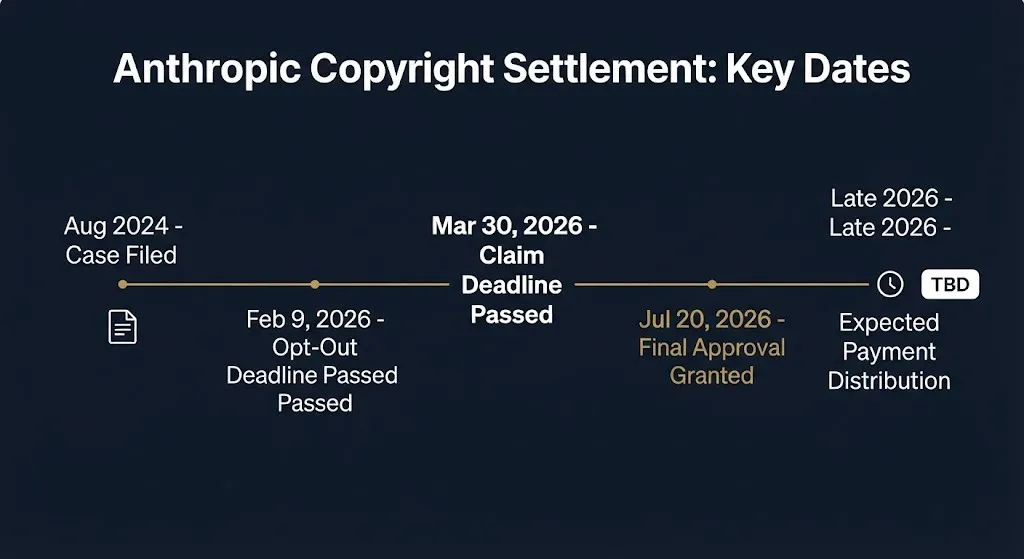
The court granted final approval on July 20, 2026. That does not mean checks mailed the next day.
Distribution takes time. The administrator must process all claims, resolve any disputes between authors and publishers, and calculate final per-work amounts after interest accrues. The original FAQ estimated an initial payout window around August 10, 2026, but that was a projection, not a guarantee. Appeals or late objections can push the timeline further.
If you filed a claim, watch your email and the settlement website for payment instructions. Do not pay anyone who contacts you claiming they can “unlock” your settlement money faster.
What Defenses Commonly Undermine Copyright Claims?
Fair use is the most common defense in copyright infringement litigation. It permits limited use of copyrighted material for purposes like criticism, news reporting, teaching, or parody.
The fair use analysis turns on four factors:
- Purpose and character of the use. Was it commercial or transformative?
- Nature of the copyrighted work. Creative works get more protection than factual ones.
- Amount used. Did the defendant copy the heart of the work?
- Market effect. Did the use harm the copyright holder’s ability to sell or license the work?
In the Anthropic case, the defendant argued that training an AI model on the books was transformative. The court did not ultimately rule on that defense; the parties settled before a final fair use ruling on the bulk of the claims.
Other defenses include independent creation, license, invalid ownership, and statute of limitations. A copyright claim generally must be filed within three years of when the infringement occurred or was discovered.
Key Takeaway
Key Takeaway: Fair use is the defense every copyright defendant tries first, and it turns on whether the use was transformative and caused market harm.
What Happens Next in Major IP Litigation in 2026?
Here is the expected sequence for the remaining stages in the Anthropic settlement:
September to December 2026: Claims processing and dispute resolution. The administrator works through any conflicts between authors and publishers claiming the same work.
Expected late 2026: Final per-work payout calculation after interest accrues and the court confirms fee reductions.
Expected late 2026 or early 2027: Distribution of payments to class members.
Ongoing: Other IP disputes continue. The Netlist v. Samsung patent case settled in August 2026 with a licensing deal worth up to $897 million in gross fees over five years. The NVIDIA class action over 3D objects used to train AI models, Beaulier v. NVIDIA Corp., remains active in the Northern District of California.
Key Takeaway
Key Takeaway: The Anthropic settlement is approved but not yet paying; the Netlist-Samsung patent deal is done and was worth up to $897 million.
Frequently Asked Questions
Do I need an intellectual property litigation attorney to file a class action claim?
No. Class action claims are designed for individuals to file directly. The claim form is free, and the administrator provides instructions. You only need an attorney if you have a unique dispute, such as a contested ownership claim with a publisher.
How much does an intellectual property litigation attorney cost?
Most IP litigation is handled on an hourly basis, often with rates ranging from $400 to $1,200 per hour depending on the attorney’s experience and market. Some plaintiffs’ firms take IP cases on contingency, meaning they take a percentage of the recovery instead of upfront fees.
Can I still file a claim in the Anthropic copyright settlement?
No. The deadline to file a claim was March 30, 2026. The court granted final approval on July 20, 2026. New claims are not being accepted.
What is the difference between an IP litigation attorney and a patent attorney?
A patent attorney is licensed to prosecute patent applications before the USPTO. An IP litigation attorney handles disputes in court, which can involve patents, trademarks, copyrights, or trade secrets. Some attorneys do both.
How long does an intellectual property lawsuit take?
Patent and copyright cases that go to trial can take two to four years from filing to verdict. Cases that settle resolve faster, often within a year. The Anthropic case moved from filing in 2024 to final settlement approval in 2026.
What happens if I missed the opt-out deadline in a class action?
If you miss the opt-out deadline, you remain in the class. You are bound by the settlement and give up your right to sue separately. You can still file a claim to get your share of the money, as long as the claims deadline has not passed.
Can I sue for copyright infringement if I never registered my work?
Yes, but registration matters. You must register your copyright before filing suit for infringement in the U.S. If you register before the infringement occurs, you can seek statutory damages and attorneys’ fees. If you register after, you are limited to actual damages and profits.
How do I check the status of my settlement claim?
Use the official settlement website. The administrator posts updates on claim processing, approval status, and payment timelines. Be cautious of third-party sites that charge for status updates; the official site is free.
Your Next Step
If you filed a claim in the Anthropic settlement, watch for payment instructions from the settlement administrator. Payments are expected to move after the court’s July 20, 2026 final approval, though the exact date depends on processing and any remaining disputes.
If you are dealing with a different IP dispute, the most important step is to preserve evidence now. Screenshots, downloads, metadata, and dated records of the infringement matter more than anything you remember later. Consult a licensed attorney in your jurisdiction before the statute of limitations runs.