What Does Base Compensation Mean in 2026? Salary, Pay, and Total Compensation Explained
Quick Answer
- Base compensation is the fixed, regular pay you earn before bonuses, overtime, commissions, or benefits.
- The U.S. Department of Labor defines salary basis as a predetermined amount paid each pay period, not subject to reductions for work quality or quantity.
- Base pay drives overtime calculations, severance formulas, and retirement contribution limits in most states.
The Facts
| Definition | Fixed, predetermined compensation paid on a regular basis |
|---|---|
| Legal Framework | Fair Labor Standards Act (FLSA), 29 CFR Part 541 |
| Typical Forms | Annual salary, hourly wage, monthly stipend |
| Excludes | Bonuses, commissions, overtime premiums, employer-paid benefits |
| Relevant Agencies | U.S. Department of Labor, Wage and Hour Division, state labor boards |
| Calculation Basis | Hourly rate × hours, or annual salary ÷ pay periods |
| Key Test | Salary basis test for exempt employees under FLSA |
Is Base Compensation Real? How to Verify What Your Employer Owes You
Base compensation is real, and it is legally protected. The term refers to the fixed amount you are promised for doing your job, before any extras are added or deductions are taken out.
Your base compensation is the number written into your offer letter or employment contract. It is not a suggestion. Once agreed, your employer must pay it on a regular schedule. The Fair Labor Standards Act (FLSA) requires that exempt employees receive a predetermined salary that cannot be reduced because of variations in the quality or quantity of work performed .
If you are an hourly employee, your base compensation is your hourly rate multiplied by the hours you work. If you are salaried, it is your annual figure divided across your pay periods.
To verify what you are owed, check three documents:
- Your offer letter or employment contract
- Your most recent pay stub
- Your employee handbook or compensation policy
If those documents conflict, your written contract usually controls. Keep copies of everything.
How Much Is Base Compensation? Payout Examples and Calculation
Base compensation does not have a single national number. It varies by job, industry, location, and experience. What is consistent is how it is calculated.
For salaried employees, the formula is straightforward: base salary per pay period × number of pay periods in a year = annual base compensation . If you earn $3,000 biweekly across 26 pay periods, your base salary is $78,000 per year.
For hourly employees: hours worked per week × weeks per year × hourly rate = annual base pay . At 30 hours per week and $40 per hour, that is $62,400 annually.
Here is how base compensation differs from other pay figures:
| Pay Type | What It Includes | What It Excludes |
|---|---|---|
| Base Compensation | Fixed salary or hourly wage | Bonuses, overtime, benefits |
| Gross Pay | Base + overtime + bonuses + tips | Taxes and deductions |
| Net Pay | Take-home after taxes | All deductions |
| Total Compensation | Base + benefits + equity + perks | Nothing (full package value) |
Not yet determined amounts apply to roles where the employer has not published a pay range or where the employee is still negotiating. In those cases, check the U.S. Bureau of Labor Statistics for occupation-level wage data or state pay transparency databases.
Key Takeaway
Key Takeaway: Base compensation is the fixed number your employer promises for regular work, and it is the foundation for overtime, severance, and retirement calculations.
Who May Qualify for Salary Basis Protection Under the FLSA?
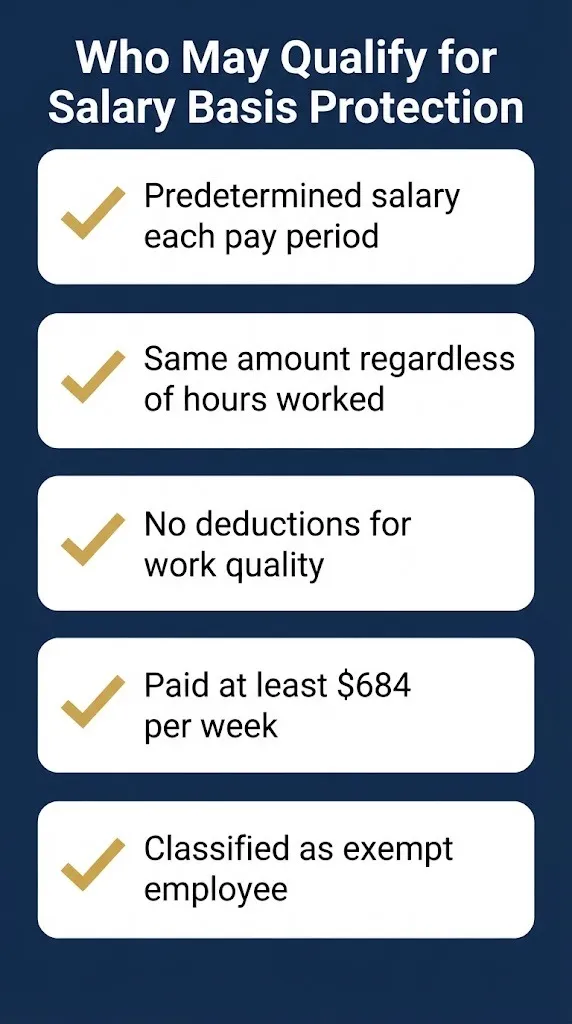
You may qualify for FLSA salary basis protection if you are classified as an exempt employee and receive a predetermined salary of at least $684 per week (the current federal threshold). That means your pay cannot be docked because your work was slow on a Tuesday, or because you left early for a doctor’s appointment.
The salary basis test has three parts :
- Regular, predetermined amount. You must receive the same base amount each pay period, regardless of hours or output.
- Weekly or less frequent basis. The salary cannot fluctuate based on daily or hourly work quantity.
- No reduction for quality or quantity. Your employer cannot cut your base pay because you had a light week.
The FLSA also distinguishes between exempt and nonexempt employees. Exempt employees are not entitled to overtime under federal law. Nonexempt employees must receive at least minimum wage for all hours worked and overtime at 1.5 times their regular rate for hours over 40 in a workweek .
Reality Check: A fancy job title does not make you exempt. If your employer deducts pay for missed hours or requires you to clock in and out, you may be misclassified. Misclassification can mean unpaid overtime, which is recoverable.
What Is the Difference Between Base Compensation and Total Compensation?
Base compensation is just the starting point. Total compensation is the full value of what your employer gives you in exchange for your work, including money and non-cash benefits .
Here is what sits on top of base pay:
- Bonuses and commissions. Variable pay tied to performance, sales, or company results.
- Overtime pay. Extra compensation for hours worked beyond 40 in a workweek.
- Health, dental, and vision insurance. Employer contributions reduce your out-of-pocket costs.
- Retirement contributions. 401(k) matches, pensions, or profit-sharing.
- Stock options or equity. Ownership stakes that vest over time.
- Paid time off. Vacation days, sick leave, and holidays.
- Wellness perks. Gym memberships, mental health support, or lifestyle stipends.
When you evaluate a job offer, compare total compensation, not just base salary. A $5,000 higher base salary can be wiped out by a worse health plan or no retirement match.
How Do You Calculate Base Pay from a Job Offer?
You calculate base pay by isolating the fixed portion of the offer. Here are the steps:
- Find the annual or hourly figure. This is the number the employer states as salary or wage.
- Identify variable components. Note any bonuses, commissions, or profit-sharing that are not guaranteed.
- Subtract non-base items. Overtime, signing bonuses, and relocation stipends are not base pay.
- Check pay periods. Biweekly means 26 pay periods. Semimonthly means 24. Monthly means 12.
- Multiply for annual. Fixed amount per period × number of periods = annual base compensation.
- Verify against the offer letter. If the math does not match the stated annual salary, ask for clarification.
- Confirm in writing. Before accepting, get the base figure confirmed in the final offer document.
Think of it like ordering a sandwich. The base pay is the sandwich itself. Bonuses, overtime, and benefits are the chips and drink on the side. You need to know exactly what is in the sandwich before you agree to pay for it.
How Does Base Compensation Affect Overtime and Severance?
Base compensation is the anchor for several downstream calculations. If your base pay is wrong, everything built on top of it is wrong too.
Overtime. For nonexempt employees, overtime is calculated at 1.5 times the regular rate of pay. The regular rate is not always just the base hourly rate. It includes certain bonuses and commissions that are tied to hours worked, production, or efficiency . Some payments are excluded from the regular rate, including discretionary bonuses, gifts, and certain premium pay for weekend or holiday work .
Severance. Severance packages often use base salary as the multiplier. A common formula is two weeks of base pay for every year of service. If your base is understated, your severance shrinks.
Retirement contributions. Employer 401(k) matches are frequently calculated as a percentage of base salary. A lower base means a smaller match.
Paid time off accrual. Some employers accrue PTO based on hours worked or base salary. Errors in base pay can create errors in PTO balances.
The Department of Labor provides guidance on what counts as base compensation for overtime purposes. When in doubt, ask your payroll department in writing.
Key Takeaway
Key Takeaway: Base compensation is not just a number on a paycheck; it drives overtime rates, severance formulas, and retirement matches, so errors compound fast.
What Happens If Your Employer Misclassifies Your Base Pay?
If your employer misclassifies your base pay, you may lose overtime, benefits, or retirement contributions. Misclassification is not always accidental. Some employers label workers as exempt to avoid paying overtime.
Here is what to check:
- Are you paid a predetermined salary each period? If your pay fluctuates based on hours, you may not meet the salary basis test.
- Do you clock in and out? If yes, you may be nonexempt regardless of your title.
- Does your pay stub show hourly deductions? Deductions for partial days or missed hours can indicate nonexempt status.
- Are you paid for all hours worked? Nonexempt employees must be paid minimum wage for every hour and overtime for hours over 40.
If you suspect misclassification, gather your pay stubs, offer letter, and any policy documents. You can file a complaint with the Wage and Hour Division of the U.S. Department of Labor. You do not need an attorney to file a complaint. The process is free.
What Happens Next in 2026 Compensation Law?
Here is the expected timeline for base compensation rules and enforcement:
Ongoing 2026: The Department of Labor continues enforcing the salary basis test for exempt employees at the $684 per week threshold. No federal increase has been finalized as of October 2026.
Expected late 2026: Several states, including California, New York, and Washington, may update their own salary thresholds for exemption. Check your state labor board for the current number.
Expected 2027: Pay transparency laws continue to expand. More employers will be required to post salary ranges on job listings.
Pending: Litigation over the regular rate calculation for overtime, particularly whether certain bonuses must be included, remains active in federal courts.
Frequently Asked Questions
What does base compensation mean in a job offer?
Base compensation is the fixed salary or hourly wage the employer promises to pay you for regular work, before bonuses, overtime, or benefits are added.
Is base pay the same as gross pay?
No. Base pay is the fixed amount. Gross pay includes base pay plus overtime, bonuses, commissions, and other earnings before deductions.
Does base compensation include overtime?
No. Overtime is extra pay for hours worked beyond 40 in a workweek. It is calculated on top of base compensation, not included in it.
Can my employer reduce my base salary?
Generally, no, not without notice and not retroactively for work already performed. For exempt employees, the salary basis test prohibits deductions for quality or quantity of work.
How is annual base salary calculated for hourly workers?
Multiply your hourly rate by the number of hours you work per week, then multiply by 52 weeks. For part-time or variable schedules, use your average weekly hours.
What is the difference between base compensation and total compensation?
Base compensation is the fixed pay only. Total compensation includes base pay plus benefits, bonuses, equity, paid time off, and perks.
Does base pay affect unemployment benefits?
Yes. Unemployment benefits are typically calculated as a percentage of your base wages over a base period. A lower base pay means lower weekly benefits if you lose your job.
What if my employer pays me less than my base compensation?
If you are paid less than your agreed base compensation, you may have a wage claim. Document the discrepancy and contact your state labor board or the U.S. Department of Labor.
Your Next Step
Pull out your offer letter and your most recent pay stub. Compare the base compensation stated in writing to the base amount on your paycheck.
If those numbers do not match, ask payroll for a written explanation. If the explanation does not resolve it, you can file a free complaint with the Wage and Hour Division. You have the right to be paid what you were promised.