What Is a Litigation Hold 2026: Notice Requirements, Legal Risks, and Compliance Steps
Quick Answer
- A litigation hold is a legal duty to preserve documents and data relevant to pending or anticipated litigation.
- There is no payout tied to a litigation hold. It is a preservation obligation, not a claim or settlement.
- The trigger date is the most important deadline. Preservation starts when litigation is reasonably anticipated.
If you received a litigation hold notice, or you are the one issuing one, you are now inside a legal process with real consequences. This is not a routine email.
A litigation hold is the legal mechanism that stops the deletion of evidence. Once it is in place, every relevant document, email, text, database record, and file must be preserved until the case ends.
This article explains what a litigation hold actually is, what the notice requires, who it affects, and what happens when someone gets it wrong. One verified detail most guides miss: federal courts have issued sanctions in hundreds of cases for spoliation, and the costs now routinely reach six and seven figures.
The Facts
| Case | No single case; governed by Federal Rules of Civil Procedure |
| Status | Ongoing legal obligation in active and anticipated litigation |
| Fund Size | Not applicable; no settlement fund |
| Est. Per Person | Not applicable; sanctions are case-specific |
| Claim Deadline | No claim deadline; preservation starts at trigger date |
| Administrator | No central administrator; party and counsel manage holds |
| Proof Needed | Notice, preservation logs, custodian acknowledgments |
Is a Litigation Hold Notice Real or a Scam?
A litigation hold notice is a real legal document. It is not a scam.
The notice comes from a party in a lawsuit, or from an attorney, or from a company’s own legal department. It instructs recipients to preserve specific categories of documents and data.
A legitimate notice will identify the matter, the parties, the types of information to preserve, and the person to contact with questions. It will also state the date the obligation begins.
Fake hold notices are rare. But phishing emails sometimes use legal-sounding language to trick people into clicking links or providing information. If you receive a hold notice from an unknown sender, verify it with your legal department or a supervisor before acting.
A real hold notice does not ask for money. It does not ask for passwords. It asks you to stop deleting things.
What Is a Litigation Hold in Simple Terms?
A litigation hold is a pause button on data destruction.
When you anticipate a lawsuit, or one is filed, you must stop all routine deletion processes. That includes email auto-delete policies, file retention schedules, and any manual deletion of relevant documents.
The hold applies to electronically stored information, or ESI. That covers emails, text messages, Slack messages, Word documents, spreadsheets, databases, voicemails, and social media posts.
It also applies to paper documents in some cases. If a file cabinet contains relevant records, those records must be preserved too.
The hold is not optional. Once the duty to preserve arises, failure to comply can lead to court sanctions, including monetary penalties and instructions to the jury that missing evidence would have hurt your case.
What Is the Legal Basis for a Litigation Hold?
The duty to preserve arises from the Federal Rules of Civil Procedure and from common law.
Rule 37(e) specifically addresses the failure to preserve electronically stored information. It allows a court to impose sanctions when ESI that should have been preserved is lost and cannot be restored.
The duty attaches when litigation is “reasonably anticipated.” That is not always the day a lawsuit is filed. It can be earlier, when a demand letter arrives, when a regulatory investigation begins, or when an incident occurs that is likely to lead to a claim.
State courts have similar rules. California, New York, and Texas all recognize the duty to preserve evidence in litigation.
The U.S. Supreme Court and federal appellate courts have reinforced this duty in a series of decisions spanning decades. The standard is clear: once you know litigation is coming, you must preserve.
Who Does a Litigation Hold Apply To?
A litigation hold applies to anyone with relevant information.
That includes employees, contractors, executives, IT staff, and sometimes third parties. If you have documents or data that relate to the dispute, the hold applies to you.
The hold also applies to the organization as a whole. The company must identify all custodians of relevant information and notify them in writing.
Custodians are the people whose files, emails, and devices contain potentially relevant data. A custodian list is typically developed by legal counsel working with IT and management.
If you are a custodian, you will receive a litigation hold notice. You must acknowledge it and comply. Ignoring it does not make the obligation go away.
What Does a Litigation Hold Notice Require?
A litigation hold notice requires three things: preservation, acknowledgment, and cooperation.
First, preservation. You must stop deleting anything that falls within the categories described in the notice. This includes disabling auto-delete features on your email and other systems.
Second, acknowledgment. Most organizations require you to confirm in writing that you received and understand the notice. This creates a record that you were informed.
Third, cooperation. You must work with legal counsel and IT to identify and preserve relevant data. That may mean allowing your devices to be imaged, or your files to be collected.
The notice itself is not the end of the process. It is the beginning. The hold remains in place until you are formally released in writing.
Key Takeaway: Once a litigation hold is issued, preservation is mandatory, and the obligation continues until written release, not until the case feels over.
What Happens If You Ignore a Litigation Hold?
Ignoring a litigation hold is one of the most expensive mistakes a person or company can make.
The court can impose sanctions for spoliation, which is the destruction or loss of relevant evidence. Sanctions can include monetary fines, adverse inference instructions, or even dismissal of claims or defenses.
An adverse inference instruction tells the jury they may assume the missing evidence was unfavorable to the party that lost it. That single instruction can swing a case.
Monetary sanctions have reached millions of dollars in high-profile cases. In one federal case, a company was ordered to pay over $3 million for failing to preserve emails. In another, a party forfeited a claim because key data was deleted.
The cost is not just financial. Losing evidence damages credibility. Once a court finds you failed to preserve, everything else you say becomes suspect.
How Long Does a Litigation Hold Last?
A litigation hold lasts until the case ends and you are released in writing.
That includes the investigation phase, the lawsuit, any appeals, and sometimes related matters. A hold can last months or years depending on the case.
You are not released when you settle. You are not released when the trial ends. You are released only when the legal team tells you, in writing, that the hold is lifted.
Some holds outlast the case because regulatory investigations continue after a lawsuit resolves. The same documents may be relevant to multiple matters.
Treat the hold like a parking brake. It stays on until someone with authority takes it off.
What Is the Difference Between a Litigation Hold and a Preservation Order?
A litigation hold is a party’s internal obligation. A preservation order is a court’s external command.
The hold is issued by counsel or the company itself. It directs custodians to preserve. It is not filed with the court.
A preservation order comes from a judge. It commands the parties to preserve specific categories of evidence. Violating a court order is more serious than violating an internal hold.
Both serve the same purpose. Both require preservation. But a court order carries the additional weight of contempt proceedings for noncompliance.
What Is Spoliation of Evidence?
Spoliation is the destruction, alteration, or loss of evidence that is relevant to litigation.
It includes deleting emails, wiping hard drives, shredding documents, and allowing auto-delete policies to run after the duty to preserve has attached.
Spoliation can be intentional or negligent. Courts sanction both, though intentional spoliation draws harsher penalties.
The key question is not whether you deleted something. The question is whether you had a duty to preserve it at the time. If the duty existed and the data is gone, spoliation has occurred.
Key Takeaway: The duty to preserve triggers before you may feel like you are in litigation, so the safest practice is to over-preserve early.
How Do You Issue a Litigation Hold?
Issuing a litigation hold follows a standard process.
- Identify the trigger. Determine when litigation became reasonably anticipated.
- Identify custodians. List every person with potentially relevant information.
- Draft the notice. Describe the matter, the categories of data, and the preservation obligations.
- Send the notice. Deliver it in writing to every custodian.
- Require acknowledgment. Confirm each custodian received and understood it.
- Suspend deletion. Work with IT to disable auto-delete and preserve backups.
- Document everything. Keep a record of every notice, acknowledgment, and preservation step.
- Monitor compliance. Follow up with custodians and update the hold as the case evolves.
Skipping step 6 is a common error. A hold notice is useless if the email system auto-deletes messages 90 days later.
What Are the Most Common Litigation Hold Mistakes?
Several mistakes recur in real cases.
Failing to issue a hold early enough tops the list. Companies wait for a lawsuit to be filed when the duty arose weeks or months earlier.
Sending the notice but not suspending auto-delete is next. The notice says preserve. The system deletes anyway.
Failing to update the hold as the case expands is another. New custodians appear. New data sources emerge. The hold must grow with the case.
Releasing the hold too early is also common. The case is dismissed, but an appeal is filed. The hold should have stayed in place.
Treating the hold as a one-time event instead of an ongoing process is the root cause of most failures.
Reality Check: A litigation hold is not a form you sign and forget. It is an active, ongoing obligation. The people who treat it as a checkbox are the ones who end up in sanctions hearings.
How Do Litigation Holds Work with Cloud Data and Messaging Apps?
Modern litigation holds extend to cloud storage, Slack, Teams, text messages, and other platforms.
The duty to preserve applies to data wherever it lives. That includes third-party servers and personal devices used for work.
Companies must work with IT and vendors to place legal holds on cloud accounts. That prevents deletion by the user and sometimes by the platform’s retention policies.
Text messages are a growing source of sanctions. Employees who delete work-related texts after a hold is issued create spoliation risk.
The rule is simple: if it relates to the case and it is under your control, preserve it. The device or platform does not matter.
What Is the Cost of Noncompliance with a Litigation Hold?
Noncompliance costs more than any compliance program.
The direct costs include sanctions, adverse inference instructions, and in some cases, liability for the underlying claims.
The indirect costs include lost credibility, increased settlement values, and damage to the client relationship.
A 2025 federal appellate decision upheld a $2.7 million sanction for spoliation of emails in a commercial dispute. The court found the company failed to suspend auto-delete even after litigation was threatened.
Another case resulted in dismissal of a plaintiff’s claims after text messages were deleted. The plaintiff had a duty to preserve and failed.
These are not rare outcomes. Courts across the country issue spoliation sanctions regularly.
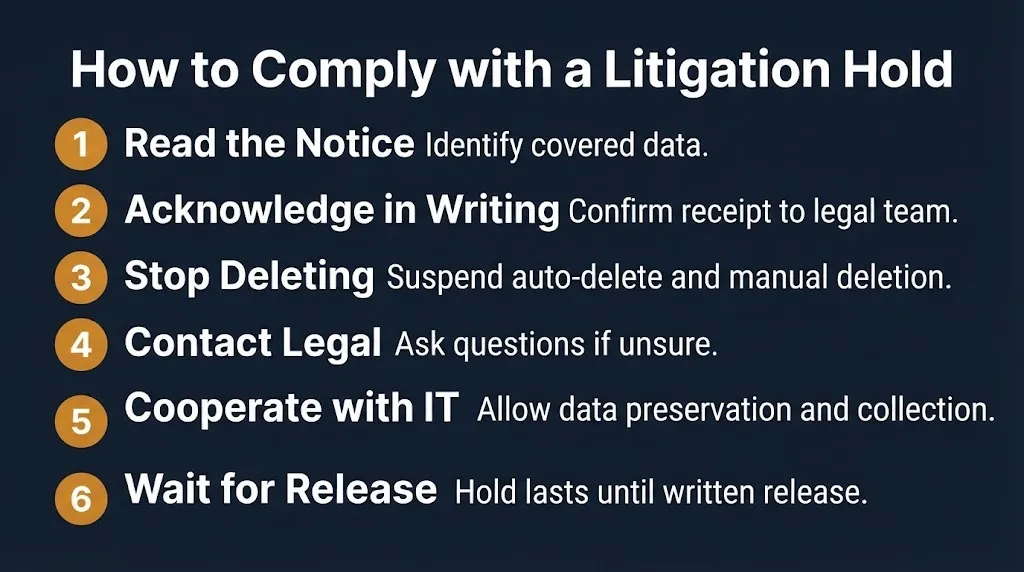
What Should You Do If You Receive a Litigation Hold Notice?
If you receive a litigation hold notice, act immediately.
First, read it carefully. Understand what categories of information are covered.
Second, acknowledge it. Respond in writing as the notice requires.
Third, preserve everything. Stop deleting anything that may relate to the matter.
Fourth, contact the legal team with questions. Do not guess about what is covered.
Fifth, cooperate with IT. Your devices and accounts may need to be preserved or collected.
Sixth, keep the hold in mind. Do not resume normal deletion until you are released in writing.
This is like a store return without a receipt. You need the record of what you did, or the store will not believe you later.
What Happens Next After a Litigation Hold Is Issued?
The litigation hold sets off a chain of events.
Expected within days: Custodian acknowledgments are collected and logged.
Expected within weeks: IT confirms deletion suspension and data preservation.
Expected within months: Discovery begins. Preserved data is collected, reviewed, and produced.
Expected at case end: Hold is released in writing. Custodians are notified they may resume normal retention.
The hold is not the end. It is the foundation for everything that follows in discovery.
Frequently Asked Questions
What is a litigation hold in simple terms?
It is a legal order to stop deleting documents and data that relate to a lawsuit or possible lawsuit.
It applies to email, texts, files, and other electronically stored information.
Who must comply with a litigation hold?
Anyone who receives the notice and has relevant information.
That includes employees, contractors, and sometimes third parties.
What happens if I delete emails after a litigation hold?
You may face sanctions for spoliation of evidence.
Courts can impose fines, adverse inferences, or even dismiss claims.
How long does a litigation hold last?
Until the case ends and you are released in writing.
It may last months or years depending on the matter.
What is the difference between a litigation hold and a preservation order?
A litigation hold is internal, issued by counsel.
A preservation order comes from a judge and carries court enforcement.
Do I need a lawyer to respond to a litigation hold?
You do not need your own lawyer to comply.
But you should contact the legal team that issued the hold with questions.
Can a litigation hold apply to personal devices?
Yes, if work-related data is on the device.
Text messages and cloud accounts on personal devices may be covered.
The single most important action is to stop deleting the moment you know litigation is possible. Everything else follows from that.