Gmail Class Action Lawsuit 2026: Settlement Status, Privacy Claims, and What Users Should Know
Quick Answer
- The Gmail class action lawsuit is real but fragmented. No single settlement covers all Gmail users in 2026.
- Per-person payouts are not yet determined for active cases. Prior Google privacy settlements paid small amounts.
- There is no claim deadline right now. Watch federal court dockets and official settlement sites for updates.
If you searched for a Gmail class action lawsuit, you likely saw a headline or a social post claiming Google is paying out. The truth is more complicated.
Google faces multiple privacy cases, not one. Some involve Gmail scanning. Some involve Chrome incognito mode. Some involve location tracking. A few have settled. Most have not.
This article separates what is real from what is rumor, what is settled from what is still pending, and what you can actually do right now. One verified detail most coverage misses: the largest Google privacy settlement to date, the Chrome incognito case, required Google to delete billions of records, not just pay money.
The Facts
| Case | Multiple Google and Gmail privacy class actions |
| Status | Varies; some settled, most in litigation |
| Fund Size | Varies by case; no single Gmail fund |
| Est. Per Person | Varies; prior settlements paid $5 to $50 per user |
| Claim Deadline | No current deadline; prior deadlines passed |
| Administrator | Varies by case |
| Proof Needed | Gmail account ownership, dates of use |
Is the Gmail Class Action Lawsuit Real or a Scam?
The Gmail class action lawsuit is real. But it is not one case, and no settlement is paying out right now.
The term “Gmail class action lawsuit” gets attached to several different legal matters. Some are about email scanning for ad targeting. Some are about privacy disclosures. Some are about data sharing with third parties.
A real settlement has a court-approved website, a case number, a claim deadline, and a neutral administrator. If you see a post claiming “Gmail users get $500” without those details, it is likely clickbait or a scam.
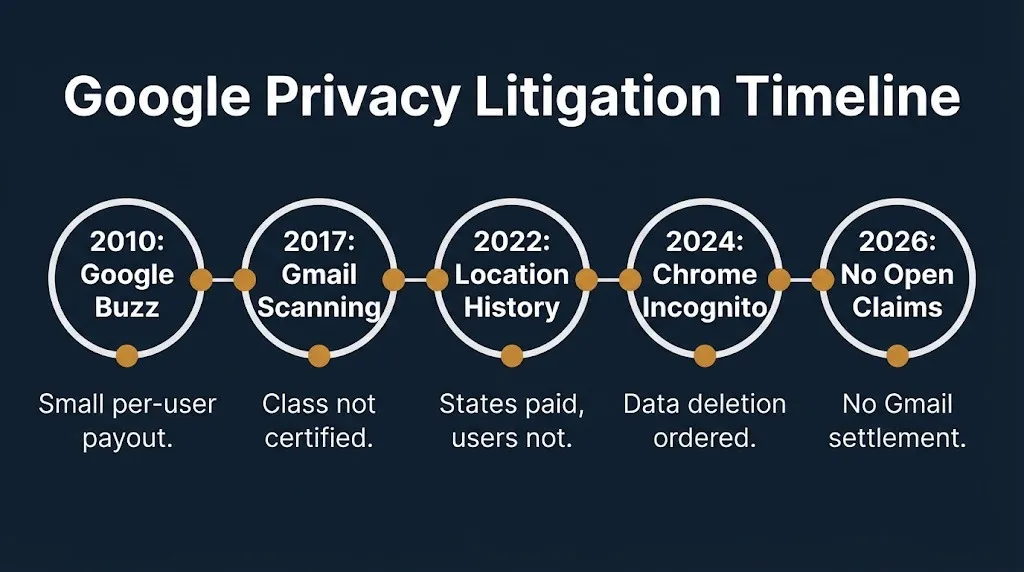
Google has faced genuine class actions. The most famous settled case involved Google Buzz in 2010. That settlement paid small amounts, around $2 to $10 per user after fees. The lesson: real cases often pay less than headlines suggest.
What Is the Google Privacy Settlement?
The Google privacy settlement is not one thing. It is a collection of cases.
The most significant recent settlement involved Chrome incognito mode. Plaintiffs alleged Google tracked users even when they browsed in incognito mode. That case settled in 2024 with Google agreeing to delete or de-identify billions of data records. It did not create a per-person payout fund for users.
Other cases involve location tracking. A 2022 settlement with state attorneys general required Google to pay $391.5 million over location history disclosures. That money went to states, not individual users.
A separate class action over Google+ data exposure settled in 2020. Eligible users could claim a small payment. The per-person amount was modest.
None of these settlements is a “Gmail settlement.” They are Google cases, but not Gmail-specific.
How Much Could a Gmail Settlement Pay Per Person?
No Gmail-specific settlement amount exists because no Gmail settlement has been approved in 2026.
Historical Google settlements provide a rough reference.
| Settlement | Year | Per-Person Outcome |
|---|---|---|
| Google Buzz privacy | 2010 | $2 to $10 after fees |
| Google+ data exposure | 2020 | Under $5 for most claimants |
| Google location history (states) | 2022 | No individual payout |
| Chrome incognito | 2024 | No individual payout fund |
The pattern is clear. Google privacy cases rarely produce large individual payouts. The most common outcome is a small check or no check at all, with the bigger remedy being changed behavior or data deletion.
If you see a post promising $500 or more per Gmail user, treat it as false until a court-approved notice says otherwise.
Key Takeaway: Prior Google privacy settlements paid small amounts per person, and several recent settlements paid individuals nothing at all.
What Is the Gmail Scanning Lawsuit?
The Gmail scanning lawsuit refers to a group of cases filed in the 2010s.
Plaintiffs alleged Google scanned Gmail messages to serve targeted ads. They argued this violated wiretap laws and privacy expectations.
The cases were consolidated in federal court in California. Google argued users consented to scanning when they agreed to the terms of service.
In 2017, a federal judge declined to certify the class, finding individual issues predominated. The case largely stalled after that ruling.
No settlement ever emerged from the Gmail scanning litigation. It was not a victory for plaintiffs. It was not a payout for users.
What Is the Difference Between Gmail and Google Class Actions?
Gmail is one product. Google is the parent company.
A Gmail class action would involve Gmail-specific conduct: email scanning, inbox data, or Gmail account practices.
A Google class action could involve any Google product: Chrome, Maps, Search, YouTube, Android, or Google’s advertising tools.
Most high-profile privacy cases involve Google, not Gmail specifically. The Chrome incognito case is about Chrome. The location history case is about Maps and account settings. Neither is a Gmail case.
When you see “Google privacy settlement,” check which product is actually at issue. The claim form, if any, will specify who qualifies.
Are There Any Open Google or Gmail Claim Deadlines in 2026?
No major Google or Gmail class action claim window is open as of September 2026.
Prior deadlines have passed. The Google+ settlement claim deadline was years ago. The location history settlement did not have an individual claim process.
New cases are filed regularly. A settlement could be announced at any time. When one is, the notice will appear on an official settlement website and in court records.
Do not rely on social media posts for deadlines. Check the court docket or a reputable legal news source.
Key Takeaway: If no court-approved claim form and deadline exist, no payout is available, regardless of what a viral post says.
How Do You File a Claim in a Google Privacy Settlement?
The process is the same for any class action settlement.
- Confirm the settlement is real by checking the court docket or official settlement website.
- Verify the case number and court name.
- Review the class definition to see if you qualify.
- Gather proof: your Gmail or Google account email address and approximate dates of use.
- Complete the online claim form before the deadline.
- Save your confirmation number.
- Wait. Payment comes after final approval and any appeals.
Filing is always free. No legitimate settlement asks for a fee to file a claim.
What Was the Chrome Incognito Settlement?
The Chrome incognito settlement is the largest Google privacy resolution to date, but it did not create a user payout fund.
The case alleged Google tracked users even when they used incognito mode in Chrome. Plaintiffs said this misled users about the privacy of their browsing.
The settlement, announced in 2024, required Google to delete or de-identify billions of data records. It also required changes to how Google discloses incognito tracking.
No individual payments were included. The remedy was structural, not monetary.
This matters for Gmail users because it shows Google’s privacy litigation strategy: settle with data deletion and disclosure changes, not cash.
Reality Check: No real Google or Gmail settlement will text you first. You will never be asked to pay a fee to receive a payout. The first notice comes by email or mail from a court-approved administrator, and filing is always free.
What Was the Google Location History Settlement?
The Google location history settlement involved state attorneys general, not a private class action.
In 2022, Google agreed to pay $391.5 million to 40 states over allegations it misled users about location tracking. The states said Google continued collecting location data even after users turned off location history.
The money went to state governments. Individual users received nothing.
The case changed how Google describes location settings. It did not create a claim process for users.
What Is the Current Status of Google Privacy Litigation in 2026?
Google faces ongoing privacy litigation on multiple fronts.
New class actions are filed regularly. Many involve Google’s advertising practices, data collection, or AI training data.
No consolidated Google privacy settlement is pending in 2026 that would create a broad claim window.
The trend in Google cases is toward injunctive relief, meaning changes to data practices, rather than large individual payouts.
For Gmail users, the practical takeaway is to watch for official notices and to be skeptical of viral settlement claims.
What Should You Do If You Receive a Gmail Settlement Notice?
If you receive a notice that appears to be about a Gmail or Google settlement, take these steps.
First, verify the case. The notice should include a case name, court, and case number. Cross-check those against the court’s public docket.
Second, confirm the administrator. Legitimate notices come from known settlement administrators, not random companies.
Third, look for the claim deadline. A real notice will state it clearly.
Fourth, check the official settlement website. Do not use links from the email if you cannot verify the sender.
Fifth, file only on the official site. Never pay a fee.
Key Takeaway: Verification comes before action. A real settlement survives scrutiny. A fake one collapses under it.
What Are the Most Common Google Privacy Claims?
Several recurring claims appear in Google privacy litigation.
Email scanning claims allege Google reads messages for advertising. These cases largely failed to certify as class actions.
Location tracking claims allege Google misleads users about data collection. These settled with state regulators.
Incognito mode claims allege Chrome tracks users who expect privacy. These settled with data deletion requirements.
Data breach claims allege Google exposed user data. The Google+ case is the main example. It settled with a small per-person payout.
AI training claims are newer. Plaintiffs allege Google used personal data to train AI models without consent. These cases are in early stages.
How Do Google Settlements Compare to Other Tech Privacy Settlements?
Google’s approach differs from some other tech companies.
Meta settled a biometric privacy case in Illinois for $650 million. Per-person payouts reached several hundred dollars. That was an unusually large outcome driven by a strong state statute.
Google’s privacy settlements rarely reach that scale for individuals. The company favors structural remedies and state-level payments.
TikTok settled a privacy class action for $92 million in 2022. Eligible users could claim modest amounts.
Amazon settled an Alexa privacy case with the FTC for $25 million. Individual users received nothing.
The pattern: Google fights, settles on its own terms, and rarely pays individuals much.
What Happens Next in Google and Gmail Privacy Litigation?
The litigation landscape continues to shift.
Expected late 2026: Rulings in pending motions to dismiss in newer privacy cases.
Expected 2027: Possible certification decisions in class actions involving data sharing and AI training.
Ongoing: Regulatory actions from the FTC and state attorneys general remain the more likely source of enforcement.
For users, the next real claim opportunity depends on a new settlement being reached and approved. None is imminent as of September 2026.
Frequently Asked Questions
Is there a Gmail class action lawsuit in 2026?
Yes, there are active privacy cases involving Google, but no single Gmail settlement exists.
No claim window is open for Gmail users as of September 2026.
How much will I get from the Gmail class action?
No Gmail-specific payout has been approved.
Prior Google privacy settlements paid small amounts or nothing to individual users.
What was the Google privacy settlement?
It is not one settlement. It is multiple cases involving Chrome, location history, and other products.
The largest recent settlement required data deletion, not cash payments.
Is the Gmail settlement email real?
If it has a case number, court name, and administrator, it may be real.
If it asks for a fee or promises a large payout, it is likely a scam.
How do I file a claim for the Google privacy settlement?
You can only file if a settlement is approved and a claim window is open.
No such window is open as of September 2026.
Did Google pay users for scanning Gmail?
No. The Gmail scanning cases did not settle.
A court declined to certify the class, and the litigation stalled.
What is the largest Google privacy settlement?
The Chrome incognito settlement required deletion of billions of data records.
It did not include individual payments.
The single most important fact: no Gmail settlement is paying users in 2026. Check official court records before acting on any claim.