Workers Compensation Insurance Arizona 2026: Requirements, Claims, and What Workers Need to Know
Quick Answer
- Arizona workers compensation insurance is mandatory for most employers, and the system is real and state-regulated.
- Benefit amounts depend on your average monthly wage and disability rating, not a settlement fund.
- The most important deadline is one year from injury to file a claim under Arizona law.
If you work in Arizona and got hurt on the job, or you run a business and need to understand coverage, this is the guide you need.
Arizona workers compensation is a no-fault system. You do not have to prove your employer was negligent to get benefits. You have to prove the injury happened at work.
This article explains who must carry coverage, how claims work, what benefits pay, and the deadlines that can make or break a claim. One verified detail most guides miss: Arizona has no state fund for workers compensation. Every employer must buy coverage from a private insurer or qualify as self-insured.
The Facts
| Case | No single case; Arizona workers compensation system |
| Status | Active state-regulated insurance system |
| Fund Size | Not applicable; private insurance or self-insurance |
| Est. Per Person | Varies by wage and disability rating |
| Claim Deadline | One year from date of injury |
| Administrator | Industrial Commission of Arizona |
| Proof Needed | Medical records, employer report, wage records |
Is Workers Compensation Insurance Arizona Mandatory?
Yes. Arizona law requires most employers to carry workers compensation insurance.
The requirement applies to any employer with one or more employees, full-time or part-time. There are narrow exceptions for independent contractors, domestic servants working less than a set number of hours, and some casual workers.

If an employer fails to carry coverage, the Industrial Commission of Arizona can impose penalties. The employer also becomes personally liable for workplace injuries.
Workers cannot waive their right to workers compensation. Any agreement that says otherwise is not enforceable.
The system is a trade-off. Workers give up the right to sue their employer for most workplace injuries. In return, they get benefits without proving fault.
Who Must Carry Arizona Workers Compensation Insurance?
The requirement is broad. It covers nearly every employer in the state.
Any business with one or more employees must have coverage. That includes part-time workers, seasonal workers, and family members who work in the business.
Sole proprietors and independent contractors are generally not required to cover themselves. But if they have employees, they must cover those employees.
Construction businesses face stricter scrutiny. The Industrial Commission of Arizona actively enforces coverage requirements on job sites.
If you are a worker, do not assume your employer has coverage. Ask for the insurance carrier name and policy number. If an injury happens and there is no coverage, your claim path changes.
How Much Does Arizona Workers Compensation Insurance Cost?
The cost varies by industry, payroll, and claims history.
Arizona uses a rating system based on the National Council on Compensation Insurance. Each job classification has a base rate per $100 of payroll.
High-risk industries pay more. Roofing, logging, and trucking have higher rates than office work. A clerical worker might cost a few cents per $100 of payroll. A roofer might cost several dollars.
The employer pays the premium. Workers do not pay for coverage. Any employer that deducts workers compensation costs from wages is violating Arizona law.
Self-insured employers must demonstrate financial ability to pay claims. This is an option only for larger companies that meet strict state requirements.
Key Takeaway: Workers compensation is employer-paid in Arizona, and any deduction from your wages for it is illegal.
How Do You File a Workers Compensation Claim in Arizona?
Filing a claim in Arizona follows a clear path, but missing a step can delay or end your case.
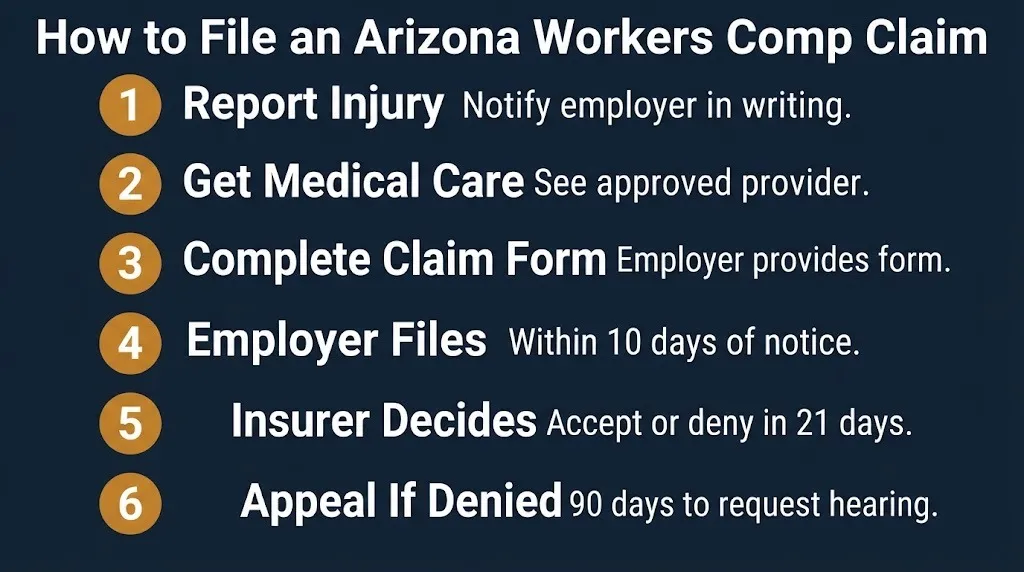
- Report the injury to your employer immediately, ideally in writing.
- Seek medical treatment. Your employer or its insurer may direct you to an approved provider.
- Complete the workers compensation claim form. Your employer should provide it.
- Your employer must file the claim with the Industrial Commission of Arizona and its insurer within 10 days of notice.
- The insurer must accept or deny the claim within 21 days of receipt.
- If the claim is denied, you have 90 days to protest to the Industrial Commission.
- Keep copies of every document, medical record, and communication.
- If your claim is disputed, request a hearing before an administrative law judge.
The one-year statute of limitations is strict. If you do not file within one year of the injury date, your claim is barred except in limited circumstances.
What Does Arizona Workers Compensation Pay?
Arizona workers compensation pays for medical care and lost wages.
Medical benefits cover all reasonable and necessary treatment related to the injury. There is no copay and no deductible for the injured worker.
Lost wage benefits are called temporary compensation. If you cannot work due to the injury, you may receive a percentage of your average monthly wage.
The amount is calculated based on your wages in the 30 days before the injury. Temporary total disability pays a percentage of that average.
Permanent disability benefits depend on the impairment rating assigned by a doctor. The Industrial Commission uses a schedule for different body parts and conditions.
How Much Can You Receive in Arizona Workers Compensation?
The amount depends on your average monthly wage and the type of benefit.
Temporary total disability generally pays two-thirds of your average monthly wage, subject to a state maximum. The maximum is adjusted annually.
Permanent partial disability pays based on the impairment rating and the body part affected. A scheduled injury, like loss of a finger, has a set number of weeks of benefits.
Permanent total disability may pay benefits for life in some cases.
| Benefit Type | Typical Rate | Duration |
|---|---|---|
| Temporary total disability | 66.67% of average monthly wage | Until released to work or stable |
| Permanent partial disability | Varies by impairment rating | Based on schedule |
| Permanent total disability | 66.67% of average monthly wage | Potentially lifetime |
| Death benefits | Varies by dependents | Set by statute |
These percentages are statutory. The actual dollar amount depends on your wage and the state maximum in effect on the injury date.
What Is the Arizona Workers Compensation Website?
The official Arizona workers compensation website is maintained by the Industrial Commission of Arizona.
The site provides claim forms, employer coverage verification tools, and information about benefits and hearings.
Workers can check whether an employer has active coverage using the Commission’s online database. This is the place to verify coverage before an injury happens.
The site also has a claim status portal. If you have an active claim, you can track its progress and see documents filed in your case.
Employers use the same site to file claims and verify compliance requirements.
Key Takeaway: The Industrial Commission of Arizona website is the official source for claim forms, coverage verification, and claim status.
What Happens If Your Employer Has No Workers Compensation in Arizona?
An uninsured employer in Arizona faces serious consequences, and you still have options.
The employer may be fined by the Industrial Commission. The Commission can issue a stop-work order that shuts down the business until coverage is obtained.
For the injured worker, the claim process changes. You can still file a claim with the Industrial Commission. The state has an uninsured employers fund that may pay benefits in some cases.
You may also have the right to sue the employer directly in civil court. The normal exclusive remedy rule does not protect an employer that failed to carry required coverage.
A civil lawsuit can seek damages beyond what workers compensation would pay, including pain and suffering.
What Injuries Are Covered by Arizona Workers Compensation?
Arizona covers injuries that arise out of and in the course of employment.
That includes sudden accidents like falls, equipment injuries, and vehicle crashes. It also includes repetitive motion injuries, occupational diseases, and some mental health conditions tied to a physical injury.
Injuries caused by horseplay, intoxication, or intentional self-harm are generally not covered.
Pre-existing conditions that are aggravated by work may be covered if the work was a substantial cause of the worsening.
The key question is whether the injury happened because of work, not whether your employer did anything wrong.
How Long Does an Arizona Workers Compensation Claim Take?
The timeline varies by claim complexity.
A simple undisputed claim can be accepted within 21 days. Medical treatment starts immediately, even before acceptance, if the employer or insurer authorizes it.
A disputed claim takes longer. You may need a hearing before an administrative law judge. That process can take months.
Permanent disability determinations add more time. You may need an independent medical examination and an impairment rating.
Most workers receive temporary benefits quickly if the claim is accepted. Permanent benefits take longer because they require a stable medical condition.
Reality Check: No one from the Industrial Commission of Arizona will call you asking for payment to process your claim. Filing is free. If someone demands money to “expedite” your claim, it is a scam.
What Is the Deadline to File a Workers Compensation Claim in Arizona?
The deadline is one year from the date of injury.
There is a narrow exception if the injury was not immediately discoverable. In that case, the clock may run from the date you knew or should have known the injury was work-related.
The one-year deadline is strict. Courts and the Industrial Commission enforce it consistently.
Do not wait. Report the injury and file the claim as soon as possible. Waiting gives the insurer a reason to deny.
How Does Arizona Workers Compensation Compare to Other States?
Arizona is a monopolistic state for workers compensation insurance, but not in the way some states are.
In some states, the government operates the only workers compensation fund. Ohio and Washington are examples. In Arizona, private insurers provide coverage. The state regulates the system through the Industrial Commission.
Arizona’s benefit rates are in the middle range compared to other states. The one-year filing deadline is shorter than some states and longer than others.
The lack of a state fund means employers have choices among private carriers. It also means the Industrial Commission focuses on enforcement and dispute resolution rather than underwriting.
What Should You Do If Your Arizona Workers Compensation Claim Is Denied?
A denial is not the end of the road.
The insurer must send a written denial notice. It states the reason and your appeal rights.
You have 90 days from the denial to request a hearing. The request goes to the Industrial Commission of Arizona.
An administrative law judge hears the case. You can present evidence, call witnesses, and cross-examine the insurer’s witnesses.
Many denied claims are overturned at hearing. The process is less formal than civil court, but it still helps to have representation.
Some workers compensation attorneys in Arizona work on contingency. They charge a percentage of benefits recovered, not an upfront fee.
Key Takeaway: A claim denial starts a 90-day clock for you to request a hearing. Missing that deadline may end your case.
What Happens Next in Arizona Workers Compensation?
The system continues to evolve.
Expected late 2026: Annual adjustment to the state’s maximum benefit rates. The Industrial Commission publishes updated figures each year.
Ongoing: Enforcement sweeps in construction and high-risk industries. Uninsured employer cases remain a priority.
Expected 2027: Legislative proposals affecting benefit calculations and medical fee schedules. Watch for hearings at the Arizona Legislature.
For workers, the next step is to verify your employer’s coverage and keep your own records. An injury changes everything in an instant.
Frequently Asked Questions
Is workers compensation required in Arizona?
Yes, for any employer with one or more employees.
There are narrow exceptions for independent contractors and some domestic workers.
How much does Arizona workers compensation pay?
It pays a percentage of your average monthly wage, generally two-thirds for temporary total disability.
The exact amount depends on your wage and the state maximum.
What is the deadline to file a workers comp claim in Arizona?
One year from the date of injury.
A narrow exception applies if the injury was not immediately discoverable.
How do I check if my Arizona employer has workers compensation?
Use the Industrial Commission of Arizona’s online coverage verification tool.
Enter the employer name to see active coverage.
Can I sue my employer in Arizona for a work injury?
Generally no, if the employer has workers compensation insurance.
If the employer is uninsured, you may sue directly in civil court.
What if my Arizona workers comp claim is denied?
You have 90 days to request a hearing with the Industrial Commission of Arizona.
Many denials are overturned at hearing.
Does Arizona have a state workers compensation fund?
No. Arizona uses private insurers and self-insured employers.
There is an uninsured employers fund for some claims against noncompliant employers.
The single most important step is to report any work injury immediately and file the claim before the one-year deadline passes.