Personal Injury Settlement Amounts Examples 2026: Real Ranges, Car Accident Cases, and What Affects Your Payout
Quick Answer
- Personal injury settlement amounts vary widely. No fixed formula or guaranteed payout exists.
- Car accident settlements commonly range from $3,000 to $75,000 for moderate injuries, more for severe cases.
- The most important deadline is your state’s statute of limitations, often two to three years from the injury.
If you are searching for settlement examples, you are likely trying to figure out what your own injury claim might be worth. That is the right question to ask.
The honest answer is that no two cases are the same. A rear-end crash with soft tissue damage settles for far less than a head-on collision with a broken leg. Insurance limits, medical bills, lost wages, and fault all move the number.
This article gives you verified ranges, real examples from public records, and the factors that matter most. One detail most guides miss: the single biggest cap on most settlements is not the injury. It is the at-fault driver’s insurance policy limit.
The Facts
| Case | No single case; personal injury settlement data |
| Status | Settlements are private but some become public record |
| Fund Size | Not applicable; per-case settlements |
| Est. Per Person | Varies widely by injury, fault, and insurance limits |
| Claim Deadline | State statute of limitations, typically 1 to 3 years |
| Administrator | No central administrator; insurance companies or courts |
| Proof Needed | Medical records, bills, wage loss, liability evidence |
Are Personal Injury Settlement Examples Real or Inflated?
The examples you see online are often real but cherry-picked.
Attorneys and claim websites publish their best results. A $500,000 verdict makes a better headline than the $4,500 settlement that most claimants actually receive.

Public court records show real settlement amounts when cases are filed and resolved in court. But most settlements never see a courtroom. They are private agreements between the injured person and the insurance company.
Insurance industry data confirms the reality: most bodily injury claims settle for modest amounts. The Insurance Research Council has reported the average bodily injury claim paid by insurers is under $20,000.
Treat extreme examples as the ceiling, not the expectation. Your case may be worth more or less.
What Is the Average Personal Injury Settlement Amount?
There is no single average that applies to every case. The value depends on the injury type.
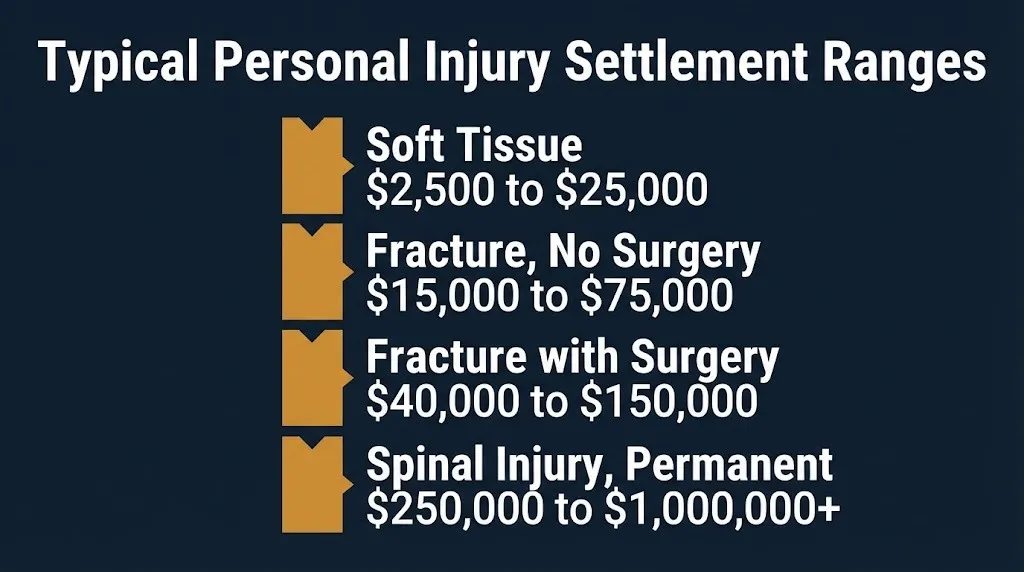
Soft tissue injuries like whiplash or strains settle for smaller amounts. These are the most common car accident injuries. Most settle between $2,500 and $25,000 depending on treatment length and medical costs.
More serious injuries like fractures, herniated discs, or surgeries push settlements higher. These commonly settle between $25,000 and $150,000. Permanent injuries, amputations, or brain injuries can reach six or seven figures.
A broken bone in a simple accident with clear liability might settle for $30,000 to $70,000. The same fracture with a disputed liability claim might settle for less.
The numbers that get quoted most often are from jury verdict research, not settlements. Verdicts run higher because they are the cases that could not settle.
What Are Typical Car Accident Settlement Examples?
Car accident settlement examples follow patterns based on injury severity.
A low-impact rear-end collision with no broken bones and a few weeks of physical therapy might settle for $4,000 to $10,000. The medical bills are low, lost wages are minimal, and pain and suffering are limited.
A moderate impact with a broken arm, surgery, and three months off work might settle for $40,000 to $100,000. The medical bills alone could reach $30,000 or more. Lost wages add to that. Pain and suffering multiplies the economic damages.
A severe accident with a spinal injury, permanent impairment, and a year of treatment might settle for $250,000 to $1 million or more. These cases often involve policy limits and underinsured motorist claims.
| Injury Type | Typical Settlement Range | Key Factors |
|---|---|---|
| Soft tissue, no fracture | $2,500 to $25,000 | Treatment length, medical costs |
| Fracture, no surgery | $15,000 to $75,000 | Bone, lost work, liability |
| Fracture with surgery | $40,000 to $150,000 | Surgery cost, recovery time |
| Herniated disc, injections | $50,000 to $200,000 | Ongoing pain, treatment |
| Spinal injury, permanent | $250,000 to $1,000,000+ | Lifelong impairment, wage loss |
How Is a Personal Injury Settlement Calculated?
The calculation starts with economic damages, then adds non-economic damages.
Economic damages are the hard numbers: medical bills, future medical care, lost wages, lost earning capacity, and out-of-pocket costs.
Non-economic damages are the human costs: pain, suffering, emotional distress, loss of enjoyment of life, and loss of consortium.
Insurance adjusters and attorneys often use a multiplier method. They take the economic damages and multiply them by a number from 1.5 to 5 depending on case strength and injury severity.
A case with $10,000 in medical bills and a clear liability might use a multiplier of 3. That yields $30,000 plus the medical bills, for a total settlement demand of $40,000.
This is a negotiation tool, not a rule. Judges and juries do not use it. Insurers use it to bracket settlement discussions.
Key Takeaway: Economic damages anchor the settlement, and the multiplier reflects how much pain and suffering the insurer is willing to pay.
What Is the Average Payout for a Personal Injury Claim?
The average payout across all personal injury claims is lower than most people expect.
The Insurance Research Council reports the average bodily injury claim payment is approximately $18,000 to $20,000. That includes every claim, from minor to severe.
The average car accident settlement specifically varies by source. Some data puts it around $15,000 to $25,000. Other sources report higher averages because they exclude the smallest claims.
The median is more useful than the mean. Half of all claims settle for less than the median. A few million-dollar cases pull the average up.
If your case has $5,000 in medical bills and no permanent injury, expecting $100,000 is unrealistic.
What Factors Affect Personal Injury Settlement Amounts?
Several factors move the number more than anything else.
Liability is first. If fault is clear, the settlement is higher. If fault is disputed or shared, it drops.
Injury severity is second. Serious injuries with objective medical evidence settle for more. Soft tissue injuries without imaging findings settle for less.
Insurance limits cap most settlements. If the at-fault driver has a $25,000 policy, your settlement may be limited to $25,000 unless you have underinsured motorist coverage.
Medical documentation quality matters. Consistent treatment, clear diagnoses, and a credible doctor strengthen the claim.
Your own credibility matters. Gaps in treatment, prior injuries, and inconsistent statements weaken the case.
What Is the Statute of Limitations for Personal Injury Claims?
The deadline to file a lawsuit varies by state.
Most states allow two to three years from the date of injury for personal injury claims. California has a two-year limit. New York has a three-year limit for most personal injury cases. Florida has a two-year limit.
Some states have shorter deadlines. Louisiana and Kentucky have one-year limits for many claims.
If you miss the statute of limitations, your claim is barred. The insurance company knows this and will not negotiate once the deadline passes.
Do not wait until the deadline approaches to act. Evidence gets harder to find, witnesses disappear, and medical treatment becomes less credible with delay.
Key Takeaway: Your state’s statute of limitations is a hard deadline. Missing it ends the claim no matter how strong the injury evidence is.
How Do Insurance Policy Limits Affect Settlement Amounts?
Insurance policy limits are the most overlooked factor in settlement examples.
The at-fault driver’s bodily injury liability limit caps what their insurance will pay. Minimum limits in many states are $25,000 per person and $50,000 per accident.
If your medical bills alone exceed $25,000 and the driver has minimum coverage, the insurer will not pay more than $25,000. You may need to pursue underinsured motorist coverage through your own policy.
If the at-fault driver has $100,000 or $250,000 limits, the settlement can go higher.
If the at-fault driver has no insurance, your own uninsured motorist coverage becomes the source of payment. If you do not have it, your options narrow.
Always check both the liability limit and your own UM/UIM coverage.
What Are Real Examples of Personal Injury Settlements from Public Records?
Public records show real settlements in filed cases.
A 2024 car accident case in California settled for $85,000. The plaintiff suffered a herniated disc and underwent epidural injections. The at-fault driver had a $100,000 policy.
A 2025 slip-and-fall case in Florida settled for $45,000. The plaintiff fractured a wrist and had surgery. Liability was disputed, which kept the number lower than the medical costs suggested.
A 2023 truck accident case in Texas settled for $650,000. The plaintiff had multiple fractures, a year of treatment, and permanent impairment. The trucking company carried a $1 million policy.
These are not typical results. They are examples of how specific facts produce specific numbers.
Reality Check: No honest attorney or website can promise a specific settlement amount without reviewing your medical records, the insurance policy, and the liability evidence. Anyone who guarantees a dollar figure is selling something.
How Does Fault Affect a Personal Injury Settlement?
Fault determines whether you recover anything at all.
In fault-based states, the person who caused the accident pays. If you are partly at fault, your recovery may be reduced.
Some states use comparative fault. California allows recovery reduced by your percentage of fault. If you are 20 percent at fault, your settlement is reduced by 20 percent.
A few states use contributory negligence. If you are even 1 percent at fault, you recover nothing. Alabama, Maryland, North Carolina, and Virginia use this rule in some form.
In no-fault states for car accidents, you recover from your own insurance regardless of fault, up to policy limits. You can only sue the at-fault driver for serious injuries that meet a legal threshold.
What Is the Difference Between a Settlement and a Verdict?
A settlement is an agreement between the parties. A verdict is a jury decision.
Most cases settle. By some estimates, 95 percent or more of personal injury cases resolve before trial.
Settlements are negotiated. They are not public unless filed in court. They can happen at any time, from before a lawsuit is filed to the middle of trial.
Verdicts are public. They happen after a trial. They can be higher than settlements, but they can also be zero.
The examples you see online are often verdicts because settlements are private. That skews the numbers.
What Should You Do After a Personal Injury to Protect Your Claim?
The steps you take in the first days and weeks matter.
- Get medical treatment immediately, even if you think the injury is minor.
- Report the injury to the right person: police, property owner, or employer.
- Document everything: photos, witness contact information, and the scene.
- Do not give a recorded statement to the insurance company without understanding your rights.
- Follow all medical advice and attend every appointment.
- Keep a file of every medical bill, receipt, and wage statement.
- Do not accept an early settlement offer without understanding the full scope of your injuries.
- Consult a personal injury attorney if the injuries are serious or liability is disputed.
What Happens Next in a Personal Injury Claim?
The process follows a predictable path.
Expected within weeks: You complete medical treatment or reach maximum medical improvement.
Expected within months: Your attorney sends a demand letter to the insurance company.
Expected within several months: Negotiations continue. A settlement is reached or a lawsuit is filed.
Expected if filed: Discovery, depositions, and possible mediation.
Expected at trial or settlement: The case resolves. Payment follows within weeks of settlement.
The timeline depends on the injury and the insurance company. Some cases settle in months. Some take years.
Frequently Asked Questions
What is the average personal injury settlement amount?
The average bodily injury insurance payment is approximately $18,000 to $20,000.
That includes minor and severe claims combined.
How much is a car accident settlement for a broken arm?
A broken arm with surgery commonly settles for $40,000 to $100,000.
Without surgery, the range is often $15,000 to $50,000.
What is the formula for personal injury settlements?
There is no fixed formula.
Many insurers use a multiplier of 1.5 to 5 times economic damages.
How long does a personal injury settlement take?
Simple cases can settle in a few months.
Cases with serious injuries or disputes may take one to three years.
Can I get a settlement without a lawyer?
Yes, for minor injuries with clear liability.
For serious injuries or disputed cases, an attorney usually recovers more even after fees.
What is the statute of limitations for personal injury?
Most states allow two to three years from the injury date.
Some states have shorter deadlines of one year.
Do insurance companies pay more after a lawsuit is filed?
Sometimes, but not always.
Filing a lawsuit increases costs for both sides and can motivate settlement.
The single most important action is to seek medical care and document everything. The settlement follows the evidence.