LDS Lawsuits in 2026: Mormon Church Abuse Claims, Tithing Fraud, and Trademark Disputes
Quick Answer
- No single LDS settlement fund exists. Abuse claims proceed individually or through private church mediation.
- Settlement amounts vary widely, from $300,000 reported in one case to a $2.28 billion verdict in another.
- The Arizona Supreme Court ruled in July 2026 that LDS bishops had no duty to report abuse learned in confession.
If you searched for an LDS lawsuit settlement expecting a claim form and a deadline, the reality is more complicated. The Church of Jesus Christ of Latter-day Saints faces multiple types of litigation, and none of them follow the class action model you might expect.
This article breaks down what’s actually happening across the LDS Church’s legal battles in 2026. You’ll learn how abuse claims work, what tithing lawsuits revealed, and why the Church’s trademark case against a podcast might backfire.
The Facts
| Case Types | Sexual abuse claims, tithing fraud lawsuits, trademark infringement, insurance coverage disputes |
| Status | No national class action; abuse cases settle privately or proceed individually |
| Fund Size | No centralized fund; settlements are confidential |
| Est. Per Person | Varies widely; reported settlements from $300,000 to multi-million verdicts |
| Claim Deadline | Varies by state statute of limitations; lookback windows apply |
| Administrator | None; cases handled through private mediation or individual litigation |
| Proof Needed | Documentation, testimony, therapy records, journal entries |
Is There an LDS Church Lawsuit Settlement in 2026?
There is no national LDS Church lawsuit settlement in 2026. Abuse claims against the Church proceed through individual lawsuits or a private mediation process that lacks public claim deadlines.
The U.S. Judicial Panel on Multidistrict Litigation declined to consolidate LDS abuse cases into one federal proceeding . The panel cited differences in plaintiffs, timelines, and church policies across states. That means no single claim form exists.
Instead, the Church handles many cases through confidential negotiations with select law firms. Attorneys submit case inventories, and the Church reviews them for settlement potential . This process bypasses court oversight entirely.
Some survivors don’t know this private option exists. Others prefer public litigation to force accountability. Either path requires your own attorney, not a class action claim form.
How Much Are LDS Church Abuse Settlements Worth?
Settlement amounts in LDS abuse cases vary dramatically based on documentation, the abuser’s role, and whether church leadership covered up the abuse. Most settlements remain confidential.
One 2023 case reported by the Associated Press involved a $300,000 payment to an alleged victim and her mother . That settlement came after recorded meetings allegedly showed church leaders focused on covering up abuse rather than reporting it.
At the other extreme, a 2023 jury verdict awarded $2.28 billion against the Church in a case involving a stepfather who abused his victim on church property . The Church was found accountable because the abuser was a prominent member.
Factors That Affect Settlement Value:
- The perpetrator’s role within the Church (leader vs. ordinary member)
- Evidence of institutional cover-up
- Severity and duration of abuse
- Documentation quality
- State law and applicable lookback windows
Not yet determined is the honest answer for most cases. Without a public settlement fund and published claim tiers, each case’s value depends on negotiation or jury decision.
Key Takeaway: LDS abuse settlement amounts are case-specific and mostly confidential, with reported outcomes ranging from $300,000 to a $2.28 billion verdict.
Who Qualifies to File an LDS Church Abuse Lawsuit?
You may qualify to file if you were sexually abused by an LDS bishop, missionary, teacher, or another church member, even if the abuse happened decades ago. State lookback laws have reopened many expired claims.
California has been a focal point. Over 100 sexual abuse claims were pending against the Church in that state as of 2025 . Many involve grooming and abuse dating back to the 1960s, made possible by changes to California’s statute of limitations.
Child abuse victims, adult survivors, and family members can all file claims . You don’t need to have reported the abuse to the Church when it happened. The question is whether you can prove the abuse occurred and that the Church bears responsibility.
Reality Check: No one will text you offering LDS settlement money. If someone contacts you claiming to represent a settlement fund and asks for payment, it’s a scam. Legitimate attorneys offer free consultations and work on contingency.
How Do You File a Claim Against the Mormon Church?
Filing a claim means hiring an attorney who handles clergy abuse cases and filing a civil lawsuit in state or federal court. There is no free online claim form to complete on your own.
Step 1: Contact a sexual abuse attorney who handles church cases. Most offer free, confidential consultations.
Step 2: Verify your state’s statute of limitations and whether a lookback window applies to your situation.
Step 3: Gather evidence including your own testimony, journals, therapy records, and any correspondence with church officials.
Step 4: Your lawyer files a civil complaint in the appropriate court. You may be able to proceed anonymously.
Step 5: Participate in discovery, which involves sharing documents and possibly giving sworn testimony.
Step 6: Negotiate a settlement or proceed to trial if no resolution is reached.
The Church has shown willingness to settle substantiated claims through private mediation, but settlement is never guaranteed .
What Did the LDS Tithing Lawsuits Reveal?
Tithing lawsuits against the Church were dismissed, but they exposed how Ensign Peak Advisors accumulated a $60.9 billion investment portfolio from member donations. The cases revealed specific financial transfers the Church had kept private.
James Huntsman, brother of former Utah Governor Jon Huntsman, sued the Church for fraud after a whistleblower exposed the portfolio . The whistleblower, David Nielsen, a former Ensign Peak fund manager, alleged the Church built a $100 billion-plus reserve without spending it on charity.
Court filings revealed two specific transfers from Ensign Peak: up to $1.4 billion to build City Creek Center, an upscale mall in Salt Lake City, and $600 million to prop up Beneficial Life, an ailing insurance company . Both transfers occurred during the Great Recession.
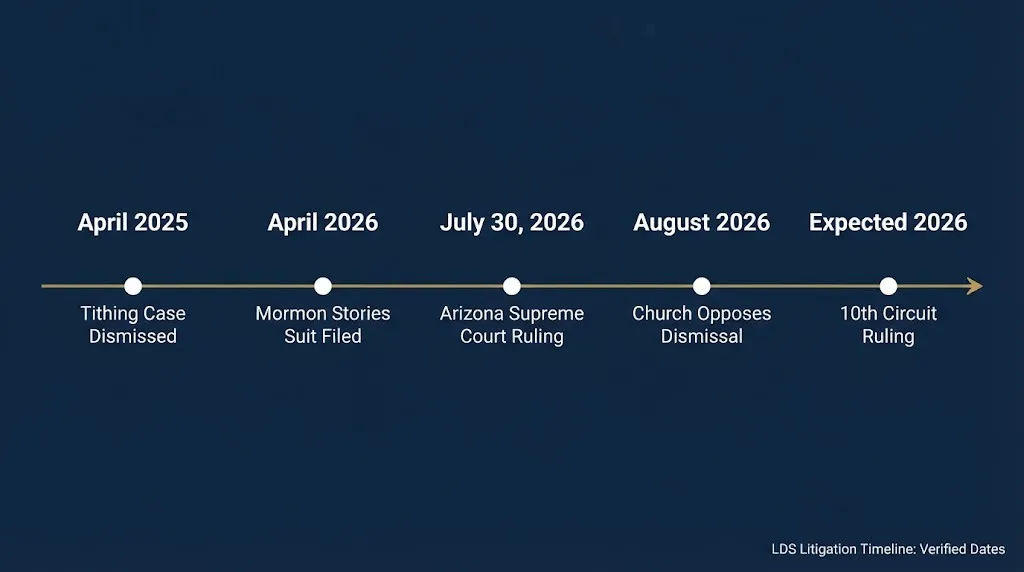
The SEC fined the Church $1 million and Ensign Peak $4 million in 2023 for obscuring the portfolio’s size from public view . A would-be class action seeking to recover tithing donations was dismissed in April 2025, and the 10th Circuit heard arguments on the statute of limitations in March 2026 .
What the Tithing Cases Revealed:
- Ensign Peak portfolio: $60.9 billion as of latest reports
- SEC fines: $5 million total against Church and Ensign Peak
- City Creek transfer: up to $1.4 billion
- Beneficial Life transfer: $600 million
- Outcome: Cases dismissed; fraud claims rejected
Why Is the LDS Church Suing Mormon Stories?
The Church sued John Dehlin’s “Mormon Stories” podcast in April 2026, alleging trademark infringement and copyright violation. The Church claims the podcast’s branding confuses listeners into thinking it’s affiliated with the faith.
Dehlin was excommunicated in 2015. His podcast has operated since 2005 and features criticism of Church leaders and teachings .
The Church’s filing argues the case “is not about silencing criticism” but about stopping Dehlin from using Church-protected names, images, and design elements . Church attorneys point to social media comments from listeners who believed the podcast was an official Church product.
Dehlin’s team counters that “Mormon belongs to the public” and that the Church abandoned the trademark by discouraging its use after 2018 . The ACLU and Electronic Frontier Foundation filed amicus briefs supporting Dehlin, arguing the First Amendment protects his use of the term .
The case remains pending in U.S. District Court for the District of Utah.
What Did the Arizona Supreme Court Rule on LDS Abuse Reporting?
The Arizona Supreme Court ruled on July 30, 2026, that LDS bishops had no legal duty to report child sex abuse they learned about through confidential confession . The unanimous decision sided with the Church in a case brought by three abuse victims.
The case involved Paul Adams, who confessed to his bishop in 2011 that he had sexually abused his daughter. The bishop did not report to law enforcement, citing the confession exemption in Arizona’s mandatory reporting law .
Adams continued abusing his other children until his arrest in 2017. He died by suicide in jail before trial.
The court found that Arizona law exempts clergy from reporting abuse learned during confidential communications. The First Amendment bars courts from questioning how clergy interpret their own religious doctrine .
What Happens Next in LDS Church Litigation
Expected late 2026: 10th Circuit ruling on tithing fraud case statute of limitations.
Ongoing: Private abuse claim mediations between the Church and select law firms.
Pending: Trademark lawsuit against Mormon Stories continues in federal court with no trial date set.
Varies by state: Individual abuse lawsuits proceed through courts; lookback windows determine filing deadlines.
Frequently Asked Questions
Is there a class action settlement against the LDS Church I can join?
No, there is no class action settlement against the LDS Church for abuse claims.
The JPML declined to consolidate cases, so claims proceed individually or through private mediation.
You need your own attorney, not a claim form.
How long do I have to file an LDS Church abuse lawsuit?
It depends on your state’s statute of limitations and whether a lookback window applies.
Many states have extended or temporarily removed deadlines for childhood sexual abuse claims.
Consult an attorney to determine your specific deadline.
Can I file anonymously in an LDS Church abuse lawsuit?
Yes, many courts allow survivors to proceed under pseudonyms to protect privacy.
Your attorney can advise whether anonymous filing is available in your jurisdiction.
The goal is to protect you while pursuing accountability.
What evidence do I need for an LDS Church abuse claim?
Your testimony is powerful evidence on its own.
Additional documentation like journals, therapy records, or correspondence strengthens your case.
An attorney can help assess what evidence supports your claim.
How much does an LDS Church abuse lawyer cost?
Most clergy abuse attorneys work on contingency, meaning you pay nothing upfront.
They take a percentage of any settlement or verdict.
Free consultations are standard.
Did the Church settle the Boy Scouts abuse claims?
Yes, the Church contributed approximately $250 million to a Boy Scouts settlement fund in 2021.
That fund covered claims of abuse in church-sponsored Scout troops.
It is separate from current individual abuse claims.
What is the status of the tithing fraud lawsuit?
A would-be class action was dismissed in April 2025 on statute of limitations grounds.
The 10th Circuit heard arguments in March 2026 but has not issued a ruling.
The case seeks to recover tithing donations, not create a settlement fund.
Is the Mormon Stories lawsuit about free speech?
Dehlin’s attorneys argue the Church is weaponizing trademark law to silence criticism.
The Church insists the case targets branding confusion, not speech content.
The outcome could affect how religious trademarks are enforced.
What You Should Do Now
If you were abused in an LDS setting, contact a clergy abuse attorney for a free consultation. Verify your state’s filing deadline before anything else. Lookback windows close, and missing them means losing your chance to pursue accountability.
For everyone else, the pattern across all LDS litigation is clear: the Church prefers private resolution to public trials. Knowing that helps you decide which path serves you.