Asbestos Exposure Lawsuit 2026: Trust Fund Payouts, Filing Deadlines, and What the Court Record Shows
Quick Answer
- Asbestos exposure lawsuits are real but split between bankruptcy trust claims and civil suits against solvent companies.
- Trust fund payouts average $300,000 to $400,000 total when claims are filed with multiple trusts, though individual trust payments run far lower.
- The most urgent deadline is your state’s statute of limitations, which starts at diagnosis and ranges from one to six years.
You were diagnosed with mesothelioma, asbestosis, or another asbestos-related disease. Maybe the diagnosis came decades after you worked around insulation, shipyard pipes, or brake pads. Or you watched a family member get sick from fibers carried home on a work uniform.
You are searching for a lawsuit because someone told you there is money set aside. That is partly true. More than $30 billion remains in asbestos bankruptcy trusts as of January 2026 . But the system does not work like a class action settlement with a single claim form and a single deadline.
This article covers how asbestos exposure lawsuits actually work in 2026, what the trusts pay, which state deadlines control your filing, and the one thing most people get wrong about the difference between a trust claim and a lawsuit. The surprising detail: most asbestos victims do not file one claim. They file with multiple trusts, and the total can exceed $1 million in strong cases .
The Facts
| Case | Not a single case: asbestos claims are individual lawsuits and bankruptcy trust claims against dozens of manufacturers |
|---|---|
| Status | Active. More than 60 trusts accepting claims; civil litigation ongoing against solvent defendants |
| Fund Size | Estimated $30 billion remaining across all asbestos trusts as of January 2026 |
| Est. Per Person | $300,000 to $400,000 average total from multiple trusts; individual trust payments vary widely |
| Claim Deadline | Varies by state: 1 to 6 years from diagnosis for civil suits. Trust deadlines separate |
| Administrator | Each trust has its own trustee and Trust Distribution Procedures. Not one central administrator |
| Proof Needed | Medical diagnosis, exposure history (work records, product identification), and trust-specific claim forms |
Is an asbestos exposure lawsuit legitimate or a scam?
It is legitimate, but the word “lawsuit” is misleading. Most asbestos compensation in 2026 does not come from a courtroom verdict. It comes from bankruptcy trusts set up by companies that went broke under the weight of asbestos liability.
Congress allowed these trusts under Section 524(g) of the Bankruptcy Code. A company like Johns Manville or W.R. Grace puts assets into a trust, and the trust pays current and future victims according to rules filed in court. Those rules are public. You can read the payment percentage and the disease categories before you file anything.
The scam risk sits elsewhere. Anyone who texts you saying they can “unlock” your asbestos money for an upfront fee is not a trust administrator. Trusts do not charge you to file. Attorneys typically work on contingency, taking a percentage of what you recover, not a fee from your pocket before anything happens.
If someone calls claiming to be from a “settlement desk” and asks for your Social Security number to “reserve your payout,” hang up. No trust operates that way.
How much can you get from an asbestos exposure lawsuit?
Not yet determined for your specific case, because no one can tell you a number before your diagnosis, exposure history, and the trusts you qualify for are reviewed. But the published averages give you a real range.
The average total recovery from asbestos trust funds is typically between $300,000 and $400,000 per claimant across all trusts, according to 2026 reporting on trust fund data . That is not one check. It is the sum of multiple smaller payments.
Individual trust payouts look very different. RAND Institute research cited in 2026 puts the average individual trust fund claim at about $41,000, with a median scheduled value of $180,000 . The gap between those two numbers is explained by payment percentages.
How trust payment percentages work:
| Trust | Initial Funding | Payment Percentage (2026) |
|---|---|---|
| Johns Manville Asbestos Trust | $2.5 billion | 5.1% |
| DII Industries (Halliburton) | $2.5 billion | 60% |
| W.R. Grace (WRG) | $3 billion | 30.1% |
| Bondex International | $797.5 million | 29.5% |
| Quigley Company | $965 million | 13.3% |
A trust with a 5.1% payment percentage pays $30,600 on a $600,000 scheduled mesothelioma claim. A trust with a 60% payment percentage pays $360,000 on the same scheduled value. That is why filing with multiple trusts matters. Your attorney identifies every trust where your work history gives you a claim.
Key Takeaway: Asbestos trust money is real, but no single trust pays the headline average; the $300,000 to $400,000 figure reflects combined claims across multiple trusts.
What is the deadline to file an asbestos exposure lawsuit?
The deadline is your state’s statute of limitations, and it almost always starts on the date of diagnosis, not the date you were exposed. This is called the discovery rule.
Most states give you two or three years from diagnosis. Some give you less. A few give you more.
State filing deadlines from diagnosis:
| State | Personal Injury Deadline |
|---|---|
| California | 1 year |
| Louisiana | 1 year |
| Tennessee | 1 year |
| Pennsylvania | 2 years |
| New Jersey | 2 years |
| Texas | 2 years |
| New York | 3 years |
| Florida | 4 years |
| Maine | 6 years |
California’s one-year deadline is codified specifically for asbestos injuries under the state’s civil procedure code . Pennsylvania gives two years from the date a physician informs you of an asbestos-related injury . New Jersey allows two years from diagnosis for personal injury and a separate two-year window for wrongful death measured from the date of death .
The state that applies is not always where you live now. It is often where you were exposed, or where the defendant company is headquartered. A worker exposed in New Jersey who retired to Florida may have a two-year deadline, not Florida’s four years.
Trust fund claims run on separate clocks. Missing a civil lawsuit deadline does not automatically bar you from filing with a trust. Some trusts allow late claims under specific circumstances, and each trust publishes its own rules.
Key Takeaway: The single most time-sensitive fact in any asbestos case is your state’s diagnosis-based filing deadline, and it can be as short as one year.
Who qualifies to file an asbestos exposure claim?
You may qualify if a doctor has diagnosed you with an asbestos-related disease and you can trace exposure to a specific source. The diagnosis is the anchor. Without a medical record naming mesothelioma, asbestosis, lung cancer, or another asbestos-related condition, no trust or court will process a claim.
The exposure does not have to be direct. Family members who developed mesothelioma from fibers carried home on a worker’s clothing have filed successful claims. One law firm reports a $32 million result in a secondhand exposure case . The legal theory is that manufacturers owed a duty to anyone foreseeably at risk, not just the person handling the product.
Veterans face a different path. You cannot sue the federal government over Navy shipyard exposure, but you can file against the manufacturers of asbestos products used on those ships. Boiler tenders, pipefitters, and shipyard workers are among the highest-risk occupations .
Who typically qualifies:
- Workers diagnosed with an asbestos disease who can identify products or employers
- Family members with secondhand exposure from a worker’s clothing or equipment
- Veterans exposed on ships, in barracks, or at military facilities
- Tenants or residents exposed in buildings during renovations or from deteriorating materials
The proof standard is called frequency, regularity, and proximity. You need to show you worked with or around the product regularly, not once, and that you were close enough for fibers to reach your lungs.
How do you file an asbestos trust fund claim?
Filing a trust claim is more like submitting an insurance claim than filing a lawsuit. You are not suing anyone. You are asking a trustee to review your medical records and work history against the trust’s distribution procedures.
Most claims go through expedited review. The trust has a scheduled value for each disease category, and if your documentation matches, you get paid at the trust’s payment percentage. About 2% to 3% of claims go through individual review, where an attorney can argue for more than the scheduled value .
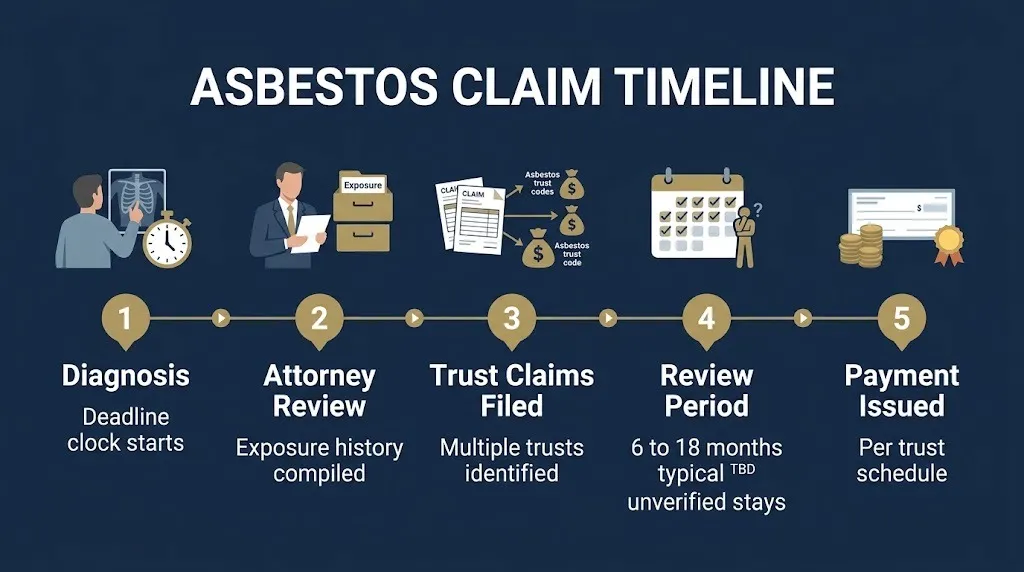
Step-by-step filing process:
- Confirm your diagnosis in writing. Get pathology reports and a physician’s letter naming the asbestos-related condition.
- Build your exposure history. Gather work records, job titles, employer names, and product names you can recall or document.
- Identify the applicable trusts. Your attorney matches your work history to the companies that made the products you used.
- Complete each trust’s claim form. Every trust has its own form and its own required proof.
- Submit medical and exposure evidence. Trusts review the package against their distribution procedures.
- Accept or challenge the offer. If the trust offers the scheduled value, you can accept. If you believe you qualify for more, individual review is an option.
- Receive payment. Expedited claims can resolve in months. Multiple trusts pay on their own schedules.
Trust fund standard review typically takes 6 to 18 months per trust, according to 2026 practitioner guidance . Civil lawsuits against solvent companies take longer, often one to three years, and trials can stretch further.
Can you sue if the exposure happened decades ago?
Yes, in almost every state, because the discovery rule starts the clock at diagnosis. Asbestos diseases have a latency period of 20 to 60 years. The average mesothelioma latency is roughly 35 to 44 years from first exposure .
A worker exposed to asbestos insulation in 1985 who is diagnosed in 2026 has the full state filing window from 2026, not from 1985. Without the discovery rule, almost every asbestos victim would be barred before they knew they were sick. Every state recognizes some version of the rule for latent disease cases .
The rule has limits. If you knew or reasonably should have known about your disease and its connection to asbestos years before you filed, a court may decide the clock started earlier. That is why the diagnosis date matters so much, and why waiting after diagnosis is the biggest mistake a claimant can make.
Reality Check: No one texts you asbestos settlement money. Trusts do not cold-call claimants. Filing with a trust is free, and attorneys work on contingency, not upfront fees. Any “claim helper” charging you a fee to access trust money is unnecessary at best.
How long does an asbestos lawsuit or trust claim take?
Trust claims are faster than lawsuits. A standard trust claim can resolve in 6 to 18 months per trust. Civil lawsuits against solvent defendants often settle in one to three years, and cases that go to trial can take longer .
Expedited review exists for terminal patients. Most trusts offer a process called extraordinary hardship or priority review for claimants with limited prognoses. It is designed to get money to people who may not survive a standard review timeline. Ask your attorney about it at the first meeting, not later.
The number of trusts you file with affects the total timeline. If you file with five trusts and one pays in six months while another takes fourteen, your first payment arrives before your last. Attorneys often file with the strongest trusts first to get money moving.
What is the difference between an asbestos lawsuit and a trust fund claim?
A lawsuit seeks money from a company that still exists and can be brought to court. A trust fund claim seeks money from a company that went bankrupt and set aside assets for victims.
The same person can do both. You can file a civil lawsuit against a solvent manufacturer while simultaneously filing trust claims against the bankrupt companies that also contributed to your exposure. The claims are not either-or.
One critical difference: asbestos class actions are largely unavailable. Courts have refused to certify most asbestos cases as class actions because each claimant’s exposure and injury are different. Your case is individual, whether it goes to a trust or a jury.
Civil lawsuit vs. trust fund claim:
| Civil Lawsuit | Trust Fund Claim | |
|---|---|---|
| Target | Solvent companies | Bankrupt companies’ trusts |
| Forum | State or federal court | Trust trustee, no courtroom |
| Timeline | 1 to 3 years typical | 6 to 18 months per trust |
| Proof | Full discovery, depositions, trial | Medical records and exposure affidavit |
| Outcome | Settlement or verdict | Scheduled payment at trust percentage |
What happens next in 2026
The asbestos compensation system is not waiting for a single court date. It operates continuously across dozens of trusts and state courts.
Expected timeline for a newly diagnosed claimant:
Immediately: Consult an asbestos attorney and confirm your diagnosis is documented. The statute of limitations clock is already running.
Within weeks: Your attorney compiles work history, medical records, and product identification. This is the foundation of every claim.
Within one to three months: Trust claims are filed with the applicable funds. Civil lawsuit complaints are prepared if solvent defendants are identified.
Six to eighteen months (expected): Trust review completes and payment offers issue. Multiple trusts pay on staggered schedules.
One to three years (expected): Civil lawsuits settle or go to trial. Most settle before a verdict.
The system is not fast, but it is not theoretical either. The money exists, the procedures are published, and the deadlines are real. The diagnosis date is the starting line for everything.
Frequently Asked Questions
Is there a single asbestos class action settlement I can join?
No. There is no single asbestos class action settlement. Asbestos claims are individual, filed either with bankruptcy trusts or as personal lawsuits against solvent companies. Courts have refused to certify most asbestos cases as class actions because each claimant’s exposure and injury differ.
How much does an asbestos attorney cost?
Most asbestos attorneys work on contingency. You pay nothing upfront, and the attorney takes a percentage of your recovery. Trust fund claims and lawsuits are typically handled this way. Be skeptical of anyone asking for a fee before you recover anything.
Can I file a claim if I was exposed at work but my employer is still in business?
You may be able to file a civil lawsuit against product manufacturers and third parties, even if your employer is protected by workers’ compensation. In most states, workers’ compensation is the exclusive remedy against your employer, but you can sue the companies that made the asbestos products you used .
Do I need a lawyer to file an asbestos trust fund claim?
You can file on your own, but the process is complex. Each trust has its own forms, its own disease categories, and its own payment percentages. An attorney identifies every trust you qualify for and tracks payment percentage changes. Missing a trust you qualify for means leaving money unclaimed.
What if my family member died before filing a claim?
Surviving family members can file a wrongful death claim or continue an existing claim through the estate. Wrongful death deadlines are separate from personal injury deadlines and often shorter, sometimes one year from the date of death. The estate typically files through an executor or administrator.
Are asbestos trust fund payments taxable?
Asbestos trust fund compensation is generally not taxable at the federal level because it compensates for physical injury or illness. Tax treatment can vary based on your personal circumstances. Consult a tax professional about your specific situation.
Can I sue if I was exposed to asbestos in the military?
You cannot sue the federal government over military exposure, but you can sue the manufacturers of asbestos products used by the military. Navy veterans, in particular, have filed successful claims against companies that supplied asbestos-containing materials for ships and shipyards.
What is the payment percentage and why does it change?
The payment percentage is the fraction of a claim’s scheduled value that a trust actually pays. A trust with a 5% payment percentage pays 5 cents on every dollar of scheduled value. Trusts adjust the percentage as they reassess remaining assets and future claims. The B&W Asbestos Trust cut its payment percentage from 4.7% to 4.3% effective June 30, 2026 .
Check your deadline first
The asbestos compensation system rewards people who move after diagnosis and punishes people who wait. Trusts will still be there next year. Your state’s statute of limitations may not.
Find your diagnosis date. Find the state where you were exposed. Then find out how long you have. That is the first call to make, before anything else.