California Wrongful Death Lawsuit 2026: Who Can File, How Much You Can Recover, and the Deadlines That Matter
Quick Answer
- California wrongful death lawsuits let surviving family members recover compensation for their losses.
- Settlements range widely, with motor vehicle cases typically resolving between $500,000 and $2 million.
- The general filing deadline is two years from the date of death, but government claims have a six-month window.
You lost someone because of someone else’s negligence. Now you’re trying to figure out if you can sue, who’s allowed to file, and what kind of money is actually on the table. California’s wrongful death statute answers those questions, but the rules aren’t intuitive.
Only certain family members have standing to file. The clock starts ticking immediately. And the value of your case depends on factors most people never think about, like the decedent’s earning capacity and how many dependents they left behind.
This guide walks through the entire California wrongful death lawsuit process in 2026. It covers who qualifies to file, how settlement values are calculated, the deadlines that can kill your case, and what the court records actually show.
The Facts
| Case Type | Wrongful death civil lawsuit |
| Governing Statute | California Code of Civil Procedure § 377.60 |
| Filing Deadline | 2 years from date of death (CCP § 335.1) |
| Government Claim Deadline | 6 months (Gov. Code § 911.2) |
| MICRA Cap (Medical Malpractice) | $650,000 non-economic damages in 2026 |
| Average Settlement | Approximately $973,000, median closer to $294,000 |
| Motor Vehicle Range | $500,000 to $2 million |
| Who Can File | Spouse, domestic partner, children, certain dependents |
Is a California wrongful death lawsuit legit or a scam?
A California wrongful death lawsuit is a legitimate civil legal action governed by Code of Civil Procedure § 377.60. It’s a statutory claim that allows specific family members to recover compensation when someone’s negligence or wrongful act causes a death.
The process is real. The courts are real. The money is real. But the high stakes attract scammers.
Here’s what the legitimate process looks like:
- You consult with a wrongful death attorney, usually for free.
- The attorney investigates liability and identifies all eligible claimants.
- A demand is sent to the at-fault party’s insurer.
- If negotiation fails, a lawsuit is filed in California Superior Court.
- The case proceeds through discovery, mediation, and possibly trial.
Red flags to watch for:
- Anyone contacting you first claiming they can get you money from a wrongful death claim you didn’t file
- Companies charging upfront fees to “process” a wrongful death settlement
- Promises of specific payout amounts before reviewing the facts
No legitimate attorney charges you upfront in a wrongful death case. They work on contingency, meaning they get paid from the recovery. If someone asks for your credit card before doing any work, that’s a scam.
How much is a California wrongful death settlement worth?
California wrongful death settlements vary widely based on the decedent’s age, income, number of dependents, and the strength of liability evidence. The average settlement is approximately $973,000, though the median is closer to $294,000 because a few large verdicts skew the average upward .
Here are typical ranges by case type:
| Case Profile | Typical Settlement Range |
|---|---|
| Elderly decedent, adult independent children | $250,000 to $750,000 |
| Middle-aged decedent, adult children | $500,000 to $2 million |
| Working-age decedent supporting spouse and minor children | $1 million to $3 million |
| Young decedent with strong earning capacity | $3 million to $10 million or more |
| Catastrophic incident with punitive exposure | $2 million to $20 million+ |
Motor vehicle wrongful death cases typically settle between $500,000 and $2 million . Truck accident and product liability cases frequently exceed $5 million .
Not yet determined applies until liability is established and damages are documented. Settlement value depends on proving economic losses like lost lifetime earnings, plus non-economic losses like loss of companionship and guidance.
Who can file a wrongful death lawsuit in California?
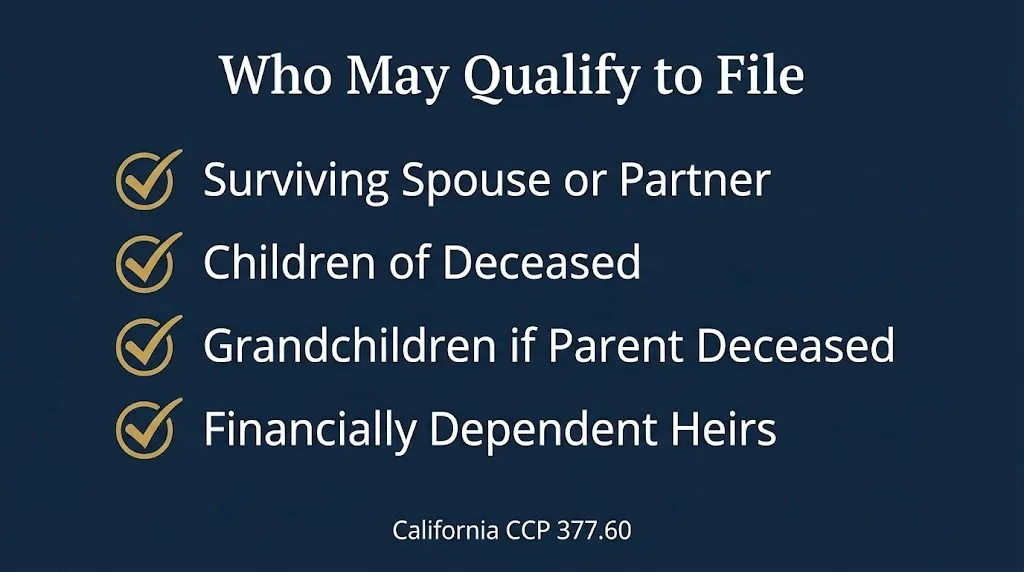
California law limits who may file a wrongful death lawsuit. Under Code of Civil Procedure § 377.60, eligible claimants are ranked in priority order, and only certain family members have standing .
The primary claimants are:
- Surviving spouse or registered domestic partner
- Children of the deceased, including legally adopted children
- Grandchildren, but only if the deceased’s child (their parent) has also died
Secondary claimants, who can file only if no primary claimants exist:
- Parents of the deceased
- Siblings
- Other heirs under California intestacy laws
- Putative spouses (someone who believed in good faith they were married)
- Stepchildren or minors who were financially dependent on the deceased
California’s “One Action Rule” requires all eligible heirs to join in a single lawsuit. If an eligible heir refuses to participate, they must be named as a nominal defendant .
Key Takeaway: The hierarchy matters. If the decedent had a surviving spouse and children, the parents typically can’t file. If you’re unsure whether you qualify, an attorney can review your family structure against the statute.
What damages are available in a California wrongful death claim?
California wrongful death damages compensate survivors for their personal losses, not the decedent’s losses. The recoverable categories are defined by statute and case law.
Economic damages include:
- Financial support the deceased would have provided over their lifetime
- Value of household services the deceased regularly performed
- Funeral and burial expenses
Non-economic damages include:
- Loss of love, companionship, comfort, and affection
- Loss of moral support and guidance
- Loss of parental training and guidance for surviving children
Notably, California does not allow recovery for grief or sorrow as separate damages. The loss of companionship and emotional support is recoverable, but it’s framed as the loss of what the decedent provided, not your emotional pain .
Reality Check: No one texts you settlement money from a wrongful death case. The money doesn’t arrive until liability is established and a settlement or verdict is reached. If someone contacts you claiming you’re owed compensation from a wrongful death claim you never filed, that’s a scam. Real wrongful death representation starts with you consulting an attorney.
What is the statute of limitations for a California wrongful death lawsuit?
The statute of limitations for a California wrongful death lawsuit is generally two years from the date of death under Code of Civil Procedure § 335.1 . Missing this deadline usually bars your claim permanently.
But the two-year rule isn’t universal. Different deadlines apply depending on who caused the death:
| Claim Type | Deadline | Governing Law |
|---|---|---|
| Standard wrongful death | 2 years from death | CCP § 335.1 |
| Government entity claim | 6 months to present claim | Gov. Code § 911.2 |
| Medical malpractice | 3 years from injury or 1 year from discovery | CCP § 340.5 |
| Workers’ compensation death | 1 year from death | Labor Code |
If a government entity or employee caused the death (a city bus, a highway worker, a police vehicle), you must file a formal administrative claim within six months. If the entity rejects the claim, you then have six months from the rejection date to file suit .
The discovery rule can extend deadlines in limited situations, but courts interpret it narrowly. If you’re near any deadline, consult an attorney immediately.
What changed in California wrongful death law for 2026?
Two significant changes affect California wrongful death and survival actions in 2026. One involves the MICRA cap on medical malpractice damages. The other concerns survival actions filed on or after January 1, 2026.
The MICRA cap on non-economic damages for wrongful death in medical malpractice cases is $650,000 in 2026. That cap rises by $50,000 each January until it reaches $1 million in 2033 .
For survival actions filed on or after January 1, 2026, the decedent’s pre-death pain and suffering is no longer recoverable. Senate Bill 447 had temporarily allowed those damages for cases filed between January 1, 2022, and December 31, 2025. That window closed, and SB 29, which would have extended it, did not pass .
The wrongful death claim itself under §§ 377.60 and 377.61 is unchanged. Survivors can still recover for their own losses.
How do you file a California wrongful death lawsuit?
Filing a California wrongful death lawsuit involves several steps, from identifying eligible claimants to serving the defendant. Most cases settle before trial, but the filing deadlines still apply.
Here are the steps:
- Identify all eligible claimants. California requires all heirs to join in one action.
- Investigate liability. Gather police reports, medical records, and witness statements.
- Calculate damages. An economist may project lost lifetime earnings.
- Send a demand letter. This starts settlement negotiations with the insurer.
- File the complaint. If negotiation fails, the lawsuit is filed in Superior Court.
- Serve the defendant. They have 30 days to respond.
- Conduct discovery. Both sides exchange evidence and take depositions.
- Mediation or trial. Most cases settle; a small percentage go to verdict.
The evidence that matters most includes police reports, medical records, autopsy findings, witness statements, and expert testimony on causation and damages .
What happens next in a California wrongful death lawsuit?
Immediately: Consult a wrongful death attorney and begin gathering evidence.
Within 6 months: File an administrative claim if a government entity is involved.
Within 2 years: File the civil lawsuit if settlement isn’t reached.
6 to 18 months after filing: Discovery and mediation. Most cases resolve here.
18 to 36 months: If the case goes to trial, expect a longer timeline.
Frequently Asked Questions
How long do I have to file a wrongful death lawsuit in California?
Two years from the date of death under Code of Civil Procedure § 335.1 for most cases. Government claims require a six-month administrative filing.
Who can file a wrongful death lawsuit in California?
The surviving spouse, domestic partner, children, and grandchildren of deceased children have priority. Parents and siblings can file only if no primary claimants exist.
How much is a California wrongful death settlement worth?
Settlements range from $250,000 for elderly decedents to $10 million or more for young decedents with dependents. Motor vehicle cases typically settle between $500,000 and $2 million.
Can I file a wrongful death lawsuit if I’m the parent of an adult child?
Only if the deceased had no surviving spouse, domestic partner, or children. Parents are secondary claimants under California law.
What is the MICRA cap for wrongful death in 2026?
The non-economic damages cap for medical malpractice wrongful death cases is $650,000 in 2026. It rises by $50,000 annually until reaching $1 million in 2033.
Can I recover for my own grief in a California wrongful death case?
No. California doesn’t allow damages specifically labeled as grief or sorrow. You can recover for loss of companionship, comfort, and support.
What is the difference between wrongful death and survival action?
A wrongful death claim belongs to survivors for their own losses. A survival action belongs to the estate for losses the decedent suffered before death.
How long does a wrongful death lawsuit take in California?
Most cases take one to three years, depending on complexity, number of defendants, and whether the case settles or goes to trial.
The Bottom Line
California wrongful death lawsuits are governed by strict deadlines and eligibility rules. The two-year filing window is the deadline that matters most, but government claims shrink that to six months.
If you lost a family member because of someone else’s negligence, talk to an attorney before the clock runs out. Most offer free consultations, and the contingency fee structure means you pay nothing unless they recover for you.