Carnival Tequila Lawsuit Verdict 2026: What the Jury Decided and What Happens Next
Quick Answer
- Yes, the verdict is real: a Miami federal jury ruled for passenger Diana Sanders on April 10, 2026.
- The jury awarded $300,000, more than the $250,000 Sanders originally requested at trial.
- Carnival has stated it will pursue a new trial and appeal, so the case is not fully closed.
A federal jury just did something cruise lines rarely see: they held Carnival financially responsible for how much alcohol its own bar staff poured. The case centers on Diana Sanders, a California nurse who was served at least 14 shots of tequila over roughly eight and a half hours aboard the Carnival Radiance.
This matters beyond one passenger. Sanders’ win is one of a small handful of overservice verdicts against a major cruise line to actually reach a jury instead of settling quietly. The single most important number here: Carnival owes $300,000, and the case is headed toward appeal.
This article breaks down exactly what the jury decided, how the fault was split, what Carnival is arguing next, and what it means if you believe you were overserved on a cruise. One detail most coverage buries: the jury awarded Sanders more money than her own attorneys asked for.
The Facts
| Case | Diana Sanders v. Carnival Corporation |
| Court | U.S. District Court, Southern District of Florida, Miami Division |
| Case Number | Not publicly confirmed in available court coverage |
| Status | Verdict entered April 13, 2026; Carnival has stated it will appeal |
| Fault Split | Carnival 60%, Sanders 40%, per jury verdict form |
| Damages Requested | $250,000 |
| Damages Awarded | $300,000 |
| Class Action Fund | Not applicable, this is a single-plaintiff verdict, not a class settlement |
| Claim Deadline | Not applicable, no claims process exists for other passengers in this case |
| Settlement Administrator | None, this case has no administrator since it is not a class settlement |
Not yet confirmed: the public case docket number was not listed in any of the news coverage reviewed for this article. Court records searches through the Southern District of Florida’s public case index did not return a confirmed match at the time of writing.
What Was the Carnival Tequila Lawsuit Verdict?
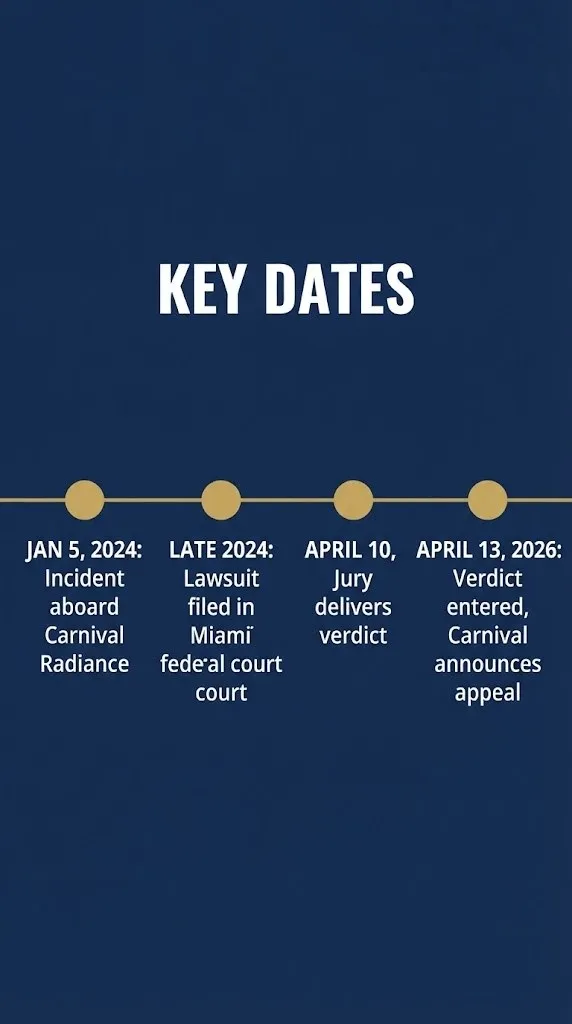
The verdict is that Carnival must pay $300,000 to passenger Diana Sanders after a Miami federal jury found the company negligent for continuing to serve her alcohol while she was visibly intoxicated. The jury reached its decision on April 10, 2026, and the verdict was formally entered into the court record on April 13, 2026.
Jurors split fault between the two parties rather than placing all the blame on one side. That split matters, since it shaped the final dollar amount Sanders actually collects.
Fault breakdown from the verdict form:
| Party | Fault Percentage |
|---|---|
| Carnival Corporation | 60% |
| Diana Sanders | 40% |
The trial took place in the U.S. District Court for the Southern District of Florida, Miami Division, and followed roughly 17 to 18 months of litigation after Sanders filed her lawsuit in late 2024.
Is the Carnival Tequila Lawsuit Real, and Did Diana Sanders Actually Win?
Yes, this is a confirmed, real federal jury verdict, not a rumor or a settlement rumor circulating online. Multiple national outlets, including ABC News, NBC Bay Area, and the Miami Herald, reported the same core facts within days of the ruling.
Sanders, a 45-year-old neonatal intensive care nurse from Vacaville, California, sued Carnival Corporation after a fall aboard the Carnival Radiance left her with a concussion and a possible traumatic brain injury. Her legal team, led by attorney Spencer Aronfeld, argued Carnival’s crew kept serving her long after she showed clear signs of intoxication.
Key Takeaway: This is a genuine jury verdict against a major cruise line, one of the few overservice cases to reach trial instead of a private settlement.
How Much Did Carnival Have to Pay in the Tequila Lawsuit?
Carnival was ordered to pay $300,000 in damages to Diana Sanders. That figure isn’t reduced by the 40% fault the jury assigned to Sanders herself, since the $300,000 already represents the jury’s final award.
Here’s how the numbers compare:
| Figure | Amount |
|---|---|
| Amount Sanders’ team requested at trial | $250,000 |
| Amount the jury actually awarded | $300,000 |
| Difference | $50,000 more than requested |
Not yet determined: whether Carnival has paid, is holding payment pending appeal, or has posted a bond. None of the reviewed sources confirmed the current payment status as of this writing.
Why Did the Jury Award More Than Sanders Asked For?
Because jurors have legal authority to award more than a plaintiff’s attorneys request, if the evidence supports it. This surprises a lot of people who assume a jury is capped at whatever number a lawyer puts in front of them.
Sanders’ attorney, Spencer Aronfeld, confirmed the award exceeded the $250,000 his team sought at trial. Jurors apparently weighed the severity of her injuries, including the concussion and possible traumatic brain injury, along with the pattern of continued alcohol service, and landed on a higher number.
This isn’t common, but it isn’t unheard of either. A jury awarding above the ask is a signal that jurors found the underlying conduct, or the harm, more serious than the plaintiff’s own team estimated.
Can Other Carnival Passengers File a Similar Lawsuit?
Only if their own situation involves comparable facts, since this verdict doesn’t create a class action or automatic payout for other passengers. Sanders’ case was an individual maritime injury lawsuit, not a class action, so there’s no claim form or settlement fund for anyone else to file into.
If you believe you were overserved and injured on a Carnival ship or any other cruise line, you’d need to file your own separate lawsuit. Maritime injury claims carry strict, short deadlines, often as little as one year from the incident under many cruise ticket contracts.
Steps typically involved in pursuing a similar claim:
- Preserve any medical records documenting your injury.
- Request incident reports and surveillance footage from the cruise line promptly.
- Identify witnesses, including other passengers and crew members if possible.
- Check your cruise ticket contract for the filing deadline and required venue.
- Consult a maritime or cruise ship injury attorney before that deadline passes.
- File suit in the court specified by your ticket contract, often Miami federal court for major lines.
What Should You Do if You Think You Were Overserved on a Cruise?
Document everything as close to the incident as possible, since cruise lines control most of the evidence, including surveillance video. Sanders’ case reportedly involved a dispute over roughly 30 minutes of missing surveillance footage, which became a point of contention at trial.
Practical steps if this happens to you:
- Report the incident to ship security and request a written incident report before disembarking.
- Ask which bars or crew members served you, and try to get names or badge numbers.
- Seek medical attention onboard and keep those records.
- Take photos of any injuries as soon as possible.
- Save your drink package receipts, which can show how much alcohol was purchased.
Reality Check: No cruise line settlement fund exists for this case, and nobody legitimately texts or emails passengers offering a piece of Sanders’ $300,000 award. If you receive a message like that, it’s a scam, not a real claims process.
Is Carnival Appealing the Tequila Lawsuit Verdict?
Yes, Carnival has publicly stated it plans to pursue a new trial and an appeal. A company spokesperson said Carnival “respectfully disagrees with the verdict and believes there are grounds for a new trial and appeal, which it will pursue.”
Carnival’s defense at trial argued that Sanders couldn’t identify a specific crew member who overserved her or name the exact bar where the drinks were served. The company also argued there was no evidence she was stumbling, slurring her words, or otherwise showing obvious signs of intoxication that staff should have caught.
Not yet confirmed: whether Carnival has formally filed appeal paperwork, and with which appellate court, as of this writing. No source reviewed for this article confirmed a filed notice of appeal.
What Happens Next in the Sanders v. Carnival Case?
The case now moves into post-trial proceedings, where Carnival’s appeal, if formally filed, would play out over months, not weeks. Appeals in federal maritime cases commonly take a year or longer to resolve.
Key Takeaway: The $300,000 verdict is not necessarily final, since Carnival has signaled intent to challenge it, and any appeal could delay or alter the outcome.
What Happened to Diana Sanders on the Carnival Radiance?
Sanders was a passenger aboard the Carnival Radiance on January 5, 2024, sailing out of Los Angeles, when she was served at least 14 shots of tequila by crew members over the course of the day. Later that night, she suffered a serious fall down a flight of stairs.
According to court documents, she was found unconscious in a crew-only area of the ship. She sustained a concussion, a possible traumatic brain injury, back and tailbone injuries, headaches, and bruising as a result of the fall.
Her lawsuit also raised a separate, disturbing concern: because of the gap in surveillance coverage, Sanders said she couldn’t get clear answers about what happened to her during the time she was unconscious, and she reportedly declined a rape kit after being told the incident was captured on video that later couldn’t be produced in full.
How Many Tequila Shots Was Diana Sanders Served?
Court documents show Sanders was served at least 14 shots of tequila between approximately 2:58 p.m. and 11:37 p.m., a span of about eight hours and 39 minutes. That works out to roughly one shot of tequila every 37 minutes across the day.
Sanders had purchased a drink package, commonly known in the cruise industry as an all-inclusive alcohol package, that allowed up to 15 alcoholic drinks within a 24-hour period. Her legal team argued this kind of package structure creates a financial incentive for bars to keep pouring rather than cut off a visibly intoxicated guest.
Timeline of alcohol service that day:
| Time Frame | Detail |
|---|---|
| 2:58 p.m. | First tequila shot recorded |
| Through the afternoon and evening | At least 14 shots served across the ship |
| 11:37 p.m. | Final drink served |
| Shortly after | Sanders fell down a flight of stairs |
Why Did the Jury Find Carnival 60% at Fault?
Jurors concluded Carnival’s crew had a duty to recognize when a passenger was too intoxicated to keep serving, and failed to act on it. The Miami Herald reported the jury agreed with Sanders’ argument that crew members had a duty to exercise reasonable care for passenger safety.
Sanders’ attorneys argued she showed visible signs of intoxication, including swaying, stammering, slurring her speech, and acting belligerently, all allegedly in view of crew members. Carnival disputed this characterization directly, arguing there were no allegations of stumbling, sleeping at a bar, or slurred speech in the complaint.
Think of it like a bartender at a regular bar who’s expected to cut someone off before handing over another round. That’s the same standard Sanders’ team argued applies on a cruise ship, and the jury agreed it wasn’t met here.
What Is Carnival’s Cheers Drink Package and How Does It Relate to the Case?
Cruise lines like Carnival sell all-inclusive alcohol packages that let passengers order a set number of drinks per day for one flat price, and Sanders’ attorney argued this pricing model encourages overconsumption. Sanders had purchased a package allowing up to 15 alcoholic beverages in a 24-hour window.
Sanders’ legal team argued in court filings that Carnival “deliberately designs its vessels” and drink policies “to maximize revenue” from alcohol sales, placing bars throughout the ship to encourage more drinking. Attorney Spencer Aronfeld specifically pointed to how these packages “encourage excessive consumption and pressure underpaid servers to prioritize tips over safety.”
Carnival disputed the broader claim that its drink packages create unsafe incentives, focusing its defense instead on the specific question of whether any identifiable crew member knew or should have known Sanders was intoxicated at the time.
How Does Maritime Law Affect Cruise Ship Alcohol Lawsuits?
Cruise ship injury cases fall under federal maritime law, which makes lawsuits against cruise lines notably harder to win than typical land-based negligence claims. Legal analysts covering this case noted that cruise lines are typically well-protected under maritime law, making Sanders’ win relatively uncommon.
A few maritime-specific factors shaped this case:
- Passengers usually must sue in the exact court named in their cruise ticket contract, often Miami federal court for Carnival.
- Filing deadlines under maritime law and ticket contracts are frequently shorter than standard state injury deadlines.
- Plaintiffs must prove the cruise line had actual or constructive knowledge of the danger, a higher bar than ordinary negligence in many states.
That last requirement is exactly what Sanders’ case turned on: did Carnival’s crew know, or should they have known, she was too intoxicated to keep serving.
Are There Other Similar Lawsuits Against Cruise Lines Over Alcohol Service?
Yes, this isn’t an isolated case, and at least one other major cruise line is facing a comparable lawsuit right now. A wrongful death lawsuit was filed against Royal Caribbean by the fiancée of a 35-year-old California man who died on a Royal Caribbean cruise.
That lawsuit alleges the man was served at least 33 alcoholic drinks before his death, filed in December of the year before the Sanders verdict. Legal commentators have pointed to both cases as part of a broader pattern of scrutiny on how cruise lines manage alcohol sales versus passenger safety.
Not yet confirmed: the current status of the Royal Caribbean wrongful death case, since it was still in earlier stages of litigation as of the most recent reporting reviewed here.
Frequently Asked Questions
Did Diana Sanders really win her lawsuit against Carnival?
Yes, a Miami federal jury ruled in her favor on April 10, 2026.
The jury awarded her $300,000 in damages.
Carnival has stated it will appeal the verdict.
How much money did Carnival have to pay?
The jury awarded $300,000, more than the $250,000 originally requested.
Fault was split 60% Carnival, 40% Sanders.
Not yet confirmed whether Carnival has paid pending its stated appeal.
Is there a class action settlement I can file a claim into?
No, this is an individual lawsuit, not a class action.
There is no settlement fund or claims process tied to this case.
Passengers with similar situations would need to file their own separate lawsuit.
How many tequila shots was Sanders served?
At least 14 shots between 2:58 p.m. and 11:37 p.m.
That’s roughly one shot every 37 minutes over about eight and a half hours.
She had purchased a drink package allowing up to 15 alcoholic drinks per day.
Is Carnival appealing the verdict?
Yes, Carnival has publicly stated it will pursue a new trial and appeal.
The company disputes the jury’s findings on notice and negligence.
Not yet confirmed whether formal appeal paperwork has been filed.
What ship was Diana Sanders on when this happened?
She was aboard the Carnival Radiance on January 5, 2024.
The ship was sailing out of Los Angeles at the time of the incident.
She suffered a serious fall later that night after being served alcohol for hours.
Can I file a lawsuit if I was overserved on a cruise?
Possibly, if you have documentation and act within your ticket’s filing deadline.
Maritime injury deadlines are often shorter than typical state injury deadlines.
Consult a maritime or cruise ship injury attorney to review your specific situation.
Are other cruise lines facing similar lawsuits?
Yes, Royal Caribbean is facing a wrongful death lawsuit over alleged alcohol overservice.
That case involves a passenger allegedly served at least 33 drinks before his death.
It remained in earlier litigation stages as of the most recent reporting available.
This verdict doesn’t create a payout for other passengers, but it does spotlight how cruise lines track drink service. If you believe you were overserved and hurt on a cruise, the clock on your filing deadline is likely already running, so talk to an attorney and check your ticket contract now.
The one fact to remember: the jury awarded Diana Sanders $300,000 on April 10, 2026, and Carnival says it isn’t done fighting.