Mold Lawsuit Settlement Amounts in 2026: Real Payouts, Case Data, and What You Can Expect
Quick Answer
- Mold lawsuit settlements are real and paid by landlords, builders, insurers, and product manufacturers. Payouts depend on your injuries, property damage, and state law.
- Verified individual mold payouts in recent cases range from roughly $2,000 for minor claims to $290,000 for serious injury cases, with larger class or government actions reaching millions .
- No universal claim deadline exists. You must file within your state’s statute of limitations, typically two to three years from when you discovered the mold .
Mold lawsuit settlement amounts vary more than almost any other personal injury category. A tenant with a documented respiratory injury and $50,000 in medical bills will settle for far more than a renter with a musty smell and no health diagnosis. The gap between low and high outcomes is enormous.
This article breaks down verified mold settlement amounts from real court records and attorney case results, explains what determines your payout, and walks through the evidence you need. You will see actual numbers, not vague ranges, so you can judge whether an offer you received is fair.
Is the mold lawsuit settlement process legitimate, or is it a scam?
Mold litigation is a legitimate legal practice area, but scams targeting worried tenants and homeowners are common. No legitimate settlement administrator will text you asking for payment to “release” mold settlement money, and no attorney can guarantee a specific payout before reviewing your evidence.
Real mold claims follow a formal process: you document the mold, get medical evidence if you were sickened, notify the responsible party, and negotiate or sue . The money comes from the at-fault party’s insurance or assets, not from a government fund.
Scammers exploit confusion around this process. Common tactics include fake “mold testing” services that pressure you into unnecessary remediation, phony “claims advocates” charging upfront fees, and callers claiming you owe money to receive a settlement check.
If someone contacts you demanding payment before you receive mold settlement money, that is a red flag. Legitimate mold attorneys work on contingency, and their fee comes out of your final recovery, not your pocket upfront.
Key Takeaway: Mold lawsuits are real legal claims with documented payouts, but no legitimate party will ever ask you to pay money upfront to receive settlement funds.
How much can you expect from a mold lawsuit settlement?
Verified mold lawsuit settlement amounts range from roughly $2,200 for a minor’s net recovery in a housing mold case to $290,000 for a serious injury case that settled after defeating summary judgment . The national average is not tracked, but case data shows most individual settlements fall between $25,000 and $300,000 depending on injury severity and property damage.
Here is what different case outcomes show for mold claims:
| Case Type | Verified Payout | Source |
|---|---|---|
| Minor child, military housing mold | $3,669.50 net | Court records |
| Minor plaintiffs, California mold case | $7,500 net each | Court records |
| Bad faith insurer mold denial | $450,000 | Mediation result |
| Serious mold injury case | $290,000 | Attorney case study |
| Apartment mold and habitability | $100,000 to $2.3 million | Attorney case results |
Those numbers describe specific outcomes, not what you will get. Your payout could be far lower for a minor claim with no medical diagnosis, or far higher for a catastrophic injury with permanent lung damage.
The single biggest driver is whether you have documented medical harm. A mold case with property damage alone settles for remediation costs. A case with a physician-documented respiratory injury, lost wages, and ongoing treatment is worth multiples more.
Key Takeaway: Verified mold settlements span from a few thousand dollars for minor claims to $290,000 or more for serious injury cases, and documented medical harm is the factor that moves your number most.
What is the average mold lawsuit settlement payout by case type?
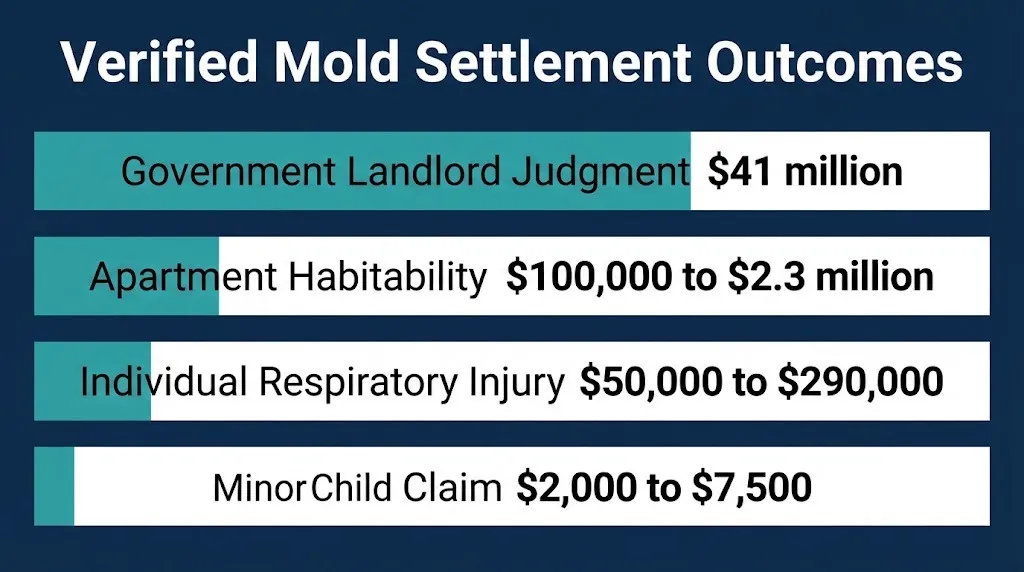
Settlement payouts by case type range from a few thousand dollars for property-only claims to millions for class actions and catastrophic injury cases, with individual injury claims typically settling between $25,000 and $300,000. The table below shows verified outcomes from real cases.
| Case Type | Typical Range | Verified Examples |
|---|---|---|
| Minor child mold claim | $2,000 to $7,500 | $3,669.50 and $7,500 net recoveries |
| Individual adult, respiratory injury | $50,000 to $290,000 | $290,000 settlement after litigation |
| Apartment habitability with mold | $100,000 to $2.3 million | $100k to $2.3M range from attorney results |
| Bad faith insurance denial | $450,000 | Mediation outcome |
| Military housing mold (bellwether) | $10.3 million | Arbitration award for Army family |
| Landlord neglect (government action) | $29.8 million restitution | Marbury Plaza tenants, 1,000+ households |
Those ranges are broad because “mold exposure” can mean a musty odor with no symptoms or a documented lung injury requiring lifelong care. The low end reflects minor claims or minors’ compromises. The high end reflects severe injuries, multiple defendants, or punitive damages.
Multiple plaintiffs or habitability violations alongside mold typically increase total settlement value. The Marbury Plaza case combined mold with water leaks, no heat, and no hot water across 2,500 tenants, producing a $41 million judgment .
Key Takeaway: Case type sets the broad range, but your final payout depends on whether you have a diagnosed injury, how long you were exposed, and whether the defendant knew about the mold and ignored it.
How are mold lawsuit settlement amounts calculated?
Mold lawsuit settlement amounts are calculated by adding your economic damages (medical bills, lost wages, property remediation costs) to your non-economic damages (pain and suffering, emotional distress), then adjusting for comparative fault and the strength of your causation evidence . Insurers often discount mold claims heavily because proving that mold caused your specific symptoms is harder than proving causation in a car accident case.
Economic damages include everything with a receipt: doctor visits, prescriptions, allergy treatments, pulmonary function tests, mold remediation costs, and replacement of contaminated belongings . These are the easier part of the calculation.
Non-economic damages cover pain and suffering, emotional distress, and loss of enjoyment of life. Mold cases often involve ongoing symptoms that improve when you leave the contaminated space, making it harder to show permanent harm .
Causation strength is the wild card. Defense attorneys argue that your symptoms could come from allergies, a cold, or another source. A physician who specializes in environmental medicine can connect the dots. Without that, insurers lowball.
Here is a simplified example. Suppose your medical bills total $12,000, you lost $2,000 in wages, and remediation cost $6,000. Your economic damages are $20,000. A moderate multiplier for pain and suffering adds $40,000. If the insurer disputes causation, they might offer $15,000 and hope you take it.
Key Takeaway: Mold settlements start with documented economic losses, add a severity-based multiplier, then get discounted by how well you can prove the mold caused your specific symptoms.
What is the Reality Check on mold settlement promises?
Reality Check: No one can promise you a specific mold settlement amount before reviewing your medical records and inspection reports. If an attorney or “mold claims specialist” guarantees a payout upfront, that is a sales pitch, not a legal assessment. Mold cases are harder to prove than most injury claims because causation is often disputed. Also, no legitimate settlement administrator will text you asking for bank details to “release” your money. Settlement funds come from insurance companies or court judgments through a formal process, and any attorney fee comes out of your final recovery.
How do you file a mold lawsuit and get a settlement payout?
Filing a mold lawsuit means documenting the mold, proving your exposure and harm, notifying the responsible party, and negotiating or litigating a claim. You do not need a lawyer to file, but mold causation is complex and representation helps. Follow these steps:
- Photograph and document the mold with dates, locations, and any spread over time.
- Get professional mold testing from a licensed inspector or industrial hygienist to identify species and spore counts.
- Seek medical care if you have symptoms, and ask your doctor to document mold exposure as a possible cause.
- Notify the landlord or property owner in writing and request remediation.
- Preserve all communications with the responsible party, including texts, emails, and work orders.
- Gather remediation and replacement receipts for contaminated belongings and cleanup costs.
- Consult an attorney to assess causation strength and statute of limitations.
- File your claim or lawsuit before the deadline and negotiate toward settlement.
Most mold cases settle before trial, often after discovery or a settlement conference . Clear liability cases with minor damages can resolve in six to twelve months. Contested causation cases take longer.
Key Takeaway: Filing is free and you can do it yourself, but mold cases hinge on expert documentation that most unrepresented claimants do not know how to build.
What evidence do you need to support a mold lawsuit?
You need five categories of evidence to support a mold lawsuit: proof the mold existed, proof the responsible party knew or should have known, proof of your exposure, medical evidence linking mold to your symptoms, and documentation of your financial losses . Without all five, your settlement value drops sharply.
Mold existence: Photographs over time, professional inspection reports identifying species and spore counts, and HVAC or leak records.
Notice: Written complaints to your landlord, maintenance requests, emails, and texts showing you reported the problem and they failed to act.
Exposure: Evidence you lived or worked in the contaminated space, including lease agreements, utility bills, or employment records.
Medical link: Records from a doctor who evaluated you, symptom journals, prescriptions, and expert testimony connecting mold to your diagnosis .
Financial losses: Medical bills, remediation receipts, hotel stays during cleanup, and pay stubs showing lost wages.
Defense attorneys will challenge your symptom journal and the timing of your medical visits. Consistent documentation from the first days after you noticed the mold matters most.
Key Takeaway: Mold claims are won or lost on documentation, and the strongest cases have professional testing, medical records linking symptoms to exposure, and written notice proving the defendant knew.
What deadlines apply to mold lawsuit claims?
The main deadline for mold claims is your state’s statute of limitations, typically two to three years from when you discovered the mold or should have discovered it. Some states allow up to six years for property damage claims. If you miss that deadline, you lose the right to sue.
Here are typical filing deadlines for mold claims by state:
| State | Filing Deadline for Mold Claims |
|---|---|
| California | 2 years from discovery |
| New York | 3 years from discovery |
| Texas | 2 years from discovery |
| Florida | 4 years for property, 2 for injury |
| Ohio | 2 years from discovery |
| Missouri | 5 years |
Mold is a “discovery” issue in many states. The clock may start when you first saw or smelled the mold, not when a doctor diagnosed your symptoms . If you noticed mold months ago but only got sick recently, you may still have time, but waiting is risky.
Do not wait until the deadline approaches. Building a mold case takes time: testing, medical records, expert review, and negotiation. Starting six months before the deadline is cutting it close.
Key Takeaway: Your state’s discovery rule determines when the clock starts, and mold cases often take longer to build than other injury claims, so consult an attorney early.
How long does a mold lawsuit settlement take?
Most mold settlements resolve within six to twenty-four months, depending on case complexity, injury severity, and whether the defendant disputes causation . Simple cases with clear liability settle in six to twelve months. Neurological or multi-defendant claims can take two to three years or longer.
Clear liability, property damage only: 6 to 12 months.
Respiratory injuries, contested causation: 12 to 24 months.
Neurological claims or multiple defendants: 24 to 36+ months.
Cases that go to trial: add 6 to 12 months on top of discovery .
Payment itself usually arrives within a few weeks after you sign the settlement agreement and release. If the case goes through a government restitution process, like the Marbury Plaza judgment, distribution can take longer as officials collect and allocate funds .
Key Takeaway: Mold cases settle faster when liability is clear and injuries are well documented, but causation disputes and multiple defendants can stretch the timeline past two years.
What happens next in the mold lawsuit process?
The mold litigation process moves through several stages, and knowing what comes next helps you avoid missing a step. Here is the expected timeline for most claims:
Immediately after discovering mold: Photograph the mold, request repairs in writing, and seek medical care if you have symptoms.
Within weeks: Get professional mold testing and start a symptom journal documenting dates, symptoms, and treatments.
After documentation: Notify the responsible party formally and consult an attorney to assess your claim.
During litigation: Discovery, depositions, and expert reports. This phase often determines settlement value .
Expected settlement or trial: Most cases settle at a mediation or settlement conference. If not, trial follows.
TBD: Payment timing after settlement depends on the agreement terms and any liens.
Frequently Asked Questions
Is the mold lawsuit settlement process real or a scam?
Mold lawsuits are real legal claims with documented payouts. Scams exist, but they usually involve upfront fees or fake “processing” charges. No legitimate mold settlement requires you to pay money first.
How much will I get from a mold lawsuit settlement?
Your payout depends on injury severity, medical evidence, property damage, and state. Verified individual settlements range from a few thousand dollars for minor claims to $290,000 or more for serious injury cases.
How long does a mold lawsuit settlement take to pay out?
Most mold cases settle within six to twenty-four months. Payment usually arrives within a few weeks after you sign the settlement agreement.
Do I need a lawyer to get a fair mold settlement?
You do not need a lawyer, but mold cases are harder to prove than most injury claims. An attorney can gather expert evidence and negotiate from a stronger position.
What is the deadline to file a mold lawsuit?
The deadline is your state’s statute of limitations, typically two to three years from when you discovered the mold. Some states allow longer for property damage claims.
Can I settle a mold claim without going to court?
Yes. Most mold cases settle before trial, often after discovery or a settlement conference. Filing suit can pressure the defendant toward a better offer.
What if my landlord ignores my mold complaints?
If your landlord ignores written complaints, document every communication. Continued neglect strengthens your claim and may support punitive damages if the landlord knew about the mold and concealed it.
Are mold lawsuit settlement payouts taxable?
Compensatory damages for physical injuries or property damage from mold are generally not taxable under IRS rules. Punitive damages are taxable, but those are less common in mold cases.
Your next step
Find your state’s statute of limitations for mold claims and write the deadline on your calendar. That date is the hard stop for your entire case.
Gather your photographs, inspection reports, medical records, and written complaints to your landlord. Those documents set the floor for your settlement value. If you have symptoms and no diagnosis, see a doctor who can document mold exposure as a possible cause. That medical link is often the difference between a low offer and a fair one.