Car Accident Settlement Payouts in 2026: What Real Claims Are Paying Now
Quick Answer
- Car accident settlement payouts are not a single number. The median US auto injury settlement sits between $27,271 and $31,000 depending on the data source .
- Represented claimants receive substantially more on average: roughly $77,600 versus $17,600 for those handling claims alone .
- No universal claim deadline exists for car accident settlements. Most states impose a two to three year statute of limitations from the accident date .
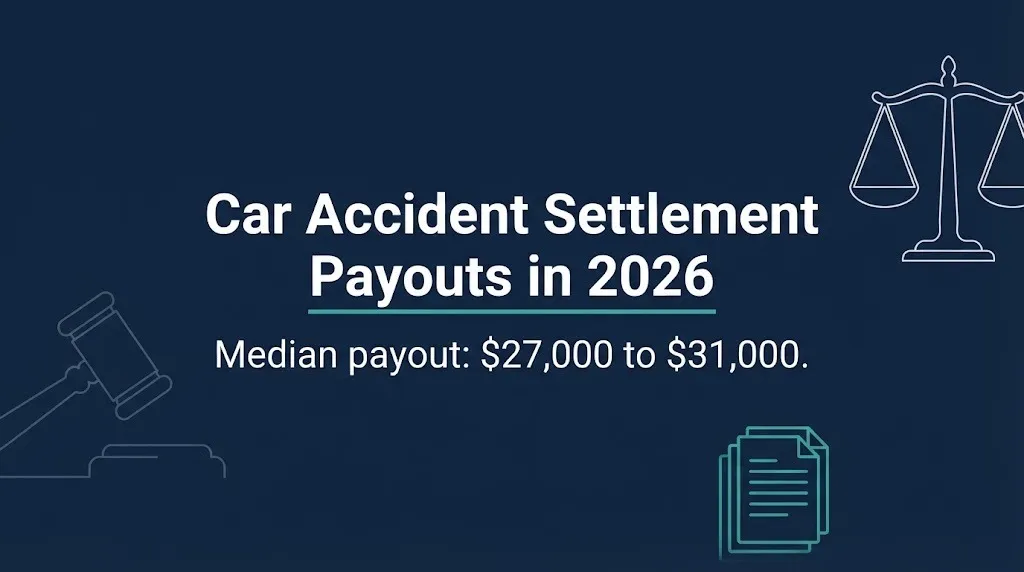
A car accident settlement payout is the money an insurance company agrees to pay you to resolve your injury claim without going to trial. The national median payout in 2026 falls between $27,271 and $31,000, based on analyses of thousands of real claims .
That number means very little on its own, though. The middle 50% of cases settle between roughly $9,300 and $133,000, a spread that reflects how wildly injury severity changes case value . A minor whiplash claim and a spinal cord injury claim are not the same animal.
This article breaks down what real car accident settlements pay in 2026, how insurance companies calculate your number, what deadlines apply, and how to tell whether an offer you received is fair. You will also find state-by-state ranges and the one factor that consistently separates higher payouts from lowball offers.
Is the car accident settlement payout process legitimate, or is it a scam?
The settlement process itself is legitimate and regulated by state insurance departments, but scams targeting accident victims are common. You should never pay an upfront fee to “unlock” settlement money, and no legitimate settlement administrator will text you asking for your bank account number first.
Real car accident settlements follow a formal claims process: you file a demand with the at-fault driver’s insurer, the adjuster evaluates liability and damages, and both sides negotiate a number . The money comes from an insurance policy, not from a government fund or a mysterious “claims desk.”
Scammers exploit confusion around this process. Common tactics include fake “settlement processing” fees, phony attorneys promising guaranteed payouts, and calls claiming you owe money to release a settlement check. None of that is real.
If someone contacts you demanding payment before you receive settlement money, that is a red flag. The only legitimate costs come out of your final settlement, usually a contingency fee if you hired a lawyer, and those fees are spelled out in a written agreement before you sign anything .
Key Takeaway: Car accident settlements are paid by insurance companies through a negotiated claims process, and no legitimate party will ever ask you to pay money upfront to receive your payout.
How much can you expect from a car accident settlement payout?
The median car accident settlement in 2026 is approximately $30,416 nationally, but your expected payout depends more on your injury severity, medical documentation, and state than on any national average . The same injury can settle for nine times more in one state than another.
Here is what different data sources show for 2026:
| Data Source | Median or Average Payout | Notes |
|---|---|---|
| Verdictly case analysis | $27,271 median | 4,188 cases analyzed |
| Insurance Research Council | $31,000 median | Industry claims data |
| SetCalc 2026 average | $30,416 | National average |
| Insurance Information Institute | $28,278 average | Paid bodily injury liability, 2024 data |
Those numbers describe the middle of the distribution, not what you will get. Your payout could be far lower for a soft tissue injury that resolves in weeks, or far higher for a fracture requiring surgery.
The single biggest driver is injury severity. A herniated disc requiring surgery settles for multiples of what a strain or sprain resolves for, because medical bills, lost wages, and pain and suffering all scale with how badly you were hurt .
Key Takeaway: The national median car accident settlement sits around $27,000 to $31,000, but injury severity and state location move that number more than any other factor.
What is the average car accident settlement payout by injury type?
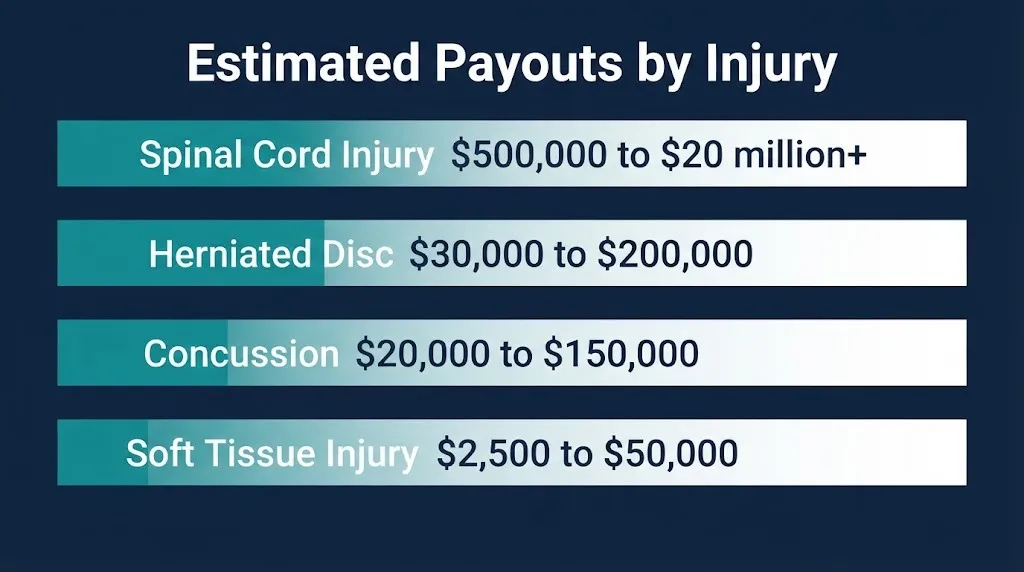
Settlement payouts by injury type range from roughly $2,500 for minor soft tissue injuries to several million dollars for catastrophic spinal cord injuries, with most moderate injuries settling between $25,000 and $150,000 . The table below shows typical 2026 ranges.
| Injury Type | Typical Settlement Range |
|---|---|
| Soft tissue injury | $2,500 to $50,000 |
| Whiplash | $7,500 to $50,000 |
| Concussion | $20,000 to $150,000 |
| Broken bone or fracture | $30,000 to $300,000 |
| Herniated or bulging disc | $30,000 to $200,000 |
| Traumatic brain injury (TBI) | $100,000 to $10 million+ |
| Spinal cord injury | $500,000 to $20 million+ |
| Wrongful death | $500,000 to $15 million+ |
Those ranges are broad because a “broken leg” can mean a simple fracture that heals cleanly or a compound fracture requiring multiple surgeries and leaving permanent impairment. The low end of each range reflects clean recovery with modest medical bills. The high end reflects surgery, permanent changes, or disputed liability that increases case value.
Multiple injuries typically increase settlement value by 30% to 50% compared to any single injury alone . If you suffered both whiplash and a herniated disc, your case is worth more than either diagnosis by itself.
Key Takeaway: Injury type sets the broad range, but within that range your final payout depends on treatment duration, permanence, and how well your medical records document the connection between the crash and your injuries.
How are car accident settlement payouts calculated?
Car accident settlement payouts are calculated by adding your economic damages (medical bills, lost wages, property damage) to your non-economic damages (pain and suffering), then reducing the total by your percentage of fault if you share any blame . Insurance adjusters often use a multiplier method for pain and suffering, applying 1.5x to 5x your economic damages depending on injury severity.
Economic damages include everything with a receipt or a pay stub: emergency room bills, surgery costs, physical therapy, prescriptions, missed work, and future medical expenses you can document . These are the easier part of the calculation because they have paper trails.
Non-economic damages cover pain and suffering, emotional distress, and loss of enjoyment of life. There is no receipt for these. Insurers estimate them by multiplying your economic damages by a factor that scales with injury severity. Minor injuries might use a 1.5x multiplier. Severe, permanent injuries can push it to 5x .
Fault reduction matters in most states. If you were 20% at fault for the crash, your settlement drops by 20%. In states with modified comparative fault, being 51% or more at fault can bar recovery entirely .
Here is a simplified example. Suppose your medical bills total $15,000 and you lost $3,000 in wages. Your economic damages are $18,000. A 2.5x multiplier for a moderate injury adds $45,000 in pain and suffering. If you were 10% at fault, the total drops by 10%, landing near $56,700 before attorney fees.
Key Takeaway: Your settlement number starts with documented economic losses, adds a severity-based multiplier for pain and suffering, then subtracts your share of fault, which is why the same injury can produce very different payouts in different cases.
How much more do you get with a lawyer for a car accident settlement?
Claimants with attorney representation receive settlements roughly 3.5 to 4.4 times larger than unrepresented claimants, even after accounting for contingency fees. The Insurance Research Council found represented claimants averaged $77,600 versus $17,600 for those handling claims alone, and 73% of unrepresented claimants accept the first offer .
That gap exists because insurance adjusters treat unrepresented claims differently. Their job is to minimize payout, and they know most people without lawyers do not know what their case is worth or how to negotiate . First offers are priced in the hope that you take them.
Lawyers change the calculation in several ways. They gather evidence, document damages fully including future medical needs, and negotiate from a position of knowing verdict and settlement values for similar cases . They also control communication so you do not accidentally say something that undermines your claim.
Most car accident attorneys work on contingency, meaning you pay nothing upfront. If you settle without filing a lawsuit, the fee is typically one-third of the settlement. If the case goes into litigation, it often rises to 40% .
Key Takeaway: Represented claimants receive substantially higher settlements on average, and because most lawyers work on contingency, you pay nothing unless your case resolves successfully.
What is the Reality Check on car accident settlement promises?
Reality Check: No one can promise you a specific settlement amount before your treatment is complete and liability is clear. If an attorney or “claims advocate” guarantees a dollar figure upfront, that is a sales pitch, not a legal assessment. Also, no legitimate settlement administrator will ever text you asking for payment or bank details to “release” your money. Settlement funds come from insurance companies through a formal process, and any fee you pay to a lawyer comes out of your final payout, never out of your pocket upfront.
How do you file a car accident claim and get a settlement payout?
Filing a car accident claim means notifying the at-fault driver’s insurance company, submitting documentation of your injuries and losses, and negotiating a settlement amount. You do not need a lawyer to file, but representation typically increases your payout. Follow these steps:
- Report the accident to police and your own insurer promptly, and get a copy of the police report.
- Seek medical treatment immediately and follow all treatment recommendations without gaps.
- Document everything: photos of damage, witness contact information, receipts, and a symptom diary.
- Notify the at-fault driver’s insurer that you are making a claim and provide basic accident details.
- Do not give a recorded statement to the other driver’s adjuster without legal advice.
- Gather medical records and bills after you reach maximum medical improvement, or MMI.
- Submit a demand package with your damages calculation to the insurer.
- Negotiate the offer, or hire an attorney to negotiate for you if the offer is low.
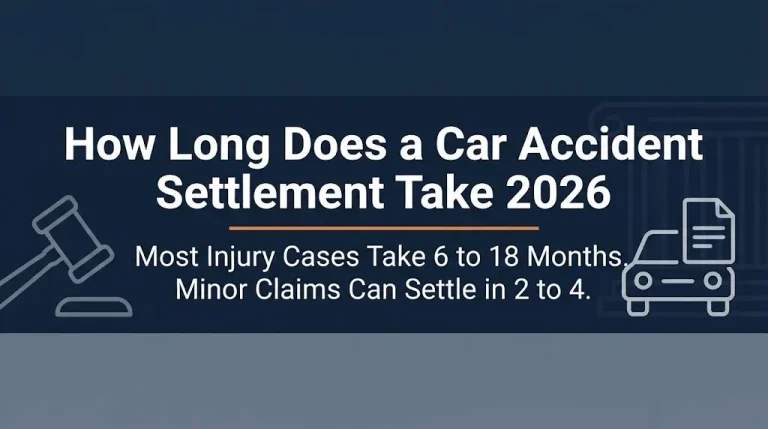
Most claims with clear liability and minor injuries settle within one to three months after treatment ends. Disputed liability or serious injuries can take a year or longer .
Key Takeaway: Filing a claim is free and you can do it yourself, but the documentation and negotiation steps are where most unrepresented claimants leave money on the table.
What deadlines apply to car accident settlement claims?
The main deadline for car accident claims is your state’s statute of limitations, which is typically two to three years from the accident date, though some states allow up to six years . If you miss that deadline, you lose the right to sue, and the insurance company has little reason to offer anything.
Here are the filing deadlines for several states in 2026:
| State | Filing Deadline |
|---|---|
| California | 2 years |
| New York | 3 years |
| Texas | 2 years |
| Florida | 2 years |
| Pennsylvania | 2 years |
| Ohio | 2 years |
| Missouri | 5 years |
| Maine | 6 years |
Do not wait until the deadline approaches. Building a claim takes time: gathering records, getting expert opinions, and negotiating. Starting six months before the deadline is cutting it close. Starting a year before is safer .
Insurance companies sometimes send settlement offers with manufactured “expiration dates.” Those deadlines are not legally binding. The only deadline that matters is the statute of limitations .
Key Takeaway: Your state’s statute of limitations is the one deadline that actually matters, and once it passes you cannot recover anything, so treat it as absolute.
What is the average car accident settlement payout by state?
State location changes car accident settlement payouts dramatically because fault rules, jury tendencies, medical costs, and insurance minimums vary. New York averages around $287,000 while the national average sits near $30,416, a difference of more than nine times . Here are 2026 averages for several states.
| State | 2026 Average Settlement |
|---|---|
| New York | $287,000 |
| California | $185,000 |
| New Jersey | $125,000 |
| Texas | $95,000 |
| Illinois | $85,000 |
| Florida | $77,000 |
| Pennsylvania | $72,000 |
| Michigan | $52,000 |
| National | $30,416 |
Those averages are heavily influenced by high-value cases in each state, so they do not predict what your specific claim is worth. A minor injury in New York still settles for a modest amount. But the state-level spread shows why moving a case to a different jurisdiction or filing in federal court can matter in close cases.
Fault rules also vary. States with pure comparative negligence, like New York and California, allow you to recover even if you were mostly at fault, though your payout drops by your percentage. States with contributory negligence, like Alabama and North Carolina, bar recovery entirely if you share any fault .
Key Takeaway: Where you file your claim can change your settlement value by several multiples, and your state’s fault rule determines whether you recover anything at all if you share blame.
How long does it take to get a car accident settlement payout?
Most car accident settlements pay within a few weeks to a few months after you agree on a number, but the full process from accident to check can take anywhere from one month to over a year depending on severity and disputes . Timeline depends on four main factors.
Injury severity and treatment duration. Minor injuries that resolve in weeks settle quickly. Serious injuries requiring surgery or long rehabilitation take longer because you should not settle until you reach maximum medical improvement .
Liability disputes. If the other driver’s insurer denies fault or blames you, the case slows down. Establishing liability requires investigation, witness statements, and sometimes accident reconstruction .
Insurance company behavior. Some insurers delay intentionally, hoping you accept a low offer out of frustration. Represented claimants typically move faster because lawyers know how to push the process .
Whether a lawsuit is filed. Cases that settle pre-suit resolve in months. Cases that go to litigation can take a year or more, though filing suit often prompts a better settlement offer .
Here is a rough timeline:
- Minor injury, clear liability: 1 to 3 months after treatment ends
- Moderate injury: 4 to 9 months
- Serious injury: 9 to 18 months
- Disputed liability or litigation: 12 to 36+ months
Payment itself usually arrives within two to four weeks after you sign the settlement agreement and release .
Key Takeaway: The settlement check comes quickly after you agree on a number, but the time to reach that agreement depends on how long your treatment lasts and whether the insurer disputes fault.
What happens next in the car accident settlement process?
The car accident settlement process moves through several stages, and knowing what comes next helps you avoid missing a step. Here is the expected timeline for most claims:
Within days of the accident: Report to police and your insurer, seek medical care, and start documenting everything.
Weeks to months after: Continue treatment and gather records. Do not settle until your doctor says you have reached maximum medical improvement .
After MMI: Submit your demand package to the at-fault driver’s insurer and begin negotiations.
If negotiations stall: Hire an attorney or file a lawsuit. Filing suit often pushes the insurer toward a better offer .
After settlement agreement: Sign the release, resolve any medical liens, and receive payment within two to four weeks .
TBD: Many cases settle without a lawsuit. If yours does not, a trial date would be set after discovery, which can take 12 to 24 months from filing .
Frequently Asked Questions
Is the car accident settlement payout real or a scam?
Car accident settlements are real and come from insurance companies. Scams exist, but they usually involve upfront fees or fake “processing” charges. No legitimate settlement requires you to pay money first.
How much will I get from a car accident settlement?
Your payout depends on injury severity, medical bills, lost wages, state, and fault. The national median is around $27,000 to $31,000, but ranges span from a few thousand dollars to millions for catastrophic injuries.
How long does a car accident settlement take to pay out?
Most settlements pay within two to four weeks after you sign the agreement. The full process from accident to check ranges from one month for minor claims to over a year for serious or disputed cases.
Do I need a lawyer to get a fair car accident settlement?
You do not need a lawyer, but represented claimants average roughly 3.5 to 4.4 times larger settlements. Most car accident lawyers work on contingency, so you pay nothing unless you recover money.
What is the deadline to file a car accident claim?
The deadline is your state’s statute of limitations, typically two to three years from the accident date. Some states allow up to six years. Missing the deadline bars your claim entirely.
Can I settle a car accident claim without going to court?
Yes. About 95% of personal injury claims settle without a lawsuit. Most cases resolve through negotiation between your attorney and the insurance company.
What if the insurance company denies my car accident claim?
If the insurer denies your claim or disputes fault, you can appeal, file a complaint with your state insurance department, or hire an attorney to pursue litigation. Denials are common when liability is unclear.
Are car accident settlement payouts taxable?
Compensatory damages for physical injuries from a car accident are generally not taxable under IRS rules. Punitive damages and interest are taxable, but those are rare in car accident settlements.
Your next step
Find your state’s statute of limitations for car accident claims and write the deadline on your calendar today. That date is the hard stop for your entire claim, and it does not move.
Gather your medical records, bills, and pay stubs from the time you missed work. Those documents set the floor for your settlement value. Then decide whether the insurer’s offer reflects the full extent of your injuries. If it does not, you have options.