Car Accident Compensation Lawyer 2026: Fees, Payout Ranges & How Claims Work
Quick Answer
- Is it legit: Yes. Contingency-fee car accident lawyers are licensed, regulated, and paid only if you recover.
- How much: Median settlement is about $31,000; severe injuries range from $100,000 to $500,000+.
- Key deadline: Statutes of limitations vary by state, typically 2 to 4 years from the accident date.
Hiring a car accident compensation lawyer usually costs you nothing upfront. Most work on contingency, meaning their fee comes out of your settlement only if they win. The question isn’t whether you can afford one. It’s whether the math works in your favor.
Median auto injury settlements sit near $31,000 nationally, with represented claimants recovering roughly $77,600 on average compared to $17,600 for those without a lawyer . That gap exists because insurers negotiate differently when an attorney is involved.
This guide breaks down how attorney fees actually work, what your case may be worth by injury type, the deadlines you can’t miss, and how to tell if an offer is fair. One detail stands out: the 1.5x to 5x multiplier method insurers use to value pain and suffering isn’t disclosed unless you ask.
The Facts
| Attorney Fees | Contingency, typically 25% to 40% of recovery |
| Upfront Cost | $0 in most cases |
| Median Settlement | ~$31,000 (Insurance Research Council) |
| Typical Deadline | 2 to 4 years, varies by state |
| Severe Injury Range | $100,000 to $500,000+ |
| Catastrophic Range | $500,000 to several million+ |
How Much Does a Car Accident Compensation Lawyer Charge in 2026?
Car accident compensation lawyers typically charge 25% to 40% of your total recovery, with most landing around 33%. You pay nothing upfront and nothing if they don’t win.
The contingency fee structure works like this :
| Fee Type | Typical Range | When Applied |
|---|---|---|
| Contingency Fee | 25% to 40% | Deducted from settlement |
| Free Consultation | $0 | Initial case review |
| Case Expenses | Advanced by firm | Reimbursed from settlement |
| Hourly (rare) | $150 to $500/hour | Limited tasks only |
The percentage can shift based on case complexity. Simple claims with clear liability sometimes settle for 25% to 30%. Cases that require filing a lawsuit and going through discovery push toward 35% to 40% because the attorney’s risk and time investment increase .
Your net recovery isn’t just the settlement minus the fee. Medical liens, health insurance subrogation claims, and case costs come out first. Understanding that order matters more than the headline percentage.
Is a Car Accident Lawyer Really Free If You Don’t Win?
Yes, most car accident lawyers work on a true no-win, no-fee basis. If they don’t recover compensation for you, you owe them nothing for their time.
That said, there’s a difference between attorney fees and case costs. Filing fees, expert witness charges, and deposition costs can arise in complex cases. Most firms cover these upfront and only recover them from your settlement if you win.
The order of payment when you settle typically goes :
- Attorney fee comes off the top
- Case costs are reimbursed from the remainder
- Medical liens (health insurer, Medicare, providers) are paid
- You receive the balance
This sequence means a $100,000 settlement with a 33% fee and $10,000 in liens leaves you with roughly $57,000, not $67,000. Ask your attorney to walk through this math before you sign.
Key Takeaway: Car accident lawyers are free upfront and only get paid from your recovery, but the final number in your pocket depends on fees, case costs, and liens deducted in that order.
Who May Qualify for Car Accident Compensation?
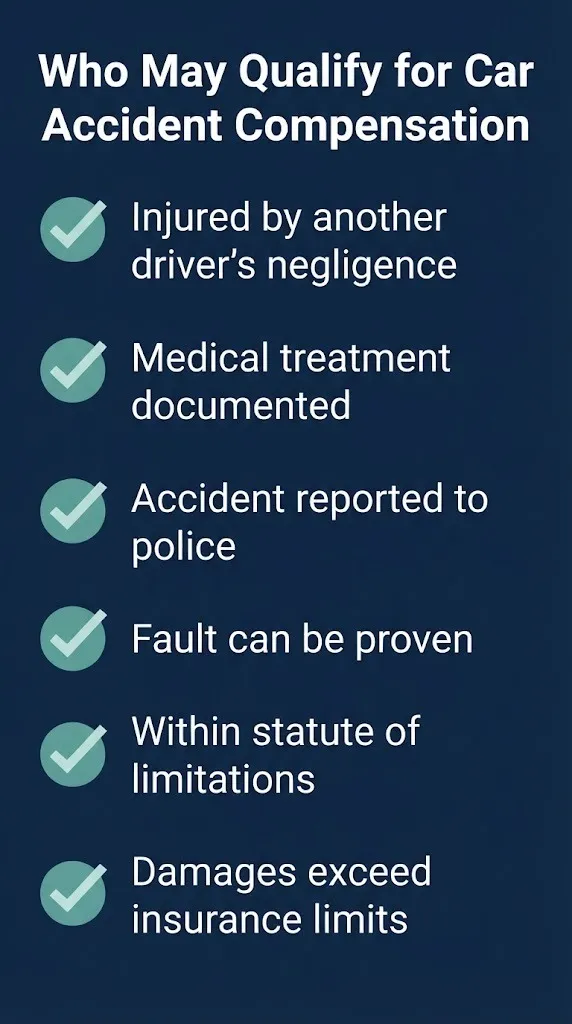
You may qualify for car accident compensation if you were injured in a collision caused in whole or part by another driver’s negligence. The key is proving the other party’s fault and documenting your damages.
Eligible claimants generally include:
- Drivers injured by another’s negligence
- Passengers in any vehicle involved
- Pedestrians struck by vehicles
- Cyclists hit by cars
- Family members of fatal crash victims (wrongful death)
Comparative fault rules affect your recovery. In modified comparative fault states like Georgia, a claimant found 50% or more at fault recovers nothing, and any fault below that reduces the award proportionally . New York recently shifted to a 51% bar under 2026 tort reform, replacing its longstanding pure comparative fault system .
If you share some fault, you may still recover. The percentage assigned to you directly scales down your final payout.
How Much Is Your Car Accident Claim Worth by Injury Type?
Your car accident claim value depends primarily on injury severity, medical costs, lost wages, and the at-fault driver’s insurance limits. Settlement ranges in 2026 cluster by injury type .
| Injury Type | Typical Settlement Range |
|---|---|
| Soft tissue / whiplash | $2,500 to $50,000 |
| Concussion | $20,000 to $150,000+ |
| Broken bone / fracture | $30,000 to $300,000+ |
| Herniated disc | $75,000 to $200,000 |
| Traumatic brain injury (TBI) | $150,000 to $5,000,000+ |
| Spinal cord injury | $500,000 to $20,000,000+ |
| Wrongful death | $500,000 to $15,000,000+ |
The multiplier method explains how pain and suffering gets added. Insurers take your economic damages (medical bills plus lost wages) and multiply by a factor based on severity :
- Soft tissue, full recovery: 1.5x to 2x
- Objective injury, full recovery: 2x to 3x
- Lasting limitation or chronic pain: 3x to 4x
- Permanent, life-altering injury: 4x to 5x+
A lumbar disc herniation with $32,000 in medical bills and $18,000 in lost wages typically settles between $90,000 and $160,000, depending on jurisdiction and fault allocation .
What Damages Can You Recover in a Car Accident Settlement?
You can recover economic damages, non-economic damages, and in rare cases punitive damages through a car accident settlement. Each category has different documentation requirements.
Economic damages cover tangible losses :
- Medical bills (past and future)
- Lost wages and lost earning capacity
- Property damage
- Out-of-pocket expenses (transportation, home care)
Non-economic damages cover intangible losses:
- Pain and suffering
- Emotional distress
- Loss of enjoyment of life
- Loss of consortium
Punitive damages are rare and reserved for extreme negligence or willful misconduct. They’re designed to punish, not compensate.
Illinois and most states don’t cap economic or non-economic damages in car accident cases, but the at-fault driver’s insurance policy limits often cap what you can actually collect . Minimum liability coverage in Illinois is $25,000 per person and $50,000 per accident. If your damages exceed those limits, your attorney may pursue underinsured motorist coverage or file suit against the driver directly.
Reality Check: No legitimate attorney will ask for a retainer upfront in a standard car accident case. If a firm demands payment before reviewing your case, walk away. Contingency means they take on the risk, not you.
What Is the Deadline to File a Car Accident Claim?
The deadline to file a car accident claim depends on your state’s statute of limitations, typically 2 to 4 years from the accident date. Missing it can end your right to recover entirely.
Examples from recent court cases show how strict these deadlines are:
- Nebraska: 4-year statute of limitations for negligence claims. A claimant filed one day before expiration but named a deceased person as defendant, and the case was dismissed as a nullity .
- Oklahoma: 2-year statute of limitations. COVID-19 emergency orders temporarily tolled deadlines, extending the filing period by 60 days for accidents occurring during the suspension .
- Ontario, Canada: 2-year limitation period, but the clock starts when the claimant discovers the injury meets the “permanent serious impairment” threshold, not necessarily the accident date .
State-specific rules matter. Some states toll the deadline for minors or incapacitated claimants. Others have shorter deadlines for claims against government entities. Checking your state’s specific rule early is the safest move.
Step-by-Step: How to File a Car Accident Compensation Claim
Filing a car accident compensation claim involves several stages. Here’s the sequence:
- Seek medical care immediately. Delays let insurers argue your injuries aren’t from the crash.
- Document everything. Photos, witness statements, police report, and medical records.
- Notify the insurance company. Provide basic facts but avoid speculating about fault.
- Reach maximum medical improvement. Settling before your condition stabilizes risks undervaluing future costs.
- Send a demand letter. Your attorney outlines facts, injuries, and the requested amount.
- Negotiate the offer. The first offer is rarely the insurer’s best.
- Sign the settlement or file suit. Most cases settle; some require litigation.
- Receive payment. The check goes to your attorney, who deducts fees and liens.
The entire process can take weeks for simple claims to months or years for disputed or litigated cases.
How Long Does a Car Accident Settlement Take in 2026?
A straightforward car accident settlement typically resolves in 3 to 6 months, while disputed or litigated cases often take 12 to 24 months or longer.
The biggest variable is reaching maximum medical improvement (MMI). Until your doctor says your condition has stabilized, the full value of future medical costs and lost earning capacity isn’t known.
Key timeline factors include:
- Injury severity: Surgery and long-term care take longer to value.
- Fault disputes: Comparative negligence fights can freeze negotiations.
- Insurance responsiveness: Some carriers stall; others move quickly.
- Litigation: Filing a lawsuit can add 6 to 18 months.
If your claim feels stuck, ask your attorney whether the delay is structural or tactical.
What Happens Next in Your Car Accident Case?
The path forward depends on where you are in the process:
Within 24 to 72 hours: Get medical care. Document the scene. Notify your insurer.
Weeks 1 to 4: Treatment continues. Evidence gathering. Initial claim filing.
Month 2 to 6: Demand letter sent. Negotiations begin.
If disputed: Lawsuit filed. Discovery phase. Mediation or trial scheduled.
After settlement: Payment arrives within 2 to 6 weeks, minus fees and liens.
Frequently Asked Questions
How much does a car accident lawyer cost?
Most charge 25% to 40% of your recovery on contingency. You pay nothing upfront, and nothing if they don’t win.
Do I need a lawyer for a car accident claim?
You can file without one, but represented claimants recover roughly 340% more on average before fees, according to Insurance Research Council data.
What is the average car accident settlement in 2026?
The median is approximately $31,000. Severe injuries range from $100,000 to $500,000+, and catastrophic cases exceed $1 million.
How long do I have to file a car accident claim?
Statutes of limitations vary by state, typically 2 to 4 years from the accident date. Missing it can bar your claim entirely.
Can I recover compensation if I was partly at fault?
In modified comparative fault states, you can recover if you’re less than 50% (or 51% in New York) at fault, but your award is reduced by your fault percentage.
What damages can I recover in a car accident settlement?
Economic damages (medical bills, lost wages), non-economic damages (pain and suffering, emotional distress), and in rare cases punitive damages.
How long does it take to get a car accident settlement?
Simple claims resolve in 3 to 6 months. Disputed or litigated cases often take 12 to 24 months or longer.
Do I have to pay taxes on a car accident settlement?
Generally no. Settlement proceeds for physical injuries are typically not taxable under IRS rules, but lost wages and punitive damages may be.
What Should You Do After a Car Accident?
Seek medical care within 24 to 72 hours, even if you feel fine. Document everything: photos, witness contacts, police report, and all medical records. Report the accident to your insurer promptly.
Contact a car accident lawyer for a free consultation before accepting any settlement offer. The consultation costs nothing and could protect thousands in compensation. The most important deadline is your state’s statute of limitations, typically 2 to 4 years. Don’t wait.