CarMax Justice Department Settlement 2026: What Servicemembers Need to Know
Quick Answer
- Yes, this is real. The DOJ announced a settlement with CarMax on February 23, 2026 over illegal vehicle repossessions.
- Affected servicemembers can receive $15,000 each, plus lost vehicle equity and interest.
- There is no open public claim form. This settlement covers a specific group already identified by the DOJ.
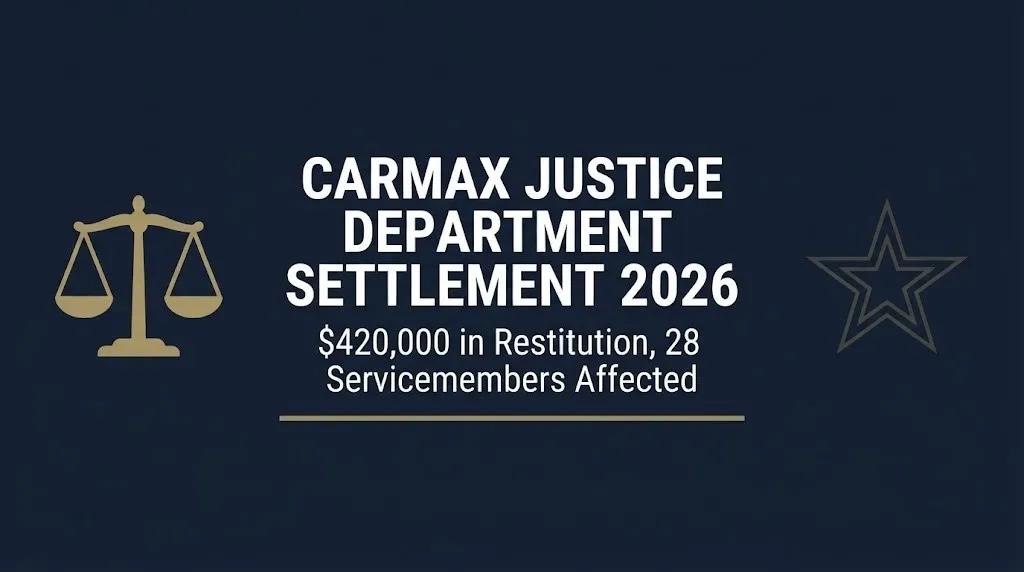
The CarMax Justice Department settlement is real, and it resolves federal allegations that CarMax illegally repossessed vehicles from military servicemembers. The Department of Justice announced the deal on February 23, 2026.
This settlement affects a specific group: at least 28 servicemembers whose vehicles were repossessed between March 1, 2018, and October 24, 2023. Each affected person can receive $15,000, plus any lost equity in their vehicle.
This article covers who qualifies, how much money is involved, and why this is not an open class action you can sign up for. One detail stands out: CarMax says it has provided relief to more than 26,000 servicemembers since 2003, yet still faced this federal enforcement action.
The Facts
| Category | Detail |
|---|---|
| Case | Settlement Agreement between the United States and CarMax, Inc. |
| Status | Settled, announced February 23, 2026 |
| Fund Size | At least $420,000 in restitution, plus a $79,380 civil penalty to the U.S. Treasury |
| Est. Per Person | $15,000 per affected servicemember, plus lost vehicle equity and interest |
| Claim Deadline | No open public claim process, this is not a class action |
| Administrator | DOJ Civil Rights Division, with CarMax Auto Finance handling direct outreach |
| Proof Needed | Applies only to identified servicemembers whose vehicles were repossessed between March 2018 and October 2023 |
Is the CarMax Justice Department Settlement Real?
Yes, this settlement is confirmed directly by the Department of Justice. The DOJ’s Civil Rights Division announced it on February 23, 2026, through an official press release.
The agreement was signed by DOJ trial attorneys from the Civil Rights Division’s Housing and Civil Enforcement Section, working with the U.S. Attorney’s Office for the Eastern District of Virginia. CarMax’s outside counsel from Troutman Pepper Locke LLP also signed the agreement.
Assistant Attorney General Harmeet K. Dhillon confirmed the terms publicly. She stated that federal law prohibits repossessing servicemembers’ vehicles without a court order.
Key Takeaway: This is a confirmed federal settlement, not a rumor or a scam notice, backed by an official Department of Justice announcement and a signed agreement.
Is This a Class Action Lawsuit?
No, this is not a class action lawsuit in the traditional sense. It is a settlement agreement between the federal government and CarMax, resolving a DOJ civil rights investigation.
The DOJ acted on behalf of identified servicemembers under its enforcement authority. No private law firm filed this case, and no class of consumers opted in through a court-certified process.
This distinction matters for anyone searching for a claim form. A comparison helps: think of this less like signing up for a refund program and more like a government agency settling a violation it already investigated and proved.
How Much Money Is in the CarMax Justice Department Settlement?
The settlement totals at least $420,000 in restitution to affected servicemembers, plus a separate $79,380 civil penalty paid to the U.S. Treasury. That penalty does not go to consumers.
The restitution figure covers a confirmed group of at least 28 servicemembers identified in the DOJ’s investigation. It is not an open fund available to the general public.
| Payment Type | Amount | Who Receives It |
|---|---|---|
| Servicemember restitution | At least $420,000 total | At least 28 identified servicemembers |
| Civil penalty | $79,380 | U.S. Treasury |
| Per-person restitution | $15,000 flat | Each identified servicemember |
| Additional compensation | Lost vehicle equity plus interest | Varies by individual case |
How Much Can an Affected Servicemember Receive?
Each identified servicemember is entitled to a flat $15,000 payment under the settlement terms. That amount is separate from any additional compensation tied to their specific vehicle.
On top of the flat payment, CarMax must compensate affected servicemembers for lost equity in their repossessed vehicle. Interest on that lost equity is also included.
Not yet determined: exact total payouts per individual. Reason: lost equity varies by vehicle and loan balance, so final amounts differ from person to person even though the base payment is fixed.
Key Takeaway: The $15,000 base payment is confirmed and fixed, but total compensation depends on each servicemember’s specific vehicle equity loss.
Can You File a Claim in the CarMax Settlement?
No, there is no open claim form for the general public tied to this settlement. The DOJ already identified the affected servicemembers through its investigation before the agreement was finalized.
This differs sharply from typical consumer class action settlements covered on this site. Those usually involve a claims administrator and a public filing window.
Here is what does and does not exist for this case:
| Question | Answer |
|---|---|
| Is there a public claim form? | No |
| Is there a claim deadline? | No, because there is no open filing process |
| Were affected people already identified? | Yes, at least 28 servicemembers |
| Can someone reach out if they think they qualify? | Yes, through CarMax Auto Finance or the DOJ |
What Should You Do if You Believe You Qualify?
If you believe your vehicle was illegally repossessed while you were on military duty, you can still reach out directly. This applies even though there is no formal public claim form.
Follow these steps if your situation matches the settlement’s timeframe and circumstances:
- Confirm your vehicle was financed or leased through CarMax Auto Finance.
- Check whether the repossession happened between March 1, 2018, and October 24, 2023.
- Gather proof of your military service dates, including any activation orders.
- Contact CarMax Auto Finance directly about SCRA eligibility.
- If CarMax does not respond, contact the Department of Justice about the settlement.
- Keep copies of all correspondence and repossession paperwork.
- Avoid any third party charging a fee to “file” this for you, since no such filing process exists.
A missed warranty claim is a fair comparison here. You may still have a valid case even after the fact, but you have to raise it yourself.
How to Contact CarMax Auto Finance About SCRA Protections
CarMax Auto Finance has a dedicated line for servicemembers seeking information about SCRA benefits. Reporting confirms a phone number of (800) 925-3612, extension 4077, for these inquiries.
CarMax has stated it has provided SCRA-related relief to more than 26,000 servicemembers and their dependents since 2003. That figure comes directly from the company’s public statement following the settlement.
If you believe you were affected and have not been contacted, reaching out proactively is your best option. Watch for scam contacts pretending to represent CarMax or the DOJ, since neither typically initiates contact by text message.
Reality Check
No government agency will text or call you out of nowhere asking for payment information to release settlement money, and CarMax will not ask for money to process your compensation. Reaching out through CarMax’s official SCRA contact line or the DOJ is free. Anyone charging you a fee to “claim” this settlement is not connected to either party.
What Is the Current Status of the Settlement?
The settlement is finalized and confirmed as of February 23, 2026. CarMax neither admitted nor denied wrongdoing as part of the agreement, which is standard in DOJ civil settlements of this kind.
CarMax must now follow a four-year monitoring and reporting period tied to the agreement. The company is required to build out formal SCRA compliance policies subject to DOJ review.
CarMax must also request that credit bureaus delete negative information tied to the illegal repossessions identified in the investigation.
What Happens Next?
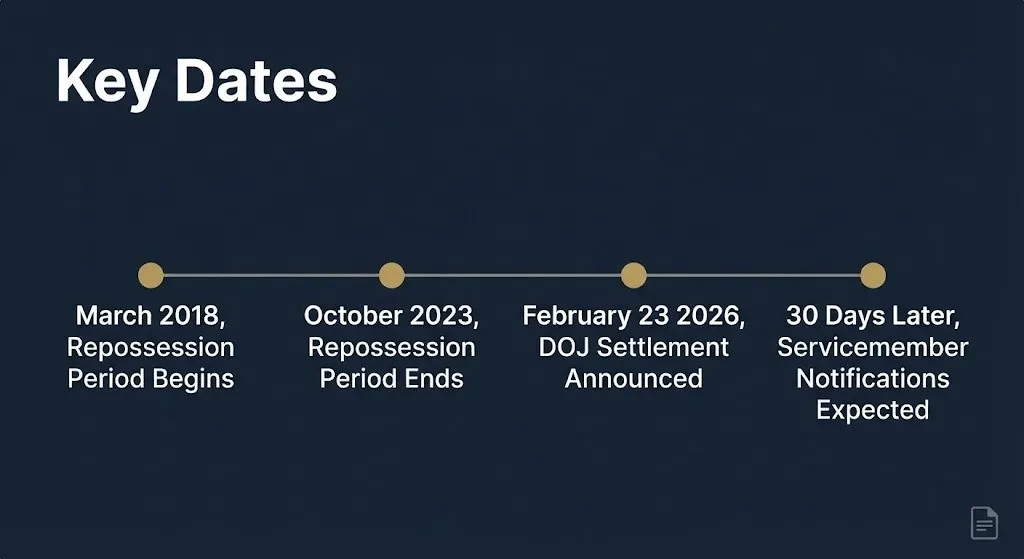
Here is the confirmed and expected timeline based on the settlement terms. Items marked “expected” have not been independently confirmed in public reporting.
- March 1, 2018 to October 24, 2023: Repossessions identified in the DOJ investigation took place.
- February 23, 2026: DOJ and CarMax finalized the settlement agreement.
- Expected within 30 days of the settlement: CarMax required to notify identified affected servicemembers, per early reporting.
- Ongoing through 2030: Four-year DOJ monitoring and compliance reporting period.
- TBD: Any additional servicemembers identified after the settlement date.
What Did CarMax Do Wrong?
The DOJ alleged CarMax repossessed vehicles from servicemembers without first obtaining required court orders. Federal law requires that step whenever a servicemember made at least one payment before entering military service.
Investigators also found that CarMax repossessed some vehicles even after owners told the company they were in the military. That allegation points to a breakdown between customer communication and the repossession process.
The DOJ further alleged CarMax failed to extend protections to reservists who had already received orders to report for active duty. That gap matters because SCRA protections begin the moment orders are received, not when a servicemember physically reports.
What Is the Servicemembers Civil Relief Act?
The Servicemembers Civil Relief Act, known as the SCRA, is a federal law protecting active duty military members from certain financial actions. It generally bars repossessing a servicemember’s vehicle without a court order.
That protection applies as long as the servicemember made at least one payment on the vehicle before entering service. The law exists to prevent financial harm while someone is focused on military duty rather than routine bill management.
Key Takeaway: SCRA protections can begin before a servicemember physically reports for duty, starting at the point orders are issued, which was central to the CarMax allegations.
Who Is Affected by the CarMax Settlement?
At least 28 servicemembers whose vehicles were repossessed between March 1, 2018, and October 24, 2023, are covered by this settlement. The DOJ identified this group through its investigation before finalizing the agreement.
This group includes both active duty members and reservists who had received activation orders. It does not automatically include every CarMax customer who experienced a repossession during that window.
If your situation matches this description and you were not contacted, reaching out directly remains your best path forward.
Has CarMax Faced Other Settlements?
Yes, CarMax faced a separate settlement in 2026 unrelated to servicemember protections. In March 2026, CarMax agreed to pay $1.1 million to resolve a California consumer protection case brought by a coalition of county district attorneys.
That California case, approved by the Santa Clara Superior Court, involved allegations that CarMax failed to timely transfer vehicle registrations and ownership. It is a separate matter from the DOJ’s SCRA settlement and involves different allegations entirely.
Key Takeaway: The DOJ servicemember settlement and the California registration settlement are two distinct 2026 cases against CarMax, and neither should be confused with the other.
What Did CarMax Say About the Settlement?
CarMax stated it cooperated fully with the DOJ throughout the resolution process. The company said the settlement does not constitute an admission of wrongdoing.
CarMax Auto Finance emphasized its long-standing commitment to servicemembers, veterans, and their families in its public statement. The company said it has since strengthened its existing compliance program.
Frequently Asked Questions
Is the CarMax Justice Department settlement legitimate?
Yes, it is a confirmed federal settlement announced directly by the DOJ on February 23, 2026.
It resolves allegations that CarMax violated the Servicemembers Civil Relief Act.
Can any CarMax customer file a claim in this settlement?
No, this settlement only covers servicemembers already identified in the DOJ investigation.
There is no public claim form open to general CarMax customers.
How much money will affected servicemembers receive?
Each identified servicemember is entitled to $15,000, plus lost vehicle equity and interest.
The exact total varies depending on individual vehicle equity loss.
What time period does the settlement cover?
The settlement covers repossessions between March 1, 2018, and October 24, 2023.
At least 28 servicemembers were identified within that window.
Does CarMax admit wrongdoing in this settlement?
No, CarMax neither admitted nor denied the DOJ’s allegations.
This is standard practice in many federal civil settlement agreements.
What is the Servicemembers Civil Relief Act?
The SCRA is a federal law protecting active duty servicemembers from certain repossessions.
It generally requires a court order before repossessing a servicemember’s financed vehicle.
Is this the same as CarMax’s California settlement?
No, the DOJ settlement and California’s $1.1 million settlement are separate cases.
The California case involved vehicle registration and ownership transfer delays, not repossessions.
Who should contact CarMax about this settlement?
Servicemembers who believe their vehicle was wrongly repossessed during the covered period should contact CarMax Auto Finance directly.
Reported contact information includes the phone line (800) 925-3612, extension 4077.
What This Means for You
If you served in the military and had a CarMax-financed vehicle repossessed between 2018 and 2023, reach out directly to CarMax Auto Finance or the DOJ. There is no public claim form, so proactive contact is your best option.
The confirmed per-person payment stands at $15,000, plus any lost vehicle equity. February 23, 2026 remains the date this settlement became official.