Car Accident Lawsuits in 2026: Timeline, Deadlines and New Fault Rules
Quick Answer
- Car accident lawsuits are individual injury or damage claims, not class actions, and most settle before trial.
- Timeline: A Martindale-Nolo survey found 10.7 months on average, and 39% were paid within three months.
- Deadline: Most states allow two to three years, but Tennessee allows one year for injury claims.
Car accident lawsuits are individual injury or property claims filed against an at-fault driver. Most never reach a courtroom. A Martindale-Nolo survey found 98% of successful claimants were paid by settlement, not a court award.
This affects anyone hurt in a crash. Your deadline matters most, and it can be as short as one year. Two years is the most common window. Missing it can end a strong claim.
Below, you’ll get a stage-by-stage timeline, real payout data, and 2026 law changes. One surprise: New York and Louisiana both adopted fault bars in 2026. Some of the numbers you’ve seen online are older than you think.
| The Facts | |
|---|---|
| Case | General guide to individual car accident claims (no class action or single case) |
| Status | Not applicable. Several states changed fault rules in 2025 and 2026 |
| Fund Size | Not applicable, no settlement fund exists |
| Est. Per Person | Not yet determined. A 2015 to 2020 survey averaged $23,900 per successful claim |
| Claim Deadline | Your state’s statute of limitations, from 1 to 6 years |
| Administrator | None. Claims run through insurers and state courts |
| Proof Needed | Typically a police report, medical records, photos, repair estimates, and wage records |
Do you have to file a lawsuit after a car accident?
No, most car accident claims settle with an insurer and never become a lawsuit.
In the Martindale-Nolo survey, 98% of successful claimants were paid through a settlement rather than a court proceeding. Law firm guides citing Bureau of Justice Statistics figures say only 3% to 4% of personal injury cases go to trial. Treat the exact percentages as approximate, but the pattern is consistent.
A lawsuit usually becomes necessary in these situations:
- The insurer denies your claim or offers far less than your documented losses.
- The other driver disputes fault.
- Your injuries are serious, and policy limits are in play.
- Your state’s filing deadline is getting close.
Filing doesn’t mean a trial. It starts formal discovery, which often pushes both sides toward a settlement. A claim is a request to an insurer. A lawsuit is a case in court.
Is the 10.7-month auto accident settlement timeline accurate?
The 10.7-month figure is real, but it’s a reader survey from 2015 to 2020, not an official clock.
Martindale-Nolo Research, published through Lawyers.com, found successful claimants waited 10.7 months on average. About 39% were paid within three months. Another 13% waited more than two years.
Injuries drive the gap. Injured claimants waited 14.5 months on average, versus 4.9 months for people who weren’t hurt. An “average wait” is like an average commute. It hides the person stuck in traffic for two hours.
| Source | Figure | Caveat |
|---|---|---|
| Martindale-Nolo survey (2015 to 2020) | 10.7 months average | Successful claims only |
| Same survey, injured claimants | 14.5 months | Uninjured: 4.9 months |
| Same survey | 39% paid within 3 months | 13% took over 2 years |
| California law firm guide | 3 to 9 months typical | Firm estimate |
| Florida law firm guide | 3 to 6 months (minor); 9 months to 2 years (litigated) | Firm estimate |
No regulator publishes a national auto accident settlement timeline. Law firm estimates are marketing, so use them as ranges, not promises.
How much do car accident lawsuits pay?
Not yet determined for any one person, because payouts depend on injuries, fault, and available insurance coverage.
The best public benchmark is still the Martindale-Nolo survey, and it’s dated. Forbes Advisor notes today’s averages are likely somewhat higher. Most survey respondents received less than $10,000.
| Measure | Amount | Source |
|---|---|---|
| Average, all successful claims | $23,900 | Martindale-Nolo, 2015 to 2020 |
| Average, injured claimants | $29,700 | Martindale-Nolo |
| Average, uninjured claimants | $16,700 | Martindale-Nolo |
| Average counting $0 payouts | $13,500 | Martindale-Nolo |
| Average bodily injury liability claim, 2022 | $26,501 | Insurance Information Institute, via Forbes Advisor |
| Average property damage liability claim, 2022 | $6,551 | Insurance Information Institute, via Forbes Advisor |
Averages hide huge spreads. Payouts in the survey ranged from a few hundred dollars to hundreds of thousands. Your number depends on your records, your coverage, and your fault percentage.
Key Takeaway: Most claims settle without a trial, the average wait is 10.7 months, and your own timeline depends mostly on your medical recovery.
What comes out of your car accident settlement before you get paid?
Attorney fees, case costs, medical liens, and unpaid bills usually come out before you receive your net payout.
Cost guides commonly cite contingency fees of 33% to 40% for injury cases. Case costs include records, experts, and filing fees. Health insurers, Medicaid, or hospitals may hold liens. In Florida, personal injury protection (PIP) payments can also be reimbursed.
Think of it like a paycheck. The gross number is exciting, and the take-home number is what pays your bills.
Here’s an illustration, not a real case:
| Item | Amount |
|---|---|
| Settlement | $30,000 |
| Attorney fee (one-third) | $10,000 |
| Case costs | $1,500 |
| Medical liens | $4,000 |
| Your net | $14,500 |
A Florida firm describes the usual flow. The insurer issues the check, the attorney deposits it into a trust account, and liens get resolved before you’re paid. Ask for a written closing statement showing every deduction.
Does hiring a lawyer change your payout and your wait?
Hiring a lawyer is linked to higher payouts and longer waits, but the survey can’t prove cause.
Analysis of the Martindale-Nolo data reports that represented claimants averaged $77,600 in gross compensation. Unrepresented claimants averaged $17,600. Attorney-led claims generally took longer, because lawyers wait for maximum medical improvement (MMI) before sending a demand.
The gap likely reflects who hires lawyers. Serious injuries and disputed fault push people toward attorneys. That’s reasoning, not a finding, so don’t read the gap as a guarantee.
Speed has a price. One cost guide notes an early settlement can pay in 4 to 10 weeks, but it’s based on damages known at signing. A Florida firm calls MMI the biggest timing variable. Settling before it risks accepting far less than the claim may be worth.
Many injury lawyers offer free consultations and take contingency fees. Confirm the fee terms in writing before you sign.
Reality Check: No insurer, lawyer, or “claims helper” should text you settlement money first. Quick offers early on reflect only the damages known today. Anyone demanding upfront fees on a contingency case is a warning sign.
How do you file a car accident lawsuit, step by step?
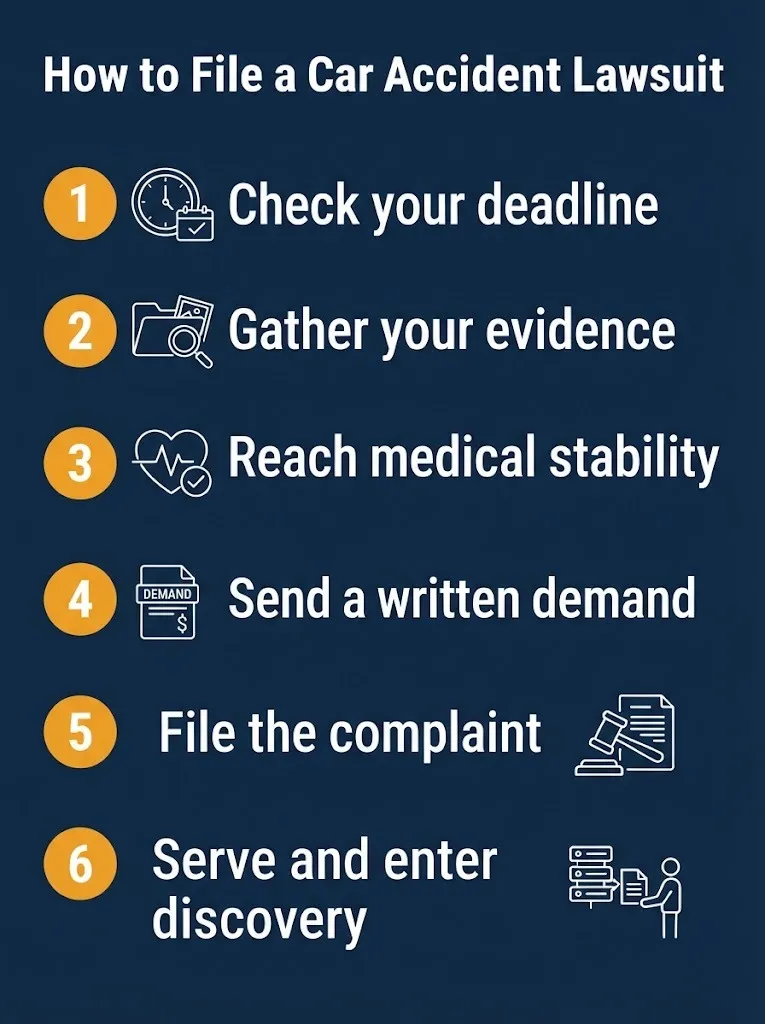
You file by completing a complaint and submitting it to the proper court before your state’s deadline.
- Check your state’s deadline and the right court.
- Gather the police report, photos, bills, and wage records.
- Reach maximum medical improvement, or get a doctor’s estimate.
- Send a written demand and negotiate with the insurer.
- File the complaint before the deadline.
- Serve the defendant, then handle discovery and mediation.
A complaint states the parties, the facts, your claims, and the relief you want. Most car accident suits go to state court, where fees vary by county. A federal civil case costs $405 to open, which is a $350 fee plus a $55 administrative fee.
Filing too early can hurt, and so can filing too late. A lawyer can help you time steps 3 through 5.
Key Takeaway: Evidence and medical recovery drive both how much you can claim and how long it takes.
How long do you have to file a car accident lawsuit?
You must file within your state’s statute of limitations, which runs from one to six years.
Most states give two or three years. Tennessee gives one year for injury claims. Maine and North Dakota give six. Property damage deadlines often differ from injury deadlines.
| State | Injury deadline | Notes |
|---|---|---|
| Tennessee | 1 year | Property damage: 3 years |
| Louisiana | 2 years | For accidents on or after July 1, 2024; one year before |
| Florida | 2 years | Cut from 4 years for claims after March 24, 2023 |
| Kentucky | 1 to 2 years | Sources differ; one cites 2 years under its motor vehicle law |
| Texas | 2 years | Property damage: 2 years |
| California | 2 years | Property damage: 3 years |
| Georgia | 2 years | Property damage: 4 years |
| Maine, North Dakota | 6 years | Longest in published tables |
Published tables disagree on a few states, so confirm yours with a lawyer or the court clerk. Exceptions exist for latent injuries, minors, and government defendants. Insurance negotiations generally don’t stop the clock.
What evidence do car accident lawsuits rely on?
Car accident lawsuits rely on proof of fault, proof of injury, and proof of cost.
Strong files usually include these items:
- The police report and the other driver’s insurance details
- Photos and video of vehicles, the road, and your injuries
- Witness names and phone numbers
- Medical records, bills, and your doctor’s treatment notes
- Pay stubs showing missed work
- Repair estimates or total-loss valuations
Your own words matter. One Florida firm warns that a casual remark at the scene, like “I didn’t see you coming,” can be used to argue shared fault. Stick to facts when speaking with insurers.
Seat belts now matter more in Georgia. Its 2025 tort law, SB 68, lets a jury consider seat belt non-use when weighing fault. Gaps in treatment can also weaken a claim, because insurers may argue your injuries weren’t serious.
What changed for car accident lawsuits in 2026?
Three states changed fault rules that can bar recovery in 2025 and 2026: New York, Louisiana, and Georgia.
| State | Change | Applies to |
|---|---|---|
| New York | Fault bar for motor vehicle injury cases; 90/180-day injury category eliminated; fault decided before injury threshold | Actions commenced on or after May 26, 2026 |
| Louisiana | Pure comparative fault replaced by a 51% bar | Accidents on or after January 1, 2026 |
| Georgia | Seat belt non-use evidence now admissible | Newly filed cases under 2025 SB 68 |
| Florida | 2023 HB 837 rules stayed intact in the 2026 session | Claims accruing after March 24, 2023 |
In New York, the date your lawsuit is commenced controls, not the crash date. A case commenced before May 26, 2026 may follow the older rule. Reports also describe a narrow $100,000 pain-and-suffering cap for uninsured, DWI-convicted, or fleeing-felony drivers.
Sources differ on how far the New York bar reaches. Some say it blocks all damages. Others say it blocks only non-economic damages such as pain and suffering. Verify with a New York attorney.
Key Takeaway: In 2026, where you file and when you file can decide whether partial fault reduces your claim or ends it.
How long does a car accident lawsuit take after filing?
A filed car accident lawsuit commonly takes 13 to 14 months to resolve, and trials take longer.
Law firm guides citing Bureau of Justice Statistics data put the median at 13 to 14 months from filing to resolution. Cases that reach a verdict run 22 to 26 months. One Florida firm says reaching a trial date can take 12 to 24 months or longer. A study cited by a California firm found personal injury cases averaged about one year and four months to disposition.
The wait feels like a delayed tax refund. Nothing is wrong, but nothing moves until the next document clears.
| Stage | What happens |
|---|---|
| Complaint and service | You file, and the defendant is formally notified |
| Answer | The defendant responds in writing |
| Discovery | Both sides exchange records and take testimony |
| Mediation | A neutral helps the parties negotiate |
| Trial | A judge or jury decides if no deal is reached |
Multiple defendants, commercial trucks, and disputed fault add months. Treat any single timeline with caution, because courts differ.
How long until you get paid after a car accident settlement?
You can typically expect payment within two to six weeks after the settlement documents are signed.
One cost guide says insurers usually process payment in two to six weeks. A Florida firm says four to six weeks. A California firm says insurers are generally required to pay within 30 days of the signed release. These ranges overlap, but state rules differ.
Delays often come after the check arrives. Your attorney deposits it into a trust account, and liens must be resolved first. Then you receive the net.
Ask these questions before you sign:
- When will the insurer issue payment after receiving the release?
- Which liens exist, and who is negotiating them?
- When will I get the written closing statement?
Can an insurance company stall your car accident settlement?
Yes, insurers can slow a claim, and some delay is strategic.
A Florida firm says insurers sometimes delay hoping you’ll accept a low offer or miss a deadline. California regulations require insurers to acknowledge a claim within 15 days, according to law firm summaries. Acknowledging a claim isn’t the same as paying it.
Florida’s 2023 HB 837 raised the bar for bad faith. Negligence alone in handling a claim no longer proves it. That matters if you’re counting on bad-faith pressure to move a slow insurer.
Practical steps people take include:
- Ask for status updates in writing.
- Keep your filing deadline on your calendar.
- Don’t assume talks pause the clock.
If the deadline is near and the insurer is still “reviewing,” that’s often the moment to talk to a licensed attorney about filing.
Key Takeaway: Slow insurers don’t stop your deadline, so calendar it and track every written response.
What is a car accident lawsuit, and who can you sue?
A car accident lawsuit is a civil case where you ask a court to hold an at-fault party financially responsible.
Most cases claim negligence. That means the other driver failed to use reasonable care and caused your harm. The at-fault driver’s insurer usually defends the case and pays within policy limits.
Other defendants can include a vehicle owner or, in commercial crashes, an employer or a trucking company. Cases with several defendants add months, according to law firm guides.
| Feature | Insurance claim | Lawsuit |
|---|---|---|
| Where it happens | With the insurer | In court |
| Starts with | A claim report and demand | A complaint |
| Typical outcome | Settlement | Settlement, dismissal, or verdict |
| Deadline | Policy and state rules | Statute of limitations |
These cases are individual. They aren’t class actions, so there’s no claims administrator, no settlement website, and no opt-out period.
How does shared fault affect your car accident claim?
Shared fault can reduce your payout, and in some states it can end your claim entirely.
Pure comparative fault lets you recover even if you were mostly to blame, reduced by your percentage. Modified systems cut you off at a threshold. Florida uses a 51% bar for claims after March 24, 2023. Louisiana moved to a 51% bar on January 1, 2026. Georgia, Utah, and Kansas are cited as 50% bar states.
It works like a school grade cutoff. At 50%, you pass with a reduction. At 51%, you get nothing.
| Your fault | $100,000 in damages: pure rule | $100,000 in damages: 51% bar |
|---|---|---|
| 30% | $70,000 | $70,000 |
| 50% | $50,000 | $50,000 |
| 51% | $49,000 | $0 |
That table is arithmetic, not a prediction. Fault percentages are decided by insurers, judges, or juries, and they’re often disputed. New York’s motor vehicle bar compares your fault to the defendant’s, or to the combined fault of all defendants.
What damages can you recover in a car accident lawsuit?
You may recover economic losses and non-economic harm, depending on your state and your proof.
- Economic damages: medical bills, lost wages, future care costs, and vehicle repair or replacement.
- Non-economic damages: pain and suffering, emotional distress, and loss of enjoyment of life.
Florida’s 2023 reform requires disclosure of actual amounts paid for medical care. That can lower the “billed” figure juries see. New York’s 2026 law added a narrow cap on non-economic damages for a small group of at-fault drivers.
Insurance limits can cap what you actually collect. A court may award more than a policy covers, but collecting the difference from an individual driver can be hard.
Keep every bill and every receipt. Your damages are only as strong as the paper trail behind them.
Key Takeaway: Fault percentage, insurance limits, and documentation decide your real recovery more than any national average.
What Happens Next
Your next steps depend on your deadline, your injuries, and your insurer’s response.
- Today (October 3, 2026): Confirm your accident date and your state’s filing deadline.
- Expected within weeks: Get medical care, gather evidence, and report the crash to insurers.
- Expected months 3 to 12: Treatment ends, a demand goes out, and many claims settle.
- Expected 12 to 24 months if suit is filed: Discovery, mediation, and a possible trial date, per one Florida firm.
- Expected 2 to 6 weeks after signing: The insurer pays, liens are resolved, and your net is released.
Frequently Asked Questions
How long does a car accident lawsuit take?
A filed lawsuit often takes 13 to 14 months to resolve, according to law firm guides citing federal data.
Trials run longer, at 22 to 26 months from filing.
What is the average auto accident settlement timeline?
A Martindale-Nolo survey found an average of 10.7 months for successful claims.
About 39% were paid within three months.
How long do I have to sue after a car accident?
It depends on your state, from one year to six.
Most states allow two or three years.
Tennessee allows one year for injury claims.
How much is the average car accident settlement?
The Martindale-Nolo survey averaged $23,900 for claims filed from 2015 to 2020.
Injured claimants averaged $29,700.
Your own amount is not yet determined and depends on your case.
Can I sue if I was partly at fault?
Often yes, but it depends on your state.
Florida and Louisiana bar recovery at 51% fault.
New York’s 2026 motor vehicle rule bars recovery when your fault exceeds the defendant’s.
When do I get my settlement check?
Expect payment two to six weeks after you sign, per one cost guide.
Liens and attorney trust account steps can add time.
Do most car accident cases go to trial?
No, most settle before trial.
In one survey, 98% of successful claimants were paid by settlement.
Did anything change for car accident lawsuits in 2026?
Yes, several states changed fault rules.
New York’s reform applies to actions commenced on or after May 26, 2026.
Louisiana’s 51% bar applies to accidents on or after January 1, 2026.
Start by writing down your accident date and your state’s filing deadline. Then gather your records and compare at least two lawyers’ fee terms.
The clock that matters most is your state’s statute of limitations: one year in Tennessee, and two years in most other states.