Typical Car Accident Settlement Amounts With Injury in 2026: Real Data, Payout Ranges, and What You Can Expect
Quick Answer
- Average injury settlement: Approximately $30,416 in 2026, with a typical range of $9,327 to $133,125 for the middle 50% of cases.
- Payout depends on injury type: Whiplash settles for $5,000 to $50,000, broken bones for $30,000 to $100,000, and spinal cord injuries for $1 million or more.
- Key deadline: Most states have a 2-year statute of limitations for personal injury claims, though some allow less time.
You were in a car accident. You’re hurt. Now you want to know what your case is actually worth. The honest answer is that no single number fits every crash, but the data gives you a realistic starting point.
The national average car accident injury settlement sits at about $30,416 in 2026, according to settlement data compiled from thousands of resolved claims . The median, which is the midpoint where half of cases pay more and half pay less, is closer to $27,271 . Those two numbers differ because a small number of catastrophic injury cases pull the average upward.
This article breaks down what real settlements look like by injury type, how insurers calculate offers, what reduces your payout, and the mistakes that cost injured people thousands. One surprising detail: about 95% of car accident cases settle before trial, which means the number you negotiate with an adjuster is almost always the number you get .
The Facts
| Topic | Verified Data |
|---|---|
| Average Injury Settlement | $30,416 (2026 data) |
| Median Settlement | $27,271 |
| Typical Middle Range | $9,327 to $133,125 |
| Most Common Injury | Back injuries |
| Cases Settling Before Trial | Approximately 95% |
| Average With Attorney | $77,600 (IRC data) |
| Statute of Limitations | Typically 2 years (varies by state) |
| Taxability | Generally not taxable for physical injuries |
What Is the Average Car Accident Settlement With Injury in 2026?
The average car accident settlement with injury is $30,416 in 2026, based on national settlement data compiled from resolved claims . That figure represents the mathematical mean, which is skewed higher by a small number of very large payouts.
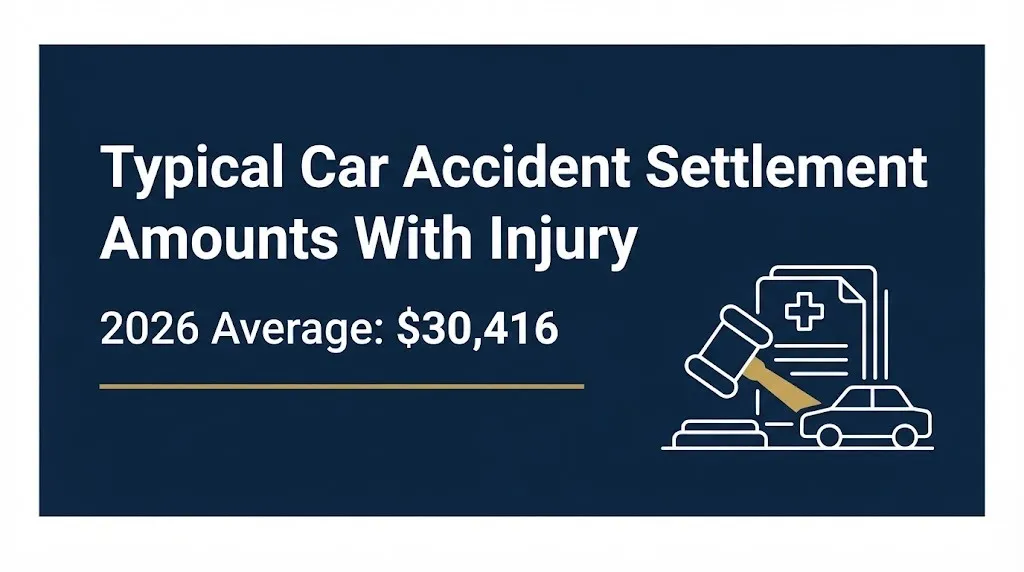
The median settlement of $27,271 is often more useful for understanding what a typical injured person actually receives . When researchers analyzed over 4,000 car accident settlements, they found the middle 50% of cases fell between $9,327 and $133,125 .
That wide range exists because injury severity drives value more than any other factor. A minor soft tissue strain resolves differently than a herniated disc requiring surgery, even if both start with the same rear-end collision.
One more number matters: the Insurance Research Council found that claimants with attorney representation receive settlements roughly 3.4 times higher on average, even after legal fees are deducted . That doesn’t mean you must hire a lawyer for every claim. It does mean that serious injuries often benefit from professional negotiation.
How Much Do Car Accident Settlements Pay by Injury Type?
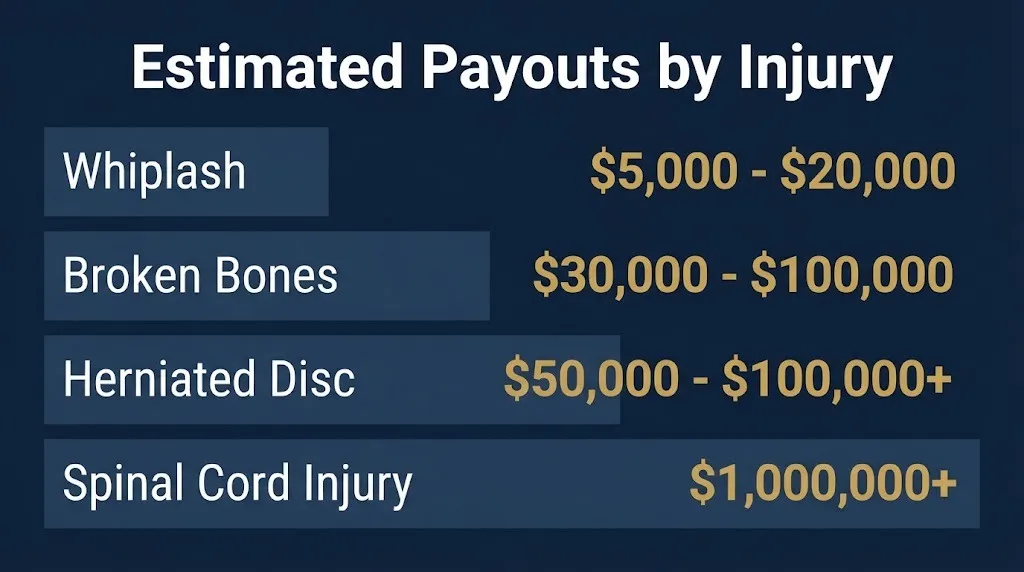
Car accident settlement amounts vary dramatically by injury type, ranging from a few thousand dollars for minor soft tissue injuries to seven figures for catastrophic harm. The table below shows typical settlement ranges based on 2026 data compiled from multiple sources.
| Injury Type | Typical Settlement Range | Severity Tier |
|---|---|---|
| Whiplash / soft tissue | $5,000 to $20,000 | Minor |
| Mild concussion | $20,000 to $30,000 | Moderate |
| Broken bones | $30,000 to $100,000 | Moderate to Serious |
| Herniated disc | $50,000 to $100,000+ | Serious |
| Neck and back injury | $30,000 to $100,000 | Serious |
| Spinal cord injury | $1,000,000+ | Catastrophic |
| Wrongful death | $1,000,000+ | Catastrophic |
These ranges come from compiled settlement data and should be treated as educational benchmarks, not predictions . Your case value depends on your specific medical records, lost wages, liability evidence, and the insurance coverage available.
Multiple injuries typically increase settlement value by 30% to 50% compared to a single injury, because the combined medical treatment and long-term impact are greater . If you suffered whiplash plus a herniated disc, for example, your claim sits higher than either injury alone would support.
Why Is the Average Car Accident Settlement Number Misleading?
The “average” car accident settlement is misleading because a few massive payouts distort the mean upward, making it look like typical cases are worth more than they actually are. A single $5 million traumatic brain injury verdict can pull the national average up for everyone, even though most claimants never see anything close to that number .
The median tells a more honest story. When researchers analyzed 4,188 car accident settlements, the median payout was $27,271 . That means half of all cases settled for less than that figure and half settled for more.
Here’s a plain-life comparison: think of it like home sale prices in a neighborhood. If one mansion sells for $10 million and twenty modest homes sell for $200,000 each, the “average” sale price sounds impressive, but it doesn’t describe what most sellers actually got. The median does.
Insurers know this, and they often quote low averages to justify low offers. Your job is to focus on the facts of your case, not a national statistic that includes thousands of cases with different injuries, different liability evidence, and different state laws.
What Factors Determine Negligence Settlement Amounts?
Negligence settlement amounts depend on six measurable variables: injury severity, documentation quality, economic losses, insurance limits, maximum medical improvement status, and jurisdiction rules . Each one can push your settlement up or down by thousands of dollars.
Injury severity and documentation are the biggest drivers. A soft tissue injury with consistent treatment records sits in a different part of the range than a herniated disc requiring surgery, even when the initial crash looks similar. Gaps in your medical care give insurers ammunition to argue the injury wasn’t serious.
Economic losses form the calculable foundation. Past medical bills, future care projections, and wage loss documentation create an objective baseline both sides reference. Higher documented losses support higher settlement positions.
Insurance limits act as a practical ceiling. If the at-fault driver carries only minimum coverage, your recovery may be capped well below what your injury is worth. Reviewing your own underinsured motorist coverage becomes essential in those situations.
Maximum medical improvement (MMI) is the point when your condition stabilizes. Settling before MMI means accepting a value before the full scope of your injury, including future care costs, is known. That’s one of the most common mistakes injured people make.
Jurisdiction rules vary significantly by state. Comparative fault frameworks, damage caps, and local jury tendencies all affect outcomes. The same injury can produce different settlement ranges depending entirely on where you file.
How Do Insurance Companies Calculate Settlement Offers?
Insurance companies calculate settlement offers by adding your economic damages (medical bills, lost wages, property damage) and then applying a multiplier of 1.5 to 5 to estimate pain and suffering . The more serious and life-altering your injury, the higher the multiplier.
Here’s how the multiplier method works in practice:
- Add up economic damages. Medical bills, lost wages, therapy costs, and property damage.
- Assign a severity multiplier. Minor soft tissue might get 1.5. Surgery and long recovery might get 3. Catastrophic injury might get 5.
- Multiply economic damages by the multiplier. That gives you non-economic damages.
- Add economic and non-economic damages together. That’s your total claim value.
For example, if you have $50,000 in medical bills and lost wages, and your injury warrants a multiplier of 3, your non-economic damages would be $150,000. Your total claim value would be $200,000 .
What insurers don’t tell you is that their first offer is typically 30% to 50% below what the claim is actually worth . That’s not an accident. It’s a strategy designed to close claims quickly and cheaply. Adjusters count on injured people accepting the first number because they don’t know what their case is really worth.
Reality Check: No one texts you settlement money first. If someone contacts you claiming they can get you a payout for your car accident, it’s a scam. Filing a claim with an insurance company is always free. You don’t need to pay a “claim helper” to get what you’re owed. Legitimate attorneys work on contingency, meaning they get paid only if you recover money.
What Reduces Your Car Accident Settlement Amount?
Several factors can reduce your car accident settlement, including your own percentage of fault, pre-existing conditions, gaps in medical treatment, and low insurance policy limits. Understanding these risks helps you protect your claim.
Your percentage of fault is the most direct reduction. In states with pure comparative negligence, your payout drops by your share of responsibility. If you were 20% at fault, your $100,000 settlement becomes $80,000 . In modified comparative negligence states, being found 50% or 51% at fault can bar recovery entirely.
Pre-existing conditions don’t automatically kill your claim, thanks to the eggshell plaintiff doctrine. That legal principle holds a defendant responsible even when a pre-existing condition made your injury worse. But you need clear medical records establishing your baseline before the accident and expert testimony distinguishing old problems from new harm.
Gaps in treatment are a gift to insurance adjusters. If you skip appointments, delay follow-up care, or stop therapy early, the insurer will argue your injury wasn’t as serious as you claim. Consistent documentation matters as much as the injury itself.
Policy limits create a hard ceiling on recovery from the at-fault driver’s insurance. If their policy caps at $25,000 and your damages exceed that, you may need to pursue underinsured motorist coverage through your own policy or consider a civil suit against the driver personally.
How Long Does a Car Accident Settlement Take in 2026?
Most car accident settlements resolve within 4 to 8 months for straightforward cases with clear liability and no surgery, though complex cases can take years . The timeline depends on how long your medical treatment lasts and whether liability is disputed.
Here’s what typically happens:
- Immediate aftermath. You receive medical care and document the scene. Police report is filed.
- Treatment phase. You attend appointments, follow doctor recommendations, and reach maximum medical improvement (MMI).
- Demand package. Your attorney or you compile medical records, bills, and wage loss documentation.
- Negotiation. The insurer makes an offer. You counter. This can take weeks or months.
- Settlement or lawsuit. If negotiations fail, you may file a lawsuit, which adds months to the timeline.
Simple soft tissue claims with clear liability often settle in two to six months once treatment concludes . Cases involving disputed fault, surgery, or ongoing treatment can take considerably longer. If a lawsuit becomes necessary, expect the process to stretch well beyond a year.
One key rule: don’t settle before you reach MMI. Accepting an offer while you’re still treating means you’re guessing at your future medical needs. Once you sign a release, you can’t go back for more money, even if complications arise later.
Key Takeaway: The average car accident injury settlement is around $30,416, but the median of $27,271 is a more realistic benchmark, and your actual payout depends on injury severity, documentation, and insurance limits.
Key Takeaway: Settlement amounts vary dramatically by injury type, from $5,000 to $20,000 for whiplash to $1 million or more for spinal cord injuries, with multiple injuries typically increasing value by 30% to 50%.
Key Takeaway: Insurance companies calculate offers using a multiplier of 1.5 to 5 on your economic damages, but their first offer is usually 30% to 50% below fair value.
Are Car Accident Settlements Taxable in 2026?
Car accident settlements are generally not taxable if the money compensates you for physical injuries, medical bills, or property damage. The IRS treats that money as restoring you to whole, not creating income .
But some portions can be taxed:
- Lost wages: If your settlement specifically includes compensation for income you lost while out of work, the IRS typically treats that portion as taxable income, just like a paycheck.
- Punitive damages: These are designed to punish the defendant for extreme negligence, not compensate you. Punitive damages are almost always taxable.
- Interest: If interest accumulates on your settlement between agreement and payment, that interest is usually taxable.
The practical takeaway: keep your settlement documentation clear about what each portion covers. If you receive a lump sum without allocation, talk to a tax professional before filing your return. Getting the tax treatment wrong can cost you more than the settlement was worth.
What Is the Statute of Limitations for Car Accident Claims?
The statute of limitations for car accident claims is typically two years from the date of the accident, though some states allow less time and others allow more. Miss this deadline and you lose your right to recover, no matter how strong your case is.
State-specific examples:
- Pennsylvania: Two years under 42 Pa. C.S. § 5524 .
- California: Two years for personal injury claims.
- Florida: Two years for most injury claims.
- Ontario, Canada: Different framework with specific notice requirements.
Exceptions exist for minors, government defendants, and cases involving delayed discovery of injuries. If the at-fault driver was a government employee, you may have as little as six months to file a notice of claim.
Don’t wait until the deadline approaches. Evidence disappears, witnesses forget details, and insurance companies become harder to negotiate with over time. The sooner you document your claim, the stronger your position.
What Happens Next in Your Car Accident Claim?
Here’s the expected timeline for a typical injury claim, from accident to resolution:
- Immediately: Seek medical attention. Document the scene with photos, witness statements, and the police report.
- Within days: Notify the at-fault driver’s insurance company. Report the claim, but don’t give a recorded statement without understanding your rights.
- Weeks to months: Continue treatment until you reach maximum medical improvement. Gather all medical records, bills, and wage loss documentation.
- After MMI: Submit a demand package to the insurer with your documented damages and a settlement request.
- Negotiation phase: Expect a low first offer. Counter with evidence. This can take weeks.
- Resolution or lawsuit: If negotiations stall, consult an attorney about filing suit. Most cases still settle before trial.
Frequently Asked Questions
How much is the average car accident settlement with injury in 2026?
The average is approximately $30,416, with a median of $27,271 across thousands of cases.
What is the typical settlement for whiplash?
Whiplash settlements typically range from $5,000 to $20,000 for uncomplicated cases, with median payouts around $10,000.
How much can I get for a broken bone from a car accident?
Broken bone settlements typically range from $30,000 to $100,000, depending on severity, surgery, and recovery time.
Do I need a lawyer to get a fair car accident settlement?
Not always, but data shows attorney-represented claimants receive roughly 3.4 times higher settlements on average, even after fees.
How long do I have to file a car accident claim?
Most states have a two-year statute of limitations, though some allow less time for government claims or special circumstances.
Will my settlement be reduced if I was partly at fault?
Yes. In comparative negligence states, your payout is reduced by your percentage of fault. In some states, being 50% or 51% at fault bars recovery entirely.
Can I settle my claim before I finish treatment?
You can, but you shouldn’t. Settling before maximum medical improvement risks undervaluing future care needs. Once you sign, you can’t ask for more money.
What evidence do I need to maximize my settlement?
Police report, photographs, witness statements, medical records linking injuries to the crash, wage loss documentation, and consistent treatment records.
Closing
Your car accident settlement won’t match a national average because your case isn’t average. The data gives you a range. Your documentation determines where you land.
Gather your medical records, lost wage proof, and the police report. Then calculate your economic damages and apply a realistic multiplier. If the insurer’s offer comes in low, you now know why.