Lyft Accident Lawsuit: 2026 Settlement Updates, Claim Deadlines, and Compensation Options
Quick Answer
- Lyft accident lawsuits in 2026 are real, active legal matters, not a single settled class action with a claim form.
- Compensation varies by case type, with individual injury settlements ranging from $15,000 to over $1 million depending on severity.
- No universal claim deadline exists because each lawsuit proceeds separately through the courts.
Lyft accident lawsuits in 2026 are not one case. They are dozens of individual personal injury claims, several proposed class actions, and at least one multidistrict litigation proceeding.
If you were injured in a Lyft accident, you may have a claim against Lyft’s insurance policy, the at-fault driver, or both. The process is not a simple settlement claim form. It is a legal claim with evidence requirements, deadlines set by state law, and insurance adjusters on the other side.
This article explains the active Lyft accident litigation landscape in 2026, what compensation looks like, how Lyft’s insurance coverage actually works, and what steps to take if you have a claim. The most important verified detail: Lyft carries $1 million in liability coverage per accident, but getting any of that money depends on proving who was at fault and when the accident occurred in the ride timeline.
The Facts
| Category | Details |
|---|---|
| Active Litigation | Multiple individual cases, proposed class actions, one MDL |
| Insurance Coverage | Up to $1 million per accident, depending on ride phase |
| Statute of Limitations | Typically 1 to 3 years, varies by state |
| Claim Deadline | No single deadline; set by state law per case |
| Settlement Range | $15,000 to over $1 million for serious injury |
| Administrator | None; claims go through Lyft’s insurer or litigation |
| Proof Needed | Police report, medical records, ride receipt, photos |
Is There a Lyft Accident Class Action Settlement in 2026?
There is no single Lyft accident class action settlement in 2026. What exists is a patchwork of individual lawsuits and a few proposed class actions on narrow issues.
The proposed class actions do not seek compensation for accident injuries. They target Lyft’s practices around driver classification, insurance disclosures, and fee structures. These cases are still in early litigation and have no settlement funds, no claim forms, and no deadlines.
The multidistrict litigation involving Lyft accidents is the closest thing to a consolidated proceeding. It centralizes pretrial discovery for passenger injury claims that share common factual questions about Lyft’s safety practices. But the MDL is not a settlement. Each plaintiff’s case still gets individually resolved.
If you heard about a Lyft accident settlement and received a notice, verify the case name and court on the notice. It may relate to a different Lyft matter, like a data privacy settlement or a driver misclassification settlement. Those are separate from accident injury claims.
Key Takeaway: No universal Lyft accident settlement exists in 2026. Accident injury claims are individual legal matters, not mass claim forms.
How Much Is a Lyft Accident Claim Worth?
A Lyft accident claim’s value depends on injury severity, medical costs, lost income, and who was at fault. No flat payout applies.
Minor injury cases with soft tissue damage and quick recovery typically settle between $15,000 and $50,000. Moderate injury cases involving fractures, surgery, or lengthy physical therapy range from $50,000 to $250,000. Severe cases with permanent disability, brain injury, or wrongful death can exceed $1 million.
The insurance policy limit caps what Lyft’s insurer will pay. Lyft’s liability coverage is $1 million per accident when the driver is at fault and the ride is active. That does not mean every claim gets $1 million. It means the ceiling is $1 million, and most claims settle far below it.
| Injury Level | Typical Settlement Range | Factors |
|---|---|---|
| Minor | $15,000 to $50,000 | Soft tissue, quick recovery |
| Moderate | $50,000 to $250,000 | Fractures, surgery, therapy |
| Severe | $250,000 to $1 million+ | Permanent injury, disability |
| Wrongful death | $500,000 to $1 million+ | State limits apply |
These ranges come from reported settlements and verdicts in rideshare accident cases, not from any official Lyft schedule. Every case is different.
How Does Lyft’s Insurance Coverage Work for Accidents?
Lyft’s insurance coverage depends on what phase the ride was in when the accident happened. The phase determines which policy applies and how much coverage exists.
When the Lyft driver is offline, Lyft provides no coverage. The driver’s personal auto insurance is the only policy in effect.
When the driver is logged into the app but has not accepted a ride, Lyft provides contingent liability coverage. This is typically $50,000 per person, $100,000 per accident for bodily injury, and $25,000 for property damage.
When the driver has accepted a ride or is transporting a passenger, Lyft’s $1 million liability policy is in effect. This covers passenger injuries, third-party injuries, and property damage caused by the Lyft driver.
The phase matters more than most people realize. If you were hit by a Lyft driver who was logged in but had not accepted a ride, the lower coverage limits apply. If the driver was on the way to pick you up, the $1 million policy applies.
This phase distinction is a frequent source of dispute. Lyft’s insurer may argue the driver was in a lower coverage phase to reduce the payout.
What Is the Lyft Accident Multidistrict Litigation?
The Lyft accident multidistrict litigation is a consolidated federal proceeding that centralizes pretrial motions and discovery for passenger injury claims against Lyft.
The MDL does not create a settlement fund. It does not have a claim form. It does not have a deadline. Each plaintiff in the MDL retains their individual case and must prove their own damages.
The MDL’s purpose is efficiency. Instead of dozens of federal judges ruling on the same discovery disputes, one judge handles them. The cases then return to their original courts for trial or settlement.
The MDL remains active in 2026, with no global resolution announced. Individual cases within the MDL are settling quietly, as most personal injury cases do, but no aggregate numbers have been confirmed.
If you are a Lyft accident victim, the MDL does not change your legal options. You still file your own claim or lawsuit, and you still negotiate your own settlement.
How Long Do You Have to File a Lyft Accident Lawsuit?
The deadline to file a Lyft accident lawsuit is set by your state’s statute of limitations, not by Lyft or any court.
Most states allow one to three years from the date of the accident to file a personal injury lawsuit. California gives two years. New York gives three years. Texas gives two years. Florida gives two years.
The clock starts on the accident date in most cases. If you miss the deadline, your case is barred forever, no matter how strong the evidence.
Some states have exceptions. If the injured person was a minor, the clock may not start until they turn 18. If the injury was not discovered immediately, some states allow a discovery rule extension.
Do not rely on general articles for your specific deadline. Check your state’s statute of limitations, or better, confirm it with a personal injury attorney. Missing the deadline is the single most common way accident victims lose valid claims.
Key Takeaway: Statute of limitations deadlines are strict and vary by state. You have one to three years from the accident date in most cases. Missing the deadline forfeits the claim.
What Should You Do After a Lyft Accident?
The steps you take immediately after a Lyft accident determine whether your claim survives. Evidence disappears fast.
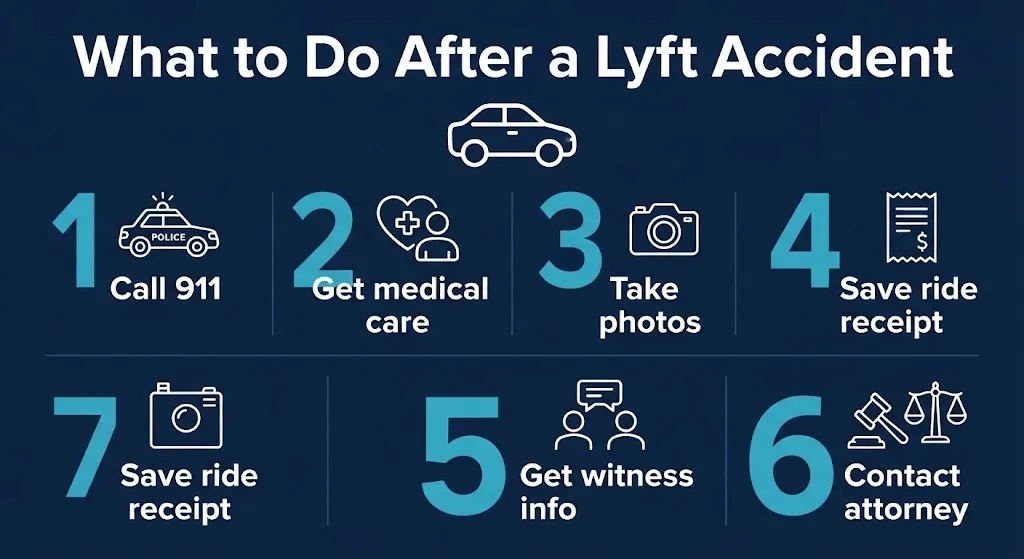
Here is the priority list:
- Call 911 and get a police report started.
- Seek medical attention even if you feel fine.
- Take photos of the accident scene, vehicles, and visible injuries.
- Screenshot your Lyft ride receipt showing the trip was active.
- Get the Lyft driver’s name, plate number, and insurance information.
- Collect contact information from witnesses.
- Do not give a recorded statement to any insurer before you understand your claim.
- Contact a personal injury attorney with rideshare experience.
The Lyft ride receipt is critical. It proves the ride was active and identifies the driver. Without it, Lyft may deny that the $1 million policy applies.
Medical records are equally critical. Gaps in treatment are the most common reason valid claims get lowballed.
What Is Lyft’s Liability for Passenger Injuries?
Lyft is not automatically liable for every passenger injury. Liability depends on who caused the accident and what the Lyft driver did wrong.
If the Lyft driver caused the accident through negligence, Lyft’s $1 million policy covers passenger injuries. Negligence includes speeding, distracted driving, running a red light, or driving while impaired.
If another driver caused the accident, the other driver’s insurance is primary. You file a claim against that driver’s policy. Lyft’s coverage may apply if the other driver is uninsured or underinsured.
If the Lyft driver was not negligent and no other driver was at fault, Lyft may deny liability entirely. Not every accident produces a Lyft payout.
The legal question in most Lyft passenger injury cases is simple: who was at fault, and how much insurance does that party carry. Everything else follows from those two facts.
Are Lyft Drivers Employees or Independent Contractors for Accident Claims?
Lyft classifies its drivers as independent contractors. That classification limits Lyft’s direct liability for driver negligence.
If a driver is an employee, the employer is generally responsible for the employee’s negligent acts during work. If a driver is an independent contractor, the company that hired the contractor is generally not liable.
Lyft argues that its drivers are independent contractors, so Lyft is not legally responsible for their driving. The $1 million insurance policy is the primary source of recovery, not Lyft’s own assets.
This classification is the subject of ongoing litigation. Several states have passed laws or issued rulings that treat rideshare drivers as employees for certain purposes. But as of February 2026, no final national resolution exists.
For accident victims, the practical effect is this: your claim goes through insurance, not through a direct lawsuit against Lyft’s corporate treasury. The insurance policy is the money.
Can You Sue Lyft Directly for an Accident?
You can sue Lyft directly, but the lawsuit usually targets Lyft’s insurance obligations, not Lyft as the negligent driver.
Lyft is not typically the entity that caused the crash. The driver caused the crash. You sue the driver for negligence, and Lyft’s insurer defends and pays the claim under the policy.
In some cases, victims sue Lyft for negligent hiring, negligent supervision, or failure to enforce safety standards. These claims allege Lyft knew or should have known that a driver was dangerous and failed to act.
Such claims are harder to win. They require evidence that Lyft had specific knowledge of a driver’s prior dangerous behavior and ignored it. General allegations that Lyft should screen drivers better rarely survive summary judgment.
Most successful Lyft accident claims are straightforward negligence claims against the at-fault driver, paid by the applicable insurance policy.
Reality Check: No one from Lyft or an insurer will call you immediately after an accident offering a fair settlement. Early offers are almost always low. Filing an insurance claim is free, and you do not need to accept the first number.
What Types of Lyft Accident Lawsuits Are Active in 2026?
The active Lyft accident litigation in 2026 falls into four main categories.
First, passenger injury claims. These are individual personal injury lawsuits filed by riders injured in Lyft vehicles. Most settle before trial.
Second, third-party injury claims. These are filed by pedestrians, cyclists, or other drivers hit by Lyft drivers. The same insurance coverage applies.
Third, driver injury claims. Lyft drivers injured while working have limited options because they are independent contractors, not employees. Workers’ compensation generally does not apply. Drivers may have claims against at-fault third parties or Lyft’s uninsured motorist coverage.
Fourth, proposed class actions on safety practices. These seek changes to Lyft’s policies rather than individual injury compensation. They remain unresolved.
No single docket number or settlement fund covers all Lyft accident claims. The litigation landscape is fragmented and will stay that way.
How Do Lyft Accident Settlements Compare to Other Rideshare Cases?
Lyft accident settlements generally track Uber accident settlements because the two companies share similar insurance structures and legal defenses.
Reported settlements in rideshare accident cases range from $20,000 for minor injuries to over $2 million for catastrophic injuries. The median settlement is not published, but personal injury attorneys report that most cases settle in the $30,000 to $100,000 range.
The settlement process works like any other personal injury claim. You gather evidence, submit a demand package, negotiate with the insurer, and either settle or file suit. Most cases settle after a lawsuit is filed but before trial.
Think of it like a warranty claim on a major purchase. The first response is often a denial or a low offer. Persistence and documentation change the number. The process takes months, not days.
What Happens Next in Lyft Accident Litigation?
The Lyft accident litigation landscape will evolve through 2026, but no single resolution is on the horizon.
Ongoing throughout 2026: Individual passenger and third-party injury claims continue to be filed, negotiated, and settled. The MDL continues pretrial proceedings.
Mid 2026: Expected rulings in several state courts on Lyft’s liability for driver negligence where drivers were logged in but not on an active ride.
Late 2026: Potential rulings on the proposed safety practices class actions, which could move forward or be dismissed.
2027 and beyond: Any broader regulatory or statutory changes to rideshare liability would take effect, but nothing is pending at the federal level in early 2026.
If you have a Lyft accident claim, the timeline that matters is your state’s statute of limitations. Do not wait for a global settlement. File your claim now.
Frequently Asked Questions
Is there a Lyft accident class action settlement in 2026?
No. There is no single class action settlement for Lyft accident injuries in 2026. Individual claims proceed separately.
How much can I get from a Lyft accident claim?
Settlements range from $15,000 for minor injuries to over $1 million for severe or fatal injuries, depending on fault and coverage.
What is Lyft’s insurance coverage for accidents?
Lyft carries up to $1 million in liability coverage when the driver is on an active ride. Lower limits apply when the driver is logged in but waiting.
How long do I have to sue Lyft after an accident?
The deadline is your state’s statute of limitations, typically one to three years from the accident date.
Do I need a lawyer for a Lyft accident claim?
Not legally, but rideshare accident claims involve insurance phase disputes and coverage limits that favor represented claimants.
What should I do immediately after a Lyft accident?
Call 911, get medical care, take photos, screenshot your ride receipt, and collect witness contact information.
Can I sue Lyft directly for my injuries?
You can sue Lyft directly on limited theories like negligent hiring, but most claims proceed through the at-fault driver and Lyft’s insurance.
Why did Lyft deny my accident claim?
Lyft may deny a claim if the driver was offline, the accident was not the driver’s fault, or the policy phase did not cover the loss.
If you were injured in a Lyft accident, your next step is not waiting for a settlement notice. It is checking your state’s statute of limitations and gathering your evidence.
The Lyft ride receipt, the police report, and your medical records are the three documents that decide whether you get paid. Get them now. The clock is running.