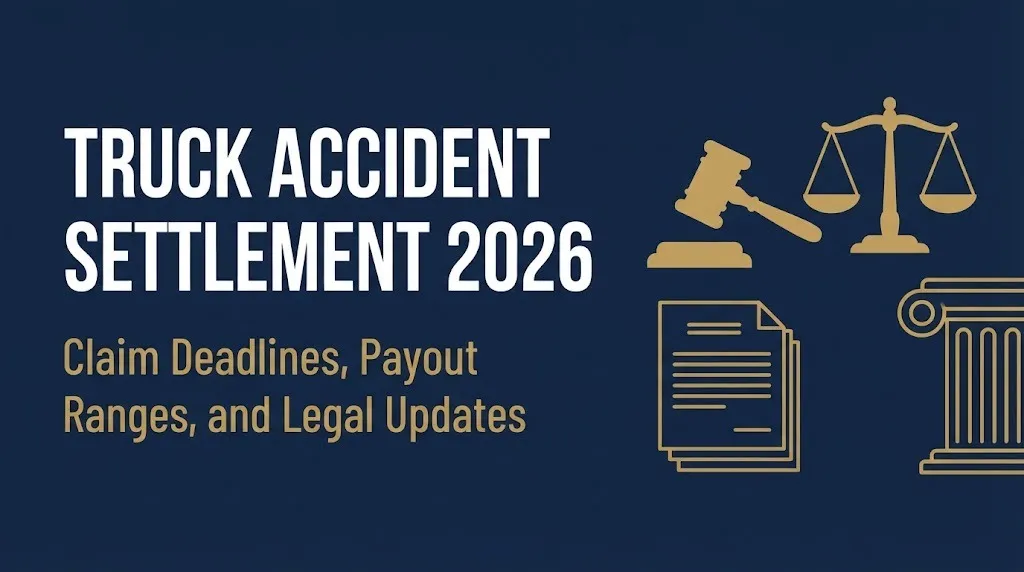
Truck Accident Settlement 2026: Claim Deadlines, Payouts, and Latest Legal Updates
Quick Answer
- Truck accident settlements are real but case-specific, not one national fund.
- Payouts vary widely; commercial policies often start at $750,000 but severe injury cases can reach seven figures.
- Deadlines depend on your state’s statute of limitations, typically two to three years from the crash date.
If you were hit by a commercial truck, you are likely searching for one thing: how much is my claim worth and how fast can it close. The answer is rarely one number. It depends on who was at fault, what insurance exists, how bad the injuries are, and where the crash happened.
Truck accident settlements are not like class action settlements with a single fund and a claim form. Each case moves on its own track. But certain patterns repeat across thousands of cases, and knowing those patterns gives you a real advantage before you sign anything.
This article breaks down verified settlement ranges, who actually pays, how long claims take, and the mistakes that shrink payouts. One surprising verified fact: many trucking companies carry policies far larger than the minimum federal requirement, and plaintiffs’ lawyers know exactly how to find them.
The Facts
| Case | Individual truck accident claims, not one class action |
| Status | Ongoing filings across all 50 states |
| Fund Size | No single fund; varies by carrier, insurer, and policy |
| Est. Per Person | $75,000 to over $1,000,000 depending on injury severity |
| Claim Deadline | State-specific; usually 2 to 3 years from crash date |
| Administrator | None; claims handled by insurers or courts |
| Proof Needed | Police report, medical records, wage loss, photos |
Is a Truck Accident Settlement Legit or a Scam?
A truck accident settlement is a legitimate legal resolution between a victim and the at-fault party, usually the trucking company or its insurer. It is not a government program or a mass payout fund.
Scams do exist in this space, and they target people who have already been in a crash. You may get a text or call from someone claiming you have a pending settlement or that you need to pay a fee to release funds. Real settlements never require upfront payment from the victim.
The most reliable way to verify a real settlement is to confirm the case exists in court records or through your own attorney. If someone contacts you out of nowhere about a truck accident settlement, ask for the case number and court name. Then check it yourself through the court’s public access system or your state’s case lookup portal.
Key Takeaway: A real truck accident settlement always traces back to a filed claim, a court case, or an insurance policy, never an unsolicited call or text.
How Much Is the Average Truck Accident Settlement?
Average truck accident settlements are difficult to pin down because most cases settle confidentially. But available data and legal industry reports point to a general range between $75,000 and $150,000 for moderate injury cases.
Severe injury cases, including traumatic brain injuries, spinal cord damage, amputations, or fatalities, routinely exceed $1,000,000. The presence of a commercial policy changes the math significantly compared to a standard car accident.
Federal law requires interstate trucking companies to carry at least $750,000 in liability insurance. Many major carriers carry $1 million to $5 million policies. That higher coverage ceiling directly raises settlement values.
| Injury Type | Typical Settlement Range |
|---|---|
| Minor soft tissue | $10,000 to $50,000 |
| Broken bones, surgery | $75,000 to $250,000 |
| Permanent injury, disability | $500,000 to $2,000,000 |
| Wrongful death | $1,000,000 to $5,000,000+ |
What Is the Biggest Factor That Increases a Truck Settlement?
The single biggest factor is the severity of the injury and its long-term impact on your life. Juries and insurers value cases based on medical costs, future care needs, lost earning capacity, and pain and suffering.
The second biggest factor is who the defendant is. A national carrier with a large insurance policy and a history of safety violations will settle for more than an independent owner-operator with minimum coverage.
Evidence quality also drives value. Dashcam footage, electronic logging device data, driver logs, and accident reconstruction reports can prove fault beyond a reasonable dispute. That proof often forces an insurer to pay policy limits rather than risk a trial verdict.
Key Takeaway: The higher your provable damages and the stronger your liability evidence, the higher the settlement ceiling becomes.
Can I Get a Settlement Without Going to Court?
Yes, most truck accident cases settle before trial. Industry estimates put the settlement rate above 90 percent for personal injury claims, including truck accidents.
Settlement happens through negotiation between your attorney and the insurance company, often through mediation or a demand letter. A formal lawsuit may be filed to protect your claim, but that filing does not mean you will see a courtroom.
The pressure to settle increases when your attorney can show clear liability and large damages. Insurers want to avoid jury verdicts, which can run much higher than negotiated amounts. That dynamic works in your favor if your case is well documented.
How Long Does a Truck Accident Settlement Take?
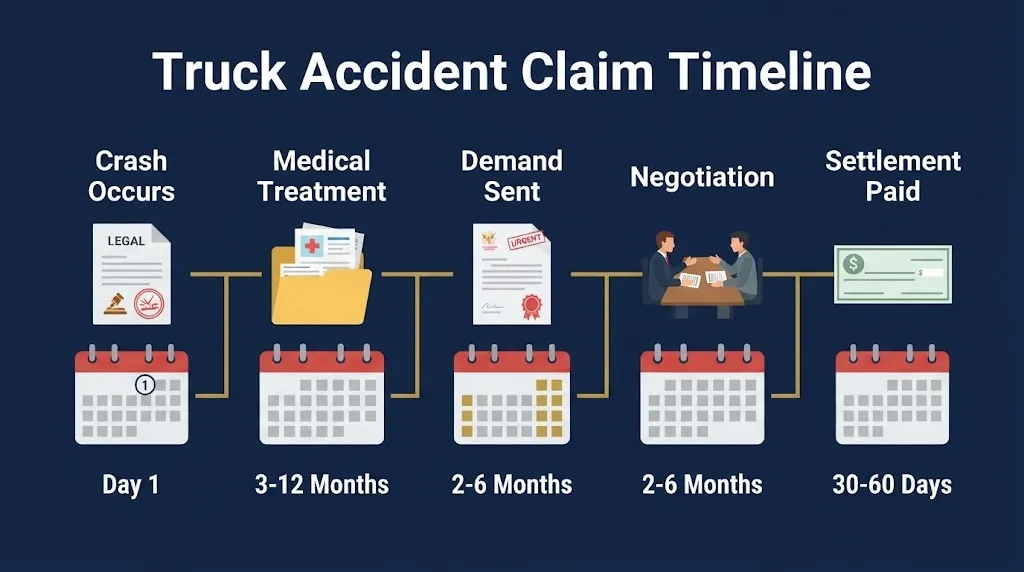
A straightforward truck accident settlement can close in six to twelve months from the date of the crash. Cases with disputed liability, severe injuries, or multiple defendants can take two to three years or longer.
The timeline breaks into stages: medical treatment and recovery first, then demand preparation, negotiation, and finally payment. Rushing to settle before you reach maximum medical improvement is a common and costly mistake.
Once a settlement is signed, payment typically arrives within 30 to 60 days. That delay covers the release signing, insurer processing, and any lien resolutions for medical providers or health insurers.
| Stage | Typical Duration |
|---|---|
| Medical treatment and records | 3 to 12 months |
| Demand and negotiation | 2 to 6 months |
| Filing and discovery (if needed) | 6 to 18 months |
| Payment after settlement | 30 to 60 days |
What Is the Deadline to File a Truck Accident Claim?
The deadline, called the statute of limitations, varies by state. Most states set the limit at two or three years from the date of the crash.
If the crash involved a government vehicle, such as a city truck or county maintenance vehicle, the deadline is often much shorter. Some states require a formal notice of claim within 60 to 180 days, far faster than the standard personal injury window.
If a wrongful death occurred, some states start the clock on the date of death, which may differ from the crash date. Check your state’s specific rule or ask an attorney immediately. Waiting too long is the single most common reason valid claims die.
Key Takeaway: Your state deadline is non-negotiable, and government-involved crashes have drastically shorter windows, sometimes just a few months.
What Damages Can I Claim in a Truck Accident Settlement?
You can claim economic damages, which are your out-of-pocket losses, and non-economic damages, which cover pain, suffering, and loss of enjoyment of life.
Economic damages include medical bills, future medical care, lost wages, lost earning capacity, property damage, and out-of-pocket expenses like transportation to appointments or home modifications.
Non-economic damages are harder to quantify but often make up the largest part of a serious injury settlement. They cover physical pain, emotional distress, disfigurement, loss of consortium, and reduced quality of life.
In rare cases involving egregious conduct, such as a trucking company knowingly putting a drunk or unqualified driver on the road, punitive damages may apply. Those damages punish the company and can dramatically increase a verdict.
How Does the FMCSA Rule Affect My Settlement?
The Federal Motor Carrier Safety Administration, or FMCSA, sets the rules that govern commercial trucking. Those rules create a standard that helps prove negligence.
Common violations include hours-of-service breaches, improper driver qualification, missing drug and alcohol testing, and failure to maintain vehicles. Each violation is evidence that the company broke a federal safety rule, which strengthens your claim.
Your attorney will request the driver’s logs, inspection reports, maintenance records, and employment file. If any of those show violations, the insurer’s negotiation position weakens quickly.
Think of the FMCSA rules like a warranty on a product. If the company violated the terms of its operating authority, the protection it normally enjoys in court starts to crack.
What Is the Reality Check on Truck Settlement Myths?
Reality Check: No one will call, text, or email you with an unsolicited truck accident settlement offer. Filing a claim is always free if you hire a lawyer on contingency, meaning the lawyer only gets paid if you win. Third-party “claim helpers” who charge upfront fees are unnecessary and often outright scams.
How Do Truck Accident Settlements Differ from Car Accident Settlements?
Truck accident settlements are different in three key ways: insurance limits, the number of potential defendants, and the regulatory framework.
A passenger car crash often involves a policy with $25,000 to $100,000 in coverage. A commercial truck crash usually starts at $750,000 in coverage and often goes to $1 million or more. That changes how aggressively insurers defend the case and how much is ultimately paid.
Truck crashes can also involve multiple defendants: the driver, the trucking company, the cargo loader, the vehicle manufacturer, or a parts supplier. Each defendant may carry its own insurance, which can multiply the total recovery available.
Federal regulations apply to trucks but not to private cars. Those regulations create additional avenues to prove fault, including violations of hours-of-service, weight limits, and drug testing rules.
Key Takeaway: Truck cases carry higher insurance limits, more possible defendants, and federal safety rules, all of which raise both complexity and potential value.
What Should I Do Immediately After a Truck Accident?
Your actions in the first hours and days directly affect your settlement value. Here is a numbered checklist to follow.
- Call 911 and get a police report started.
- Get medical attention even if you feel fine.
- Photograph the scene, vehicles, road conditions, and your injuries.
- Get the truck’s DOT number, license plate, and company name.
- Collect contact information from witnesses.
- Do not post about the crash on social media.
- Contact a truck accident attorney before speaking to any insurance adjuster.
How Do I File a Truck Accident Claim?
Filing a claim means notifying the at-fault party’s insurer, usually through a demand letter prepared by your attorney. If the insurer does not offer a fair amount, your attorney files a lawsuit in court.
The process begins with an investigation. Your attorney gathers the police report, medical records, driver logs, and maintenance history. Then they send a demand package that lays out liability and damages.
Negotiation follows. The insurer responds, often with a low initial offer, and your attorney counters with evidence. Most cases settle during this phase.
If settlement fails, the case moves to litigation. Discovery, depositions, and possibly trial follow. The litigation phase is slower and more expensive, but it can pressure the insurer to settle for more.
What Is the Current Status of Truck Accident Lawsuits in 2026?
Truck accident litigation remains active in 2026, with no nationwide pause or change in filing patterns. Federal courts continue to see cases against major carriers, and state courts handle the bulk of individual injury claims.
One development worth noting: electronic logging device data has become standard evidence in most cases. That data shows driver hours, speed, and sometimes hard braking events, which can prove fatigue or distraction.
Nuclear verdicts, jury awards over $10 million, continue to influence insurer behavior. Carriers and their insurers now settle more cases before trial to avoid that risk, which benefits victims with strong evidence.
What Happens Next After I Settle?
Once you accept an offer, you sign a release. That release ends your right to seek more money from the same defendant for the same crash.
The insurer then processes payment. Your attorney resolves any medical liens, deducts the agreed fee, and issues you a check. The entire post-settlement process usually takes 30 to 60 days.
After payment, the case is closed permanently. That is why you should never settle before understanding your full medical picture and future needs.
Key Takeaway: The release is final. Settle only after you know your full damages and have a realistic payout range from your attorney.
How Do Contingency Fees Work in Truck Accident Cases?
Truck accident attorneys almost always work on contingency. That means you pay nothing upfront, and the attorney receives a percentage of your recovery.
The standard percentage is 33 percent if the case settles before a lawsuit is filed, and often 40 percent if litigation is required. Some firms use a sliding scale based on case stage.
Costs, such as filing fees, expert witnesses, and depositions, are separate from the fee. Those costs are usually advanced by the firm and deducted from your recovery along with the fee.
Always read the fee agreement before signing. A clear agreement should explain the percentage, how costs are handled, and what happens if the case is lost.
Can I Still File a Claim If the Truck Driver Was Killed in the Crash?
Yes, you can file a claim against the trucking company, the driver’s estate, and any other at-fault parties even if the driver died.
The driver’s death does not erase the company’s responsibility if the driver was acting within the scope of employment at the time. The company’s insurance policy still applies.
If the driver was an independent contractor, the analysis is more complicated. But the truck owner, the broker, or the shipper may still bear liability depending on the facts.
What If I Was Partially at Fault for the Truck Accident?
Your recovery depends on your state’s fault rule. Most states use comparative negligence, which reduces your settlement by your percentage of fault.
In a pure comparative negligence state, you can recover even if you are 99 percent at fault, though your recovery shrinks accordingly. In a modified comparative negligence state, you recover nothing if your fault exceeds 50 or 51 percent.
A small minority of states use contributory negligence, where any fault on your part bars recovery entirely. Those states include Alabama, Maryland, North Carolina, Virginia, and the District of Columbia.
Key Takeaway: Your share of fault directly reduces your payout, and in a few states any fault kills the claim entirely, so fault analysis happens early and matters enormously.
What Records Should I Keep for a Truck Accident Claim?
Keep every record related to the crash and your recovery. The more complete your file, the stronger your claim.
Maintain a folder with the police report, medical bills, pharmacy receipts, repair estimates, and any correspondence from insurers. Track missed work days and lost income with pay stubs or employer letters.
A daily pain journal helps document non-economic damages. Note your pain level, limitations, and emotional state. That contemporaneous record carries weight in negotiations.
Frequently Asked Questions
Is there a national truck accident settlement in 2026?
No, truck accident claims are handled individually, not through a national class settlement fund.
How much can I get from a truck accident settlement?
Payouts range from under $50,000 for minor injuries to over $1 million for severe or fatal cases.
How long do I have to file a truck accident claim?
Most states allow two to three years from the crash date, but government-involved crashes have much shorter deadlines.
Do I need a lawyer for a truck accident claim?
You can file without one, but truck cases involve federal rules and aggressive insurance defense, making experienced counsel nearly essential.
How long does it take to get paid after settling?
Payment usually arrives within 30 to 60 days after you sign the release and the insurer processes the paperwork.
Can I reopen a truck accident settlement later?
No, once you sign the release, the case is closed permanently, even if your injuries worsen.
What if the trucking company says I caused the crash?
Fault is decided by evidence, not the company’s claim. Do not argue with the insurer; let your attorney respond with proof.
Does hiring a lawyer mean I have to go to court?
No, most cases settle without trial, but filing a lawsuit may be necessary to get a fair offer.
Your next move is to calendar your state’s filing deadline and gather every record from the crash. If you have not spoken with an attorney, most offer free consultations and work on contingency, so there is no upfront cost to learn your options.
The single most important fact: every day you wait makes evidence harder to gather and brings you closer to the legal deadline. Check the official court rules in your state and act before that clock runs out.