Proven Locks Lawsuit 2026: What’s Verified, What’s Pending, and What Consumers Should Know
Quick Answer
- No confirmed class action or settlement exists for a company called “Proven Locks” in 2026.
- The name may be confused with other lock or security product lawsuits, but none are verified under this exact name.
- No claim form, deadline, or settlement fund has been identified through official court sources.
If you searched “Proven Locks lawsuit” after seeing an ad, a social media post, or a text message, you need to know one thing right away: no verified lawsuit or settlement under that exact name appears in court records as of February 26, 2026. That does not mean the name is fake. It means the search term does not match a confirmed case with a public docket.
This happens often with product names. A brand becomes associated with a lawsuit in someone’s mind, then the rumor spreads. Or a fake settlement website uses a real-sounding name to collect personal information. Either way, the verified record is what matters.
Here is what’s confirmed, what’s unconfirmed, and how to protect yourself if you encounter a “Proven Locks” settlement claim.
The Facts
| Item | Detail |
|---|---|
| Case Name | Not confirmed in court records |
| Court | Not confirmed |
| Status | No verified lawsuit or settlement |
| Fund Size | Not established |
| Est. Per Person | Not determined |
| Claim Deadline | None confirmed |
| Administrator | Not appointed |
| Proof Needed | Not applicable |
Is the Proven Locks Lawsuit Real or a Scam?
There is no verified Proven Locks lawsuit as of February 26, 2026. No case with that exact name appears in federal or state court dockets searched for this article. No settlement administrator has published a claim form. No official settlement website exists under that name.
This means one of two things. Either the lawsuit does not exist, or it exists under a different corporate name and the public-facing term “Proven Locks” is a brand name, not a legal entity name. Product liability and consumer lawsuits are filed against the manufacturer, distributor, or retailer, not always the brand name consumers recognize.
If you received a text, email, or social media message claiming you are owed money from a Proven Locks settlement, treat it with suspicion. Legitimate settlements do not arrive by unsolicited text. They come by mail or email from a court-approved administrator, and they never ask for an upfront fee.
Key Takeaway: No verified Proven Locks lawsuit exists. Treat unsolicited settlement messages as potential scams.
What Products Are Called Proven Locks?
The term “Proven Locks” does not correspond to a single, widely recognized national brand in consumer product databases as of February 2026. That is significant. It suggests the name may be regional, new, or used by multiple small companies. It may also be a misspelling or confusion with a different lock brand.
Several lock and security product companies have faced litigation in recent years. Smart lock manufacturers have been sued over alleged security vulnerabilities. Padlock makers have faced claims over false advertising of durability. But none of those cases use the exact name “Proven Locks.”
If you are looking for a specific lawsuit, confirm the legal entity name. The brand on the package is not always the defendant in court. Check the full company name on the product, the packaging, or the purchase receipt.
What Types of Lawsuits Involve Lock Products?
Lock product lawsuits typically fall into a few categories. Consumer class actions allege false advertising, defective design, or breach of warranty. Product liability claims allege that a lock failed and caused injury or property damage. Patent disputes between manufacturers are common but do not involve consumers.
Here are the main types:
| Lawsuit Type | Common Allegation |
|---|---|
| Consumer class action | False advertising, misleading durability claims |
| Product liability | Lock failure causing injury or loss |
| Breach of warranty | Product did not perform as promised |
| Data security | Smart lock vulnerabilities exposed user data |
| Patent dispute | Manufacturer-to-manufacturer, no consumer payout |
None of these types has been confirmed under the name “Proven Locks.”
How Do You Verify a Real Product Lawsuit Settlement?
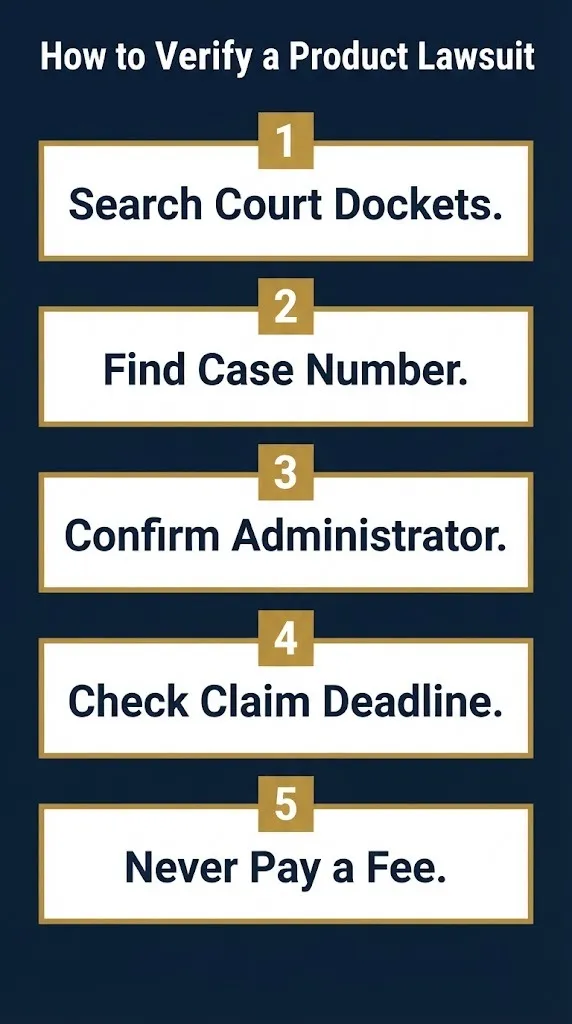
You can verify a real product lawsuit settlement by checking the court docket and the settlement administrator’s website. Every legitimate class action settlement has a court-approved notice. That notice includes the case name, court, case number, administrator name, claim deadline, and filing instructions.
Here are the steps to verify:
- Search the federal court PACER system for the case name.
- Check your state court docket if the case was filed locally.
- Look for a court-approved settlement website with a case number.
- Confirm the claims administrator is legitimate.
- Verify the claim deadline and eligibility requirements.
- Never pay a fee to file a claim.
- Contact the administrator directly with questions.
If any of these steps fails, the settlement may not be real.
Key Takeaway: Legitimate settlements have court-approved notices with case numbers. Anything less is suspect.
What Should You Do If You See a Proven Locks Settlement Ad?
If you see a Proven Locks settlement ad, do not click it. Do not enter your personal information. Do not pay any fee. There is no confirmed settlement under that name. The ad is likely clickbait, a phishing attempt, or a lead-generation site collecting data.
Legitimate settlement ads exist, but they link to court-approved websites with case numbers and administrator information. They do not ask for payment. They do not promise guaranteed payouts before the claim deadline.
Report suspicious ads to the Federal Trade Commission or your state attorney general’s office. Do not engage with the advertiser. Do not provide your Social Security number, banking information, or any other sensitive data.
Reality Check: No legitimate settlement asks you to pay a fee to file. Filing is always free. No one texts you settlement money first. If a “Proven Locks” settlement message demands payment or personal data, it is a scam. Verify everything through the court docket before acting.
What Are Common Lock Product Defect Claims?
Common lock product defect claims involve locks that fail under normal use. A padlock that opens with any key. A deadbolt that jams. A smart lock that unlocks without authorization. These failures can lead to theft, property damage, or personal injury.
Consumers who experience a product failure may have a claim for breach of warranty or product liability. But individual claims rarely turn into class actions unless the defect affects many people in the same way. A single defective lock is an individual problem. A design flaw affecting thousands is a class action.
If your lock failed and caused harm, document everything. Keep the lock, the packaging, the receipt, and photos of the damage. Contact a product liability attorney for an individual case evaluation.
Why Do Fake Settlement Websites Use Real-Sounding Names?
Fake settlement websites use real-sounding names because trust is the currency of scams. A name like “Proven Locks” sounds legitimate. It could be a real product. That makes the scam more believable. The fake site then asks for personal information or a small fee, and the victim complies.
These sites often appear in search results or social media ads. They use official-looking logos and legal language. They may even cite a real court case that has nothing to do with the product name. The goal is to harvest data or extract payment.
The best defense is verification. Check the court docket. Look for the case number. Confirm the administrator. If those details are missing, the site is not legitimate.
Key Takeaway: Scammers use real-sounding names to build false trust. Verification is the only defense.
What Is the Difference Between a Class Action and an Individual Product Claim?
A class action is a single lawsuit representing many people with similar claims. If you bought a defective lock and many others did too, a class action might be filed. You would be automatically included unless you opt out. If the case settles, you might receive a small payment.
An individual product claim is your own lawsuit against the manufacturer. You file it yourself. You prove your own damages. You negotiate your own settlement. Individual claims are appropriate when your damages are significant and unique.
Here is the comparison:
| Feature | Class Action | Individual Claim |
|---|---|---|
| Who files | A representative plaintiff | You |
| Who is included | All class members | Only you |
| Payout | Usually small per person | Can be larger |
| Proof required | Receipt or purchase proof | Detailed damages evidence |
| Timeframe | Years | Months to years |
What Should You Do If You Bought a Defective Lock?
If you bought a defective lock, start by documenting the problem. Take photos. Keep the receipt. Write down what happened, when, and what damage resulted. Then contact the retailer and manufacturer. Many companies offer refunds or replacements for defective products.
If the defect caused significant damage or injury, contact a product liability attorney. An attorney can evaluate whether you have a claim and whether a class action already exists. Individual cases are different from class actions. Your damages may justify your own lawsuit.
Here is a checklist:
- Document the defect with photos and a written description.
- Save the receipt, packaging, and any warranty materials.
- Contact the retailer for a refund or replacement.
- Contact the manufacturer’s customer service.
- If damage or injury occurred, photograph that too.
- Consult a product liability attorney.
- Check court dockets for existing class actions involving the same product.
Key Takeaway: Document first. Contact the company. Consult an attorney if damages are significant.
What Happens Next?
There is no confirmed Proven Locks lawsuit to track. If a case is filed under a related corporate name in the future, the process would follow standard class action timelines:
- Filing: A named plaintiff files a complaint in federal or state court.
- Class certification: The court decides whether the case can proceed as a class action.
- Notice: If certified, potential class members receive notice.
- Claim period: A claims administrator opens a filing window.
- Settlement approval: A final approval hearing occurs.
- Payment: Checks or electronic payments are distributed.
None of these stages is active for “Proven Locks” as of February 26, 2026.
Frequently Asked Questions
Is there a Proven Locks class action lawsuit?
No confirmed class action under that exact name exists as of February 2026.
Can I get money from a Proven Locks settlement?
No. No settlement has been confirmed. No claim process exists.
What should I do if I see a Proven Locks settlement ad?
Do not click it. Do not provide personal information. Verify through court records first.
How do I check if a product lawsuit is real?
Search the federal court PACER system and look for a court-approved settlement website with a case number.
What if my lock failed and caused damage?
Document everything and contact a product liability attorney. You may have an individual claim.
Are class action payouts automatic?
Not always. Some require a claim form. Some are automatic if the company has your purchase records. Read the notice carefully.
How long do product liability cases take?
Class actions typically take two to four years. Individual cases can resolve in months or take years.
Do I need a receipt to file a product claim?
Not always. Some settlements allow alternative proof of purchase. But a receipt makes the claim easier.