Respiratory Acidosis Compensation 2026: Lawsuit Payouts and Claim Process
Quick Answer
- Is it legit? Yes. Respiratory acidosis from medical negligence can support a malpractice claim, but no class action exists.
- How much? Payouts depend on injury severity and state law. Verified verdicts range from $500,000 to $2.35 million.
- Key deadline? Most states require filing within two years of injury. Check your state’s statute of limitations immediately.
Respiratory acidosis is not a product defect or a consumer class action. It is a medical condition caused by carbon dioxide buildup in the blood. When that buildup results from a doctor’s error, a missed diagnosis, or a hospital’s failure to monitor a patient properly, the patient or their family may have grounds for a medical malpractice lawsuit.
The compensation in these cases is not automatic. There is no settlement administrator collecting claim forms. There is no national fund. Each case is filed individually against the specific provider or hospital that caused the harm. The amounts vary widely based on the injury, the state, and the strength of the evidence.
This article covers the verified case results, the legal standards courts apply, and the steps to take if you believe respiratory acidosis was caused by medical negligence. One detail worth knowing up front: many cases involving respiratory acidosis also involve a related condition called respiratory alkalosis, and the two are often confused.
The Facts
| Case Type | Medical malpractice (individual, not class action) |
|---|---|
| Fund Size | No national settlement fund exists |
| Est. Per Person | Varies by case. Verified results from $132,923 to $2.35 million |
| Claim Deadline | State-specific statute of limitations, typically 2 years |
| Administrator | None. Claims are filed directly against providers. |
| Proof Needed | Medical records, expert testimony, causation evidence |
Is the Respiratory Acidosis Lawsuit Real or a Scam?
The respiratory acidosis lawsuits are real, but they are not a single case. If someone tells you that you automatically qualify for money from a “respiratory acidosis settlement,” that is a scam.
There is no class action involving respiratory acidosis patients. No court has certified a class. No settlement fund has been established. The cases that exist are individual medical malpractice lawsuits filed by patients or families against specific doctors, hospitals, or health systems.
The confusion likely comes from the volume of malpractice cases where respiratory acidosis appears as a claimed injury. A legal database search shows cases involving this condition in birth injury claims, post-surgical complications, and emergency room failures. Each is a separate lawsuit with its own facts.
If you receive a text, call, or email saying you are owed money from a respiratory acidosis settlement, treat it as fraudulent. Legitimate malpractice claims start with a lawyer reviewing your medical records, not with an unsolicited message promising payment.
How Much Is a Respiratory Acidosis Claim Worth?
Respiratory acidosis claim values depend on the severity of the injury, the state where the case is filed, and whether the negligence is clear. Verified case results show a wide range, from low six figures to over $2 million.
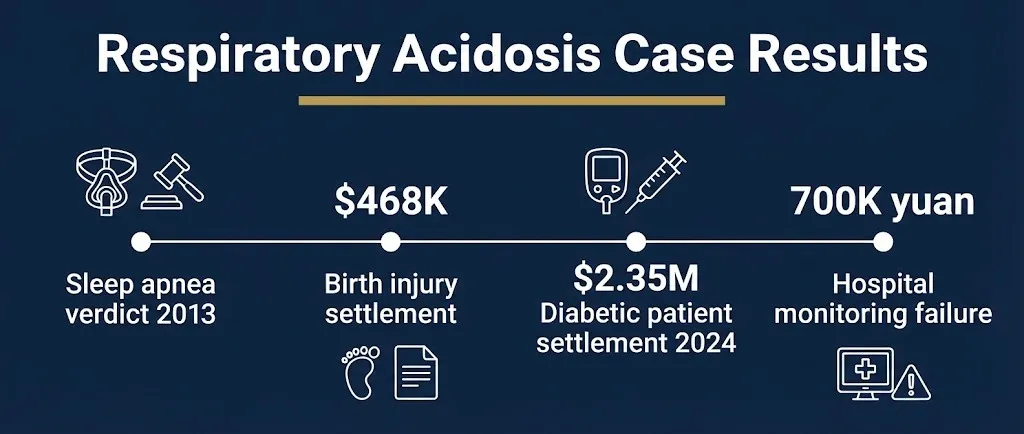
The highest reported result involves a 46-year-old woman with Type 1 diabetes. She was admitted to the hospital with pneumonia symptoms. Over 48 hours, staff failed to monitor her blood glucose, failed to administer insulin, and failed to treat her pneumonia properly. She developed severe metabolic and respiratory acidosis, required intubation and a tracheostomy, and now has permanent cognitive impairment. The case settled for $2.35 million in March 2024.
A 76-year-old man with severe spinal stenosis and sleep apnea was found unresponsive in the hospital. Bloodwork showed respiratory acidosis. The doctor chose non-invasive breathing support instead of intubating. By the time the error was recognized, the patient required a crash intubation that failed, causing esophageal insufflation, intestinal ischemia, and death. A jury awarded $1.576 million in 2013.
In a birth injury case from Texas, a newborn suffered severe acidosis and was placed on a ventilator that malfunctioned. The child suffered permanent brain injury. The hospital settled for $468,750, and the remaining doctor was found 15 percent at fault for an additional $451,500.
A Chinese court awarded 700,000 yuan (approximately $100,000) after a hospital failed to monitor blood gases for nine hours while a patient’s acidosis worsened.
| Case Type | Verified Result |
|---|---|
| Diabetic patient, delayed treatment | $2.35 million settlement |
| Obstructive sleep apnea, failed intubation | $1.576 million verdict |
| Birth injury, ventilator malfunction | $468,750 settlement + $451,500 judgment |
| Hospital monitoring failure (China) | 700,000 yuan |
Not yet determined: There is no average payout for respiratory acidosis claims. Each case turns on its own facts.
Who May Qualify for Respiratory Acidosis Compensation?
You may qualify for compensation if you or a family member suffered respiratory acidosis because a medical provider failed to meet the standard of care. The key is proving that the negligence caused the acidosis or made it worse.
The following situations commonly support a claim:
- Failure to monitor blood gases. If a patient’s condition required regular arterial blood gas testing and the provider skipped it, that is evidence of negligence.
- Delay in treating respiratory distress. When warning signs appear and no one acts, the acidosis can worsen.
- Improper ventilator management. A ventilator set incorrectly can cause carbon dioxide retention or excessive ventilation.
- Missed diagnosis of an underlying condition. Pneumonia, COPD, or airway obstruction can cause respiratory acidosis if not treated promptly.
- Medication errors. Opioids or sedatives can suppress breathing and lead to carbon dioxide buildup.
The injury does not have to be fatal to support a claim. Cognitive impairment, organ damage, and prolonged hospitalization are all recoverable harms.
Reality Check
Reality Check: No one texts you malpractice money before you hire a lawyer and file a case. Filing a malpractice claim is not free, but the initial case review usually is. Lawyers who handle these cases work on contingency, meaning they get paid only if you win. Any company demanding an upfront fee to “process” a respiratory acidosis claim is a scam.
How Do You File a Respiratory Acidosis Lawsuit?
You file a respiratory acidosis lawsuit by hiring a medical malpractice attorney, gathering your medical records, and proving that a provider’s negligence caused the condition. The process takes months to years, not days.
Here are the steps involved:
- Get your medical records. Request complete records from every provider involved in the treatment where the acidosis occurred.
- Consult a malpractice lawyer. Most offer free initial reviews. The lawyer will assess whether the facts support a claim.
- Obtain expert review. A physician in the relevant specialty must confirm that the care fell below the standard and caused harm.
- File the complaint. The lawsuit is filed in the appropriate state court, naming the providers and institutions responsible.
- Conduct discovery. Both sides exchange records, take depositions, and build their cases.
- Attempt mediation. Many malpractice cases settle before trial through court-ordered or voluntary mediation.
- Proceed to trial if needed. If no settlement is reached, the case goes before a jury.
The timeline varies. Some cases settle within a year. Others take three to five years if they go to trial.
Key Takeaway: Respiratory acidosis compensation is not automatic. It requires proving that a medical provider’s negligence caused the condition, and the case must be filed before your state’s deadline.
What Is the Difference Between Respiratory Acidosis and Respiratory Alkalosis?
Respiratory acidosis and respiratory alkalosis are opposite conditions. Acidosis means too much carbon dioxide in the blood. Alkalosis means too little. Both can result from medical errors, but the legal claims are different.
Respiratory acidosis occurs when breathing is too slow or too shallow. Carbon dioxide builds up, pH drops, and the body becomes acidic. Causes include opioid overdose, sedative effects, airway obstruction, and ventilator settings that do not allow enough exhalation.
Respiratory alkalosis occurs when breathing is too fast or too deep. Carbon dioxide is blown off too quickly, pH rises, and the body becomes alkaline. Causes include pain, anxiety, fever, and overaggressive mechanical ventilation.
The legal relevance of the distinction matters. Respiratory acidosis from untreated opioid sedation is often a clear case of negligence. Respiratory alkalosis from hyperventilation is harder to attribute to a provider unless the hyperventilation was caused by improper ventilator settings or a failure to treat pain.
In one Louisiana case, a patient had respiratory alkalosis from hyperventilation related to congestive heart failure. The defendant’s expert testified that the treating doctor met the standard of care by addressing the heart failure and discharging the patient with instructions to follow up.
What Happens Next
October 2026: No national respiratory acidosis settlement is pending. Individual cases continue to be filed state by state.
Ongoing: Malpractice attorneys continue to review respiratory acidosis claims, particularly birth injury and post-surgical cases.
Expected 2027: No change in the legal landscape. Respiratory acidosis claims will remain individual malpractice cases.
Frequently Asked Questions
Is there a respiratory acidosis class action lawsuit?
No. There is no class action involving respiratory acidosis patients. Each case is filed individually as a medical malpractice claim.
How much can you get for respiratory acidosis malpractice?
Amounts vary widely. Verified results range from around $132,000 to $2.35 million, depending on the injury and the evidence.
What is the deadline to file a respiratory acidosis lawsuit?
Most states have a two-year statute of limitations for medical malpractice. Some states have shorter deadlines for claims against government hospitals.
Do you need a lawyer to file a respiratory acidosis claim?
Yes. Medical malpractice cases require expert testimony and complex evidence. Representing yourself is not realistic.
Can you sue for respiratory alkalosis?
Yes, if you can prove that a provider’s negligence caused the alkalosis and resulting harm. The standard is the same as for acidosis.
What evidence is needed to prove a respiratory acidosis claim?
You need medical records showing the acidosis, expert testimony on the standard of care, and evidence that the negligence caused the injury.
How long does a respiratory acidosis lawsuit take?
Most cases resolve in one to three years. Cases that go to trial can take longer.
What You Should Do Now
If you or a family member suffered respiratory acidosis during medical treatment, act before the deadline passes. Gather your medical records and consult a malpractice attorney for a free review.
The most important fact: most states require filing within two years of the injury. Miss that window and you lose the right to compensation. Check your state’s deadline immediately.