Jefferson Capital Systems Lawsuit 2026: Debt Collection Cases and FDCPA Claims Explained
Quick Answer
- Jefferson Capital Systems is a legitimate debt buyer facing multiple FDCPA and FCRA lawsuits, not a scam operation, but consumer disputes are active in federal courts.
- No class action settlement fund exists yet, and no per-person payout amount has been approved or determined in any of these cases.
- If you received a collection notice from Jefferson Capital Systems, you have 30 days to request debt validation, a critical deadline under federal law.
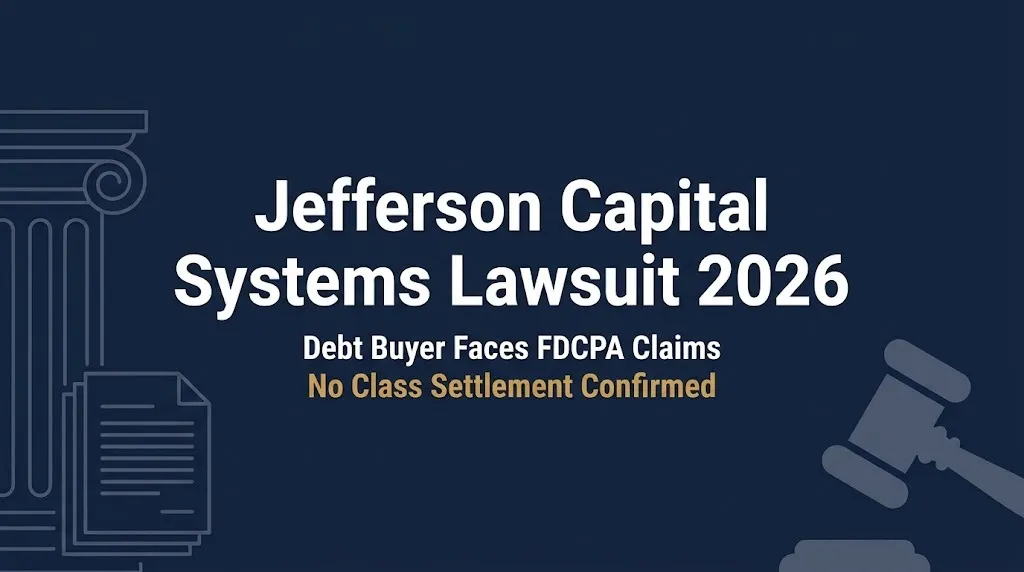
The Jefferson Capital Systems lawsuit picture in 2026 is not a single case with a single payout. It is a scattered set of individual federal lawsuits, most filed by consumers alleging the company violated debt collection and credit reporting laws, alongside a steady stream of state court collection cases the company files as a plaintiff.
If you searched for this because you got a letter or a court summons, the most important fact is this: the deadline to respond is real, and ignoring it has consequences. This article breaks down the active federal cases, the consumer protections that apply, and what your actual options are.
The Facts
| Item | Verified Detail |
|---|---|
| Case Name | Multiple individual federal actions (Flory v. Jefferson Capital, Boykin v. Jefferson Capital, Johnson v. Jefferson Capital, and others) |
| Status | Active litigation, several notices of settlement filed in individual cases |
| Fund Size | Not yet confirmed (no class settlement approved) |
| Est. Per Person | Not yet determined |
| Claim Deadline | Not applicable (no class settlement) |
| Administrator | Not yet appointed |
| Proof Needed | Check your individual case docket or collection notice |
Is the Jefferson Capital Systems lawsuit real or a scam?
The Jefferson Capital Systems lawsuit is real, but it is not the kind of case that produces a class-wide payout. Jefferson Capital Systems is a debt buyer, a company that purchases unpaid debts from original creditors and attempts to collect them. It is a legitimate business entity that files thousands of debt collection lawsuits each year in state courts.
The “lawsuits” you see in headlines are mostly individual federal actions filed by consumers who claim Jefferson violated the Fair Debt Collection Practices Act or the Fair Credit Reporting Act. In 2026 alone, federal dockets show cases in Arizona, Pennsylvania, Washington, Ohio, and Texas . These are not class actions. They are individual disputes.
There is also a steady stream of state court cases where Jefferson Capital Systems is the plaintiff, suing consumers over unpaid debts. Texas justice courts, Florida small claims courts, and New York supreme courts all show active filings in 2026 .
Key Takeaway: Jefferson Capital Systems is a real debt buyer facing real consumer lawsuits, but no class action settlement exists in 2026, and no payout pool has been created for consumers.
How much is the Jefferson Capital Systems lawsuit worth?
No settlement amount has been approved or determined in any Jefferson Capital Systems class action because no class action has reached settlement. The federal cases on record are individual actions, and several have ended with private settlement notices where the terms are not public .
What is confirmed is that individual FDCPA cases against debt collectors can produce statutory damages of up to $1,000 per violation, plus actual damages and attorney fees. But those figures apply to individual plaintiffs who file and win, not to anyone who simply received a collection letter.
| Case Type | Potential Recovery | Who Qualifies |
|---|---|---|
| FDCPA individual claim | Up to $1,000 statutory damages plus actual damages | The individual who filed the lawsuit |
| FCRA individual claim | Actual damages, statutory damages, attorney fees | The individual who filed the lawsuit |
| State court collection defense | Dismissal of debt if collector cannot prove ownership | The individual named as defendant |
If you are searching for a payout amount, the honest answer is that none exists for the general public. Any website promising a Jefferson Capital Systems settlement check is not describing a verified legal outcome.
How do you respond to a Jefferson Capital Systems collection letter?
You must send a written debt validation request within 30 days of receiving the initial collection notice. This is your strongest immediate protection under the FDCPA. Once you request validation, the collector must stop collection efforts until it provides proof of the debt.
Here is what a validation request should include:
- Your name and address as they appear on the collection letter
- The account number or reference number from the letter
- A clear statement that you dispute the debt and request validation
- A demand for the name of the original creditor, the amount owed, and the chain of ownership
- A request that all communication be in writing
Keep a copy of the letter and send it by certified mail with return receipt. The 30-day window is not flexible. Miss it, and you lose the automatic pause on collection activity.
Think of it like a store return policy. If you catch the issue within the window and follow the procedure, you get a pause and a review. If you wait, the return desk can simply say no.
What is the 30-day debt validation deadline for Jefferson Capital Systems?
The 30-day debt validation deadline is your legal right under the Fair Debt Collection Practices Act to demand proof that the debt is yours and that Jefferson Capital Systems has the authority to collect it. The clock starts the day you receive the initial written collection notice.
If you miss the deadline, you do not lose all rights. You can still dispute the debt. But you lose the automatic requirement that the collector stop collection efforts while the dispute is investigated. That pause is valuable.
A validation request forces the collector to provide several key pieces of information:
- The amount of the debt and how it was calculated
- The name of the original creditor
- Verification that the collector owns or has authority to collect the debt
- A copy of the judgment or contract if one exists
If Jefferson cannot provide this information, it may have to stop collection. Many debt buyer cases fall apart at this stage because the chain of ownership from original creditor to debt buyer is poorly documented.
Reality Check: No one from Jefferson Capital Systems will call you and offer to settle for pennies on the dollar if you pay immediately with a gift card. That is a scam. Legitimate debt collectors send written notices and do not demand payment through prepaid cards or wire transfers.
How do you file an FDCPA lawsuit against Jefferson Capital Systems?
You file an FDCPA lawsuit against Jefferson Capital Systems by hiring a consumer protection attorney, documenting the violations, and filing a complaint in federal court within one year of the violation. The statute of limitations under the FDCPA is one year from the date of the violation.
Most consumer attorneys handle FDCPA cases on contingency, meaning you pay nothing upfront. Attorney fees are recoverable under the statute if you prevail. This makes it possible for ordinary consumers to pursue claims without large out-of-pocket costs.
Here are the steps to evaluate a potential claim:
- Gather every collection letter, envelope, and phone record.
- Write down dates, times, and what was said in each communication.
- Identify the specific violation (false representation, harassment, failure to validate, etc.).
- Consult a consumer attorney in your state.
- File within one year of the violation date.
Not every frustrating collection experience is a legal violation. The FDCPA prohibits specific conduct: calling before 8 a.m. or after 9 p.m., calling your workplace after you ask them to stop, using obscene language, threatening arrest, or misrepresenting the amount owed.
How do you check the status of a Jefferson Capital Systems case?
You check the status of a Jefferson Capital Systems case by searching the court docket using the case number from your summons or collection notice. Federal cases appear on PACER, and state cases appear on county court websites or portals like UniCourt.
If you received a summons, the case number is printed on the first page. The court name is also on the document. Search that court’s online records with the case number, and you will see every filing, hearing date, and order.
| Court Type | Where to Search | What You Need |
|---|---|---|
| Federal district court | PACER or CourtListener | Case number and district |
| Texas justice court | County clerk website or UniCourt | Case number and county |
| Florida small claims | County clerk website | Case number and county |
| New York supreme court | State court portal or UniCourt | Case number and county |
If you cannot find the case online, call the clerk’s office for the court listed on your summons. Provide the case number and ask for the current status and next hearing date.
Why is Jefferson Capital Systems suing so many people in 2026?
Jefferson Capital Systems sues consumers because that is its business model. The company buys charged-off debts for pennies on the dollar and then attempts to collect, either through letters and calls or through the courts. Filing lawsuits is a standard tool for debt buyers.
The company files in justice courts and small claims courts because those courts handle smaller amounts and have streamlined procedures. A debt buyer can file dozens of cases per day in some jurisdictions. Many defendants do not show up, and default judgments are entered automatically.
In 2026, state court records show active Jefferson Capital filings against consumers in Texas, Florida, New York, Oklahoma, and Pennsylvania . The amounts are typically a few thousand dollars or less.
If you are sued, showing up matters. A default judgment gives the collector the right to garnish wages or bank accounts in many states. Appearing and demanding proof of the debt can change the outcome.
What happens next: timeline for Jefferson Capital Systems litigation
Ongoing 2026: Individual FDCPA and FCRA cases continue to be filed in federal courts across the country.
Ongoing 2026: State court collection cases proceed, with many ending in default judgments when defendants do not appear.
Expected late 2026 or 2027: Several federal cases with notices of settlement on the docket will likely be dismissed after private settlement terms are finalized.
Not yet confirmed: Any consolidated class action or public settlement fund for Jefferson Capital Systems consumers.
Frequently Asked Questions
Is Jefferson Capital Systems a legitimate company?
Yes. It is a debt buyer that purchases unpaid debts and attempts to collect them. It is not a scam, though consumer lawsuits allege it sometimes violates debt collection laws.
Can I be arrested for owing money to Jefferson Capital Systems?
No. Debt is a civil matter, not a criminal one. No one can be arrested for failing to pay a debt. Threats of arrest are an FDCPA violation.
What happens if I ignore a Jefferson Capital Systems lawsuit?
A default judgment may be entered against you. That judgment can lead to wage garnishment, bank account levies, or property liens, depending on your state’s laws.
Does Jefferson Capital Systems settle debts?
Individual settlements happen, as shown by notices of settlement in federal cases. Terms are private. You can negotiate directly or through an attorney.
How long does Jefferson Capital Systems have to sue me?
That depends on your state’s statute of limitations for debt collection, which is typically three to six years from the date of default. If the statute has expired, the debt may be time-barred.
Can Jefferson Capital Systems report a debt to my credit report?
Yes, if it owns the debt and the information is accurate. You can dispute inaccurate reporting under the Fair Credit Reporting Act.
What you should do now
If you received a collection letter, send a written validation request within 30 days by certified mail. That is the single most important action you can take right now.
If you received a court summons, do not ignore it. Find the case number, check the docket, and show up on the hearing date. A default judgment is the worst outcome, and it is avoidable.
No class action settlement exists for Jefferson Capital Systems in 2026. Do not wait for a payout that is not coming. Deal with the notice you have, and the 30-day window is the deadline that matters.