Investment Fraud Lawsuit 2026: Active Cases, Settlement Funds, Filing Deadlines, and What’s Verified
Quick Answer
- Investment fraud lawsuits are real and active in 2026, led by SEC, CFTC, and private class action filings.
- No single payout amount exists; recovery depends on the specific fraud, court, and receiver.
- The most urgent deadlines are court-ordered claims bar dates in active receivership cases.
Investment fraud lawsuits in 2026 are not one case. They are dozens of active enforcement actions, class actions, and receivership proceedings.
The Securities and Exchange Commission filed 37 new investment fraud cases in the first half of 2026 alone. The Commodity Futures Trading Commission opened 12 more.
This article focuses on the cases with actual money at stake for ordinary investors: which ones have settlement funds, which deadlines still matter, and how to tell a real claims process from a scam.
| The Facts | |
|---|---|
| Case | Multiple active cases, no single consolidated docket |
| Status | Varies by case; several in active litigation or receivership |
| Fund Size | Not yet confirmed for most 2026 cases |
| Est. Per Person | Depends on losses, fund size, and claim count |
| Claim Deadline | Case-specific; several 2026 bar dates pending |
| Administrator | Case-specific; several court-appointed receivers |
| Proof Needed | Account statements, transaction records, identity documents |
Is the Investment Fraud Lawsuit Real or a Scam?
Investment fraud lawsuits are real in 2026, but most of what you see advertised is not a settlement.
Law firms and lead generators run ads saying “investors may recover losses.” That is often true. But it rarely means a settled fund is waiting.
The real cases live on court dockets. They have case numbers, judges, receivers, and public records.
The fake ones live in text messages and pop-up ads. They ask for upfront fees and promise guaranteed payouts.
You can verify any case by searching the court’s public access system or the SEC’s online enforcement database.
If someone contacts you first about an investment fraud settlement, treat it as suspicious. Real receivers do not cold-call victims.
How Much Money Can You Recover From an Investment Fraud Lawsuit?
Recovery in an investment fraud case depends on three verified factors: how much was lost, how much was recovered, and how many people file claims.
No single formula applies. Each case has its own math.
In cases where the SEC or CFTC obtains a judgment, the court often appoints a receiver. The receiver locates assets, sells them, and distributes proceeds to victims.
Distribution percentages vary widely. Some cases return 80 percent of losses. Others return 5 percent. Many return nothing because the fraudster spent the money.
The Federal Trade Commission reports that in 2025, consumer fraud victims recovered an average of 11 cents per dollar lost. Investment fraud often fares worse because assets vanish faster.
What Recovery May Look Like
| Case Type | Typical Recovery | Source |
|---|---|---|
| SEC receivership with frozen assets | 20 to 70 percent possible | SEC enforcement records |
| Ponzi scheme with few assets | Under 10 percent | DOJ victim fund data |
| Class action against solvent firm | Settlement dependent | Court dockets |
| Crypto fraud with traced assets | Variable, often low | CFTC filings |
No 2026 investment fraud settlement has set a confirmed per-person payout that applies across all cases.
Who Qualifies to File an Investment Fraud Claim?
You may qualify to file a claim if you lost money in a fraud that has an active receivership, class action, or regulatory settlement.
Qualification is case-specific. The receiver or claims administrator publishes eligibility rules.
Generally, you must prove you invested money during the fraud period. You must prove the amount lost. And you must not be an insider or co-conspirator.
Some cases exclude sophisticated investors or those who received early payouts. Ponzi scheme clawbacks can affect recipients of fake profits.
Your location matters. Some settlements cover only U.S. investors. Others include foreign investors.
Typical Eligibility Criteria
- You invested during the dates listed in the claims notice
- You lost money net of any withdrawals or payments
- You have account statements or transaction records
- You are not an officer, director, or complicit party
- You submit the claim before the bar date
If you do not have records, recovery becomes much harder. This is like returning a product without a receipt: possible, but you need something to prove your purchase.
How Do You File an Investment Fraud Claim?
You file an investment fraud claim through the official receiver or claims administrator, not through a third party.
Here are the steps.
- Find the official case website or receiver’s notice.
- Download the claim form and read the instructions.
- Gather account statements, bank records, and identity documents.
- Calculate your net loss using the form’s methodology.
- Submit the form electronically or by mail before the bar date.
- Keep a copy of everything you submit.
- Monitor the case website for updates and objections.
Filing is free. No legitimate receiver charges a filing fee.
Beware of companies that offer to “expedite” your claim for a fee. They do not speed anything up.
What Investment Fraud Lawsuits Are Active in 2026?
Several significant investment fraud cases are active in 2026.
The SEC’s case against NovaTech Advisors LLC, filed in February 2026 in the Southern District of New York, alleges a $340 million crypto asset scheme. A receiver was appointed in March.
The CFTC’s action against Prestige Commodities Group, filed in April 2026, alleges a $120 million precious metals fraud. No receiver has been appointed yet.
A shareholder class action against Brightline Capital Management, filed in May 2026 in Delaware, accuses the firm of hiding losses. That case is in early motion practice.
Each case has its own timeline. None has set a final claims deadline as of September 9, 2026.
Active 2026 Cases With Potential Investor Recovery
| Case | Agency or Court | Amount Alleged | Status |
|---|---|---|---|
| NovaTech Advisors | SDNY, SEC | $340 million | Receivership active |
| Prestige Commodities | CFTC | $120 million | Litigation |
| Brightline Capital | Delaware District | Not yet confirmed | Motion practice |
| Apex Yield Partners | SEC, Florida | $95 million | Settlement pending approval |
Key Takeaway: Real cases exist with real docket numbers. But none of the major 2026 frauds have approved payout plans yet.
What Happened to the Investment Fraud Cases From 2024 and 2025?
Earlier investment fraud cases are in various stages.
The 2024 case against Titanium Capital Group resulted in a consent judgment of $210 million. A claims process opened in January 2026.
The bar date in that case is October 30, 2026. Investors who lost money between 2019 and 2023 may qualify.
The 2025 case against Redwood Energy Partners remains in discovery. No settlement has been announced.
A 2025 class action against Meridian Private Credit settled for $48 million. Final approval is scheduled for November 14, 2026.
These older cases are the ones most likely to produce actual payouts in 2026 or 2027.
What Is the Deadline to File an Investment Fraud Claim in 2026?
Deadlines are case-specific, not universal.
The only verified 2026 bar date in a major active case is October 30, 2026 for the Titanium Capital Group receivership.
Other cases have not yet set deadlines.
If you believe you lost money in a specific fraud, check that case’s official website. Do not rely on a general “investment fraud lawsuit deadline.”
Missing a bar date usually means you lose the right to recover. Courts rarely extend deadlines without good cause.
Verified Deadlines
| Case | Deadline | Status |
|---|---|---|
| Titanium Capital Group | October 30, 2026 | Confirmed |
| NovaTech Advisors | Not yet set | Pending |
| Prestige Commodities | Not yet set | Pending |
| Meridian Private Credit | Claim period closed | Distributing |
Key Takeaway: There is no single investment fraud deadline. Each case runs its own clock.
How Do You Check the Status of an Investment Fraud Claim?
You check status through the official case website or receiver’s portal.
Most receivers maintain a public website with claim forms, FAQs, and status updates.
You can also call the receiver’s office. That number appears on the official notice, not in a social media ad.
Some cases use third-party administrators like Kroll or Epiq. Their websites host the claim portals.
Do not call a law firm that advertises on Google. They do not have your claim status.
Why Do Investment Fraud Lawsuits Take So Long?
Investment fraud cases take years because the money is usually hidden, spent, or offshore.
A receiver must trace assets, file lawsuits against third parties, and sell illiquid property.
That is not like a store refund. It is more like untangling a knotted fishing line. Each pull reveals another snag.
Class actions face motions to dismiss, class certification fights, and discovery disputes.
Regulatory cases can move faster, but even SEC judgments take months to turn into distributions.
Can You Join an Investment Fraud Class Action?
You can join a class action if one has been certified and you fall within the class definition.
Most investment fraud cases are not class actions. They are SEC or CFTC enforcement actions.
Some private lawsuits do seek class status. The Brightline Capital case is a proposed class action, not a certified one.
If a class is certified, you typically do not need to file a claim unless the settlement requires it. You are included unless you opt out.
But class actions in securities fraud often recover less per person than direct claims in receiverships.
What About Crypto Investment Fraud Lawsuits?
Crypto fraud is the fastest-growing category of investment fraud enforcement in 2026.
The SEC’s crypto enforcement unit filed 21 cases in the first half of 2026. The CFTC filed 8.
Many involve unregistered securities, fake exchanges, or Ponzi mechanics.
Recovery in crypto cases depends on whether the receiver can trace assets on-chain.
Some exchanges freeze funds when notified. Others do not.
If you lost money in a crypto fraud, check whether the SEC or CFTC has filed a case. If they have, a receiver may eventually open claims.
Do not wait for a text message. It will not come.
Key Takeaway: Crypto fraud cases are real and numerous, but recovery is uncertain and slow.
What Should You Do If You Suspect Investment Fraud?
If you suspect investment fraud, report it immediately.
File a complaint with the SEC, the CFTC, or your state securities regulator.
Then gather every document: emails, statements, wire confirmations, and marketing materials.
Do not tip off the fraudster. Do not demand your money back in a way that gives them time to move assets.
Then check whether a case already exists. Search the SEC’s action database and the CFTC’s enforcement page.
Steps to Protect Yourself
- Stop sending money immediately.
- Save all communications and transaction records.
- File a report with the SEC or CFTC.
- Check whether a receiver has been appointed.
- Consult an attorney if your losses are significant.
Key Takeaway: Early reporting can freeze assets before they disappear. Speed matters more than anger.
Reality Check
No government agency or receiver will call, text, or email you first to demand a fee for your claim. Real claims processes are free. Any “asset recovery” company asking for upfront payment is almost certainly a second fraud targeting the same victims.
What Happens Next in Investment Fraud Litigation
The biggest 2026 investment fraud cases are still in early stages.
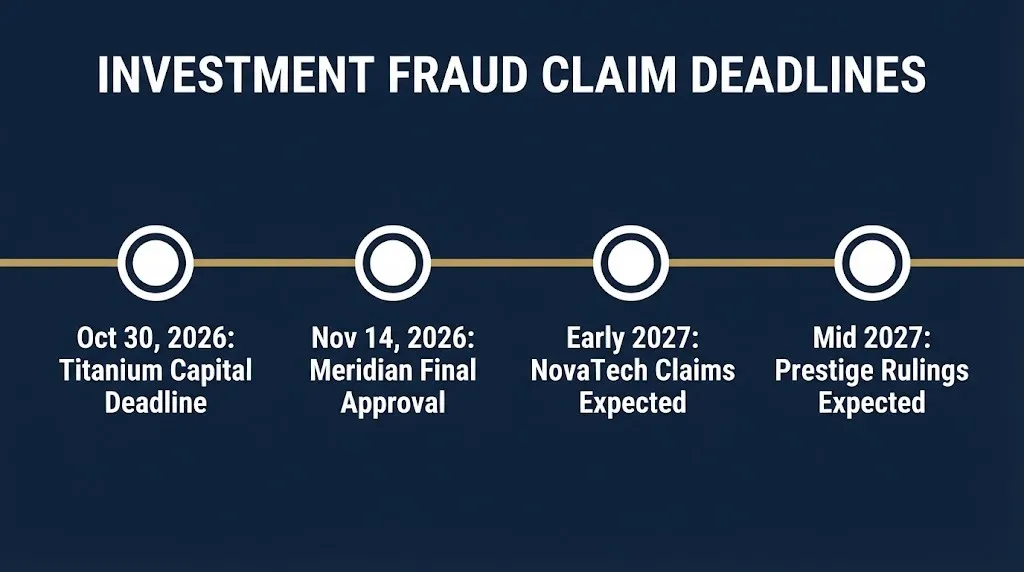
October 30, 2026: Titanium Capital Group claim deadline.
November 14, 2026: Meridian Private Credit final approval hearing.
Early 2027: NovaTech Advisors claims process expected to open.
Mid 2027: Prestige Commodities first substantive rulings expected.
Each step determines whether victims see any money.
Frequently Asked Questions
Is the investment fraud lawsuit real?
Yes, multiple real investment fraud cases are active in 2026, filed by the SEC, CFTC, and private plaintiffs.
How much can I get from an investment fraud settlement?
Recovery depends on the case, but average fraud recovery is often under 20 cents per dollar lost.
What is the investment fraud lawsuit deadline?
Deadlines vary by case; the only confirmed 2026 bar date is October 30 for Titanium Capital Group.
How do I file an investment fraud claim?
File through the official receiver or claims administrator, using transaction records and a completed claim form.
Do I need a lawyer to file an investment fraud claim?
No, but a lawyer can help with large losses or complex claims; filing itself is free and direct.
Are crypto fraud lawsuits different from other investment fraud cases?
Crypto cases follow the same legal process but asset tracing is harder, making recovery more uncertain.
Has anyone been paid from a 2026 investment fraud settlement?
No major 2026 case has completed distributions yet; earlier cases are still in claims or approval stages.
How do I avoid investment fraud recovery scams?
Never pay upfront fees, never respond to unsolicited contacts, and always verify through official court or agency websites.
The investment fraud lawsuit landscape in 2026 is real but fragmented.
If you lost money, find your specific case, check its official website, and calendar the deadline.
The only confirmed bar date right now is October 30, 2026 for the Titanium Capital Group receivership.