RealPage Lawsuit 2026: Settlement Details, Claim Deadlines, and What Renters Need to Know
Quick Answer
- The RealPage lawsuit alleges landlords used shared pricing software to inflate rents across major U.S. markets.
- No settlement fund or per-person payout amount has been finalized or approved by any court yet.
- No claim deadline currently exists because no claims process has opened. Watch the official settlement website for updates.
Key Takeaway: If you rented in a RealPage-managed building between 2017 and 2024, your lease dates and address matter more than anything else right now.
The RealPage lawsuit is not a scam, and it is not a quick payout. It is a sprawling antitrust case that accuses one of the largest property management software companies in the country of helping landlords coordinate rent increases. The U.S. Department of Justice filed its own enforcement action in August 2024. Private class actions followed and were later consolidated.
You may have seen ads on social media or received emails claiming you are owed money. Some of those ads are real. Some are not. The verified situation is this: no settlement has been reached, no fund exists, and you cannot file a claim yet. What you can do right now is protect your records and understand whether you fall inside the proposed class definitions.
This article breaks down every verified detail, what remains unconfirmed, and the specific steps you can take today without paying anyone a cent.
The Facts
| Fact | Verified Value |
|---|---|
| Case | In re: RealPage Rental Software Antitrust Litigation |
| Status | Consolidated class actions, discovery ongoing |
| Fund Size | Not yet established |
| Est. Per Person | Not yet determined |
| Claim Deadline | None set yet |
| Administrator | Not yet appointed |
| Proof Needed | Lease agreements and rent payment records, check claim form when available |
Is the RealPage lawsuit legitimate?
Yes. The RealPage antitrust litigation is a verified set of federal cases, not a rumor. The U.S. Department of Justice sued RealPage in August 2024. Multiple private class action complaints were filed in federal courts across several states and later consolidated into a multidistrict litigation, commonly called an MDL.
The core allegation is straightforward. RealPage sells software called YieldStar and AI Revenue Management. Landlords feed their rental data into these tools. The software then recommends pricing for available units. The plaintiffs argue that enough landlords used the same recommendations at the same time that it functioned like a coordinated rent-fixing scheme.
RealPage has denied the allegations. In public statements, the company says its software is advisory and landlords make their own pricing decisions. The court has not ruled on the merits.
A coalition of state attorneys general has also filed or joined cases. The DOJ action names several large landlords as defendants too. That matters because it tells you the scope: this is not one case, it is a cluster of overlapping enforcement and private claims.
Is the RealPage settlement real or a scam?
There is no RealPage settlement as of March 18, 2026. Any website, text, email, or social media post telling you a settlement has been approved and you can claim money now is misleading at best and fraudulent at worst.
The confusion comes from several sources. Some law firm marketing pages describe the case as if a payout is imminent. Others run generic “check if you qualify” ads that apply to dozens of unrelated class actions. A few outright scam pages use the RealPage name to harvest personal data.
Here is what a real settlement would look like. A court would issue a preliminary approval order. A settlement administrator would launch an official website with a claim form. You would see a deadline, a fund amount, and a clear class definition. None of that exists yet.
Do not pay anyone to check your eligibility. Do not give bank details to any site claiming to process a RealPage claim. No legitimate class action requires upfront payment from a class member.
How much money could renters get from the RealPage lawsuit?
No per-person payout has been calculated. No settlement fund has been approved. Anyone quoting a specific number is speculating.
That said, the potential scale is large. The complaint covers millions of rental units across dozens of metropolitan areas. If the case settles or the plaintiffs win at trial, any fund could run into the billions. But that is a projection, not a promise.
In similar antitrust settlements, individual class member recoveries have varied widely. Some renters received a few hundred dollars. Others received over a thousand, depending on how long they rented and how many affected properties they lived in. Those figures come from unrelated cases and are only useful as a rough reference.
The payout formula, if one emerges, will likely consider your total months in affected units, your rent level, and the metro area. The more months you leased, the larger your share, in most scenarios. But none of that is confirmed here.
Who may qualify for a RealPage class action claim?
The proposed class definitions are not final. The most common version in the consolidated complaints includes renters who leased residential units in buildings managed by landlords that used RealPage revenue management software during the alleged period.
The alleged period typically runs from 2017 through 2024, though some complaints extend later. The properties named in the complaints are concentrated in large metro areas where RealPage has heavy market penetration. Those include but are not limited to Atlanta, Austin, Boston, Charlotte, Dallas, Denver, Houston, Las Vegas, Los Angeles, Miami, Nashville, Phoenix, Portland, San Diego, Seattle, and Tampa.
You may qualify if:
- You signed a lease for a residential apartment unit.
- The landlord or property manager was named in the DOJ action or class complaints.
- Your lease term fell between 2017 and 2024 or later, depending on the final class period.
- You paid rent at market rates, not subsidized or income-restricted rates, in most proposed definitions.
You may not qualify if you lived in subsidized housing, leased commercial space, or your landlord never used RealPage software. The final class definition will control, and it has not been certified yet.
Which landlords are named in the RealPage lawsuit?
The DOJ complaint names several large property management companies as co-defendants. The private class actions name more. The verified list from the government filing includes:
- Greystar Real Estate Partners
- LivCor, a Blackstone portfolio company
- Cushman & Wakefield and its subsidiary Pinnacle Property Management
- Willow Bridge Property Company
- Cortland Management
- BH Management Services
- Camden Property Trust
- Avenue5 Residential
- Bozzuto Management Company
- Equity Residential
- Essex Property Trust
- JBG Smith
Not every building managed by these companies necessarily used RealPage software for every unit. The allegations are specific to properties where YieldStar or AI Revenue Management was active.
If you are not sure whether your landlord used RealPage, check your lease. Some leases reference pricing software in a data privacy or disclosure addendum. You can also search the public court filings, which list named properties in exhibits.
How do I file a RealPage lawsuit claim?
You cannot file a claim yet. No claim form exists. No settlement administrator has been appointed. The claim process will only open if and when a court approves a settlement or a judgment creates a fund.
What you can do right now is prepare. Collect the documents that a future claim form will likely request. For most renters, that means gathering lease agreements and rent payment receipts.
Here is a practical checklist:
- Locate every residential lease you signed from 2017 to 2024.
- Save rent payment records: bank statements, portal screenshots, or receipts.
- Record the exact addresses and lease start and end dates for each property.
- Note the landlord or property management company name on each lease.
- Store digital copies in one folder with the property address in each filename.
- Keep the folder until a real claim window opens.
- Check the official settlement website periodically. Do not rely on third-party ads.
The moment a claims process opens, a legitimate administrator will publish a simple online form. Filing will be free and should take under 15 minutes if your documents are ready.
RealPage lawsuit update: where does the case stand in 2026?
The case is in discovery. The consolidated class action, captioned In re: RealPage Rental Software Antitrust Litigation, is pending in the U.S. District Court for the Middle District of Tennessee, Nashville Division.
The DOJ action is proceeding separately in the same district. Multiple state attorneys general joined or filed parallel actions. A motion to dismiss was denied in part, allowing core antitrust claims to move forward.
Class certification has not been granted. That is a key milestone. Before any settlement or trial, the plaintiffs must persuade the court that the proposed class meets the legal standards. If certification fails, the case could fragment into smaller individual actions, which would change everything for renters hoping for a simple payout.
RealPage filed a motion for summary judgment. The court has not ruled. The judge has scheduled further status conferences, but no trial date is set.
When will RealPage lawsuit checks be mailed?
No checks are coming in 2026. The earliest any payout could occur is after a settlement is reached, preliminarily approved, noticed to the class, and finally approved at a fairness hearing. That process alone usually takes 9 to 18 months after a deal is signed.
If a trial produces a verdict for the plaintiffs, appeals would delay payments further. Realistic timelines in comparable antitrust cases put any distribution at 2027 or later, assuming the case resolves in favor of the class at all.
Anyone who tells you a check is on the way is wrong. Anyone who asks you to pay a processing fee to speed up a check is running a scam. Bookmark the official court docket and the future settlement administrator site instead.
Key Takeaway: The RealPage case is real, the potential class is massive, but the payout timeline is measured in years, not months.
How does the RealPage lawsuit affect current renters?
If you are renting right now in a building managed by one of the named landlords, you could be part of the class even if you move out tomorrow. The relevant question is whether you leased during the proposed class period, not whether you are still there.
The lawsuit does not automatically lower your current rent. No injunction has stopped landlords from using RealPage software. The DOJ complaint asks for an end to certain practices, but the court has not ordered that relief.
Some tenants have reported that their landlords removed RealPage disclosures from new leases. Others say pricing feels different, with more negotiation room on renewals. That is anecdotal, not verified as a direct result of the litigation. The safest assumption is that your rent terms are set by your lease, not the lawsuit.
Can I opt out of the RealPage class action?
Not yet. The opt-out window opens only after the court certifies a class and approves a notice plan. At that point, you will receive a formal notice by mail or email if the administrator can identify you.
If a settlement is reached, the notice will include a deadline to exclude yourself. Opting out preserves your right to sue individually. It also means you receive nothing from the settlement.
For most renters, staying in the class is the right default. You lose nothing by remaining a class member unless the final deal is unusually poor, which is rare in antitrust cases of this size. But that choice is yours, and you do not need to decide until the official notice arrives.
What happened with the DOJ RealPage case?
The U.S. Department of Justice Antitrust Division filed its complaint against RealPage on August 23, 2024, in the Middle District of Tennessee. The complaint alleges that RealPage’s software enables landlords to share non-public pricing data and effectively collude on rent levels.
The DOJ joined with eight state attorneys general at filing. Several more states added their own complaints later. The action names both RealPage and multiple landlords as defendants. The allegations mirror the private class actions but carry the weight of government enforcement.
RealPage called the case flawed in a public statement. The company argued that landlords set prices independently and that the software does not force anyone to accept its recommendations. The market has not waited for the outcome. RealPage announced layoffs in 2025 and reportedly lost some landlord clients, though no court finding has confirmed any liability.
Key Takeaway: Government enforcement and private litigation are running in parallel, which increases settlement pressure but does not guarantee one.
What does RealPage software actually do?
RealPage makes property management software. Two products sit at the center of the litigation: YieldStar and AI Revenue Management, formerly known as Lease Rent Options.
YieldStar collects rent and occupancy data from participating landlords. The software applies a pricing algorithm and recommends rent levels for new leases and renewals. Landlords input their own parameters, but the recommendation engine draws on pooled data across competing properties.
The plaintiffs claim this is a classic hub-and-spoke conspiracy. The software acts as the hub. Each landlord is a spoke. By feeding the same hub, they collectively shift market prices upward. RealPage calls the practice legal price optimization. The legal outcome will determine which characterization holds.
A former RealPage employee allegedly told ProPublica in 2022 that the software was designed to push rents higher. The company disputed that characterization. The court will weigh internal documents, executive testimony, and econometric analysis.
Is there a RealPage class action settlement website?
Not yet. There is no official settlement website for the RealPage litigation as of March 18, 2026. Any domain claiming to be the official RealPage settlement site is either a law firm’s marketing page or a scam.
When a settlement is reached, the administrator will launch a dedicated site with a clear URL, usually containing the case name or docket number. That site will host the claim form, deadline, and court documents. Until then, the best official sources are the U.S. District Court for the Middle District of Tennessee’s public docket and the DOJ Antitrust Division press releases.
Be wary of lookalike sites. Scammers register domains that sound official but are not. Before entering any personal information, verify that a site matches the name in the court-approved notice. If in doubt, wait. A legitimate class action notice will find you.
What is the best way to track the RealPage lawsuit?
You do not need a lawyer to follow this case. The public record is online and free.
The case number for the consolidated private class action in the Middle District of Tennessee is 3:23-md-03071. That docket shows every substantive filing. You can access it through the Public Access to Court Electronic Records system, called PACER. There is a small per-page fee, but the docket sheet itself is cheap to check.
For free updates, watch the DOJ Antitrust Division press room and the websites of the state attorneys general who joined the case. Legal news outlets with established antitrust desks cover major motions and hearing dates.
Set a calendar reminder to check every 60 days. That cadence is enough to catch a settlement notice without obsessing over the docket.
Key Takeaway: Your lease documents are the most valuable thing you own in this case. Protect them now, before you need them.
Reality Check
No one from the RealPage class action will text you, call you, or DM you asking for money to release your payout. Filing a claim, when the time comes, is always free. Third-party claim helpers charge fees for services you can do yourself in minutes. The official court notice will explain everything, and you will not need to pay anyone to understand it.
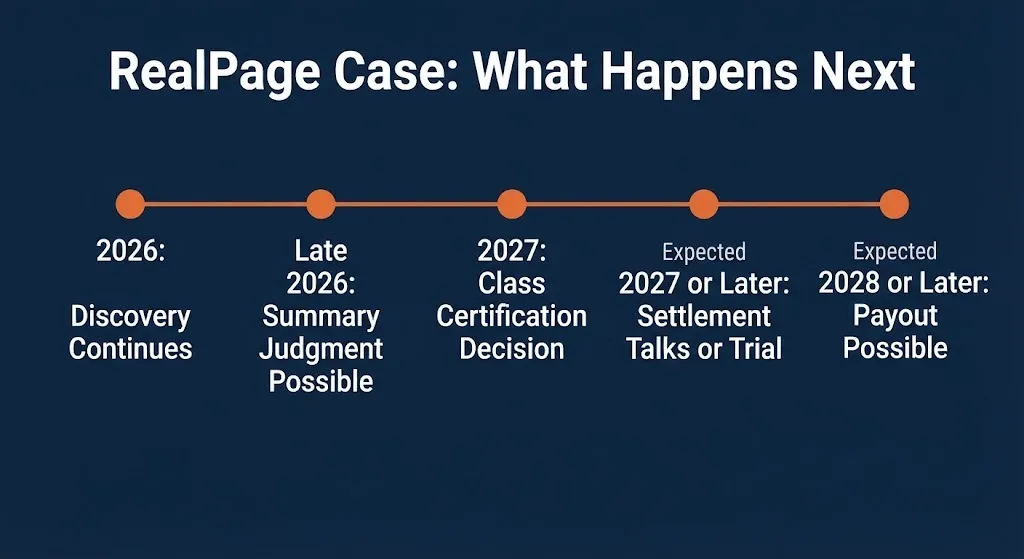
What Happens Next
| Timeline | Expected Stage |
|---|---|
| Mid to late 2026 | Discovery continues; summary judgment ruling possible |
| Late 2026 or 2027 | Class certification decision |
| 2027 | Potential settlement talks or trial scheduling |
| 2027 or later | If settled, preliminary approval and notice process |
| 2028 or later | Possible payout distribution, only if settlement approved |
These dates are estimates based on the current pace of the litigation. None are confirmed court orders.
Frequently Asked Questions
Is the RealPage lawsuit real or fake?
The RealPage lawsuit is real. The DOJ filed its case in August 2024, and private class actions are consolidated in federal court in Tennessee.
How do I know if I qualify for the RealPage settlement?
No final class definition exists. You may qualify if you rented in a building managed by a named landlord that used RealPage software between 2017 and 2024.
Has a RealPage settlement amount been announced?
No settlement has been reached. No fund size, no per-person payout, and no formula have been determined.
When is the RealPage claim deadline?
There is no claim deadline because there is no claim process yet. A deadline will be set only after a court approves a settlement.
Do I need a lawyer to file a RealPage claim?
No. When a claim process opens, filing will be free and straightforward. You do not need a lawyer or a paid claim helper.
What documents do I need for the RealPage lawsuit?
Gather your residential leases from 2017 onward and any rent payment records. Store digital copies in one folder.
Will RealPage lower my current rent?
The lawsuit does not change current lease terms. No court has ordered landlords to stop using RealPage software.
How long until RealPage checks are mailed?
If a settlement or verdict occurs, payments are likely years away. Realistic estimates point to 2028 or later.
Bottom Line
The RealPage lawsuit is one of the largest antitrust matters affecting renters in decades. The allegations are serious, the class could include millions of people, and the potential dollar amounts are substantial. But the case is not resolved. No claim form exists today.
Keep your leases. Watch the official docket. Ignore anyone asking for money to file a claim that does not exist yet. The single most important date right now is the one you put in your own calendar: every 60 days, check the case. That habit will keep you ahead of every deadline that actually matters.