Dispersed Settlement Pattern 2026: What It Means in Lawsuits, Archaeology, and Consumer Claims
Quick Answer
- What it is: A technical term for scattered housing in geography, or decentralized mass claim resolution in law.
- How much could I get? Nothing. There is no fund, no case, and no claim process tied to this term.
- Most important thing: If you saw a headline about a “dispersed settlement pattern” lawsuit, it is not a real case.
If you searched for “dispersed settlement pattern” expecting to find a settlement payout, you are looking at the wrong term. This phrase does not describe a specific lawsuit or a consumer claim you can file. It describes two separate things depending on context, and neither one is a legal case with money waiting for you.
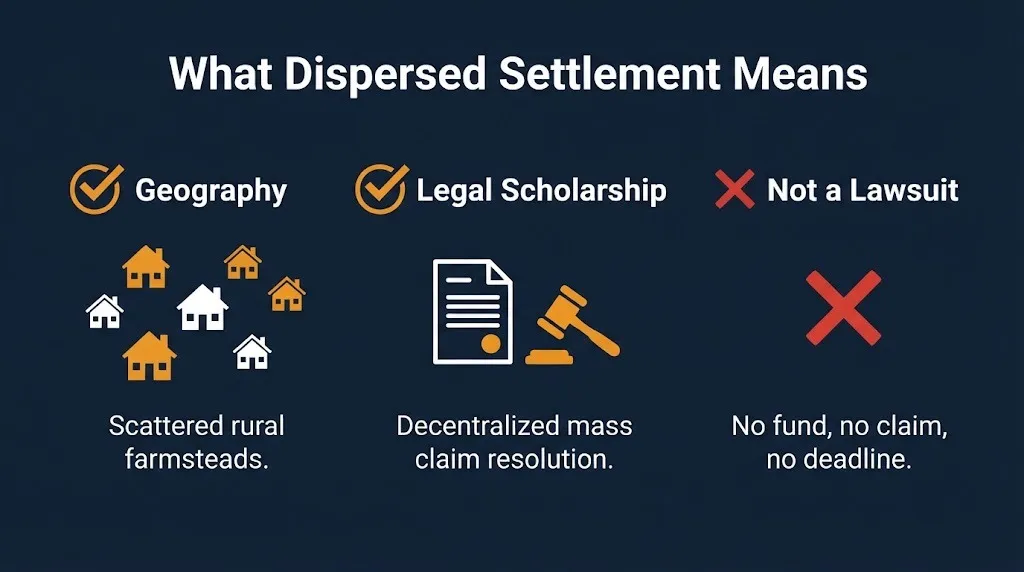
The first meaning comes from geography and archaeology. A dispersed settlement pattern describes rural housing where individual farmsteads sit far apart rather than clustered in a village. That is a physical arrangement of buildings on land, not a legal event.
The second meaning comes from legal scholarship. A 2004 Vanderbilt Law Review article used the phrase to describe how American tort law has long resolved large volumes of similar claims through private, decentralized settlement systems rather than formal class actions. That is an academic description of a system, not a case you can join.
This article explains both meanings, clears up the confusion, and tells you what to do if you arrived here looking for a payout. The most important fact: no settlement fund exists under this term, and no claim deadline is coming.
The Facts
| Item | Detail |
|---|---|
| Case Name | Not applicable, this is a technical term, not a case |
| Jurisdiction | Not applicable |
| Case Number | Not applicable |
| Current Status | Not a legal case, no settlement exists |
| Total Settlement Fund | Not applicable |
| Estimated Per-Person Payout | Not applicable |
| Claim Deadline | Not applicable |
| Administrator | Not applicable |
| Proof Required | Not applicable |
Is a Dispersed Settlement Pattern a Real Lawsuit or Scam?
A dispersed settlement pattern is not a lawsuit. It is a technical term from geography, archaeology, and legal scholarship.
If you saw an ad or a text promising money from a “dispersed settlement pattern claim,” treat it as suspicious. No such case exists. No court has approved a settlement under that name. No administrator is collecting claims.
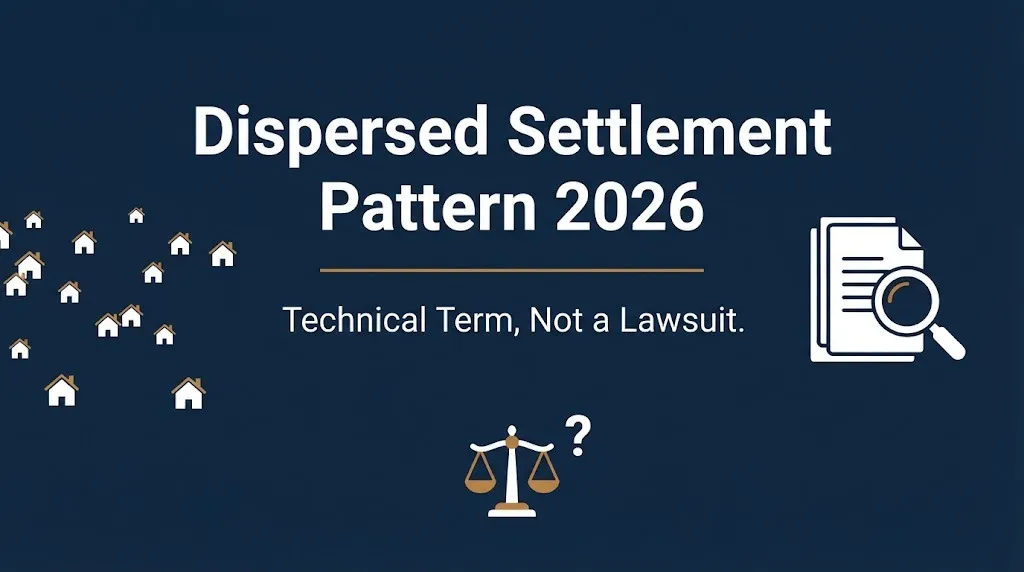
The confusion is understandable. “Settlement” has two very different meanings. In law, it means resolving a dispute. In geography, it means where people build their homes. “Dispersed” just means spread out. Put together, the phrase describes scattered housing, not a legal payout.
A 2004 law review article by Samuel Issacharoff and John F. Witt used “dispersed settlement” differently. It described how private claims agents and settlement mills handle thousands of similar personal injury cases in bulk. That article is academic analysis, not a court case. It does not create a fund or a claim process.
Key Takeaway: “Dispersed settlement pattern” is a technical term, not a legal case. There is no money to claim.
What Is a Dispersed Settlement Pattern in Geography?
A dispersed settlement pattern means individual buildings, usually farmsteads, are spread far apart across a rural area instead of clustered together in a village.
This is one of the main ways geographers and landscape historians classify rural settlements. A dispersed pattern contrasts with a nucleated village, where homes cluster tightly around a center.
In England, dispersed settlements are common in areas like Essex, Kent, and the West Country. In mountainous regions, isolated farms may sit several kilometers apart. That is the physical arrangement of buildings on land.
The pattern matters for understanding how people lived. Dispersed settlements often reflect farming systems where each family needed its own land. Nucleated villages reflect shared resources or defense needs. Neither one is a legal event or a payout.
You will never receive a check because you live in a dispersed settlement area. It is a description of where houses sit, not a legal claim.
What Does Dispersed Settlement Mean in Legal Scholarship?
In legal scholarship, dispersed settlement describes decentralized, private systems that resolve large volumes of similar lawsuits through bulk processing rather than individual trials.
The phrase comes from a 2004 Vanderbilt Law Review article by Samuel Issacharoff and John F. Witt. They studied how American tort law has handled “mature torts” for over a century. These are personal injury cases with regular, repeated fact patterns.
Their finding: private claims agents and settlement mills have long resolved thousands of similar cases in bulk. Car accident claims are one example. Asbestos cases are another. The article calls this “dispersed settlement” because the resolution happens through many private actors, not one centralized court process.
The article is a critique of how mass claims get resolved. It notes that plaintiffs in these systems often receive standardized sums without individualized attention. A settlement mill might handle thousands of small cases at once, with little attorney involvement per case.
This is academic analysis. It describes a system. It is not a case with a docket number or a claim form.
Is There a Dispersed Settlement Payout or Fund?
No. There is no dispersed settlement payout, fund, or claim process. The term describes a system or a housing pattern, not a specific case.
If you arrived here after seeing a headline about a “dispersed settlement” lawsuit, check the source carefully. Some websites confuse technical terms with actual cases. Others may be trying to generate clicks by mixing legal keywords.
No settlement administrator has been appointed. No court has approved a fund. No deadline exists. If anyone asks you to pay a fee or provide personal information to “claim” money from a dispersed settlement, that is a scam.
The legal scholarship article from 2004 has no connection to any current settlement. It is a historical and theoretical analysis. It does not create legal rights for anyone.
Reality Check: No one texts you settlement money first. Filing a claim is always free. If a website says you can claim a “dispersed settlement payout” by paying a fee, close the page. No such payout exists.
Dispersed Settlement vs. Nucleated Settlement: What’s the Difference?
Dispersed settlement means scattered, isolated buildings. Nucleated settlement means clustered buildings in a central village.
These are the two ends of a spectrum in settlement geography.
| Pattern | Description | Example |
|---|---|---|
| Dispersed | Farmsteads spread kilometers apart | Mountainous areas, parts of Kent and Essex |
| Nucleated | Homes clustered around a center | Traditional English villages |
| Linear | Buildings arranged along a road or river | Valley settlements |
Archaeologists use statistical methods to measure these patterns. They look at distances between sites, density, and clustering. A dispersed pattern shows up when sites are far apart with no central hub.
None of this has anything to do with legal settlements. It is about where people built their homes hundreds or thousands of years ago.
Why Do People Confuse Dispersed Settlement with Lawsuit Settlements?
People confuse the two because the word “settlement” has two unrelated meanings: a legal resolution and a place where people live.
Search engines do not always distinguish between them. If you type “dispersed settlement” into Google, you may see results about rural housing patterns next to results about legal settlements. That mix creates confusion.
The legal scholarship use of “dispersed settlement” adds another layer. That article is about lawsuit resolution, but it is academic. It does not describe a current case. It describes a system that has existed for over a century.
If you are looking for a consumer settlement payout, you need a specific case name. Terms like “dispersed settlement pattern” are not case names. They are descriptions.
What to Do If You Were Looking for a Settlement Payout
If you arrived here looking for a settlement payout, you need to find the specific case name, not a technical term.
Real consumer settlements have specific names, docket numbers, and official websites. They do not go by generic technical phrases.
Here is what to do:
- Check the original source. Where did you see “dispersed settlement” mentioned? Was it a news article, a text message, or an ad?
- Look for a case name. Real settlements have names like “Smith v. Company” or “In re Product Settlement.”
- Search for an official settlement website. Real settlements have one. It will have a domain that matches the case name.
- Check court records. Federal court records are public through PACER. State court records vary by state.
- Never pay a fee to claim. Filing a settlement claim is always free.
- Verify through official sources. The FTC and state attorneys general publish information about major settlements.
If you cannot find a case name or an official website, there is likely no real settlement.
Frequently Asked Questions
Is dispersed settlement pattern a real lawsuit?
No. It is a technical term from geography and legal scholarship, not a case name.
How much is the dispersed settlement payout?
There is no payout. No fund exists under this term.
What is a dispersed settlement in geography?
Scattered rural housing where farmsteads sit far apart, not clustered in a village.
What is dispersed settlement in law?
A term from legal scholarship describing decentralized, private systems that resolve mass claims in bulk.
Is dispersed settlement pattern a scam?
The term itself is not a scam. Scammers may use it to trick people into paying fees for a fake claim.
How do I find a real settlement I might qualify for?
Look for a specific case name and an official settlement website. Check court records and government agency announcements.
What is the difference between dispersed and nucleated settlement?
Dispersed means scattered. Nucleated means clustered in a central village.
Can I file a claim for a dispersed settlement?
No. There is no claim process tied to this term. Only specific, named settlements have claim processes.
What Happens Next: If You Are Looking for a Real Settlement
Expected ongoing 2026: New consumer class action settlements are announced regularly by the FTC, state attorneys general, and settlement administrators.
Expected ongoing 2026: Court records remain the authoritative source for case details, docket numbers, and deadlines.
Expected ongoing 2026: Official settlement websites appear when a fund is approved and claims open.
The most important action you can take is to verify the specific case name. “Dispersed settlement pattern” will not appear as a case name on any court docket. If you are looking for money, you need the real name.
The Bottom Line
“Dispersed settlement pattern” is not a lawsuit, a settlement fund, or a claim you can file. It is a technical term with two meanings: scattered rural housing in geography, and decentralized mass claim resolution in legal scholarship. If you saw a headline or an ad suggesting otherwise, verify the source. Real settlements have specific case names and official websites. This term has neither.