Mandamus Lawsuit 2026: What It Is, How to File, and When Courts Will Grant It
Quick Answer
- What this is: A lawsuit asking a court to order a government official or lower court to do a specific duty.
- How much: No money is awarded; mandamus compels action, not damages. Courts deny most petitions because the remedy is “extraordinary” and rarely granted.
- Deadline: No fixed federal deadline, but you must make a demand first and act promptly; state rules vary widely.
You’ve hit a wall. A government agency is sitting on your application, a lower court ignored a clear legal rule, or an official simply won’t do the job the law says they must. You’ve heard the term “mandamus lawsuit” and wonder if it’s the tool that forces action.
A mandamus lawsuit is real, but it’s not a normal lawsuit. It doesn’t seek money. It asks a court to issue a writ, an order commanding a specific official or court to perform a nondiscretionary duty. The bar is high, the remedy is rare, and courts reject most petitions. This guide explains what mandamus actually does, the four elements you must prove, how to file, and the recent 2026 federal cases that show how courts are applying the standard. One thing that surprises people: you can’t just file. You usually have to demand action first and wait for a refusal.
The Facts
| Case | Individual mandamus petition (no class action or settlement) |
|---|---|
| Court | Federal court of appeals, federal district court, or state court, depending on the target |
| Status | Active petitions filed daily; no central settlement or docket |
| Fund Size | Not applicable; mandamus does not award money |
| Est. Per Person | Not applicable; the remedy is a court order, not damages |
| Claim Deadline | No uniform deadline; demand and refusal often trigger the clock |
| Administrator | Not applicable |
| Proof Needed | Clear legal right, clear duty, no other adequate remedy |
Key Takeaway: Mandamus is a procedural tool, not a payout. It forces action when an official or court has a clear legal duty and refuses to perform it.
Is a Mandamus Lawsuit Legit or a Scam?
A mandamus lawsuit is a legitimate legal procedure, but it’s often misunderstood and oversold online. You may see ads promising to “force” agencies to pay or “unlock” stalled claims with a mandamus filing. That’s misleading. Courts grant mandamus only in narrow, exceptional circumstances.
The writ itself is ancient, rooted in English common law, and it survives in every U.S. jurisdiction. Federal courts have authority to issue writs of mandamus under the All Writs Act, 28 U.S.C. § 1651 . Federal district courts also have original jurisdiction over mandamus actions to compel a federal officer or agency to perform a duty owed to the plaintiff under 28 U.S.C. § 1361 .
Scammers exploit the term by charging fees for “mandamus packages” that have no chance of success. If you’re thinking about filing, the first question isn’t “how do I file,” it’s “does the official actually have a clear, nondiscretionary duty they’re ignoring?” If the answer is no, mandamus won’t work.
What Is a Mandamus Lawsuit and When Does It Apply?
A mandamus lawsuit is a petition asking a court to order a government official, agency, or lower court to perform a specific duty the law requires. It applies when the duty is ministerial, meaning the official has no discretion to refuse.
The U.S. Department of Justice describes mandamus as an “extraordinary remedy” reserved for “exceptional circumstances of peculiar emergency or public importance” . Courts consistently hold that mandamus is not a substitute for appeal and is not available when other remedies exist.
Typical scenarios where mandamus may apply include:
- A federal agency refusing to process a claim or application within a mandated timeline
- A lower court failing to rule on a motion after an unreasonable delay
- A public records custodian refusing to release documents required by statute
- A government official refusing to perform a duty imposed by law
The common thread is a clear legal duty, not a discretionary decision. If the official has judgment to exercise, mandamus won’t lie .
What Are the Elements Required to Win a Mandamus Lawsuit?
You must prove four elements to win a mandamus petition: a clear legal right, a clear duty to act, no other adequate remedy, and a demand that was refused. Missing any one of these sinks the petition.
Courts and legal authorities consistently articulate these requirements. The Wisconsin Attorney General’s office states that mandamus requires “a clear legal right, a positive and plain duty, substantial damages, and no other adequate remedy at law” . A federal court filing in 2026 summarized the standard as a clear legal right to relief, a clear duty to perform the act, and no other adequate remedy .
The demand-and-refusal requirement is critical. In New York, courts hold that “it is necessary to make a demand and await a refusal, and the limitations period does not commence until the refusal” . If there’s no refusal, the clock doesn’t start.
Reality Check: What Mandamus Won’t Do
Reality Check: Mandamus cannot force an official to exercise discretion a certain way, and it cannot award money damages. If you’re seeking compensation, you’re looking at the wrong tool. Courts also reject petitions when the petitioner has an appeal or other remedy available. Filing a mandamus petition is not a shortcut to a settlement, and no “mandamus payout” exists.
How Do You File a Mandamus Lawsuit in Federal Court?
Filing a federal mandamus petition requires following Rule 21 of the Federal Rules of Appellate Procedure if you’re targeting a court, or 28 U.S.C. § 1361 if you’re targeting a federal agency. The rules are strict, and courts dismiss petitions for procedural defects.
For a petition directed to a court, Federal Rule of Appellate Procedure 21 governs . The petition must be titled “In re [name of petitioner],” state the relief sought, the issues presented, the facts, and the reasons the writ should issue. You must file with the circuit clerk, serve all parties, and provide a copy to the trial-court judge.
For a petition against a federal agency, 28 U.S.C. § 1361 gives district courts jurisdiction over actions “to compel an officer or employee of the United States or any agency thereof to perform a duty owed to the plaintiff” .
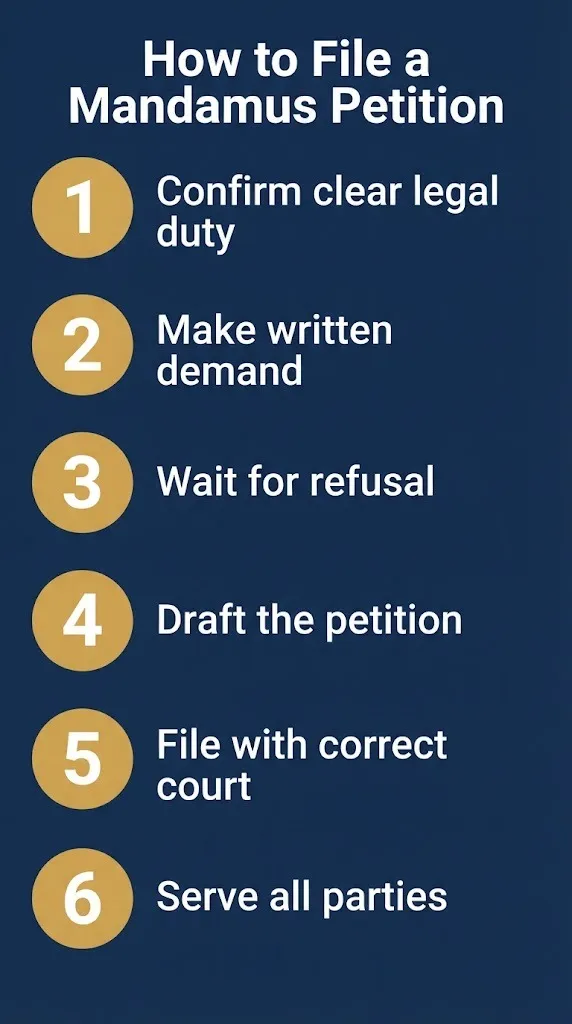
Here are the steps for a federal petition:
- Confirm the legal duty is clear, specific, and nondiscretionary
- Make a formal demand on the official or agency in writing
- Wait for a refusal or an unreasonable delay
- Draft the petition following Rule 21 or § 1361 requirements
- File with the correct court (circuit court for court action, district court for agency action)
- Serve all required parties including the trial judge for court-directed petitions
- Pay the docket fee or apply to proceed in forma pauperis
What Recent 2026 Federal Mandamus Cases Show
Recent 2026 Supreme Court and appellate dockets show how courts handle mandamus petitions in practice. The outcomes are mixed, and many petitions resolve before any ruling on the merits.
In April 2026, Oliver Bruckauf and others filed a petition for a writ of mandamus with the Supreme Court, docketed as No. 25-1181 . The petition was filed after an application for an injunction pending mandamus was denied by Justice Sotomayor . By May 2026, the respondents waived their right to respond, and the petitioners later sought to withdraw the petition as moot .
A separate petition, In Re Richard Devillier, was docketed in May 2026 and distributed for conference on September 28, 2026 . That petition remains pending.
At the Court of Appeals for Veterans Claims, a petitioner filed for mandamus in April 2026 to compel the VA to pay retroactive benefits already awarded . The VA requested a stay to resolve the matter, and by July 2026, the petitioner moved to dismiss as moot because the VA had resolved the complaint . The court granted the dismissal.
These cases illustrate a pattern: mandamus petitions often achieve their practical goal through the pressure of litigation, even when the court never rules on the merits. That’s not a guarantee, but it’s how the process sometimes works.
What Are the Deadlines for Filing a Mandamus Lawsuit?
There is no single federal deadline for mandamus petitions, but you must act promptly and make a demand before filing. State deadlines vary, and some courts apply laches to bar delayed petitions.
In New York, the four-month statute of limitations for Article 78 proceedings begins when the demand is refused, not when the injury occurs . Courts have held that the reasonable time for making a demand is measured by that same four-month period .
Federal courts don’t apply a fixed limitations period to mandamus under § 1361, but delay can bar relief under laches. The practical rule is simple: don’t sit on your rights. If you need an official to act, demand it in writing, document the refusal, and file promptly.
What Happens Next: Timeline for a Mandamus Petition
Step 1: Make a written demand on the official or agency, creating a record.
Step 2: Wait for a response or a clear refusal, which starts any applicable clock.
Step 3: File the petition with the correct court, following Rule 21 or § 1361.
Step 4: The court reviews the petition and may deny it without an answer or order a response.
Step 5: If the court orders a response, the respondent has a fixed time to answer, and the case proceeds.
Frequently Asked Questions
What is a mandamus lawsuit in simple terms?
A mandamus lawsuit asks a court to order a government official or lower court to do a specific job the law requires. It doesn’t seek money; it seeks action.
Can I file a mandamus lawsuit to get money from an agency?
No. Mandamus compels action, not payment. If you’re owed money, you need a different legal claim, such as a breach of contract or a statutory damages action.
How long does a mandamus lawsuit take?
It varies. Some petitions resolve in weeks if the agency acts under pressure; others take months. The court may deny the petition quickly or order a response, which extends the timeline.
Do I need a lawyer to file a mandamus petition?
You can file pro se, but the procedural rules are strict. A mistake can get your petition dismissed. A lawyer experienced in administrative or appellate law improves your odds.
What’s the difference between mandamus and an appeal?
An appeal asks a higher court to reverse a decision. Mandamus asks a court to order an official or lower court to act. Mandamus is not a substitute for appeal.
Can I file a mandamus lawsuit in state court?
Yes. Every state has its own mandamus procedures, often called writs of mandate. California, for example, has ordinary and administrative mandates with different rules .
What happens if I win a mandamus petition?
The court issues a writ ordering the official or court to perform the duty. If they still refuse, the court can hold them in contempt, but that’s rare.
How do I know if I have a valid mandamus claim?
You need a clear legal duty, a demand, and a refusal. If the official has discretion to decide, mandamus won’t work. A lawyer can evaluate your specific facts.