Total Compensation Statement 2026: What It Is, Why Employers Send Them, and How to Read Yours
Quick Answer
- What it is: A document showing salary plus benefits value, usually about 30% more than base pay.
- How much could I get? Nothing new. It’s a report of what you already received, not a payout.
- Most important thing: Check if your employer provides one. Statements usually arrive annually or during open enrollment.
A total compensation statement is not a legal settlement, and it is not something you file a claim for. It is a report your employer creates to show you the full value of what you earn beyond your paycheck. Benefits typically account for about 30% of total employer cost for private industry workers. If you got an email titled “Your Total Compensation Statement” and wondered if you were owed money, you are not. You are being shown what you already have.
This confusion happens often. The word “statement” sounds legal. It sounds like a settlement disbursement. It is neither. Your pay stub shows wages and deductions. Your W-2 shows taxable earnings. A total compensation statement shows the whole package: salary, health insurance, retirement match, paid time off, and more.
This article explains what these statements contain, why employers send them, how to read one line by line, and what to do if you never received yours. The most important fact to know upfront: this document exists to inform you, not to pay you.
The Facts
| Item | Detail |
|---|---|
| Document Type | Personalized employer report, not a legal settlement or claim |
| Typical Contents | Base salary, bonuses, health/dental/vision, retirement match, PTO, life insurance |
| Benefits Share of Employer Cost | About 30% of total compensation for private industry workers |
| Issuance Frequency | Annually, or during open enrollment or performance reviews |
| Claim Deadline | Not applicable, no claims process exists |
| Payout | Not applicable, this reports compensation already received |
| Administrator | Your employer’s HR or payroll department |
| Proof Needed | None, you just read it |
Is a Total Compensation Statement Legitimate or a Scam?
A total compensation statement is legitimate. It is a standard HR communication tool, not a scam.
Employers use these statements to show employees the full value of their package. That includes the parts you never see in your bank account, like the company’s share of health insurance premiums and 401(k) match.
Scammers sometimes exploit confusion around official-sounding documents. If you receive an email demanding you “claim your compensation statement” by clicking a link and entering personal information, treat it as suspicious. Real statements come from your HR system or a verified company email. They do not ask you to pay a fee or provide your Social Security number to “release funds.”
If your employer uses Oracle, Workday, or similar HR platforms, the statement lives behind a secure login. Vanderbilt University, Indiana University, and Ohio State University all publish instructions telling employees to access statements through their internal systems. That is how legitimate delivery works.
Key Takeaway: Real total compensation statements come through your HR portal, not through unsolicited emails asking for personal information.
What Is a Total Compensation Statement?
A total compensation statement is a personalized report showing the full dollar value of your salary, benefits, and employer contributions in one place.
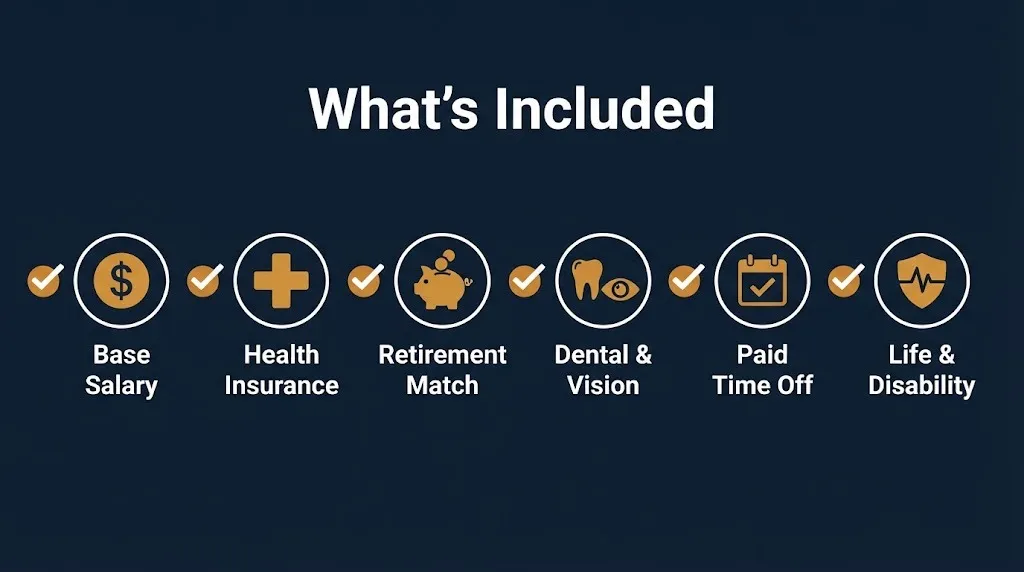
It goes beyond your base pay. A typical statement includes base salary, bonuses, health insurance premiums paid by your employer, dental and vision coverage, retirement contributions (including company match), life and disability insurance, and paid time off.
The point is visibility. An employee earning $70,000 might have a total compensation value of $91,000 once you add employer retirement contributions, insurance costs, and paid leave. That extra $21,000 is real money the employer spends. It just never appears in a paycheck.
Statements are often presented with simple visuals. Pie charts show how wages and benefits split. Bar charts compare employee retirement deferrals next to employer match amounts. The design is intentional: make invisible value visible.
What’s the Difference Between a Total Compensation Statement and a Pay Stub?
A pay stub shows actual payments and deductions for a specific period. A total compensation statement shows the annual value of everything your employer provides.
Your pay stub is a transaction record. It lists gross wages, tax withholdings, and net pay for that pay cycle. It answers: what did I get paid this period?
A total compensation statement is a valuation report. It answers: what is my entire package worth over a year? It includes employer-paid insurance premiums, which never touch your bank account. It includes retirement match dollars that go directly into your 401(k) or 403(b). It includes the dollar value of your paid time off.
Think of it like a store receipt versus an annual spending summary. The receipt shows one purchase. The summary shows everything you bought and what it all cost. Both are useful. They serve different purposes.
Texas Woman’s University explains it clearly: the statement is not a pay slip, and it is not a W-2. W-2 earnings are generally lower because pre-tax benefit contributions are subtracted from gross earnings for tax reporting. The total compensation statement shows the pre-tax value.
Key Takeaway: Your pay stub shows what hit your bank account. Your total compensation statement shows what your employer actually spent on you.
How Much Is My Total Compensation Worth?
Your total compensation is your base salary plus the dollar value of employer benefits, which typically adds about 30% to your base pay.
The exact percentage depends on your benefits package. Employer costs for private industry workers break down roughly 70% wages and salaries, 30% benefits. That is an average. Your number could be higher or lower.
Here is a simplified example for someone earning $70,000:
| Component | Annual Value |
|---|---|
| Base Salary | $70,000 |
| Employer Retirement Match (5%) | $3,500 |
| Health Insurance (employer share) | $8,000 |
| Dental and Vision | $800 |
| Life and Disability Insurance | $500 |
| Paid Time Off (value) | $5,000 |
| Total Compensation | $87,800 |
Those numbers are illustrative, not a prediction for your situation. Your actual statement will use your real salary and your employer’s real contribution rates.
The retirement match is often the most eye-opening line. An employee who defers 5% gets a 5% match. That is $3,500 from the employer on top of the $3,500 the employee contributes. Over ten years, that is $70,000 in contributions before any investment growth. Seeing that number in writing changes how people think about their 401(k).
Reality Check: A total compensation statement is not a settlement check. It is not new money. It is a report of compensation you already received or are entitled to through your employment. No one owes you a payout because you received one of these statements.
Who Gets a Total Compensation Statement?
Employers choose whether to issue total compensation statements. There is no federal or state law requiring them.
This is a voluntary communication tool. Some employers send them annually. Some send them during open enrollment. Some never send them at all.
Large employers, universities, and organizations competing for talent are more likely to provide them. Vanderbilt University issues statements for fiscal year data covering July through June. Indiana University updates total rewards statements daily in its employee portal. Ohio State University makes statements available in Workday, updated each pay period. William & Mary sends password-protected PDFs to employee email addresses in the first quarter of the calendar year.
If your employer does not provide one, you can ask. HR departments sometimes have the data and can generate a statement on request. The information comes from payroll systems, benefits administration platforms, and retirement plan records. It takes effort to compile, which is why some smaller employers skip it.
How to Read Your Total Compensation Statement
Read your total compensation statement by checking three sections: earnings, employer contributions, and benefits value.
Start with the earnings section. That should match your base salary and any bonuses or overtime you earned. If it looks wrong, contact payroll.
Next, look at employer contributions. This includes retirement match, Social Security and Medicare taxes your employer pays on your behalf, and any other employer-funded accounts. These are dollars spent on you that do not appear in your take-home pay.
Finally, review the benefits section. Health, dental, vision, life insurance, and disability coverage all have dollar values. Your employer pays a share. The statement shows what that share is.
A well-designed statement includes a total line. That is your total compensation for the period. It is almost always higher than your salary. That is the point. The gap is the value of your benefits.
Check the effective date on the statement. Vanderbilt’s covers July 2025 through June 2026. Texas Woman’s University uses data as of December 2025 for its 2026 statements. Know what time period you are looking at.
Why Do Employers Send Total Compensation Statements?
Employers send total compensation statements to improve retention, boost benefits awareness, and support recruitment.
The logic is simple. Employees who understand what their benefits cost are less likely to leave for a slightly higher salary elsewhere. If you know your employer pays $8,000 a year toward your health insurance, a job offer with a $5,000 raise and worse benefits is not actually a raise.
Statements also drive retirement plan participation. The match is invisible in a paycheck. When employees see the dollar amount, they contribute more. That helps them and helps the employer pass nondiscrimination testing.
Recruitment benefits too. A clear statement makes an offer package more competitive. Instead of saying “we have great benefits,” an employer can show the dollar value.
None of this is charity. It is a retention and engagement strategy. But it gives you real information you can use in salary negotiations and career decisions.
Key Takeaway: Employers send these statements because they want you to stay. Use the information to evaluate your full package, not just your salary.
What If Your Employer Doesn’t Provide a Total Compensation Statement?
If your employer does not provide a total compensation statement, you can request one or calculate an estimate yourself.
Start by asking HR. Some employers have the capability but have not prioritized it. A request from an employee might prompt action.
If that fails, gather your own data. Your pay stub shows salary and deductions. Your benefits enrollment materials show premium costs, including the employer share if you look at the summary plan description. Your retirement plan statement shows employer contributions. Combine those numbers.
Use this checklist:
- Find your base salary. Check your offer letter or pay stub.
- Find your employer’s health insurance contribution. Look at your benefits summary or ask HR.
- Find your retirement match. Check your 401(k) or 403(b) statement.
- Estimate PTO value. Divide salary by working days, multiply by days off.
- Add other benefits. Life insurance, disability, tuition assistance, wellness stipends.
- Sum the total. Compare to salary.
It will not be as polished as a professional statement. It will still open your eyes.
Frequently Asked Questions
Is a total compensation statement the same as a settlement?
No. A total compensation statement is an employer report. A settlement is a legal resolution of a dispute. They share no process or purpose.
Do I have to pay taxes on my total compensation statement?
No. The statement is informational. It is not a tax document. Use your W-2 for tax filing. The total compensation figure includes pre-tax benefits, so it is higher than W-2 earnings.
How often should I receive a total compensation statement?
There is no required schedule. Many employers issue them annually. Some do it during open enrollment. Some never do.
Can I use my total compensation statement for a loan application?
Probably not. Lenders want pay stubs and W-2s. A total compensation statement is not a standard income verification document.
What if my total compensation statement shows numbers I don’t recognize?
Contact your HR or payroll department. Errors happen, especially with employer contribution calculations. Ask for an explanation of any line item that confuses you.
Does a total compensation statement mean I’m getting a raise?
No. It shows what you already receive. It is not a promise of future compensation or a bonus.
Why is my total compensation higher than my salary?
Because it includes employer-paid benefits. Health insurance, retirement match, and PTO all have dollar values. They are part of what your employer spends on you.
Can I get a total compensation statement if I’m self-employed?
No, not from an employer. If you are self-employed, you calculate your own total compensation by adding business revenue minus expenses, or however you structure your pay. There is no employer to issue a statement.
What Happens Next: Timeline for Statements and Reviews
Expected first quarter 2027: Many employers issue annual statements covering the prior calendar year. William & Mary sends its statements in the first quarter.
Expected during open enrollment (typically October or November): Some employers time statements to coincide with benefits selection.
Expected during performance review cycles: Some employers deliver statements alongside compensation discussions.
Ongoing: Employees at institutions like Indiana University can access updated statements daily through internal portals.
The most important date depends on your employer. If you have not received a statement and want one, ask now. Do not wait for a deadline that does not exist.
The Bottom Line
A total compensation statement is not a lawsuit, a settlement, or a payout. It is a report showing the full value of your pay and benefits. If you received one, read it. Check the employer contributions and benefits sections. If you did not receive one, ask your HR department or calculate an estimate yourself. The number might surprise you. Your base salary is only part of what you earn.