Property Settlement Agreement Virginia 2026: Requirements, Templates and Filing Rules
Quick Answer
- A property settlement agreement in Virginia is a private contract, not a lawsuit or a payout.
- There is no fixed dollar amount. Courts divide marital property under 11 statutory factors.
- Couples without minor children need a signed agreement to use the 6-month separation ground.
A property settlement agreement in Virginia is a written contract between spouses that divides property, debt, and support before or during a divorce. Under Virginia Code Section 20-91(A)(9), a signed agreement is required before a childless couple can file for no-fault divorce after only six months of separation instead of twelve.
This matters to anyone separating in Virginia right now, because the wrong agreement, or no agreement at all, can double your waiting period. There is no government fund here and no claim deadline. This is a private legal document you and your spouse create together.
This article covers what the agreement must contain, how Virginia courts review it, the filing fees involved, and where free templates fall short. One detail most guides skip: once a court incorporates your agreement into the final decree, the property terms generally cannot be changed later, even if your finances shift.
The Facts
| What it is | A private contract dividing marital property, debt, and support between divorcing or separating spouses |
| Governing law | Virginia Code Sections 20-109, 20-109.1, and 20-107.3 |
| Fund or payout | Not applicable. This is a negotiated agreement, not a settlement fund |
| Filing fee | $60 to $95 in most Virginia circuit courts, plus $2 per page for certified copies |
| Separation requirement | 6 months with a signed agreement and no minor children, or 12 months otherwise |
| Enforceability | Binding once signed. Enforceable as a court order once incorporated under Section 20-109.1 |
| Proof needed | Full financial disclosure, notarized signatures, and often a corroborating witness for the divorce itself |
Is a Virginia property settlement agreement a real legal document?
Yes. It’s a binding contract recognized under Virginia Code Section 20-109, not a form you fill out for show.
A separation agreement becomes legally binding once both spouses sign it, according to Virginia family law guidance. That happens before any judge sees it.
The agreement gains extra power once a court gets involved. Under Virginia Code Section 20-109.1, when a court affirms, ratifies, and incorporates the agreement into a divorce decree, its terms become enforceable as a decree of the court.
That distinction matters practically:
| Stage | Legal status |
|---|---|
| Signed by both spouses | Binding contract between the parties |
| Incorporated into the divorce decree | Enforceable as a court order |
| Violated after incorporation | Can trigger contempt proceedings |
A reconciliation after signing can undo the agreement. Virginia Code Section 20-155 states that reconciliation abrogates a separation or property settlement agreement unless the agreement expressly says otherwise.
How much money can you get from a property settlement agreement?
There is no set payout, because this is not a lawsuit or a claims fund. Your share depends on negotiation and, if contested, on 11 statutory factors a judge applies.
Virginia is an equitable distribution state, not a community property state. Courts divide marital property fairly under Virginia Code Section 20-107.3, but fair does not mean automatically equal.
| Distribution system | How it works |
|---|---|
| Community property (9 states) | Presumes a 50/50 split of marital assets |
| Equitable distribution (Virginia, 40 other states) | Divides property based on 11 statutory factors, which can produce splits from 0% to 100% on a single asset |
In practice, courts applying these factors often land near a 50/50 split of marital property, though the court can order 60/40, 55/45, or other ratios depending on the facts.
What courts weigh includes each spouse’s monetary and nonmonetary contributions, the length of the marriage, and the circumstances leading to the divorce.
Anyone who tells you a fixed dollar figure or percentage before reviewing your specific assets and debts is guessing. Your agreement is negotiated, not assigned by a formula.
What must a Virginia property settlement agreement include?
It must address every major financial and custody issue the couple faces, or gaps in it will surface later in court.
Separation agreements typically cover division of marital property, allocation of debt, spousal support, child custody, visitation, child support, and attorney’s fees.
A complete agreement generally addresses:
- Division of the marital home and any other real estate
- Division of vehicles, bank accounts, and investment accounts
- Division of retirement accounts, which often requires a separate court order
- Allocation of marital debt, including mortgages, credit cards, and loans
- Spousal support terms, if any apply
- Child custody, visitation schedule, and decision-making authority, if applicable
- Child support consistent with state guidelines
Dividing a 401(k) or pension generally requires a separate Qualified Domestic Relations Order beyond the settlement agreement itself. Skipping that step is a common and costly oversight.
Vague language creates future disputes. Terms like “reasonable visitation” leave too much room for disagreement, and specific schedules hold up better.
Key Takeaway: A property settlement agreement is only as strong as its specifics, and vague custody or missing retirement provisions are the most common source of post-divorce conflict.
Does your agreement need to be notarized in Virginia?
Practically, yes. Most Virginia circuit courts expect a notarized or properly acknowledged agreement before incorporating it into a decree.
Virginia Code Section 20-109.1 specifically references properly acknowledged agreements, including those where jurisdiction over a nonresident spouse comes through an order of publication.
What courts generally expect:
- Both spouses’ original signatures
- Notarization or acknowledgment before a notary public
- Full financial disclosure attached or referenced
- Clear, unambiguous language on every material term
If one spouse hides assets or fails to disclose debts, the entire settlement agreement could be challenged under Virginia Code Section 20-107.3.
Think of it like a warranty claim missing a receipt. Even a fair deal becomes hard to enforce if the paperwork itself has a defect.
How does a property settlement agreement affect your divorce timeline?
It can cut your waiting period in half. Virginia requires either six or twelve months of continuous separation before a no-fault divorce, and a signed agreement determines which one applies.
Virginia Code Section 20-91(A)(9) allows the six-month track only when the couple has no minor children together and has a written separation agreement.
| Separation ground | Waiting period | Agreement required |
|---|---|---|
| No minor children, signed agreement | 6 months | Yes |
| Minor children, or no agreement | 12 months | No |
The requirement is strict. If you have a child who is not yet 18, or you do not have a signed property settlement agreement, you cannot request a divorce based on the six-month ground.
Courts also require no marital cohabitation during the separation period. That means no shared meals, no intimate relations, separate finances, and clear intent to live apart.
Reality Check: No court clerk, attorney, or online service will contact you out of the blue with a “settlement payout” tied to your divorce. There is no government fund here. Filing your agreement with the court costs the standard circuit court fee, and anyone offering to “process” free government paperwork for an inflated fee is selling convenience you don’t need.
Key Takeaway: Without a signed property settlement agreement, childless couples in Virginia are locked into the full 12-month separation period regardless of how amicable the split is.
Who needs a property settlement agreement in Virginia?
You may benefit from one if you’re separating or divorcing and want to control how property, debt, and custody get divided, rather than leaving it entirely to a judge.
A separation agreement is not legally required to get divorced in Virginia in every case. But it becomes mandatory specifically for couples pursuing the six-month no-fault ground.
You likely need one if:
- You and your spouse are separating and own property together
- You want to avoid the full 12-month waiting period and have no minor children
- You want to resolve support, custody, or debt terms without a contested trial
- You have retirement accounts, a home, or business interests requiring careful division
A signed agreement does not create Virginia’s version of a formal legal separation status, since the state does not recognize one. It also cannot force your spouse to sign, since it remains a voluntary contract.
Custody and support terms carry limits. A court retains authority over the best interests of the child and cannot be prevented by agreement from exercising its power to decide child support.
How do you get a property settlement agreement in Virginia step by step?
Draft it early, disclose everything, and don’t sign before understanding what you’re giving up.
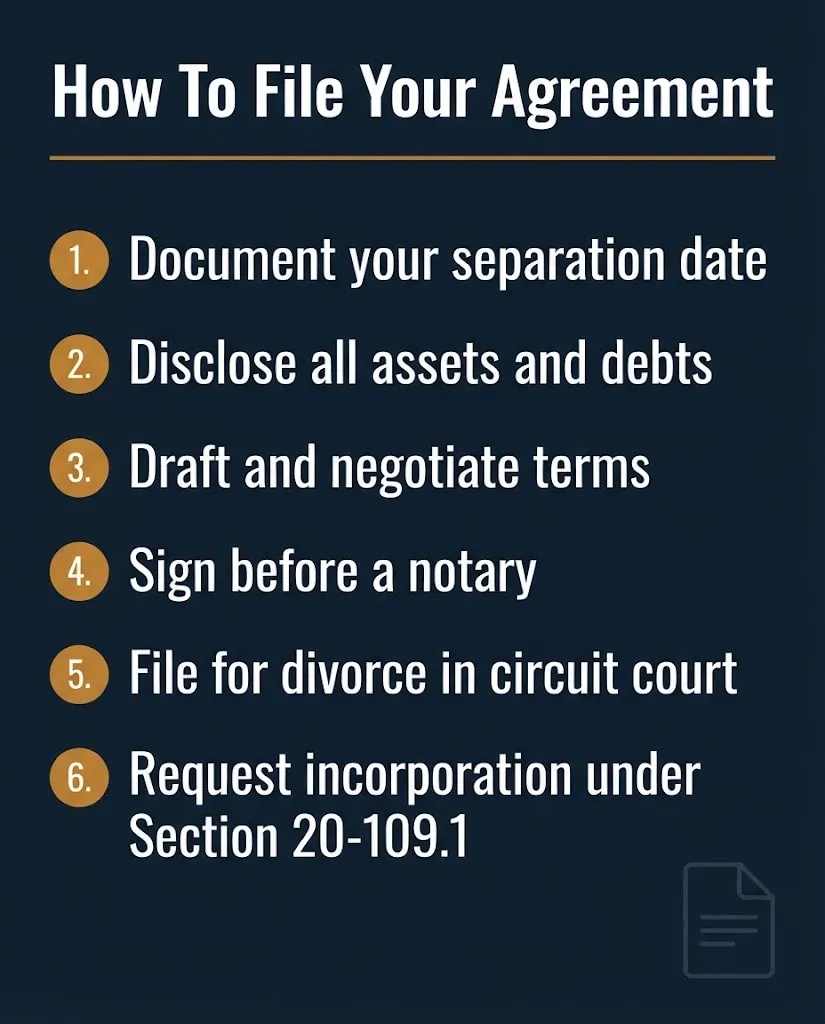
- Determine your separation date and document it clearly.
- Gather complete financial records, including bank, retirement, and debt statements.
- List every asset and debt as marital, separate, or hybrid.
- Negotiate terms for property, debt, support, and custody if applicable.
- Draft the agreement in writing, addressing every issue specifically.
- Have both spouses sign before a notary.
- File for divorce, requesting the agreement be affirmed, ratified, and incorporated under Section 20-109.1.
- Present a corroborating witness for the no-fault separation, since Virginia courts generally require one.
The corroborating witness step trips up people who don’t realize it’s required until late in the process. That witness must have personal knowledge of your separation, such as having visited your separate residences.
Under Virginia Code Section 20-109.1, a court will generally affirm and incorporate a property settlement agreement into the final decree unless it finds the terms unconscionable.
What is marital property versus separate property in Virginia?
Marital property is everything acquired by either spouse between the marriage date and the separation date. Separate property covers what you owned before marriage, inheritances, and gifts from someone other than your spouse.
| Property type | Examples |
|---|---|
| Marital | Income earned during marriage, homes bought together, retirement contributions made during marriage |
| Separate | Premarital savings, inheritances, gifts from third parties |
| Hybrid | A home bought before marriage but paid down with marital income |
Virginia courts follow a three-step process: classify each asset, value it as of the evidentiary hearing date, then distribute the marital share.
Separate property can lose its protection. If it gets commingled or retitled into joint names, it’s presumed to have become marital unless you can trace it back with clear evidence.
Debt follows a different rule from assets. Marital debt is measured as of the date of separation, not the date of the hearing, which creates a meaningful asymmetry in how debts and assets get valued.
Key Takeaway: Property acquired during the marriage is presumed marital and divisible, while separate property can quietly convert into marital property through commingling.
What does a Virginia property settlement agreement template need to cover?
A generic template rarely covers Virginia’s specific statutory requirements, and that gap is where DIY agreements fail.
A template built for another state may miss Virginia-specific rules, such as the QDRO requirement for retirement accounts or the corroborating witness requirement for no-fault divorce.
Before using any template, confirm it addresses:
- Explicit classification of marital versus separate property
- A retirement division mechanism, referencing a future QDRO if needed
- Specific custody and visitation schedules, not vague language
- A clause on whether the agreement is incorporated or merely referenced in the decree
- A reconciliation clause addressing what happens if the couple reunites
DIY agreements often contain unclear or unenforceable provisions. Errors in custody terms or property division language can lead to disputes or expensive litigation later.
A template is a starting point, not a finished document. Treat any free downloadable Virginia property settlement agreement template as a draft that still needs review against your specific assets and Virginia’s statutory requirements.
What does filing a property settlement agreement cost in Virginia?
Filing fees run modest, but the total cost of a divorce with a settlement agreement varies widely depending on complexity.
Virginia’s circuit court filing fee for divorce runs in the $60 to $95 range in most counties, with one county reporting an $86 fee in 2026.
| Cost item | Typical range |
|---|---|
| Circuit court filing fee | $60 to $95 |
| Certified copies of the decree | $2 per page |
| Service of process, if needed | $40 to $75 |
| Uncontested divorce overall | $500 to $1,500 |
| Contested divorce overall | $15,000 to $50,000 or more |
Attorney fees, where used, commonly run $250 to $500 per hour, with contested cases requiring far more hours than uncontested ones.
An uncontested divorce, where both spouses already agree through a signed settlement agreement, stays firmly on the lower end of that range.
Can a Virginia property settlement agreement be changed later?
Custody and child support terms can be modified. Property division terms generally cannot, once incorporated into the final decree.
Custody and support terms may be modified if there is a material change in circumstances, since courts retain ongoing authority over children’s welfare.
Property terms work differently. They usually cannot be changed once incorporated into the divorce decree unless there was fraud, duress, or another legal defect in the original agreement.
That asymmetry catches people off guard. Situations that generally do not reopen a property division:
- A job loss after the divorce is final
- A change in the value of an asset you kept
- Regret over a trade you agreed to at the time
Situations that may support reopening a settlement:
- Proof one spouse concealed assets during disclosure
- Evidence of fraud in how the agreement was procured
- Duress that undermined a spouse’s ability to consent freely
Think of it like a home warranty claim filed after the coverage window closed. Once the deal is signed and incorporated, the standard path for reopening it is narrow.
What happens next
Before filing: Confirm your separation date and begin gathering financial disclosure documents.
During separation: Draft, negotiate, and sign the property settlement agreement with notarization.
At 6 months (no children, signed agreement) or 12 months (otherwise): File for no-fault divorce under Virginia Code Section 20-91(A)(9).
At the hearing: Present your corroborating witness and request the court affirm, ratify, and incorporate the agreement under Section 20-109.1.
After the decree: Complete any required QDRO filings for retirement account division separately from the main agreement.
Frequently Asked Questions
Do I need a property settlement agreement to divorce in Virginia?
Not always, but it’s required for one specific path.
Couples without minor children need a signed agreement to use the shorter six-month no-fault separation ground.
Couples with minor children, or without an agreement, face the full twelve-month wait.
How much will I get from a Virginia property settlement?
There’s no fixed amount, since this is a negotiated contract, not a lawsuit payout.
Virginia courts apply 11 statutory factors under equitable distribution if the case is contested.
Your specific assets, debts, and negotiation determine the outcome.
Is a property settlement agreement the same as legal separation?
No, and Virginia doesn’t recognize formal legal separation at all.
A separation agreement is a private contract, not a court-granted status.
It governs your rights while you live apart, ahead of or during a divorce filing.
Can I use a free online template for my Virginia agreement?
You can start with one, but a generic template often misses Virginia-specific requirements.
Retirement division, custody specificity, and incorporation language need close attention.
Review any template against Virginia Code Sections 20-107.3 and 20-109.1 before signing.
Can my spouse be forced to sign a settlement agreement?
No. It’s a voluntary contract, and Virginia law cannot compel a signature.
If your spouse refuses, there is no agreement until you both reach terms.
Contested cases then proceed through the standard divorce and equitable distribution process.
What happens if my spouse hides assets before I sign?
Concealed assets can undermine the entire agreement.
Incomplete financial disclosure can lead to the settlement agreement being challenged under Virginia Code Section 20-107.3.
Full disclosure protects both spouses from a later legal challenge.
Can property terms be changed after the divorce is final?
Generally, no, once the agreement is incorporated into the decree.
Courts require proof of fraud, duress, or a similar defect to reopen property terms.
Custody and support terms remain modifiable for a material change in circumstances.
Gather your full financial picture before you draft or sign anything, and confirm your separation date in writing. If you have no minor children and want the shorter track, your six-month clock depends entirely on having a signed, complete agreement in place.