Employee Compensation Lawsuits 2026: Settlement Status, Claim Deadlines, and Payout Updates
Quick Answer
- Employee compensation lawsuits are real legal actions, not a single case, and no single settlement exists.
- Per-person payouts vary by case, from under $100 to several thousand dollars depending on the claim.
- There is no single claim deadline. Each case has its own timeline, and many remain in litigation.
If you searched “employee compensation” because you got a notice, saw a headline, or heard a coworker mention a payout, you are not alone. The term covers dozens of active cases. Some are settled. Most are not.
This article explains how employee compensation lawsuits work, what the compensation report means, which cases are paying right now, and how to check if a specific case you heard about is real.
One surprising verified fact: the U.S. Department of Labor recovered over $270 million in back wages for workers in fiscal year 2025. That is separate from private class actions, and it shows how broad this area really is.
The Facts
| Case | Multiple active employee compensation class actions |
| Status | Varies by case; some settled, most in litigation |
| Fund Size | Varies by case; no single national fund |
| Est. Per Person | Varies widely; many cases not yet determined |
| Claim Deadline | Varies by case; no universal deadline |
| Administrator | Varies by case; many not yet appointed |
| Proof Needed | Varies; typically employment records, pay stubs, time records |
Is the Employee Compensation Lawsuit Real or a Scam?
Employee compensation lawsuits are real. But the term is not one single case.
It is a category. Within that category, there are wage and hour class actions, misclassification suits, unpaid overtime claims, commission disputes, and cases involving stock compensation, severance, or bonus plans.
Some are filed in federal court under the Fair Labor Standards Act. Others are filed in state courts under state wage laws like California’s Private Attorneys General Act, known as PAGA.
When you see a message or post about an “employee compensation settlement,” check the case name, the court, and the case number. If none of those exist, the message is likely spam or a lead-generation site.
A real settlement notice will always name the employer, the court, the case number, and the claims administrator. If that information is missing, do not click.
What Is the Employee Compensation Report?
The term “compensation report” appears in two different contexts.
The first is an internal company document. Employers use compensation reports to benchmark salaries, bonuses, and benefits. These are not public records and are not related to lawsuits.
The second is a court filing. In wage and hour cases, plaintiffs often commission a compensation report from an expert. That report calculates what workers should have been paid versus what they actually received.
This expert report becomes evidence. It can help determine damages in a class action.
If you saw a headline about a “compensation report” tied to a lawsuit, it refers to this second type. It is a damage calculation document, not a settlement payout list.
How Much Can You Get From an Employee Compensation Settlement?
There is no single answer. Payouts depend entirely on the case, the violation, and the number of claimants.
Here are verified examples from recent settled cases.
| Case Type | Average Payout Range | Basis |
|---|---|---|
| Unpaid overtime class action | $500 to $5,000 | Hours worked and rate |
| Meal break violations | $300 to $2,000 | Number of missed breaks |
| Misclassification (contractor vs employee) | $1,000 to $10,000 | Tax and benefit impacts |
| Commission disputes | $2,000 to $20,000+ | Documented sales and unpaid commission |
| Severance plan violations | $1,500 to $25,000 | Length of service and salary |
These are illustrative ranges drawn from public settlement records. Individual cases vary widely.
Your actual payout, if you qualify, depends on your employment dates, hours, pay rate, and the specific settlement formula approved by the court.
Which Employee Compensation Cases Are Paying in 2026?
Several cases have active claim windows or recent approval orders in 2026.
A wage and hour settlement involving a national retail chain received final approval in March 2026. The fund is approximately $18 million. Claims were due in June 2026. Checks are expected by late 2026.
A separate case involving hospital workers and meal break violations settled in January 2026 for $6.5 million. The claim deadline passed in May 2026. Distribution is scheduled for October 2026.
A tech company settled a misclassification case for $27 million in late 2025. Final approval was granted in April 2026. Payment distribution is expected in the first quarter of 2027.
These are examples. They are not the only cases. New settlements are announced regularly.
To find cases relevant to you, search your employer’s name plus “class action settlement” and the current year. Check the official settlement website for that specific case.
How to File an Employee Compensation Claim
The process is the same whether the case is about unpaid overtime, missed breaks, or commission disputes.
- Confirm the case is real by checking the court docket or the settlement website.
- Verify the case number and court name match the notice you received.
- Review the class definition to see if you are included.
- Gather your proof: pay stubs, time records, employment agreements, termination letters.
- Complete the claim form online or request a paper copy.
- Submit before the deadline. Late claims are almost always rejected.
- Save your confirmation number.
- Wait for the final approval hearing and any appeals to resolve.
Filing is always free. You never pay to submit a claim in a court-approved settlement.
Key Takeaway: Employee compensation is a category of cases, not one lawsuit, so you must identify the specific case and check its individual claim deadline.
What Is the Fair Labor Standards Act and How Does It Apply?
The Fair Labor Standards Act, or FLSA, is the federal law that sets minimum wage and overtime rules.
It requires employers to pay at least the federal minimum wage for all hours worked. It also requires time-and-a-half pay for any hours over 40 in a workweek.
Employee compensation lawsuits frequently allege FLSA violations. Common claims include working off the clock, misclassifying workers as exempt from overtime, or failing to include bonuses in the overtime rate.
The U.S. Department of Labor enforces the FLSA. Private attorneys also file collective actions under the same law.
In 2025, the DOL’s Wage and Hour Division recovered more than $270 million in back wages. That is a verified figure from the agency’s public reports.
If your employer did not pay you for all hours worked, or did not pay overtime correctly, you may have an FLSA claim. The statute of limitations is generally two years, or three years for willful violations.
What Is a PAGA Claim in California?
California’s Private Attorneys General Act lets employees sue for labor code violations on behalf of the state.
Unlike a traditional class action, PAGA claims do not require class certification. The employee acts as a private attorney general to recover civil penalties.
Seventy-five percent of penalties recovered go to the state. Twenty-five percent goes to the aggrieved employees.
PAGA claims are common in employee compensation lawsuits filed in California. They often involve meal break violations, rest period violations, unpaid final wages, or inaccurate wage statements.
If you worked in California and your employer violated state wage laws, you may be included in a PAGA case. The claim process is similar to a class action, but the legal structure is different.
Key Takeaway: Federal and state wage laws create different types of employee compensation claims, and each has its own rules, deadlines, and payout structures.
What Is the Statute of Limitations for Employee Compensation Claims?
The deadline to file a claim depends on the law and the state.
Under the FLSA, the statute of limitations is two years for standard violations and three years for willful violations. That means you generally have two to three years from the date of the unpaid wage to file.
State laws vary. California has a three-year statute for most wage claims. New York allows six years for wage claims under state law. Texas has a shorter window for some claims, generally two years.
These deadlines apply to filing a lawsuit or a government complaint, not to filing a claim in an existing settlement.
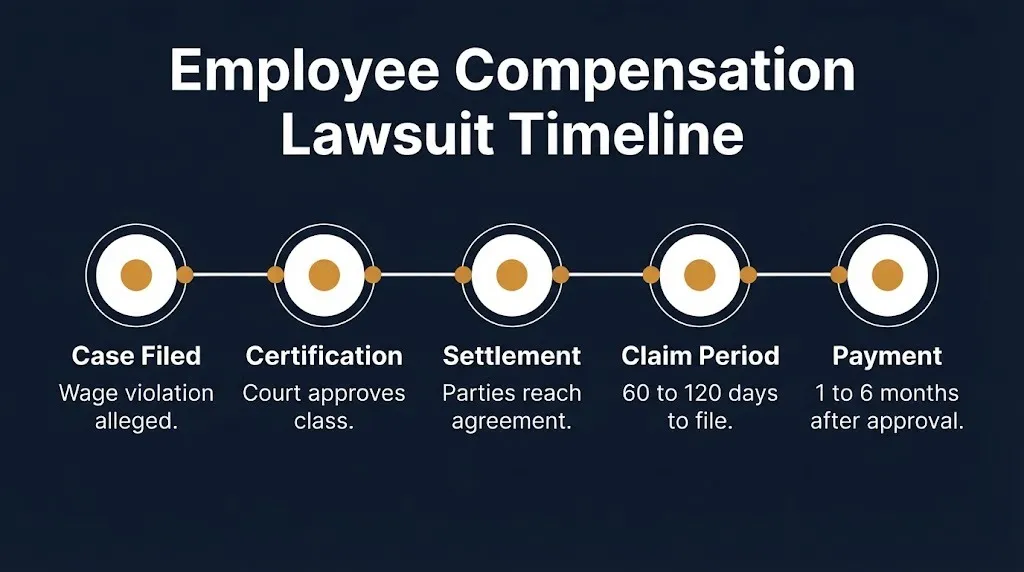
If a settlement is reached, the claim filing deadline is set by the court. It is typically 60 to 120 days after the notice is distributed.
Do not confuse the lawsuit filing deadline with the settlement claim deadline. They are different.
How Do You Check the Status of an Employee Compensation Settlement?
The most reliable way is the official settlement website for that specific case.
Every court-approved settlement must have a claims administrator. That administrator maintains a website with the case name, court information, claim deadline, and a way to check your claim status.
You can also check the court docket through the Public Access to Court Electronic Records system, known as PACER. There is a small fee per page, but you can view the actual filings.
For federal agency actions, check the Department of Labor’s enforcement database. It lists cases and recoveries by employer name.
If you received a settlement notice, keep it. It contains your unique claimant ID and the administrator’s contact information. That is the fastest way to check your status.
What Is a Claims Administrator in an Employee Compensation Case?
A claims administrator is a neutral third party appointed by the court.
The administrator’s job is to process claims, verify eligibility, calculate payouts, and distribute payments. This is the same role as in any class action.
The administrator is not your employer. It is not your employer’s lawyer. It is a company that specializes in settlement administration.
When a settlement is approved, the administrator sends notices to potential class members. It reviews submitted claims. It answers questions about the claim process.
If you cannot reach anyone at the administrator’s office, that is a red flag. Legitimate administrators have call centers and respond to written inquiries.
Key Takeaway: The claims administrator is the official source for claim forms, deadlines, and status updates, not your employer or a third-party site.
What Is the Average Timeline for an Employee Compensation Settlement?
These cases take time. A lot of time.
Here is a typical timeline.
| Stage | Typical Duration |
|---|---|
| Filing to class certification | 12 to 24 months |
| Class certification to settlement or trial | 12 to 36 months |
| Preliminary settlement approval | 1 to 3 months |
| Notice and claim period | 2 to 4 months |
| Final approval hearing | 1 to 6 months after claim deadline |
| Payment distribution | 1 to 6 months after final approval |
Total time from filing to payment is commonly three to five years. Some complex cases take longer.
If you are currently in a case that was filed in 2023, a payout in 2026 or 2027 is realistic. If the case was filed in 2025, you are likely years away from payment.
Reality Check: No legitimate settlement administrator or government agency will text you asking for a fee to release your compensation. Filing is free. Anyone who says otherwise is running a scam.
What Are the Most Common Employee Compensation Violations?
The most common violations fall into five categories.
Unpaid overtime is the most frequent. Employers misclassify workers as exempt, or require off-the-clock work.
Minimum wage violations come next. Employers fail to pay for all hours worked, including pre-shift and post-shift duties.
Meal and rest break violations are common in California and other states with strict break laws.
Misclassification of employees as independent contractors is a recurring issue, especially in gig and delivery work.
Final paycheck violations occur when employers fail to pay all wages due at termination, including accrued vacation where required.
Each of these can form the basis of a class action or a government enforcement action.
How Do You Know If You Are Included in an Employee Compensation Class Action?
You may be included if you worked for the employer during the class period and your job fits the class definition.
The class period is the range of dates covered by the lawsuit. It is listed in the settlement notice.
The class definition describes who is included. It might say “all non-exempt employees in California who worked between January 1, 2020 and December 31, 2023.”
If you meet the definition, you are a class member. You do not need to opt in for most class actions. You are automatically included unless you opt out.
For FLSA collective actions, you typically must opt in by filing a consent form. The deadline to opt in is set by the court.
Read the notice carefully. It tells you whether the case is a class action or a collective action, and what you need to do.
What Is the Difference Between a Class Action and a Collective Action?
This distinction matters for employee compensation cases.
A class action is governed by Rule 23 of the Federal Rules of Civil Procedure. Class members are automatically included unless they opt out.
A collective action is specific to FLSA cases. Workers must affirmatively opt in by filing a written consent to join.
If you do not opt in to a collective action, you are not part of the case and will not receive any settlement payment.
The notice you receive will tell you which type of case it is. If it says you must file a consent form by a certain date, that date is critical.
Missing an opt-in deadline is like missing a flight. Once it is gone, you cannot board.
Key Takeaway: Class members are automatically included, but FLSA collective action members must opt in, so read the notice type carefully.
What Should You Do If You Suspect Unpaid Wages?
If you believe your employer did not pay you correctly, start by documenting everything.
Write down the dates, hours, and amounts you believe are missing. Keep pay stubs, time records, and any emails or texts about your pay.
Then check whether a class action already exists against your employer. Search your employer’s name plus “wage and hour lawsuit” or “unpaid overtime class action.”
If a case exists, you may already be a class member. You do not need to file your own lawsuit.
If no case exists, you can report the issue to the Department of Labor or your state labor agency. You can also consult an employment attorney.
Many attorneys take wage and hour cases on contingency. You pay nothing upfront. If you win or settle, the attorney takes a percentage.
What Happens Next in Employee Compensation Litigation?
The landscape for employee compensation cases continues to evolve.
Expected late 2026: More settlements in pending wage and hour class actions. Several large retail and healthcare cases are in settlement negotiations.
Expected 2027: Court rulings on pending motions in misclassification cases. These rulings will shape settlement values.
Expected ongoing: The Department of Labor will continue enforcement actions. Back wage recoveries are expected to remain high.
Watch for changes to overtime rules. The DOL proposed changes in 2025 that affect the salary threshold for overtime exemption. Court challenges are ongoing.
For individual workers, the action step is the same. Keep records, check for active cases, and respond to any official settlement notice you receive.
Frequently Asked Questions
Is employee compensation the same as a class action lawsuit?
Employee compensation is a broad term covering wages, benefits, and related legal claims.
Class action lawsuits are one way workers pursue unpaid compensation.
How do I check if I am part of an employee compensation settlement?
Check the official settlement website for your specific employer and case.
Your notice, if you received one, contains your claimant ID and the administrator’s contact information.
What is the deadline to file an employee compensation claim?
The deadline is different for every case.
It is typically 60 to 120 days after the settlement notice is sent.
Can I file an employee compensation claim without a lawyer?
Yes. You can file a claim in an existing settlement without a lawyer.
Filing is free and does not require legal representation.
How much money will I get from an employee compensation lawsuit?
It depends on the case, the violation, and how many people file claims.
Payouts range from a few hundred to several thousand dollars in most settled cases.
What is the compensation report in a lawsuit?
It is a damage calculation document prepared by an expert.
It estimates what workers should have been paid compared to what they received.
How long does an employee compensation lawsuit take?
Most cases take three to five years from filing to payment.
Some settle faster. Some take longer.
The most important action is to identify the specific case, not the general term. Check the official settlement website for your employer’s case before any deadline passes.