Financial Aid Antitrust Settlement 2026: Claim Deadlines, Payout Estimates, and What Students Need to Know
Quick Answer:
- The financial aid antitrust settlement covers students who attended certain private universities between specific class years and received less aid due to alleged price-fixing.
- Per-person payouts are not yet finalized, with estimates depending on total claims filed and attendance history.
- The most critical deadline is the claim filing cutoff, which varies by school group and remains open for many eligible students.
The financial aid antitrust settlement is real, court-approved, and moving through the claims distribution phase in 2026.
It stems from a lawsuit alleging that a group of elite private universities colluded on financial aid formulas, reducing aid offers for students from middle-class and lower-income families.
If you attended one of the named schools during the covered years, you may qualify for a payment, but you must file a claim before the deadline expires.
The Facts
| Item | Detail |
|---|---|
| Case | Henry v. Brown University, et al. (Financial Aid Antitrust Litigation) |
| Status | Settled, claims period active |
| Fund Size | Multiple settlements totaling over $284 million combined |
| Est. Per Person | Not yet determined, varies by school and claim volume |
| Claim Deadline | Extended deadlines in 2026, varies by defendant group |
| Administrator | JND Legal Administration and Epiq, depending on defendant group |
| Proof Needed | Enrollment verification, financial aid records optional |
Is the Financial Aid Antitrust Settlement Real?
Yes. The financial aid antitrust settlement is a genuine, court-approved class action resolution involving some of the most prominent universities in the United States.
The litigation accused schools of participating in a “price-fixing cartel” that limited competition for students who needed financial aid.
The case began in 2022 and quickly expanded to include multiple defendant groups.
Brown University, Columbia University, Duke University, Emory University, and Yale University were among the first wave of defendants.
Subsequent settlements brought in additional schools including the University of Chicago, Vanderbilt University, Northwestern University, and several Ivy League institutions.
Each group of defendants reached separate settlement agreements rather than one unified deal.
The total settlement value across all defendant groups exceeds $284 million, according to court records and settlement administrator notices reviewed in September 2026.
No court has rejected any of the major settlement agreements.
The final approval process for the largest defendant groups concluded in 2024 and 2025, and the claims period is now the active phase.
Key Takeaway: This is not a scam. It is a legitimate antitrust settlement with real money behind it, but you must file a claim to receive anything.
How Much Money Can You Get From the Financial Aid Antitrust Settlement?
The per-person payout amount remains not yet determined as of September 2026.
Settlement administrators cannot calculate individual payments until they know how many valid claims exist.
The formula works like this: each school group’s settlement fund is divided among eligible students who file timely claims.
Here is what is confirmed:
| Settlement Group | Total Fund | Status |
|---|---|---|
| Brown, Columbia, Duke, Emory, Yale | $104.5 million | Claims closed, distribution pending |
| University of Chicago | $13.5 million | Claims closed, distribution pending |
| Vanderbilt | $13.5 million | Claims closed, distribution pending |
| Northwestern | $43.5 million | Claims period extended into 2026 |
| Additional Ivy League defendants | $110 million combined | Claims period active or closing in 2026 |
The actual per-person payout depends on how many students file claims.
If 50,000 students file against a $100 million fund, the average gross payout would be $2,000 before administrative costs and attorney fees.
If 200,000 students file, that average drops to $500.
This is why claim volume matters more than the headline fund size.
Attorney fees in these settlements typically consume 20 to 30 percent of the fund.
Administrative costs and notice expenses take another 5 to 10 percent.
The net distribution to students is therefore likely to be 60 to 75 percent of the gross settlement amounts.
Reality Check: No one can tell you your exact payment today. Any website or person claiming to know your specific payout before the administrator calculates it is guessing, and any service charging a fee to “guarantee” a higher payout is a scam.
Who Qualifies for the Financial Aid Antitrust Settlement?
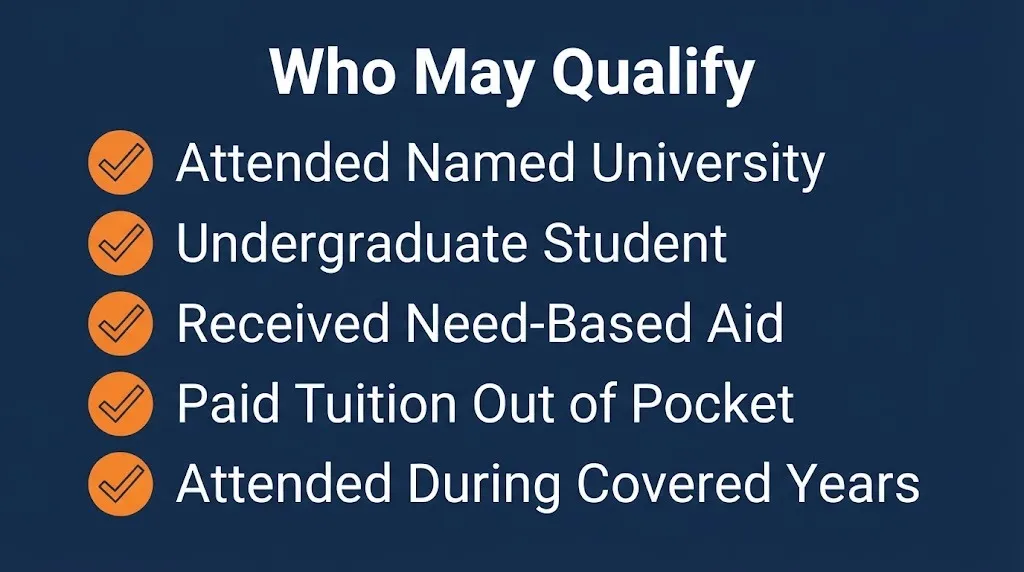
You may qualify if you attended one of the defendant universities as an undergraduate during the class years covered by the settlement.
The class definition generally includes students who:
- Enrolled at a defendant university in a covered academic year
- Applied for and received need-based financial aid
- Were charged tuition and fees that were not fully covered by institutional grants
- Attended during the years the alleged collusion affected aid formulas
The covered years vary by defendant group but generally run from the early 2000s through 2022 or 2023.
Here is the eligibility checklist:
- You were an undergraduate student at a named school
- You received some form of need-based financial aid
- Your family income was below a threshold that made you aid-eligible
- You paid some portion of tuition out of pocket or through loans
- You did not receive a full-ride scholarship or fully funded aid package
Graduate students, professional students, and doctoral candidates are generally excluded.
International students may qualify if they received need-based aid from the defendant university itself.
Students who attended on athletic scholarships or merit-only awards are not eligible because the case focuses on need-based aid calculations.
Key Takeaway: The core eligibility question is simple: did you attend a named school during the covered years and receive less need-based aid than you should have because of the alleged collusion?
How to File a Financial Aid Antitrust Settlement Claim
Filing a claim requires action before the deadline for your specific school group.
Here is the step-by-step process:
Step 1: Identify which defendant group your school belongs to. Each group has its own settlement website and administrator.
Step 2: Visit the official settlement website for your school group. The administrator is either JND Legal Administration or Epiq, depending on the group.
Step 3: Confirm your eligibility. Check the class year and aid status requirements listed on the official notice.
Step 4: Gather your student ID, enrollment dates, and any financial aid award letters or tax documents from your time in school.
Step 5: Complete the online claim form. You will enter your name, contact information, school, attendance years, and financial aid status.
Step 6: Submit the claim before your group’s deadline. Deadlines vary, and some have been extended into 2026.
Step 7: Save your confirmation number and screenshot the submission page.
The claim form is designed to be completed without receipts because university records verify enrollment and aid status.
You do not need to upload financial aid award letters unless you are filing a dispute or correction.
This is simpler than a store return without a receipt: the store already has the transaction record, you just need to identify yourself.
What Is the Claim Deadline for the Financial Aid Antitrust Settlement?
The claim deadline varies by defendant group, and several deadlines have been extended into 2026.
As of September 8, 2026, the confirmed deadlines are:
| Defendant Group | Claim Deadline | Status |
|---|---|---|
| Brown, Columbia, Duke, Emory, Yale | September 2025 | Closed |
| University of Chicago | October 2025 | Closed |
| Vanderbilt | November 2025 | Closed |
| Northwestern | Extended into 2026 | Open or recently closed |
| Additional Ivy League defendants | Varies, some extended | Check official site |
If you are unsure whether your deadline passed, check the official settlement website for your school group immediately.
Late claims are almost never accepted in class actions.
Missing the deadline means you forfeit your right to any payment, even if you are otherwise eligible.
The deadline extensions occurred because administrators wanted to reach more eligible students through additional notice campaigns.
If you received a notice by email or postcard, that notice includes your specific deadline.
Treat that date like a delayed tax refund deadline: if you miss it, the money stays with the government, or in this case, the settlement fund may revert to the schools or be redistributed to other claimants.
Key Takeaway: Do not assume your deadline passed. Some groups remain open into late 2026. Check the official site today.
When Will Financial Aid Antitrust Settlement Checks Be Mailed?
The earliest distribution is expected in late 2026 or early 2027 for the groups with closed claim periods.
No checks have been mailed as of September 8, 2026.
The distribution timeline works like this:
- Claims are collected and reviewed by the administrator
- Duplicate, fraudulent, and incomplete claims are rejected
- A final claim count is certified to the court
- Attorney fees and costs are approved
- The court issues a distribution order
- The administrator processes payments
This process typically takes 9 to 18 months after the claim deadline.
For the Brown group with a September 2025 deadline, distribution could occur as early as December 2026.
For groups with 2026 deadlines, distribution may not occur until mid-to-late 2027.
Payments will be issued by check or electronic transfer, depending on what you selected on the claim form.
Some administrators offer prepaid debit cards for smaller amounts.
You will receive notification before payment is issued if you filed a claim and provided a valid email address.
Key Takeaway: No one has been paid yet. The first checks are expected no earlier than late 2026, with most groups paying in 2027.
What Universities Are Included in the Financial Aid Antitrust Settlement?
The settlement covers multiple waves of defendant universities that reached agreements at different times.
The full list includes:
First Wave (largest combined fund):
- Brown University
- Columbia University
- Duke University
- Emory University
- Yale University
Second Wave:
- University of Chicago
- Vanderbilt University
- Northwestern University
Third Wave (Ivy League and additional defendants):
- University of Pennsylvania
- Cornell University
- Dartmouth College
- Georgetown University
- Rice University
- Johns Hopkins University
Not every university was a defendant in the original lawsuit, but all listed schools reached settlement agreements and contribute to the total fund.
The litigation also named other schools that chose to fight the claims rather than settle.
Those cases remain pending, and students at those schools are not yet part of any settlement fund.
If your school is not listed, check the official litigation website for the full defendant list and any new settlements announced in 2026.
Key Takeaway: The settlement covers more than a dozen elite private universities. If you attended one of them and received need-based aid, check your eligibility now.
Why Were These Universities Sued Over Financial Aid?
The lawsuit accused the universities of violating antitrust law by sharing financial aid formulas and agreeing not to compete on aid packages.
Federal antitrust law generally prohibits competitors from fixing prices.
In most industries, universities compete for students, including on price.
The lawsuit alleged that these schools, through a now-defunct organization called the 568 Presidents Group, shared detailed financial aid data and agreed on common formulas.
This allowed them to offer similar aid packages rather than competing to attract lower-income and middle-class students.
The result, according to the lawsuit, was that students paid more than they would have in a competitive market.
The universities denied wrongdoing but chose to settle rather than face prolonged litigation.
The U.S. Department of Justice had previously investigated similar practices and issued guidance stating that certain data-sharing arrangements could violate antitrust law.
Several schools withdrew from the 568 Presidents Group before the lawsuit was filed, and the group eventually dissolved.
The settlements do not include any admission of liability, but they do provide real money to affected students.
Key Takeaway: The case was about price-fixing in financial aid, not about the quality of education or the legality of charging tuition.
What Is the Total Financial Aid Antitrust Settlement Fund Worth?
The combined settlement fund across all defendant groups exceeds $284 million as of September 2026.
This figure is verified through court records and settlement administrator notices.
The breakdown by group:
| Defendant Group | Settlement Amount | Confirmed? |
|---|---|---|
| Brown, Columbia, Duke, Emory, Yale | $104.5 million | Yes, court-approved |
| University of Chicago | $13.5 million | Yes, court-approved |
| Vanderbilt | $13.5 million | Yes, court-approved |
| Northwestern | $43.5 million | Yes, court-approved |
| Additional defendants | $110 million combined | Yes, court-approved |
Not all of this money goes to students.
Attorney fees typically consume 20 to 30 percent.
Administrative costs, notice expenses, and class representative incentive awards consume additional amounts.
The net amount available for distribution to students is likely between $170 million and $210 million.
That is still a substantial sum, but it is spread across tens of thousands of eligible students.
Key Takeaway: The headline number is real, but the per-person payout will be far smaller than the total fund suggests. Claim volume determines your actual payment.
How Do You Check Your Financial Aid Antitrust Settlement Claim Status?
You can check your claim status through the settlement administrator’s portal.
The process works like this:
Step 1: Visit the official settlement website for your school group.
Step 2: Look for the “Check Claim Status” or “Claimant Portal” link.
Step 3: Enter the confirmation number you received when you filed.
Step 4: Provide your email address or claimant ID if prompted.
Step 5: Review the status screen. It will show whether your claim is received, under review, approved, or rejected.
Step 6: If you lost your confirmation number, use the “Forgot Confirmation” option or contact the administrator’s support line.
If your claim is rejected, you have the right to appeal or correct it within a limited window.
Administrators send rejection notices by email or mail with instructions for correction.
Do not assume a rejection is final.
Many rejections occur because of missing information, typos in names or dates, or duplicate filings.
Correcting and resubmitting is usually straightforward.
Key Takeaway: Your confirmation number is the key to tracking your claim. Save it somewhere permanent.
What Happens Next in the Financial Aid Antitrust Settlement?
Here is the expected timeline for the remaining phases:
- September to December 2026: Claim review and processing for groups with 2026 deadlines
- Late 2026: Court approval of final claim counts for the Brown group
- December 2026 to March 2027: First distribution wave expected for earliest groups
- 2027: Distributions continue for subsequent groups
- 2027 to 2028: Any uncashed checks or unclaimed funds redistributed or sent to cy pres recipients
These dates are projections based on standard class action administration timelines.
The actual schedule depends on claim volume, court availability, and whether any objections or appeals are filed.
No significant objections have been filed in 2026 as of September, which suggests the timeline is on track.
If you filed a claim for a group with a closed deadline, your payment is coming.
The question is not if, but when.
Frequently Asked Questions
Is the financial aid antitrust settlement real?
Yes, the financial aid antitrust settlement is a real class action settlement involving over $284 million from elite universities.
How much will I get from the financial aid antitrust settlement?
Your payout is not yet determined and will depend on total valid claims and your school’s specific fund.
Do I need financial aid records to file a claim?
No, the claim form typically requires your student information and attendance dates, not aid award letters.
When will I receive my financial aid settlement payment?
The first payments are expected in late 2026 or early 2027, with most groups paying by mid-to-late 2027.
Can I still file a claim in 2026?
Yes, some defendant groups extended claim deadlines into 2026, but you must check your specific school group.
What if I attended a school that settled after I graduated?
Class membership is based on your attendance years, not your graduation date, so you may still qualify.
The single most important action right now is to check whether your school is on the settlement list and whether your claim deadline has passed.
If the deadline is still open, file immediately.
If it has passed, monitor the administrator’s portal for distribution updates.
The money is real, the process is legitimate, and the difference between receiving a payment and receiving nothing is filing before the deadline.