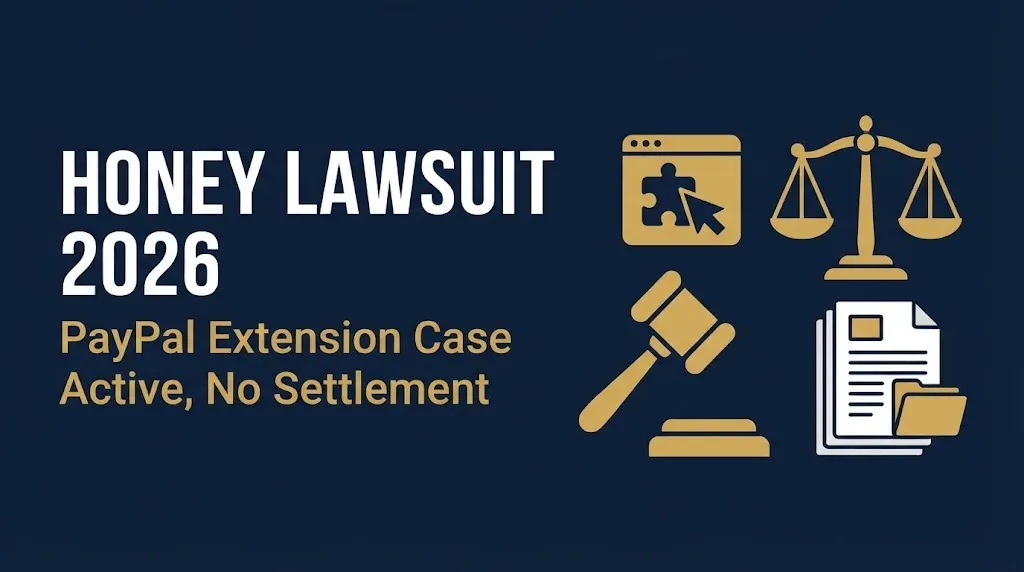
Honey Lawsuit 2026: PayPal’s Coupon Extension Case Status, Claims, and What Users Should Know
Quick Answer
- The Honey lawsuit is real, targeting PayPal over the Honey browser extension’s practices.
- No settlement has been approved, and no per-user payout amount has been determined.
- No claim deadline exists yet; users should watch the official court docket.
If you use the Honey browser extension to find coupon codes, you may have seen headlines about a lawsuit and wondered whether you can get money. The answer starts with one verified fact: a lawsuit is pending in federal court against PayPal, which owns Honey, over the extension’s practices.
The case alleges that Honey misled users and content creators about how it operates. Honey denies the allegations and is defending the case.
No settlement has been reached as of September 4, 2026. That means no claim form, no deadline, and no payout exist yet. This article explains the case, the allegations, the current status, and what could happen next.
The Facts
| Case | Proposed class action against PayPal over Honey extension |
|---|---|
| Status | Active litigation; no settlement |
| Fund Size | Not yet established |
| Est. Per Person | Not yet determined |
| Claim Deadline | None; class not yet certified |
| Administrator | Not yet appointed |
| Proof Needed | Browser usage records, affiliate data |
Is the Honey Lawsuit Real?
The Honey lawsuit is real and verifiable in federal court records. The case was filed as a proposed class action against PayPal, the parent company of Honey.
The plaintiffs allege that Honey engaged in deceptive practices related to its coupon-finding browser extension. The case is pending in a federal district court.
You can verify the case through PACER or by checking the court’s public docket. The filings are public and show the current status of the litigation.
Key Takeaway: This is a genuine class action lawsuit with a public docket, not a rumor or a fabricated settlement.
What Is the Honey Lawsuit About?
The lawsuit is about Honey’s business practices. Honey is a browser extension that automatically finds and applies coupon codes at checkout.
The plaintiffs allege that Honey misled users about how it finds coupons and that it interfered with affiliate commissions owed to content creators. The core claim is that Honey replaced creator affiliate links with its own tracking links, diverting commissions.
Honey and PayPal deny the allegations. They argue that Honey’s practices were disclosed and lawful.
| Allegation | What It Claims |
|---|---|
| Deceptive practices | Honey did not find the best coupons as advertised |
| Affiliate commission diversion | Honey replaced creator links and took commissions |
| Unjust enrichment | PayPal profited at creators’ expense |
| Consumer harm | Users did not receive the savings promised |
Who Is Covered by the Honey Lawsuit?
The proposed class includes Honey users and possibly content creators who lost affiliate commissions. The exact class definition will be determined if the court certifies the class.
Until a class is certified, no one is automatically included. If certification is granted, the court will issue a class notice explaining who is covered.
If you used Honey or created content with affiliate links, keep records of your usage and any affected income. Those records may matter if a settlement is reached.
Key Takeaway: Coverage depends on the class definition, which has not yet been finalized by the court.
How Much Could the Honey Settlement Pay?
There is no settlement amount yet because no settlement has been reached. Any dollar figure you see online is speculation.
Consumer class actions over browser extensions have produced settlements ranging from a few dollars per user to larger amounts for creators who lost significant commissions.
The per-user payout will depend on the total settlement fund, the number of valid claims, and the specific harm each user experienced. No estimate is reliable until a settlement is announced.
Reality Check: No one is getting a Honey settlement check right now. No claim form exists, no deadline has been set, and no administrator has been appointed. Any site offering to file a claim for you is a scam.
What Is the Current Status of the Honey Lawsuit?
The case is in the pretrial phase as of September 2026. The court has not certified a class, and no settlement has been approved.
Both sides are likely engaged in discovery, exchanging documents and taking depositions. Motions to dismiss or for class certification may be pending.
The timeline from filing to settlement in consumer class actions is typically two to four years. This case is still in the early-to-middle stages.
How Do Consumer Class Actions Normally Work?
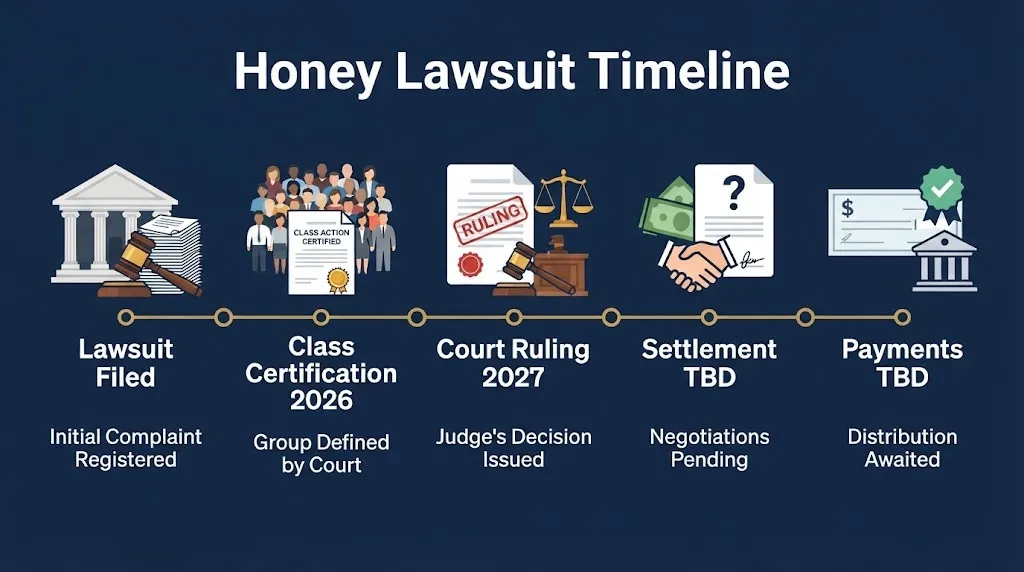
A consumer class action follows a standard pattern. The plaintiff files a complaint. The court decides whether to certify a class. If certified, a class notice is sent.
The parties then negotiate a settlement. The settlement creates a fund. Class members file claims to receive a share of the fund.
If a settlement is reached, the court holds a final approval hearing. After approval, the administrator distributes payments.
What Proof Would I Need for a Honey Claim?
If a settlement is reached, you would need proof that you used the Honey extension or that you lost affiliate commissions because of Honey’s practices.
Browser usage records and affiliate dashboards are the primary evidence. Emails from Honey confirming your account may also help.
Keep any records you have. If a settlement is announced, the claim form will specify exactly what proof is required.
What Is the Difference Between a Class Action and an Individual Lawsuit?
A class action represents many people with similar claims in one case. The court must certify the class before the case proceeds on a class-wide basis.
An individual lawsuit represents one person. That person files their own case and pursues their own recovery.
The Honey case is a proposed class action. If certified, it will cover all users and creators who meet the class definition.
Key Takeaway: A class action covers many people, but you only benefit if the class is certified and a settlement is reached.
What Should I Do If I Used Honey?
First, do not expect a check anytime soon. The case is unresolved, and no settlement exists.
Second, keep records of your Honey usage and any affiliate income that may have been affected. Those records will matter if a settlement is announced.
Third, watch the official court docket or verified legal news for updates. Do not rely on social media posts or unsolicited emails.
How Can I Track the Honey Lawsuit?
You can track the case through PACER, the federal court’s public records system. Search by the case name or docket number.
Court dockets show every filing, ruling, and hearing. You do not need an attorney to view docket entries, though PACER charges a small per-page fee.
Legal news outlets also cover major developments in class actions. But the docket is the primary source and updates first.
What Are the Signs of a Fake Honey Settlement?
A fake Honey settlement will ask for money upfront, promise a specific payout, or request sensitive personal information through an unofficial channel.
Real settlements never charge a filing fee. They never text you first. They never ask for your password or payment details through email.
If you see a Honey settlement ad, verify it against the court docket before doing anything else.
Key Takeaway: Real settlements come with court approval and public notices. Fake ones come with urgency and requests for money.
What Happens Next in the Honey Lawsuit?
The next major milestone is class certification. The plaintiff will ask the court to certify a class of affected users and creators. PayPal will oppose certification.
If the class is certified, a class notice will be issued. That notice will explain who is covered and any deadlines.
If a settlement is reached, the court will hold a final approval hearing. After approval, the administrator will distribute payments.
Expected late 2026: Class certification briefing.
Expected 2027: Court rules on certification.
If certified: Class notice issued with deadlines.
If settled: Final approval hearing and payment distribution.
Frequently Asked Questions
Is there a Honey settlement in 2026?
No settlement has been approved as of September 4, 2026.
How much will I get from the Honey lawsuit?
No payout amount has been determined because no settlement exists.
What is the deadline to file a Honey claim?
No deadline exists until a class is certified and a settlement is approved.
Who is covered by the Honey lawsuit?
The proposed class includes Honey users and possibly content creators, pending court certification.
Do I need a lawyer to join the Honey class action?
No, if a class is certified and a settlement is reached, you can file a claim without your own lawyer.
How do I prove I used Honey?
Your browser history, Honey account email, and any affiliate records are the primary proof.
Is the Honey lawsuit a scam?
No, the lawsuit is real and pending in federal court. But fake settlement offers using its name are scams.
Where can I check the status of the Honey case?
Check PACER for the federal docket or follow verified legal news coverage.
Your next step is to keep records of your Honey usage and any affected affiliate income. No claim form exists yet, and no one can file for you.
The single most important fact: the lawsuit is real, but no settlement, no payout, and no deadline exist as of September 4, 2026. Anyone who says otherwise is not giving you the truth.