Peachtree Settlement Funding in 2026: What the Court Dockets Actually Show About This Factoring Company
Quick Answer
- Peachtree Settlement Funding is a specialty factoring firm that buys structured settlement and annuity payment rights from individuals in exchange for lump sums.
- There is no settlement fund, no claim deadline, and no payout program for consumers to join.
- If you sold or are considering selling payments to Peachtree, court approval of the transfer is the key legal step, and each state sets its own rules.
Peachtree Settlement Funding is not a defendant in a settlement you can claim against. It is the company on the other side of the table, a Georgia limited liability company with its principal place of business in Boca Raton, Florida, that makes money by purchasing structured settlement payment rights from people who need cash now . The company describes itself as a specialty factoring firm that assists people in meeting immediate financial needs through the purchase of structured settlements and other deferred payment arrangements .
If you searched for Peachtree because you got a letter, a call, or saw an ad promising “cash for your settlement,” the honest answer is that the real legal question is not whether Peachtree owes you money. It is whether the transfer they are offering you will be approved by a judge, and on what terms.
This article covers what the 2026 court records show, how the transfer approval process works, what the actual costs look like, and the warning signs that separate a legitimate factoring transaction from a bad deal.
The Facts
| Item | Detail |
|---|---|
| Entity Type | Georgia limited liability company, principal place of business in Boca Raton, Florida |
| Business | Purchases structured settlement and annuity payment rights for lump sums |
| 2026 Court Activity | Multiple petitions filed in Florida, California, Texas, New York, and Michigan |
| Consumer Settlement Fund | None |
| Claim Deadline | None (no settlement program exists) |
| Court Approval Required | Yes, in most states, before a transfer becomes effective |
| Proof Needed | Varies by state; court petition and disclosure statement typically required |
| Key Risk | Selling future payments at a discount can cost far more than the cash received |
Is Peachtree Settlement Funding legit, or is it a scam?
Peachtree Settlement Funding is a real, operating company with a long court record, not a scam. The company files petitions across the country asking judges to approve structured settlement transfers, and its filings appear in Florida Circuit Courts, California Superior Courts, Texas District Courts, and New York Supreme Courts throughout 2026 .
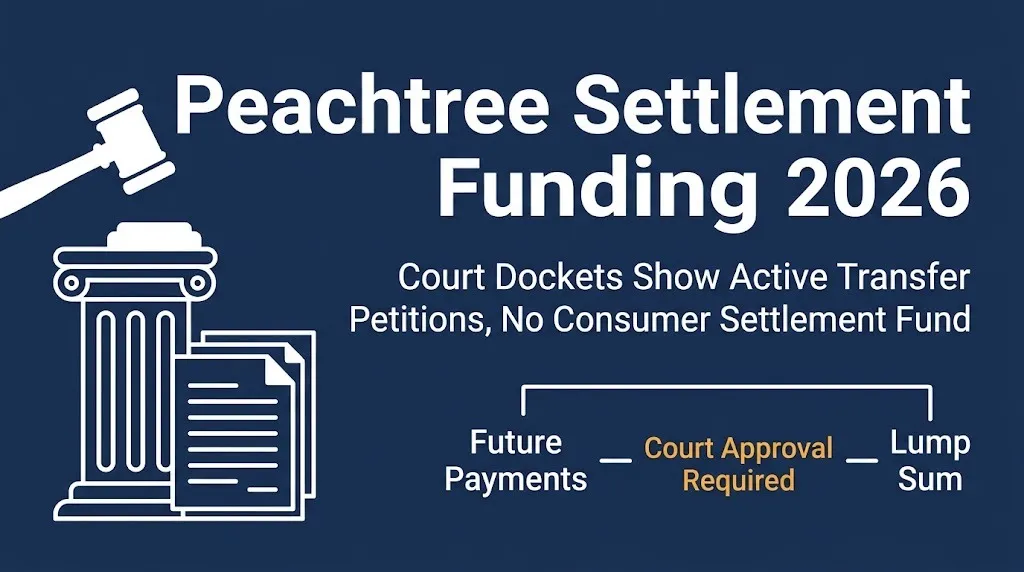
The scam risk sits elsewhere. It sits in companies that pretend to be Peachtree, or in intermediaries who charge fees for “helping” you sell payments when the actual buyer handles the transaction directly. Peachtree’s own court filings show it operates as the purchaser, not as a broker collecting upfront fees from consumers.
A second legitimate concern is pricing, not fraud. Structured settlement factoring is legal in most states, but the discount rate can be steep. A court has to find the transfer is in your best interest and that the discount is fair, and judges do reject transfers when the numbers do not hold up.
Key Takeaway: Peachtree Settlement Funding is a legitimate factoring company with a verifiable court record, and the real risk is the price you pay for immediate cash, not the company’s existence.
How much cash does Peachtree Settlement Funding actually pay?
There is no published rate card, no standard payout, and no average you can trust. What Peachtree pays depends on the specific payment stream, the number of years remaining, the discount rate built into the transaction, and the state where the transfer is approved. Every deal is priced individually.
What the court record does show is the structure of the transaction. Peachtree files a petition for approval of a transfer of structured settlement payment rights, and the petition includes a purchase contract and a disclosure statement . The disclosure statement lays out the gross amount payable to the seller, the net amount after fees, and the discount rate applied to the future payments.
| Transaction Component | What It Means |
|---|---|
| Future payments being sold | The specific dollar amounts and dates you give up |
| Gross amount payable to you | The lump sum before any deductions |
| Discount rate | The percentage cost of getting money early |
| Court filing fee | Varies by state; Florida petitions show a $400 fee |
| Net amount you receive | What lands in your account after the transfer is approved |
The critical number to compare is the total of the future payments you surrender versus the lump sum you receive. If you are selling $100,000 in future payments over ten years for a $60,000 lump sum today, the discount is not $40,000. It is $40,000 plus the time value of the money, and the disclosure statement shows the annualized rate.
Reality Check: No one texts you settlement money first, and Peachtree does not run a claims program you can join. If someone contacts you claiming to represent Peachtree and asks for an upfront fee to “release” a settlement, that is not how the transaction works. The buyer pays you, not the other way around.
How does the court approval process for a Peachtree transfer work?
A structured settlement transfer is not effective unless a judge approves it in advance, in most states. Georgia law, for example, states that no transfer of structured settlement payment rights shall be effective unless the transfer has been approved in advance in a final court order by a court of competent jurisdiction . Most states have similar structured settlement protection acts.
The process follows a predictable sequence. Here is what the filings show.
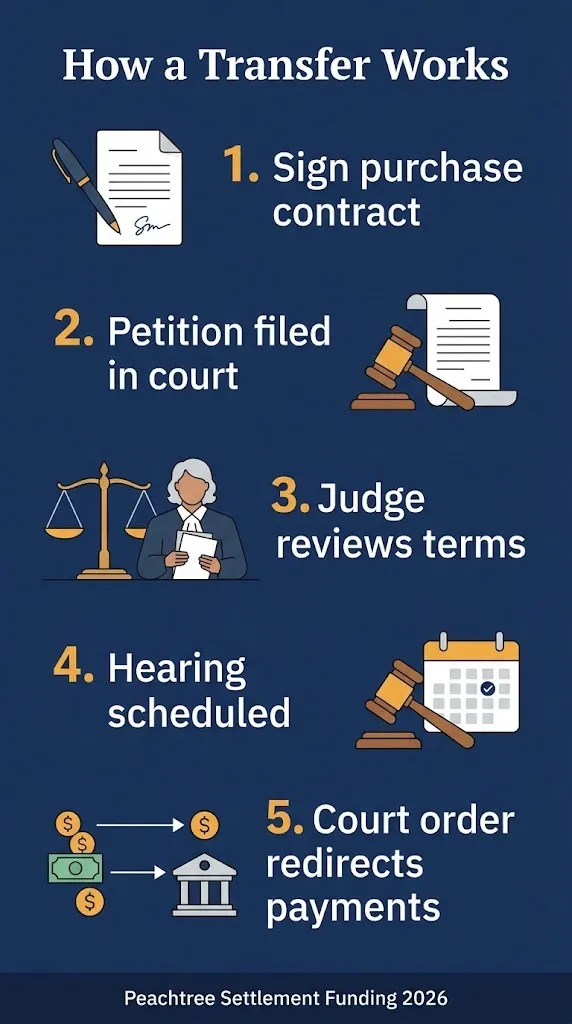
- Peachtree and the seller sign a purchase contract and disclosure statement.
- Peachtree files a petition in the county or district where the seller lives, asking a judge to approve the transfer.
- The petition includes the purchase contract, the disclosure statement, evidence of entitlement to the annuity, and a notice letter to interested parties .
- A hearing is scheduled, sometimes by remote appearance or telephone.
- The judge reviews whether the transfer is in the seller’s best interest and whether the discount rate is fair.
- If approved, the judge signs an order, and the annuity issuer is directed to redirect payments to Peachtree.
A California filing from June 2026 shows a hearing on a petition to approve a transfer of structured settlement payment rights, with the matter continued by the court before resolution . A Texas filing from September 2026 shows an amended application and a hearing notice, with a law day docket set for November 9, 2026 . These are routine procedural steps, not signs of a dispute.
What is the difference between Peachtree Settlement Funding and a settlement administrator?
Peachtree Settlement Funding is a buyer, not a settlement administrator. This distinction matters because people searching for Peachtree often confuse the two roles. A settlement administrator is the neutral party appointed by a court to run a class action settlement: processing claims, verifying eligibility, and mailing checks. Peachtree does none of those things.
Peachtree’s role is on the opposite side of a transaction. It offers to buy your future payment stream. The company profits from the difference between what it pays you today and what it collects over time from the annuity issuer. That is a factoring business, not a claims administration business.
If you are looking for a settlement administrator, you are on the wrong trail. If you are considering selling structured settlement payments, Peachtree is one of several companies that buy them, and you can compare offers. The court approval step applies regardless of which buyer you choose.
What are the risks of selling structured settlement payments to Peachtree?
The biggest risk is financial: you may receive far less than the future payments are worth. A second risk is that you lose the long-term income stream entirely, and you cannot undo the sale after the court approves it and the money is paid. A third risk is transaction costs that eat into the lump sum.
The disclosure statement is where these risks are quantified, and you should read it line by line before signing. Look for the discount rate, the total amount of payments being sold, and the net amount you will actually receive. Compare that net amount against what you would have received over the same period if you kept the payments.
State law gives you a cancellation window in some cases. A Vermont Attorney General filing that reproduces Peachtree’s contract language shows a five-business-day rescission period after you receive payment, during which you can cancel without penalty by returning the full amount . Georgia residents get a longer window under that contract language, running until 5:00 p.m. on the twenty-first day after receiving the notice of cancellation rights, or the hearing date, or five business days after payment, whichever comes last .
Key Takeaway: Selling payments to Peachtree means permanently giving up future income, and the disclosure statement’s discount rate is the single number that tells you the true cost.
How do you check the status of a Peachtree court petition?
You check the status by pulling the docket in the court where the petition was filed. Peachtree’s 2026 filings are spread across Florida Circuit Courts, California Superior Courts, Texas District Courts, New York Supreme Courts, and Michigan courts, so the courthouse depends on where the seller lives and where the petition was filed .
The docket will show the filing date, the case number, the judge assigned, and any scheduled hearings. A Florida petition filed on October 14, 2026 in the Twelfth Judicial Circuit is listed as open, with a civil cover sheet and the petition for court approval appearing in the docket . A New York Supreme Court filing from August 28, 2026 in Niagara County lists Pacific Life and Annuity Services as a defendant alongside the seller .
You can also check the annuity issuer’s records. The issuer is the company paying the structured settlement, and it will have a record of any transfer that has been approved and directed. If Peachtree has contacted you, ask for the case number and the court where the petition will be filed, then verify that the case exists before you sign anything further.
What happens next in the Peachtree court process
The timeline below covers the stages that matter for a pending or future Peachtree transfer, based on the dockets and hearing notices visible in 2026 filings.
November 9, 2026: A Texas Harris County District Court has a law day docket scheduled for entry of judgment on a Peachtree application for approval of transfer of structured annuity benefits .
November 10, 2026: A Florida Thirteenth Judicial Circuit case filed by Peachtree against Pacific Life has a differentiated case management hearing scheduled .
Ongoing 2026: Peachtree continues filing new petitions across multiple states, with Florida, California, Texas, and New York all showing 2026 activity.
Pending: Any specific consumer settlement or class action against Peachtree is not yet confirmed. The 2026 court records reviewed show routine transfer petitions, not a consolidated consumer action.
Frequently Asked Questions
Is Peachtree Settlement Funding a real company?
Yes. Peachtree Settlement Funding is a Georgia limited liability company with its principal place of business in Boca Raton, Florida, and it files structured settlement transfer petitions in courts across the country.
Does Peachtree Settlement Funding owe me money?
No settlement fund or consumer payout program tied to Peachtree Settlement Funding has been confirmed. If you received a notice about money, check the official settlement website or the court docket to verify what it relates to.
How much does Peachtree pay for structured settlement payments?
There is no published rate. The amount depends on the payment stream, the discount rate, and the state where the transfer is approved, and the disclosure statement shows the specific numbers for your transaction.
Do I have to go to court to sell payments to Peachtree?
In most states, a judge must approve the transfer before it becomes effective. The hearing may be held by remote appearance or telephone in some jurisdictions.
Can I cancel a transfer after I sign with Peachtree?
Some states give you a cancellation window. The contract language reproduced in a Vermont filing shows a five-business-day rescission period after payment, and Georgia residents get a longer window running until the twenty-first day after notice or the hearing date.
What is the difference between Peachtree Settlement Funding and a class action settlement?
Peachtree buys future payment streams. A class action settlement pays compensation to people harmed by a defendant’s conduct. Peachtree is not a defendant in a consumer class action based on the 2026 records reviewed.
Where can I check a Peachtree court case?
Check the docket in the court where the petition was filed. Peachtree’s 2026 cases appear in Florida Circuit Courts, California Superior Courts, Texas District Courts, and New York Supreme Courts, among others.
Is Peachtree Settlement Funding related to JG Wentworth?
Peachtree and JG Wentworth are separate factoring companies that both buy structured settlement payments. The two have been involved in litigation against each other, but they are distinct businesses.
What to do before you sign anything
Pull the court docket for your state before you agree to any transfer, and read the disclosure statement’s discount rate out loud to yourself. The number that matters is not the lump sum, it is what you give up to get it.
The most important date for any pending Peachtree transaction is the hearing date on the petition, because that is the last point where a judge can reject the deal before the money moves.