Katy Perry Lawsuit: Settlement Status, Payout Updates, and Claim Deadlines for 2026
Quick Answer
- The “Dark Horse” lawsuit was a copyright infringement case between music producers, not a consumer class action.
- No settlement fund exists for the public. The case ended with a federal appeals court ruling in March 2022.
- There is no claim deadline, no claim form, and no payout for consumers in 2026.
If you searched “Katy Perry lawsuit” expecting a class action settlement or consumer payout, here is the direct answer: this case has nothing to do with consumer claims. It was a copyright dispute over a musical beat. It produced no settlement fund for the public. No claim form exists. No deadline exists. No check is coming.
The case everyone still asks about is formally titled Marcus Gray et al. v. Katy Perry et al. It involved the 2013 song “Dark Horse” and a 2009 Christian rap track called “Joyful Noise.” The litigation bounced through jury trials, appeals, and reversals for nearly eight years. It ended in Perry’s favor.
This article breaks down exactly what happened, what the court actually decided, why some websites still publish misleading headlines about a “settlement,” and what the real story means for anyone trying to understand the case in 2026.
The Facts
| Detail | Verified Information |
| Case | Marcus Gray et al. v. Katy Perry et al. |
| Status | Closed. Perry prevailed on appeal. |
| Fund Size | None. No consumer settlement exists. |
| Est. Per Person | None. No payouts to the public. |
| Claim Deadline | None. No claim process. |
| Administrator | None. No settlement administrator. |
| Proof Needed | None. No claims accepted. |
Is the Katy Perry Lawsuit a Class Action Settlement?
No. The Katy Perry lawsuit is not a class action settlement. It never was.
A class action settlement involves a group of consumers or employees who share a common legal injury. They receive notice, file claims, and sometimes get paid. The Katy Perry case involved none of that.
This was a federal copyright lawsuit filed by two songwriters and a rapper. The plaintiffs claimed that Perry’s 2013 hit “Dark Horse” copied a beat from their 2009 song “Joyful Noise.” No consumers were involved. No class was certified. No settlement fund was created for the public.
The confusion likely comes from the word “lawsuit” paired with a celebrity name. People assume a big payout followed. In truth, the case went through a trial, a verdict, an appeal, and a reversal. The final result was no payment at all from Perry.
If you saw a post or video claiming you can claim money from a Katy Perry settlement, that is false. No such settlement exists.
Is the Katy Perry Dark Horse Lawsuit Real?
Yes, the underlying case is real. It produced a real jury verdict and a real appellate decision.
The case was filed in 2014 in the U.S. District Court for the Central District of California. The plaintiffs were Marcus Gray, Emanuel Lambert, and Chike Ojukwu. Gray performed as Flame. Lambert performed as Da Truth. Ojukwu was a producer.
They claimed that the instrumental beat in “Dark Horse” copied the beat from “Joyful Noise.” The case went to trial in 2019. A jury found Perry liable for copyright infringement. The jury awarded the plaintiffs $2.78 million.
That verdict was later thrown out. In March 2020, the district court judge granted judgment as a matter of law to Perry. The judge ruled that the beat in question was not original enough to deserve copyright protection. It was a common musical building block.
The Ninth Circuit Court of Appeals affirmed that ruling in March 2022. The case is now closed.
Key Takeaway: The Katy Perry lawsuit was real, but it was a copyright case between music creators. It was never a consumer settlement, and no public payout ever existed.
What Was the Katy Perry Dark Horse Lawsuit About?
The lawsuit centered on an eight-note musical phrase.
The plaintiffs said “Dark Horse” copied a descending ostinato, a repeating musical pattern, from “Joyful Noise.” The pattern appears in both songs. But the court found that the pattern was not protectable under copyright law.
The district judge compared the musical phrase to using common words in a sentence. It was too short and too common to be owned by anyone. The appeals court agreed.
The case became a landmark of sorts in music copyright law. It showed that not every similarity between songs is enough for a legal claim. Some musical elements are too basic to protect.
For consumers, the legal details matter less than the outcome. The case produced no settlement, no fund, and no money for anyone other than the lawyers who billed hours.
Did Katy Perry Have to Pay in the Dark Horse Lawsuit?
No. Katy Perry was not required to pay any damages after the appeals court ruled in her favor.
The original jury verdict in 2019 awarded $2.78 million to the plaintiffs. That amount included $550,000 from Perry personally and the rest from Capitol Records and other defendants.
But the trial judge erased that verdict in 2020. The appeals court kept it erased in 2022. No payment was made.
Some articles still circulating online reference the $2.78 million figure as if it was a settlement. It was not a settlement. It was a jury award that was overturned.
In 2026, the financial outcome is zero for the plaintiffs and zero for consumers.
Can I Get Money from the Katy Perry Lawsuit?
No. There is no money for consumers from this case.
This is the most important point for anyone who found this article through a search about claim forms or payout checks. You cannot file a claim. You cannot get a check. There is no fund.
Websites that suggest otherwise are either outdated, misleading, or using the celebrity name to generate clicks. Some may show ads for “claim filing services” that charge money for nothing.
Filing for a real class action is always free. But in this case, there is nothing to file.
Is There a Katy Perry Settlement Claim Form?
No settlement claim form exists.
A claim form only exists when a court approves a class action settlement and appoints a settlement administrator. That never happened here.
The case ended with a defense verdict, not a settlement. There was no class. There was no fund. There was no administrator.
If you see a link to a “Katy Perry settlement claim form,” do not click it. It is likely a scam or a bait page.
Key Takeaway: Any website offering a claim form, payout estimate, or deadline for a Katy Perry settlement is false. The case produced no consumer remedy.
Reality Check: No legitimate settlement ever requires you to pay a fee to file a claim. If someone asks for your bank account, Social Security number, or a “processing fee” to get settlement money, it is a scam. Real claim forms are free and come from official court-approved administrators.
What Happened with the Katy Perry Dark Horse Verdict?
The verdict followed a familiar pattern in music copyright cases: a jury win for the plaintiffs, then a judicial reversal.
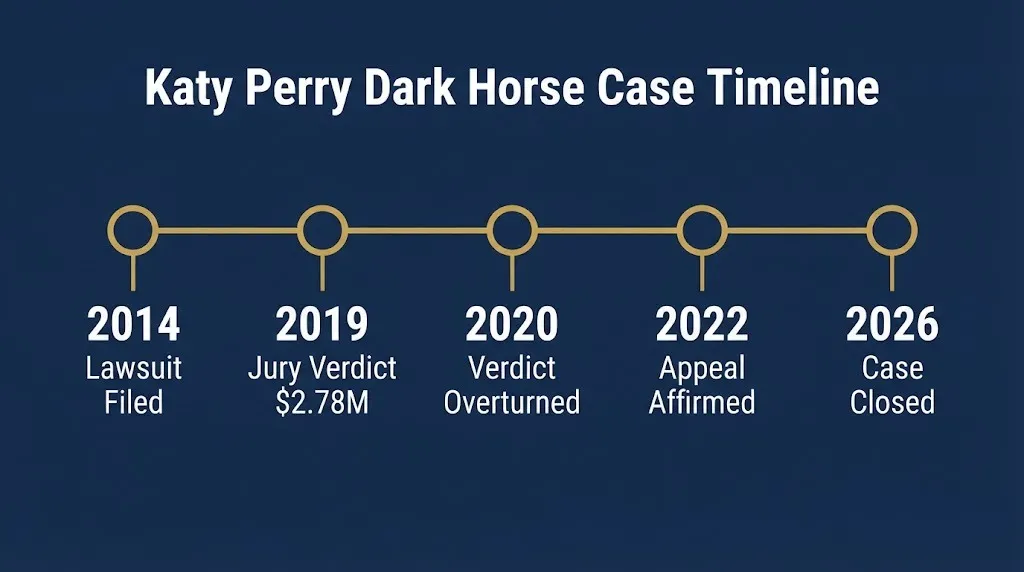
Here is the timeline of the actual legal events:
| Date | Event |
| July 2014 | Lawsuit filed in federal court in California |
| July 2019 | Jury finds Perry liable, awards $2.78 million |
| March 2020 | Judge overturns verdict, rules for Perry |
| March 2022 | Ninth Circuit affirms the reversal |
| 2026 | Case closed, no further appeals pending |
The judge’s 2020 ruling was blunt. He wrote that the musical phrase at issue was not protectable. Allowing the verdict to stand would have given the plaintiffs a monopoly over a basic musical element.
The appeals court agreed. The ruling is now final.
Why Do People Still Search for a Katy Perry Settlement in 2026?
The search interest persists for a few reasons.
First, the case involved a massive celebrity. Katy Perry is one of the best-selling music artists of all time. Any legal headline with her name draws clicks for years.
Second, the original jury verdict received far more media coverage than the later reversal. Many people remember the $2.78 million headline but never saw the follow-up. They assume the case settled.
Third, automated content farms generate pages with keywords like “Katy Perry settlement” and “claim deadline” without checking facts. Those pages pollute search results and confuse readers.
The result is a persistent myth that money is available. It is not.
How Does This Compare to Real Consumer Class Actions?
It may help to understand the difference by looking at a real consumer settlement.
A real class action starts when a company is accused of harming a group of people: overcharging fees, selling defective products, or mishandling data. A court certifies a class. The company often settles without admitting fault. A fund is created. Consumers file claims. Checks go out after final approval.
The Katy Perry case had none of those steps.
It is more like a store return without a receipt. You might win the argument, or the store might refuse. Either way, it is a two-party dispute. No one else gets paid.
That is what happened here. Two parties fought over a song. One won. The public watches.
Katy Perry Dark Horse Lawsuit Update 2026
There is no active update for 2026.
The case concluded in March 2022 when the Ninth Circuit issued its ruling. The deadline to seek further review passed without action. The case is closed.
No new filings have appeared. No settlement talks are underway. No payout is scheduled.
Anyone claiming a “2026 update” with new money or claim deadlines is misinformed.
Key Takeaway: The only verified update is that the case remains closed. No new developments have occurred since the 2022 appeals ruling.
What Is the Katy Perry Lawsuit Settlement Amount?
There is no settlement amount.
The jury verdict was $2.78 million, but that verdict was overturned. The reversal means the amount never became a judgment.
A settlement amount only exists when both sides agree to resolve a case with a payment. That never happened here. Perry fought the case through trial and appeal. She won.
The $2.78 million figure is often repeated as if it is a settlement. It is not. It is a number from a verdict that no longer has legal force.
Who Was Involved in the Katy Perry Copyright Case?
The parties matter because they show this was a dispute between creators, not a company-versus-consumer case.
The plaintiffs were Marcus Gray (Flame), Emanuel Lambert (Da Truth), and Chike Ojukwu. They created “Joyful Noise” in 2008 or 2009.
The defendants were Katy Perry, Capitol Records, and several producers and songwriters involved in “Dark Horse,” including Dr. Luke, Max Martin, and Juicy J.
The case was heard in the U.S. District Court for the Central District of California. The trial judge was Christina A. Snyder. The appeal went to the U.S. Court of Appeals for the Ninth Circuit.
All of these names and venues are a matter of public record.
Did the Katy Perry Lawsuit Go to Trial?
Yes. The case went to a full jury trial in July 2019.
Trials are rare in civil cases. Most settle. This one did not.
The trial lasted about a week. The jury deliberated and returned a verdict finding that “Dark Horse” infringed on “Joyful Noise.” The jury awarded $2.78 million in damages.
The trial was covered by major music and legal outlets. It included testimony from musicologists on both sides.
The trial verdict made headlines. The later reversal did not receive the same attention.
How Long Did the Katy Perry Lawsuit Last?
The case lasted nearly eight years from filing to final resolution.
It was filed in July 2014. The Ninth Circuit ruled in March 2022. That is about seven years and eight months.
Including any time for potential further appeals that were never filed, the case effectively ended in 2022. By 2026, there has been no activity for over four years.
That is a long time for a copyright case. Most settle within two to three years. Perry’s willingness to fight made this case unusual.
Key Takeaway: The case spanned nearly eight years, but it has been closed since 2022 with no further activity through 2026.
What Does the Dark Horse Ruling Mean for Music Copyright?
The ruling matters for musicians, not for consumers seeking money.
The Ninth Circuit’s decision reinforced the idea that basic musical elements cannot be copyrighted. A short, common musical phrase is not protectable just because it appears in two songs.
This was a significant win for songwriters and producers. It limits the ability of plaintiffs to claim infringement based on tiny musical similarities.
For everyone else, the ruling is a legal curiosity. It does not create any consumer rights or remedies.
How to Spot a Fake Settlement Claim
Because the Katy Perry name attracts search traffic, fake claim sites sometimes appear. Here is how to spot them.
- Check the official case name. Real settlements have a named court case and a settlement administrator website.
- Verify on the court’s website. Federal courts post settlement notices for class actions.
- Look for a claim deadline and final approval hearing date. Real settlements always have both.
- Never pay a fee to file. Real claim forms are free.
- Search for a government or court source. If none exists, the settlement is not real.
- Check the date. Old verdicts are not settlements. The Perry case ended in 2022.
- Be wary of “claim helper” sites. They charge fees for forms you can file yourself for free.
Will There Ever Be a Katy Perry Settlement for Consumers?
No. It is not possible.
The case did not involve consumers. A consumer settlement requires a class of consumers harmed by a company. That factual basis does not exist here.
Even if Perry had settled with the plaintiffs, the settlement would have paid only the plaintiffs. No public fund would have been created.
The only way consumers would ever receive money related to Katy Perry is if a completely new case were filed: for example, a data breach involving her fan club or a ticketing dispute with a promoter. No such case exists in 2026.
What Happens Next
There are no future dates in this case. It is closed.
- March 2022: Ninth Circuit affirmed judgment for Perry.
- 2022 through 2026: No further appeals, no settlement talks, no new filings.
- 2026 onward: No expected activity.
The only thing that could change is a new, unrelated lawsuit with a similar name. That has not happened.
Frequently Asked Questions
Is the Katy Perry Dark Horse lawsuit a class action?
No. It was a copyright infringement lawsuit between music creators. No consumer class was ever involved.
Did Katy Perry settle the Dark Horse lawsuit?
No. Perry did not settle. She won the case after a jury verdict against her was overturned on appeal.
How much was the Katy Perry jury verdict?
The jury awarded $2.78 million. The judge later threw out the verdict. No payment was made.
Can I file a claim in the Katy Perry lawsuit?
No. There is no claim process. The case involved no consumer fund and no settlement administrator.
Why do websites show a Katy Perry settlement amount?
Many sites repeat the old $2.78 million jury figure without noting that it was overturned. Others use the celebrity name to generate ad clicks.
Is there a Katy Perry settlement deadline in 2026?
No. There is no settlement and no deadline. Any site listing a deadline is false.
What was the Dark Horse lawsuit actually about?
It was about an eight-note musical phrase that the plaintiffs claimed was copied from their song “Joyful Noise.”
Who won the Katy Perry lawsuit?
Katy Perry won. The district court ruled in her favor in 2020. The Ninth Circuit affirmed in 2022.
The most important fact is simple. The Katy Perry lawsuit ended in 2022 with no settlement, no fund, and no consumer payout. Any claim to the contrary is false.
If you are looking for real class action settlements, check official court websites and settlement administrator pages. Those are the only places where legitimate claim forms appear.