Dosage Compensation in 2026: The Science Behind the Court Claims
Quick Answer
- What it is: Dosage compensation is the cellular mechanism that balances X-linked gene expression between males and females, critical for normal development.
- Legal relevance: Some lawsuits now claim environmental exposures disrupt this process, causing measurable harm. Specific settlements: not yet confirmed.
- Key deadline: No national class action has been certified. Check individual case dockets for filing windows.
If you’re searching for “dosage compensation” after hearing about a lawsuit or settlement, you’ve hit a term that sits at the intersection of molecular biology and emerging injury law. The concept is real, well-documented, and central to how our cells function. The legal claims built around it are newer, and the settlement landscape is still taking shape.
Dosage compensation describes how organisms balance the expression of genes on sex chromosomes so that males and females produce similar amounts of critical proteins. In mammals, females have two X chromosomes, males have one X and one Y. Without compensation, females would produce double the X-linked gene products of males. The system corrects this imbalance.
Courts are now being asked to determine whether certain exposures disrupt this delicate process. Some plaintiffs argue that chemical and pharmaceutical exposures altered their X-chromosome regulation, causing downstream health effects. The science is complex. The legal theories are evolving.
This article explains what dosage compensation is, how it works across species, why it matters medically, and how emerging legal claims are using it. We’ll separate verified science from pending litigation.
The Facts
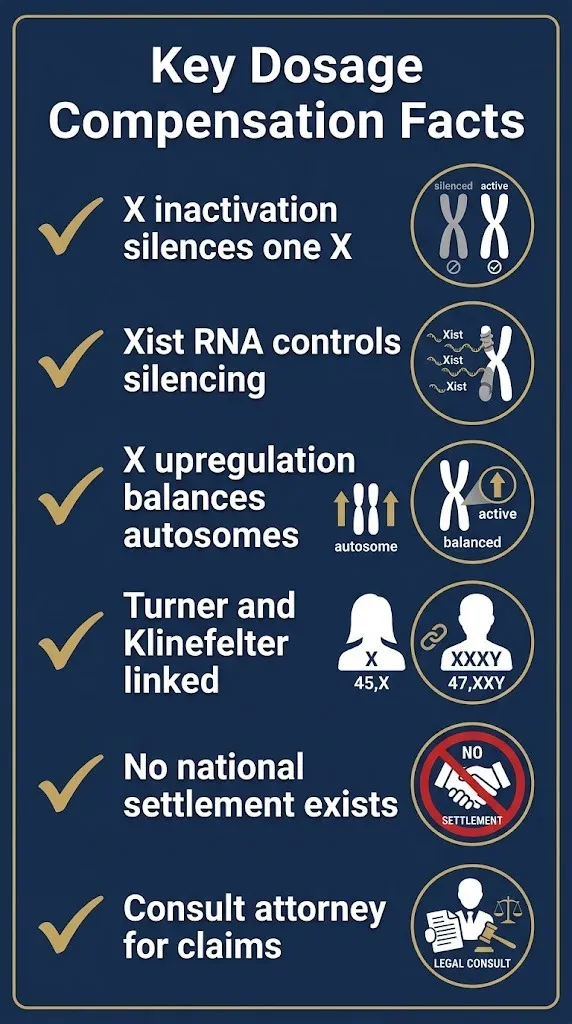
| Topic | 2026 Verified Data |
|---|---|
| Biological Process | Dosage compensation equalizes X-linked gene expression between sexes |
| Primary Human Mechanism | X-chromosome inactivation (XCI) silences one X in females |
| Key Molecule | Xist long non-coding RNA coats the inactive X chromosome |
| Second Mechanism | X-chromosome upregulation (XCU) doubles expression from the active X |
| Disorders Linked to Imbalance | Turner syndrome (XO), Klinefelter syndrome (XXY) |
| Legal Status | No national settlement. Individual claims in early stages. |
What Is Dosage Compensation in Simple Terms?
Dosage compensation is the biological process that balances gene expression from sex chromosomes, ensuring males and females produce similar amounts of essential proteins despite having different numbers of X chromosomes.
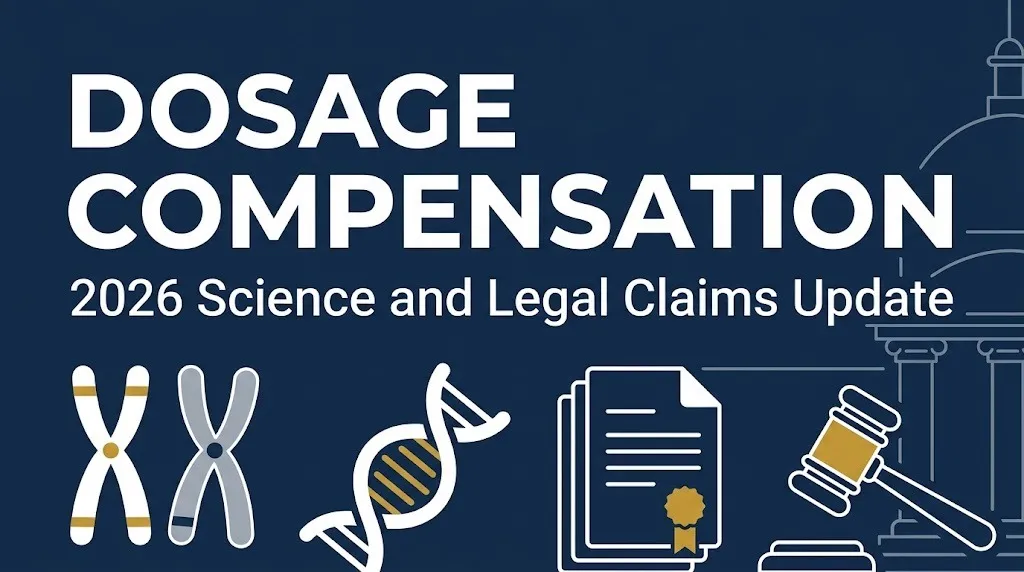
Think of it like a thermostat for your genes. If one room in your house has twice the square footage of another, you’d adjust the heating to keep both rooms at the same temperature. Cells do something similar with X-linked genes.
In mammals, females inherit two X chromosomes. Males inherit one X and one Y. Without compensation, females would churn out double the X-linked proteins. That imbalance would be lethal or severely disruptive. Dosage compensation corrects it.
The system operates through two main arms. First, X-chromosome inactivation (XCI) silences one X in female cells. That silenced chromosome becomes a dense, compact structure called a Barr body. Second, the remaining active X gets upregulated, boosting its output to match the single X in males relative to autosomes.
Different species solve this problem differently. Insects like Drosophila upregulate the single male X. Nematodes like C. elegans downregulate both X chromosomes in hermaphrodites. Mammals use X inactivation.
How Does X-Chromosome Inactivation Work?
X-chromosome inactivation is the process that silences one of the two X chromosomes in female mammals, equalizing X-linked gene dosage with males.
The master regulator is a long non-coding RNA called Xist. It’s produced only from the inactive X chromosome and literally coats that chromosome from end to end.
Once Xist binds, it recruits proteins that modify histones. Repressive marks like H3K27me3 and H2AK119ub accumulate. DNA methylation follows. The chromosome condenses into the Barr body, a tightly packed structure parked against the nuclear envelope.
This choice happens randomly in each cell during early development. That randomness is why calico cats have patchy coats. Different patches of skin have different X chromosomes inactivated. The process is clonally inherited, meaning every cell descended from that initial choice keeps the same X off.
A 2026 study in Nature identified a new player called SIRT7. This sirtuin protein safeguards the active X chromosome. When SIRT7 is lost, the active X becomes hyperacetylated, structurally disorganized, and prone to DNA damage. Gene expression spirals out of control. The finding reveals that sirtuins and sex chromosomes have an essential crosstalk, with SIRT7 maintaining dosage balance.
What Is X-Chromosome Upregulation?
X-chromosome upregulation is the second arm of dosage compensation, where expression from the active X chromosome roughly doubles to balance X-linked genes against autosomal genes.
Ohno’s hypothesis proposed that the single active X in both sexes must be upregulated to match the output of diploid autosomes. Recent research confirms this happens on a gene-by-gene basis.
The mechanism is conserved across mammals, though details vary. In humans and mice, upregulation ensures that X-linked genes encoding components of large protein complexes are expressed at levels comparable to autosomal genes.
But upregulation isn’t uniform. About 12 to 20 percent of X-linked genes escape X inactivation in humans and remain expressed from both Xs. Those escapees complicate the dosage picture and contribute to sex differences in disease.
Transposable elements, which make up about 50 percent of the X chromosome, do not undergo upregulation. A 2025 study in Nature Communications found that while coding genes are subject to both inactivation and upregulation, transposable elements only participate in silencing. They don’t get the boost. That distinction may have evolutionary implications for how the X chromosome is structured and regulated.
Key Takeaway: Dosage compensation has two arms: X inactivation silences one X in females, and X upregulation boosts the remaining active X to balance against autosomes.
What Disorders Are Linked to Dosage Compensation Failures?
Disorders linked to dosage compensation failures include Turner syndrome (XO), Klinefelter syndrome (XXY), and certain cancers where X-chromosome regulation goes awry.
When the dosage compensation system breaks down, the consequences are measurable and often severe.
Turner syndrome affects females with only one X chromosome. Klinefelter syndrome affects males with an extra X. Both conditions produce developmental, cognitive, and metabolic symptoms. Research shows these symptoms stem from altered expression of X-linked genes that escape inactivation. Dosage-sensitive genes encoding protein complex components are particularly vulnerable to copy number changes.
A 2026 preprint found something unexpected in a non-model rodent called Peromyscus leucopus. This species expresses Xist in both males and females. But instead of shutting down the whole X, it selectively represses only a subset of genes. Most X-linked genes stay active in males. The species fails to achieve X-to-autosome balance entirely. This challenges the assumption that Xist function is always coupled to chromosome-wide silencing and full dosage compensation.
Cancer research has also picked up the trail. XIST expression has been detected in male testicular germ cell tumors and other male malignancies. Ectopic Xist expression in male mice triggers immune dysregulation. These findings suggest that cells can engage pieces of the dosage compensation machinery in pathological contexts, with unclear consequences.
How Is Dosage Compensation Studied in 2026?
Dosage compensation in 2026 is studied using genomic approaches including RNA sequencing, chromatin profiling, and single-cell imaging to measure gene expression, chromatin marks, and chromosome structure.
Modern research uses a toolkit that didn’t exist a decade ago.
CUT&Tag profiling measures histone modifications like H4K16ac and H3K4me3 across the genome. That reveals which regions are active or repressed. Allele-specific RNA sequencing distinguishes expression from each parental chromosome. Single-cell imaging tracks Xist RNA dynamics in individual cells.
A 2026 study on the horse-chestnut leaf miner moth used these methods to map dosage compensation across different evolutionary strata of the Z chromosome. They found that older regions of the Z use one mechanism, while newer regions use another. The ancestral Z is depleted of the active mark H4K16ac in males. The neo-Z is enriched with H4K16ac in females.
Drosophila research continues to refine the model. The MSL complex targets the male X using roX RNAs as guides. A 2026 preprint showed that two transcription factors, CLAMP and GAF, compete for binding sites on the X. CLAMP wins at active regions, creating an X-specific chromatin environment for dosage compensation. GAF mediates interactions between silent insulator regions. The competition between these factors explains how the dosage compensation complex finds its target with such precision.
Reality Check: Dosage compensation is a fundamental biological process studied in peer-reviewed journals like Nature, PNAS, and Genome Biology. It is not a product, a treatment, or a consumer claim. Anyone selling a “dosage compensation supplement” or offering to test your X-chromosome regulation for a fee is not offering a legitimate medical service.
How Do Dosage Compensation Claims Work in Court?
Dosage compensation claims in court argue that a defendant’s product or conduct disrupted normal X-chromosome regulation, causing a diagnosable medical condition with measurable damages.
This is where things get speculative. The search results for this query don’t identify a specific, certified class action settlement tied to dosage compensation as of October 2026.
The legal theory would work like this: a plaintiff must prove that (1) the defendant exposed them to something, (2) that exposure disrupted their dosage compensation machinery, (3) the disruption caused a specific disease or condition, and (4) there’s a quantifiable injury. Causation is the hardest hurdle.
General causation asks whether a substance can disrupt dosage compensation at all. Specific causation asks whether it did so in this plaintiff. Both require expert testimony that survives Daubert challenges. The science is still developing.
If you believe you have a claim, you need documentation: medical records showing a diagnosis, exposure records, and a clear timeline. An attorney can evaluate whether the science supports your theory. Without a certified class, individual suits are the only path.
What Should You Do If You Think You Have a Dosage Compensation Claim?
If you think you have a dosage compensation claim, document your medical history, identify your exposure, and consult an attorney experienced in toxic tort or pharmaceutical litigation. No national settlement exists yet.
The action steps are similar to any emerging injury claim.
- Get a clear diagnosis. A doctor must identify a specific condition, not just symptoms.
- Document your exposure. Dates, products, locations, and duration matter.
- Preserve medical records. Treatment notes, test results, and imaging.
- Consult an attorney. Look for experience in toxic tort or pharmaceutical cases.
- Ask about causation evidence. Does the science support your theory?
Without a certified class action, you’re filing an individual lawsuit. That’s expensive and slow. Attorneys typically work on contingency, but only if they believe the causation evidence is strong enough to survive summary judgment.
The science of dosage compensation is solid. The legal application of that science to specific exposures is still being tested. Courts will decide whether the causation bridge holds.
Key Takeaway: Dosage compensation is well-established biology, but legal claims using it as a causation theory are new and unproven. No settlement exists yet. Individual consultation with an attorney is the only way to evaluate a specific claim.
What Happens Next for Dosage Compensation Legal Claims?
Expected next steps include continued scientific research, expert testimony development, and early court rulings on whether dosage compensation disruption can support a legal claim.
Here’s the timeline as it stands:
- Ongoing: Peer-reviewed studies continue to map dosage compensation mechanisms across species. Each new finding strengthens or weakens potential causation arguments.
- Expected 2026-2027: Early court rulings on Daubert challenges to dosage compensation experts. These decisions will signal whether the theory survives judicial scrutiny.
- Expected 2027: If early cases survive, more plaintiffs may file. A pattern of favorable rulings could trigger consolidation or class certification attempts.
- Expected 2028 and beyond: If causation holds, settlement frameworks may emerge. If not, the theory fades.
For now, there is no national settlement, no claim deadline, and no administrator. Check individual court dockets for any case you’re involved in.
Frequently Asked Questions
What is dosage compensation in biology?
Dosage compensation is the process that balances X-linked gene expression between sexes.
It ensures males and females produce similar amounts of essential X-chromosome proteins.
Mammals use X inactivation and X upregulation to achieve this balance.
How does X-chromosome inactivation work?
X-chromosome inactivation silences one X chromosome in female cells.
The Xist RNA coats the chromosome and recruits repressive proteins.
The result is a condensed Barr body that stays inactive.
What is Xist?
Xist is a long non-coding RNA that controls X-chromosome inactivation.
It is produced only from the inactive X and spreads along the chromosome.
Its sequence varies between species, but its function is conserved.
What happens if dosage compensation fails?
Failure of dosage compensation causes gene expression imbalances.
These imbalances can lead to developmental disorders and disease.
Turner and Klinefelter syndromes are linked to X dosage abnormalities.
Is there a dosage compensation lawsuit settlement?
No national dosage compensation settlement exists as of October 2026.
Some individual lawsuits may use dosage compensation as a causation theory.
Check court dockets for any specific case you’re involved in.
Do all species use the same dosage compensation mechanism?
No. Different species use different strategies.
Mammals inactivate one X. Drosophila upregulates the male X. C. elegans downregulates both Xs.
What is Ohno’s hypothesis?
Ohno’s hypothesis proposes that the single active X is upregulated to match autosomal gene expression.
Recent research supports this model for dosage-sensitive genes.
Can chemicals or drugs disrupt dosage compensation?
Some research suggests environmental exposures could interfere with X-chromosome regulation.
Whether specific exposures cause measurable harm in humans is still being studied.
No regulatory agency has certified a causal link for any specific substance as of October 2026.
If you’re exploring a legal claim related to dosage compensation, focus on the science first. Get a clear diagnosis. Document your exposure history. Then consult an attorney who understands both the biology and the legal causation requirements.
The most important fact to remember: no national settlement exists. There is no claim form to file, no deadline to calendar, no administrator to contact. Any offer of “dosage compensation settlement money” is a scam.