Estate Litigation Attorneys in 2026: What Families Fight Over and What It Costs
Quick Answer
- What it is: Estate litigation attorneys resolve disputes over wills, trusts, and inheritances after someone dies or becomes incapacitated.
- Typical cost: Retainers start at $3,000 to $10,000. Hourly rates run $300 to $600. Full trials can exceed $100,000.
- Key deadline: Most states require will contests within 2 to 4 years of probate. Some challenges have no deadline until the estate closes.
If you’re searching for estate litigation attorneys, you’re likely in one of two situations. Either a family member just died and the will doesn’t match what you were promised. Or you’re the executor, and someone is threatening to sue you over how you’re handling the estate.
Both situations are painful. Both are expensive. And both are becoming more common.
The American Bar Association reports that America’s demographic shifts are reshaping probate litigation . Baby Boomers are expected to leave more than $18 trillion in bequests to charitable interests alone . With that much money moving between generations, families are fighting more. Courts are getting crowded. Attorneys who once handled simple probate administration are now litigating capacity challenges, undue influence claims, and fiduciary breaches.
This article explains what estate litigation attorneys actually do, what these cases cost, how to find the right lawyer, and what happens when a dispute can’t be settled.
The Facts
| Topic | 2026 Verified Data |
|---|---|
| Typical Case Duration | 18 to 24 months for contested matters |
| Standard Retainer Range | $3,000 to $10,000 (varies by jurisdiction) |
| Hourly Rates | $300 to $600 per hour |
| Full Trial Costs | $30,000 to $100,000+ |
| Expert Witness Costs | $3,000 to $10,000+ for capacity assessments |
| Mediation Costs | $1,500 to $5,000, split between parties |
| Contingency Fees | 25% to 40% of recovery (rare in estate litigation) |
What Do Estate Litigation Attorneys Actually Do?
Estate litigation attorneys represent beneficiaries, executors, trustees, and heirs in disputes over wills, trusts, and estates. They handle will contests, breach of fiduciary duty claims, accounting disputes, and removal of executors or trustees.
The job is different from estate planning. Planning attorneys draft wills and trusts before death. Litigation attorneys fight over what those documents mean after death, or whether they’re valid at all.
A 2026 guide from Expert Law Firm explains that estate litigation occurs when there’s a disagreement among family members after death, and it typically takes 18 to 24 months to complete . The average probate process takes 20 months to finish. Contested cases can take years.
What estate litigation attorneys handle:
- Will contests. Challenging or defending a will based on lack of capacity, undue influence, fraud, or improper execution.
- Trust disputes. Claims that a trustee breached fiduciary duties, mismanaged assets, or failed to account properly.
- Fiduciary removal. Petitions to remove an executor or trustee who is acting improperly.
- Accounting disputes. Demands for a full accounting of estate assets and expenses.
- Elder abuse claims. Financial exploitation of an aging parent by a sibling or caregiver.
- Heirship disputes. Determining who qualifies as an heir when someone dies without a will.
The common thread: money. Someone believes they’re entitled to more, or someone believes the estate is being drained unfairly.
How Much Do Estate Litigation Attorneys Cost in 2026?
Estate litigation attorneys cost between $300 and $600 per hour, with retainers typically starting at $3,000 to $10,000. Full trials can exceed $100,000. Most attorneys bill hourly, not on contingency.
The cost structure matters. Estate litigation is not like personal injury, where attorneys work on contingency and get paid from a settlement. In estate litigation, the default is hourly billing. You pay as you go.
A 2026 guide to Alberta estate litigation costs breaks down the standard progression :
| Stage | Typical Cost | What Happens |
|---|---|---|
| Initial consultation | $250 to $500 | Attorney assesses the strength of your case |
| Retainer | $3,000 to $7,500 | Upfront deposit billed against hourly work |
| Court filing fees | $300 to $500 | Government fees to open the action |
| Expert witnesses | $3,000 to $8,000 | Capacity assessments, forensic accounting |
| Mediation | $2,000 to $5,000 | Private mediator, split between parties |
| Full trial | $30,000 to $100,000+ | Multi-day trial with witnesses and experts |
The total cost to defend a contested will in Alberta was estimated at $5,000 to $10,000 for the initial response phase, $8,000 to $15,000 for mediation, and $30,000 to $100,000+ for a full trial .
Who pays? That’s the complicated part. Historically, courts allowed estate disputes to be paid from the estate itself. Modern courts are stricter. If you challenge a will and lose, you may pay your own fees plus a portion of the estate’s costs . The general rule is “loser pays,” though judges retain discretion.
Reality Check: No one calls you offering estate litigation money. If you get a text or email saying you’re owed an inheritance from a stranger, it’s a scam. Real estate disputes start when you hire an attorney and file in probate court. There’s no settlement administrator, no claim form, and no deadline to “claim your funds.” Estate litigation is a lawsuit between named parties, not a class settlement.
How Long Does Estate Litigation Take in 2026?
Estate litigation takes 18 to 24 months for contested cases that settle, and 2 to 4 years if they go to trial. Simple disputes resolved through early mediation can wrap up in 3 to 6 months.
The timeline depends almost entirely on whether the parties can agree.
A straightforward probate administration with no disputes takes about 20 months on average . Add a will contest or fiduciary dispute, and the clock stretches. An Alberta cost guide notes that a dispute resolved through early negotiation might wrap up in 3 to 6 months, but if family members refuse to compromise and push to trial, the process routinely takes 2 to 3 years .
What slows things down:
- Discovery. Depositions, document production, and interrogatories take months.
- Expert witnesses. Capacity assessments and forensic accounting require time to complete.
- Court backlogs. Probate courts in major metropolitan areas are crowded .
- Emotional intransigence. Family disputes are personal. Parties sometimes fight longer than the economics justify.
What speeds things up:
- Early mediation. Settling before discovery saves tens of thousands.
- Clear documentation. If the deceased left detailed records and a well-drafted will, disputes resolve faster.
- Reasonable parties. One stubborn sibling can extend everything.
Think of it like a delayed tax refund with a family argument attached. The money exists, but nobody releases it until the fight ends.
How Do You Choose an Estate Litigation Attorney?
Choose an estate litigation attorney with specific experience in contested probate matters, not just estate planning. Look for board certification, published cases, and familiarity with your local probate court.
Not every estate attorney litigates. Many draft wills and trusts but never set foot in a courtroom. You need someone who does both.
What to look for:
- Litigation experience. Ask how many contested matters they’ve taken to trial.
- Local court familiarity. Probate judges have preferences. Local attorneys know them.
- Published decisions. Attorneys who argue appeals and publish opinions know the law deeply.
- Peer recognition. Chambers High Net Worth rankings, ACTEC fellowship, and Super Lawyers listings signal credibility .
- Clear fee structure. Get the retainer, hourly rate, and billing practices in writing.
The Chambers High Net Worth guide ranks attorneys like Terrence M. Franklin and Margaret G. Lodise as leaders in estate and trust litigation . Franklin brings more than three decades of experience in high-stakes trust, estate, and probate litigation in California. Lodise has more than 35 years representing beneficiaries and trustees, and serves as President of the American College of Trust and Estate Counsel .
You don’t need a nationally ranked attorney for every dispute. But you do need someone who handles contested matters regularly.
What Are the Most Common Estate Litigation Claims in 2026?
The most common estate litigation claims in 2026 are will contests based on lack of capacity, undue influence, breach of fiduciary duty, and financial elder abuse. Digital forgery and remote signing abuse are emerging as new threats.
The ABA reports that aging adults with diminishing capacity are increasingly vulnerable to digital exploitation . E-signature platforms and remote notarization have created new opportunities for abuse.
Digital forgery and exploitation are growing problems. Adult children manage their parents’ email and bank logins. Documents get signed electronically that the parent never touched. The transactions look legitimate, complete with timestamps and confirmation emails. But the signer never touched the device.
Litigators are fighting back with digital forensics. Audit trails, metadata, and IP logs now play the role once reserved for handwriting analysis. If a trust amendment was signed from an IP address in Ohio while the client was hospitalized in California, that’s actionable .
Other common claims:
- Lack of capacity. The deceased didn’t understand what they were signing.
- Undue influence. Someone pressured the deceased into changing their will.
- Breach of fiduciary duty. The executor or trustee mismanaged assets or self-dealt.
- Financial elder abuse. A family member or caregiver drained assets before death.
California law imposes strict penalties for elder abuse. A 2026 case, Moramarco v. Nowakoski, held that the statutory penalty of twice the value of taken property is mandatory once conditions are met .
Key Takeaway: Estate litigation in 2026 is driven by capacity challenges, undue influence claims, and digital exploitation of aging parents. The cases are getting more complex as technology changes how documents are signed.
Can You Challenge a Will Without a Lawyer?
You can represent yourself in probate court, but estate litigation is one of the worst areas for self-representation. The rules are complex, the stakes are high, and procedural mistakes can kill your case.
Texas probate courts are explicit about this. A Bexar County Probate Court policy states that individuals applying for letters testamentary, letters of administration, determinations of heirship, and guardianships must be represented by a licensed attorney .
The reasoning: an executor doesn’t represent only themselves. They represent the interests of beneficiaries and creditors. That fiduciary relationship gives rise to legal obligations that require legal expertise. If you’re not a lawyer, creating legal pleadings while acting as a fiduciary would constitute the unauthorized practice of law .
There are limited exceptions. All of a decedent’s heirs may work together without a lawyer to file a small estate affidavit in narrow situations . A sole beneficiary may probate a will as a muniment of title if there are no debts. But these are edge cases.
For will contests, trust disputes, and fiduciary removal actions, self-representation is a recipe for losing. The other side will have a lawyer. You’ll be outmatched on procedure, evidence, and negotiation.
Key Takeaway: Estate litigation is not a do-it-yourself project. The procedural rules are complex, and the consequences of mistakes are severe. Hire an attorney for any contested matter.
What Happens Next in an Estate Litigation Case?
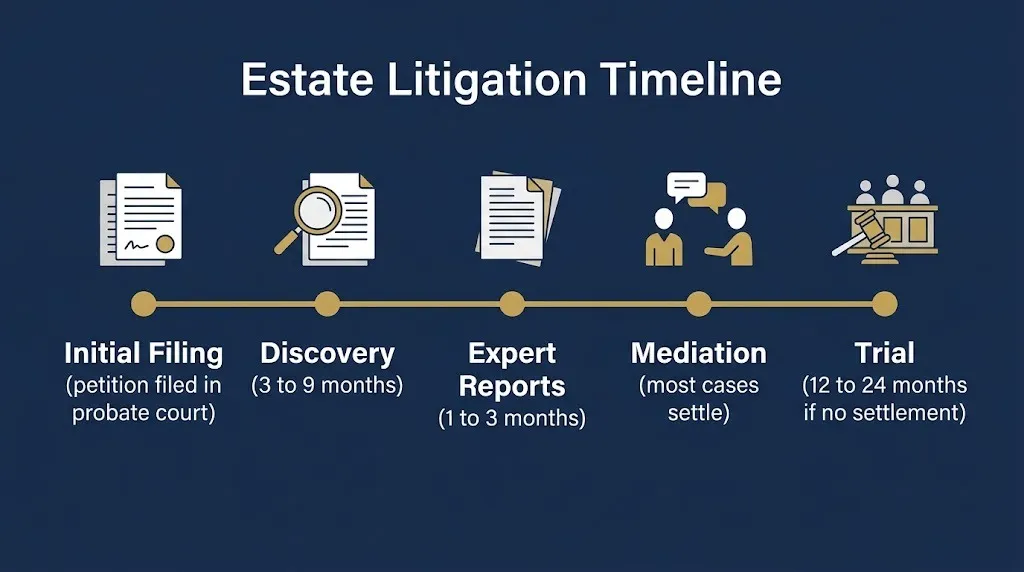
Expected next steps include filing a petition or contest, conducting discovery, attending mediation, and either settling or proceeding to trial. Most cases settle before trial.
Here’s the typical sequence:
- Filing: The contesting party files a petition in probate court. The executor or trustee responds.
- Discovery: Both sides exchange documents, take depositions, and gather evidence. This phase takes 3 to 9 months.
- Expert witnesses: Capacity assessors, forensic accountants, and appraisers are hired. Reports take 1 to 3 months.
- Mediation: Most courts require or encourage mediation before trial. A private mediator costs $2,000 to $5,000, split between parties .
- Trial: If mediation fails, the case goes to trial. This adds 12 to 24 months and $30,000 to $100,000+ in costs .
- Appeal: Either side can appeal. This adds another 12 to 18 months.
The single most important thing you control is whether you’re willing to settle. Mediation resolves most cases. Trial is expensive and unpredictable.
Frequently Asked Questions
What does an estate litigation attorney do?
An estate litigation attorney represents parties in disputes over wills, trusts, and estates.
They handle will contests, breach of fiduciary duty claims, and removal of executors or trustees.
They work for beneficiaries, executors, trustees, and heirs.
How much does estate litigation cost in 2026?
Estate litigation costs $300 to $600 per hour, with retainers starting at $3,000 to $10,000.
Full trials can exceed $100,000, including expert witnesses and court costs.
Most attorneys bill hourly, not on contingency.
How long does a contested will case take?
Contested will cases typically take 18 to 24 months to resolve.
Cases that go to trial can take 2 to 4 years.
Early mediation can settle a dispute in 3 to 6 months.
Can I contest a will without a lawyer?
You have the right to represent yourself, but it’s strongly discouraged.
Probate courts require attorney representation for most fiduciary applications.
The procedural rules are complex, and mistakes can be fatal to your case.
What are the grounds for contesting a will?
The most common grounds are lack of testamentary capacity, undue influence, fraud, and improper execution.
You must prove the deceased didn’t understand what they were signing or was pressured into it.
Capacity challenges often require expert medical testimony.
Who pays for estate litigation?
The general rule is that each side pays their own attorney fees.
If you challenge a will and lose, you may be ordered to pay the estate’s costs.
Executors acting in good faith can often use estate funds to defend the will.
Do estate attorneys work on contingency?
Rarely. Estate litigation is usually billed hourly.
Contingency fees of 25% to 40% are sometimes used for strong family maintenance claims.
Most estate litigators require a retainer and bill against it.
What is undue influence in estate law?
Undue influence means someone pressured the deceased into changing their will or trust.
The pressure must be enough to overcome the deceased’s free will.
Evidence includes isolation, dependency, and suspicious timing of changes.
If you’re facing an estate dispute, gather your documents before you call an attorney. Get the will, trust documents, and any communications showing what the deceased intended.
The most important number to remember is the statute of limitations for will contests in your state. Most range from 2 to 4 years, but some run from the date of probate rather than the date of death. Missing that window can bar your claim entirely.