Litigation Support Specialist in 2026: Role, Skills, Salary, and Career Path
Quick Answer
- A litigation support specialist manages electronic discovery (e-discovery), data, and courtroom technology for legal teams.
- Entry-level salaries range from $55,000 to $75,000; mid-level specialists earn $70,000 to $100,000 or more .
- The role is growing as courts push through case backlogs, with demand strongest for those who know e-discovery platforms like Relativity .
The Facts
| Role Focus | E-discovery, data management, courtroom technology |
|---|---|
| Entry-Level Salary (2026 est.) | $55,000 to $75,000 per year |
| Mid-Level Salary | $70,000 to $100,000 per year |
| Median Paralegal Wage (BLS) | ~$61,000 (May 2024) |
| Key Platform | Relativity (dominant e-discovery review tool) |
| Core Certification | Relativity Certified Administrator, ACEDS CEDS |
| Typical Employer | Law firms, legal service providers, government agencies |
What Is a Litigation Support Specialist?
A litigation support specialist is the person who manages the technology and data behind a legal team’s cases, with a particular focus on electronic discovery . You are the bridge between the lawyers and the technology.
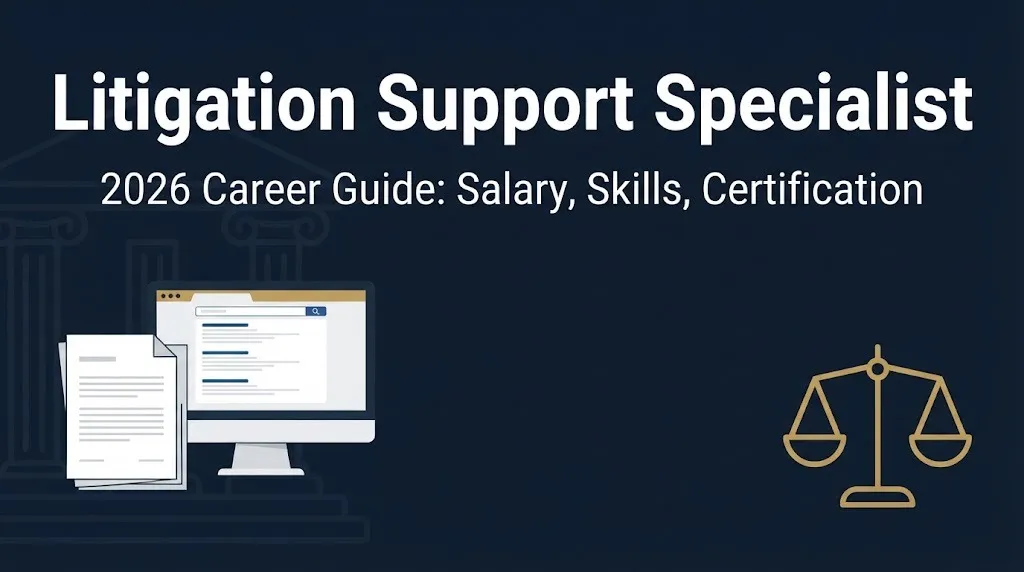
Modern litigation runs on data. A single commercial case can involve millions of emails, documents, chat messages, and files. Someone has to collect that material, load it into review platforms, keep it defensible, and help the legal team make sense of it . That is your job.
The role sits at the intersection of law, data, and technology. You are equal parts technologist and translator, able to explain what the data can and cannot do to attorneys who may not be technical . Twenty years ago, the job focused on courtroom presentation and managing scanned paper. Now, since most information starts digitally and often never appears on paper, the principal focus is managing electronically stored information (ESI) .
How Much Does a Litigation Support Specialist Make in 2026?
Salaries depend on your experience level, location, and technical depth. The U.S. Bureau of Labor Statistics does not track this exact title separately, but it reported a national median annual wage of about $61,000 for the broader paralegal and legal assistant category in May 2024. Litigation support specialists typically earn above that figure because of the technical demands .
Here are estimated 2026 U.S. ranges by seniority :
| Level | Estimated 2026 Salary Range | Typical Profile |
|---|---|---|
| Analyst / Entry Level | $55,000 to $75,000 | Processing data, loading documents, basic searches |
| Specialist (Mid-Level) | $70,000 to $100,000 | Managing workflows, running productions, training users |
| Manager / Director | $100,000 to $150,000+ | Overseeing teams, budgets, firm-wide e-discovery strategy |
Vault.com reported that litigation support and eDiscovery analysts earned an average salary of $74,250, with a range of $65,250 to $91,250, according to the Robert Half Legal 2025 Salary Guide . Government and public defender roles sometimes pay higher at the top end. A Federal Defenders of San Diego litigation support paralegal position posted in June 2026 listed a salary range of $85,307 to $186,785 .
Key Takeaway
Key Takeaway: Litigation support specialist pay starts around $55,000 and rises past $100,000 with experience, driven by technical skills in e-discovery platforms rather than legal credentials alone.
Who May Qualify for a Litigation Support Specialist Career?
You may qualify for a litigation support specialist role if you have a mix of legal knowledge, technical skill, and project management ability. There is no single required degree, but most people enter through one of three paths.
Path 1: Paralegal to specialist. Many people start as paralegals or legal assistants, learn the e-discovery tools on the job, and move into a dedicated litigation support role. The skills overlap, but litigation support focuses on data and technology while paralegal work focuses on substantive legal tasks .
Path 2: IT to legal. Information technology professionals with database, search, or data processing skills can transition into litigation support. The legal knowledge can be learned on the job, especially at larger firms with training programs.
Path 3: Direct entry. Some employers hire entry-level analysts who process data and load documents, then grow into the role through certification and experience. Document coding is a common entry point .
Reality Check: You do not need a law degree to work as a litigation support specialist. You do not need to pass the bar. What matters is whether you can manage data defensibly and explain technical processes to attorneys. Certifications like the Relativity Certified Administrator or the ACEDs CEDS designation carry significant weight in hiring .
What Does a Litigation Support Specialist Do Daily?
A litigation support specialist manages the Electronic Discovery Reference Model (EDRM), the framework that describes every stage of e-discovery from identification through production . Your daily work varies by case stage.
Typical responsibilities include :
- Collecting and preserving electronically stored information (ESI) in a defensible way
- Processing and loading data into review platforms such as Relativity
- Setting up document review workflows, search terms, and coding layouts for attorneys
- Running searches, analytics, and technology-assisted review to narrow large data sets
- Producing documents to opposing parties in the correct format and tracking productions
- Preparing trial exhibits and supporting the technology used in the courtroom
- Troubleshooting technical issues and advising attorneys on what is possible and defensible
At a law firm like Baker Sterchi, the role includes managing litigation databases, overseeing data loading and formatting, providing technical support to trial teams, and training case teams on litigation technology . At a public defender office, you might work with forensic tools to extract data from digital devices, produce reports summarizing evidence, and support trials and evidentiary hearings .
What Skills and Certifications Matter Most?
The skills that matter most are e-discovery platform expertise, data processing, and the ability to communicate technical concepts to non-technical attorneys .
Technical skills employers look for :
- E-discovery platforms, above all Relativity (the dominant tool in the field)
- Data processing and load-file formats, including metadata and file types
- Database and search skills, including SQL and search syntax for larger roles
- Analytics and technology-assisted review
- Trial technology such as presentation tools used in the courtroom
Certifications worth pursuing :
- Relativity Certified Administrator. Highly valued because the platform is so widely used.
- ACEDS Certified E-Discovery Specialist (CEDS). Signals broad e-discovery competence.
- Paralegal certificate or degree. Helps with the legal side of the role.
The value of a good litigation support specialist is defensibility. When a production is challenged or a data set has to hold up under scrutiny, the difference between a well-documented, sound process and a sloppy one can shape the outcome of the case .
Key Takeaway
Key Takeaway: Relativity certification and ACEDS credentials are the two marks that most reliably separate candidates in a competitive hiring pool.
How Does a Litigation Support Specialist Differ from a Paralegal?
A litigation support specialist focuses on data, technology, and workflows. A paralegal focuses on substantive legal work like research, drafting, and case preparation .
The roles overlap, especially in smaller firms where one person may do both. In larger firms and dedicated e-discovery providers, litigation support is its own career track with specialized titles: litigation support analyst, e-discovery specialist, project manager, and at senior levels, litigation support manager or director .
Here is how they compare:
| Feature | Litigation Support Specialist | Paralegal |
|---|---|---|
| Primary Focus | Data, technology, e-discovery workflows | Legal research, drafting, case prep |
| Key Tools | Relativity, analytics, trial tech | Legal research databases, document drafting |
| Certification Path | Relativity, ACEDS | Paralegal certificate, NALA |
| Career Track | Analyst to manager/director | Paralegal to senior paralegal |
Many specialists start as paralegals or in IT and move into the field as they build technical depth .
What Is the Job Outlook for Litigation Support in 2026?
The job outlook is steady, with demand driven by courts pushing through case backlogs and law firms turning to AI to enhance efficiency .
The U.S. Department of Labor projects job opportunities for paralegals and legal assistants, a category that includes many litigation support roles, to grow by 1 percent from 2023 through 2033. That is slower than the average for all careers. Despite that prediction, paralegals and legal assistants are in demand because they are a cost-effective alternative to lawyers .
Robert Half Legal reported that many law firms need more discovery, trial preparation, and litigation support professionals due to tight deadlines as courts continue to push through case backlogs . Specialists with expertise in advanced artificial intelligence will have especially strong job prospects. Some law firms are building their own proprietary generative AI models, creating demand for professionals with advanced technology skills .
The market research firm Research and Markets predicts the global eDiscovery market will grow from $11.2 billion in 2022 to $17.1 billion by 2027 .
How to Get Started as a Litigation Support Specialist
Here are the steps to break into the field:
- Get a paralegal certificate or degree. This helps with the legal side of the role and shows employers you understand the legal context.
- Learn Relativity. Take free or low-cost training through Relativity’s community platform. The Relativity Certified Administrator credential is the gold standard .
- Consider ACEDS membership. The Association of Certified E-Discovery Specialists offers the CEDS certification and a mentorship program .
- Start in a document review or coding role. Many specialists enter through document coding, then move into analyst positions .
- Network in legal technology. Join the International Legal Technology Association (ILTA) and attend events. Read Peer to Peer Magazine .
- Target the right employers. Law firms, legal service providers, government agencies, and eDiscovery software vendors all hire for these roles .
Key Takeaway
Key Takeaway: The fastest entry path is a paralegal certificate plus Relativity training, followed by a document review or analyst role to build hands-on e-discovery experience.
What Happens Next in the Litigation Support Career Path?
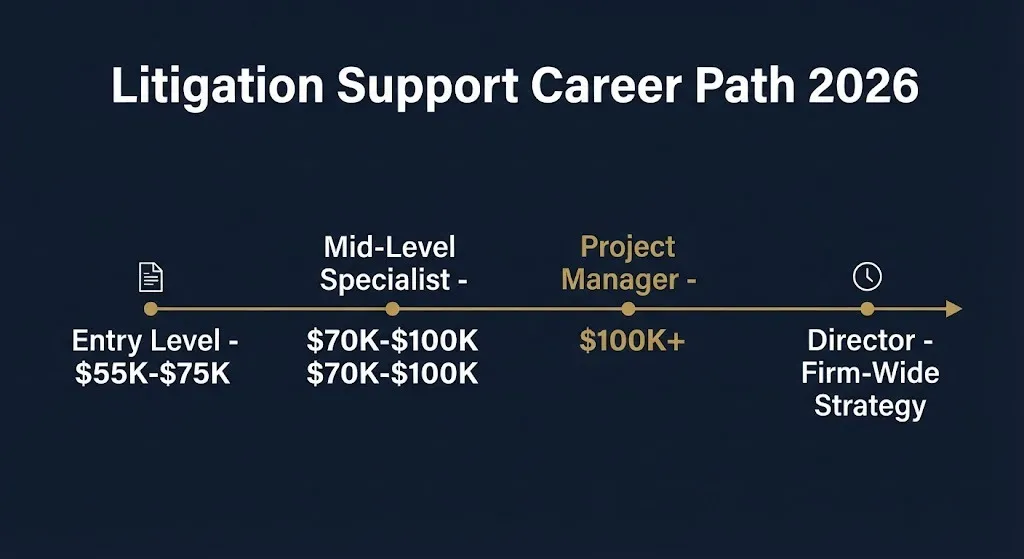
Here is the expected progression for someone entering the field in 2026:
Months 0 to 12: Entry-level analyst role. You process data, load documents, run basic searches, and learn the firm’s workflows.
Years 1 to 3: Mid-level specialist. You manage workflows independently, run productions, train attorneys, and earn Relativity or ACEDS certifications.
Years 3 to 7: Senior specialist or project manager. You oversee complex cases, manage budgets, and serve as the point person for technical issues.
Years 7+: Litigation support manager or director. You oversee a team, set firm-wide e-discovery strategy, and work with managing partners on technology decisions .
TBD: Advancement opportunities at smaller firms may be limited. Larger firms and service providers offer more defined tracks.
Frequently Asked Questions
What does a litigation support specialist do?
A litigation support specialist manages electronic discovery, data processing, and courtroom technology for legal teams, serving as the bridge between lawyers and IT .
How much do litigation support specialists make?
Entry-level salaries range from $55,000 to $75,000, mid-level specialists earn $70,000 to $100,000, and managers earn $100,000 to $150,000+ .
Do I need a law degree to be a litigation support specialist?
No. A paralegal certificate or IT background is more common. What matters is e-discovery platform expertise and the ability to manage data defensibly .
What is the difference between litigation support and e-discovery?
E-discovery is the process of collecting, reviewing, and producing electronic evidence. Litigation support is the broader role that manages e-discovery, plus courtroom technology and trial preparation .
Is litigation support a good career in 2026?
Yes, for those with technical skills. Demand is driven by case backlogs and AI adoption, though overall growth in the paralegal category is slower than average .
What certifications help most?
Relativity Certified Administrator and ACEDS Certified E-Discovery Specialist (CEDS) are the two most valued credentials .
Can I work remotely as a litigation support specialist?
Some roles offer hybrid or remote work, especially for data processing and analysis. Trial support requires in-person presence at courthouses .
What is the career path from litigation support?
Analyst to specialist to project manager to litigation support manager or director. Some specialists move into legal technology consulting or e-discovery vendor roles .
Your Next Step
If you are considering this career, start with Relativity training. The platform is the dominant tool in the field, and certification opens doors faster than almost anything else .
Join ACEDS to access the CEDS certification and mentorship program . Then target document review or analyst roles at law firms, legal service providers, or government agencies. The pay starts around $55,000, but the ceiling is high for specialists who can manage complex data and defend their processes under scrutiny.