What Is a Compensation Package? 2026 Definition, Components, and What It Really Means for Workers
Quick Answer
- A compensation package is the total value your employer provides: base pay, bonuses, insurance, retirement, and paid leave.
- Federal data shows benefits account for about 30 percent of total compensation costs, though this varies by industry.
- Ask for the total dollar value of every component, not just the salary number.
A compensation package means everything your employer gives you in exchange for your work. It includes your salary, but also health insurance, retirement contributions, paid time off, and any other perks the company offers. The salary is only one piece of a much larger financial picture.
If you are comparing job offers or trying to understand what you are actually worth, the package matters more than the paycheck. The Bureau of Labor Statistics reports that benefits account for about 30 percent of total compensation costs for civilian workers. That is real money you are leaving on the table if you only look at salary.
This article breaks down exactly what counts as a compensation package, how to calculate its full value, and what questions to ask before you sign anything. One detail that surprises most people: federal data shows health insurance alone costs employers an average of $3.84 per hour worked, which adds up fast.
The Facts
| Case | Compensation Package (employment concept) |
|---|---|
| Status | Standard employment practice, not a legal case |
| Fund Size | Not applicable |
| Est. Per Person | Varies by employer, industry, and role |
| Claim Deadline | Not applicable |
| Administrator | Not applicable |
| Proof Needed | Request a total compensation statement from HR |
What Is a Compensation Package Definition?
A compensation package is the total set of pay, benefits, and incentives an employee receives from an employer. It includes direct compensation like salary, overtime, and bonuses, plus indirect compensation like health insurance, retirement contributions, and paid leave. The definition is broader than most people assume when they hear the word “compensation.”

The confusion usually comes down to language. Employers say “salary” when they mean one component. Recruiters say “total comp” when they mean the whole thing. The compensation package is the whole thing.
Federal measurement systems treat it the same way. The Bureau of Labor Statistics counts wages and salaries as about 70 percent of total compensation costs, with benefits making up the other 30 percent. That split holds across most industries, though it shifts depending on sector and employer size.
Key Takeaway: A compensation package is not your salary. It is the total dollar value of everything your employer provides, and benefits typically add about 30 percent on top of wages.
How Much Is Your Compensation Package Actually Worth?
Your compensation package is worth more than your annual salary by roughly 30 percent on average, though the exact figure depends on your employer and industry. Federal data shows total compensation costs average $48.78 per hour for civilian workers, with $33.45 going to wages and $15.33 to benefits.
That benefit portion breaks down into specific categories you can actually calculate. Paid leave adds $3.70 per hour. Insurance, including health, life, and disability, adds $4.04. Retirement and savings contributions add $2.52. Legally required benefits like Social Security and Medicare add another $3.36.
Here is what that looks like in practical terms:
| Component | Average Employer Cost Per Hour | What It Means for You |
|---|---|---|
| Wages and salaries | $33.45 | Your taxable paycheck |
| Paid leave | $3.70 | Vacation, holidays, sick days |
| Supplemental pay | $1.71 | Overtime, bonuses, shift differentials |
| Insurance | $4.04 | Health, life, disability coverage |
| Retirement and savings | $2.52 | 401(k) match, pension contributions |
| Legally required benefits | $3.36 | Social Security, Medicare, unemployment |
The numbers vary dramatically by industry. In leisure and hospitality, benefits are only about 19 percent of compensation. In information services, they are 35.6 percent. State and local government workers see benefits account for 38.3 percent of total compensation, largely driven by pension costs.
Key Takeaway: A $70,000 salary offer may actually be worth closer to $100,000 when you add benefits, but the exact value depends on what your employer actually provides.
What Counts as Part of a Compensation Package?
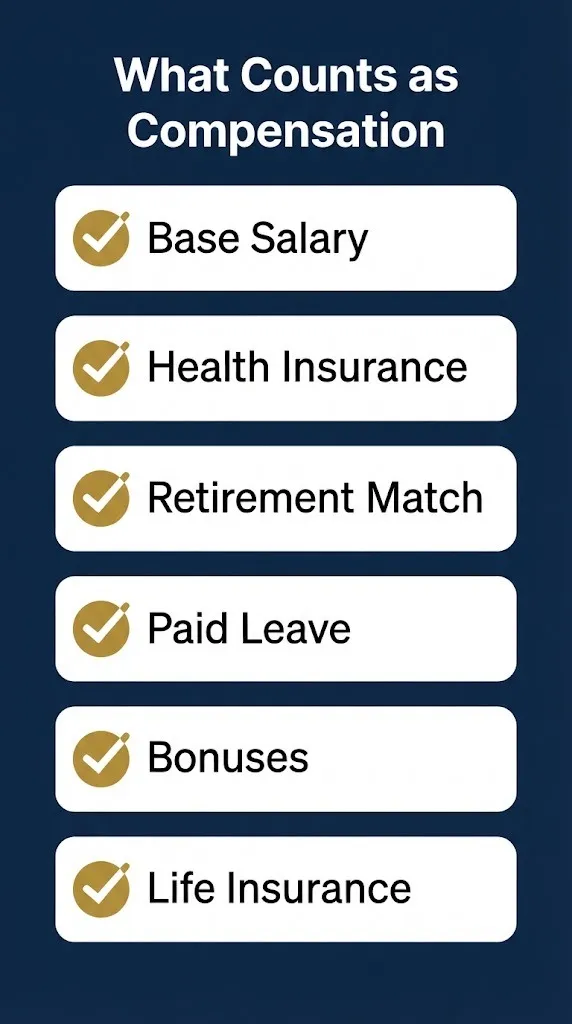
Everything your employer pays for on your behalf counts as part of your compensation package. That includes your base salary, performance bonuses, commissions, overtime pay, health insurance premiums, dental and vision coverage, life insurance, retirement plan contributions, paid vacation, sick leave, parental leave, and any other financial benefit.
The list gets longer for higher-level roles. Executive compensation packages frequently include stock options, restricted stock grants, equity grants, deferred compensation, severance agreements, and perquisites like company cars or housing allowances. Those components can dwarf base salary in value, which is why executive pay disclosures are so closely watched.
Some benefits are legally required, not optional. Social Security, Medicare, unemployment insurance, and workers’ compensation are mandated by law and count as part of your compensation even though your employer has no choice about providing them.
Other benefits are discretionary. Gym memberships, tuition reimbursement, commuter stipends, and wellness programs are perks that some employers offer and others do not. They still count toward the total value if you receive them.
Key Takeaway: If your employer pays for it, it counts. Salary, insurance, retirement, leave, and perks all add up to your real compensation.
How Do You Calculate the Total Value of a Compensation Package?
To calculate your total compensation, add your base salary, the dollar value of your health insurance premiums, retirement contributions, paid leave, bonuses, and any other benefits. The Bureau of Labor Statistics provides a framework for this: wages plus benefits equals total compensation. You can apply the same logic to your own offer.
Start with the salary number. Then ask HR for the employer cost of each benefit. Most large employers can provide a total compensation statement that shows exactly what they spend on you.
Here is a simplified example for someone earning $60,000 per year:
| Component | Annual Value |
|---|---|
| Base salary | $60,000 |
| Health insurance (employer share) | $7,000 |
| Dental and vision | $800 |
| Retirement match (4% of salary) | $2,400 |
| Paid time off (15 days at daily rate) | $3,450 |
| Life and disability insurance | $300 |
| Total package value | $73,950 |
That is roughly $14,000 more than the salary alone. If the employer offers a pension, stock options, or a larger 401(k) match, the gap widens further.
Key Takeaway: Always ask for the employer’s cost of benefits, not just the salary. The total package value is the number that matters for comparing offers.
What Benefits Are Legally Required in a Compensation Package?
Legally required benefits include Social Security, Medicare, federal and state unemployment insurance, and workers’ compensation. The Bureau of Labor Statistics categorizes these as mandatory compensation costs that every covered employer must pay. They are not optional perks. They are the floor.
Social Security and Medicare alone cost employers an average of $2.75 per hour worked for civilian workers. Workers’ compensation adds another $0.42 on average. Federal and state unemployment insurance adds a smaller amount.
These legally required benefits are part of your compensation package even though you never see them as cash. They fund your retirement, your healthcare after 65, and your protection if you are injured on the job. When you calculate total compensation, they count.
Employers sometimes overlook these costs when quoting salary figures. That is a mistake. The government requires them, and they are part of the deal.
Key Takeaway: Social Security, Medicare, unemployment insurance, and workers’ compensation are mandatory parts of every compensation package.
Reality Check: No employer will send you a check for “benefits value” as cash. The dollar value of your compensation package is an accounting figure, not money in your pocket. You cannot spend your employer’s health insurance contribution on rent. Use the total value to compare offers, not to budget your monthly expenses.
What Is the Difference Between Compensation and Total Rewards?
Compensation refers to the monetary and benefit value an employer provides. Total rewards is a broader concept that includes compensation, benefits, and non-monetary elements like recognition, career development, flexible work arrangements, and mentorship. The distinction matters when you are negotiating or comparing employers.
A total rewards strategy includes things that do not have a clean dollar figure. Flexible hours, remote work options, professional development budgets, and mentorship programs all have value, but they are harder to quantify than a salary number.
Gartner survey data from 2026 shows employees are prioritizing financial stability and security over work-life balance and career growth. That shift means traditional compensation components like pay increases, long-term incentives, and medical benefits are becoming more important to workers than flexible schedules or wellness perks.
The practical takeaway: compensation is the measurable part. Total rewards is everything. When you evaluate a job offer, focus on compensation first, because that is what you can calculate and negotiate most directly.
Key Takeaway: Compensation is the measurable value. Total rewards includes the harder-to-quantify extras. Compare offers using compensation numbers, then factor in the rest.
How Has the Compensation Package Changed in 2026?
Compensation packages in 2026 are shifting toward financial security and stability, according to employee surveys from Gartner and WTW. Employees are prioritizing medical benefits, long-term incentives, and flexible financial benefits over work-life balance perks and wellness programs.
The Gartner survey of over 10,000 employees found that paid time off, work-life balance, and individual pay differentiation are less important to workers than they were in previous years. What employees want now is protection against unexpected costs and a path to long-term wealth creation.
That translates into specific preferences. Employees value future base pay increases, long-term incentive targets, and vesting schedules more than short-term bonuses. They want spot bonuses and increased bonus frequency. They are less interested in merit pay differentiation.
Employers are responding by restructuring their offerings. Gartner recommends broadening access to long-term incentives for non-executive employees and piloting cash incentive units as performance drivers. The WTW survey found that 70 percent of employees now say their benefits package meets their needs, up from about half in 2017.
The broader economic context matters here. AI disruption, inflation concerns, and job security worries are pushing employees to value stability over flexibility. Compensation packages are adapting to that reality.
Key Takeaway: In 2026, employees want financial security from their compensation packages, not just perks. Medical benefits, retirement contributions, and long-term incentives are the priorities.
What Should You Ask Before Accepting a Compensation Package?
Before accepting any offer, ask for the total compensation breakdown in writing. Request the employer’s cost for health insurance premiums, the retirement match formula, the exact number of paid leave days, and whether bonuses are guaranteed or discretionary. These details determine whether the offer is actually competitive.
Here are the specific questions that matter:
- What is the employer’s annual cost for my health insurance premiums?
- What is the 401(k) or retirement match, and when does it vest?
- How many paid vacation, sick, and personal days do I receive per year?
- Is the bonus guaranteed or performance-based, and what is the target amount?
- What is the total value of the compensation package, including all benefits?
Get the answers in writing. Verbal promises about benefits are difficult to enforce. The written offer letter and benefits summary are your proof.
If the employer cannot provide a total compensation statement, ask for the individual cost figures and calculate it yourself. The Bureau of Labor Statistics framework gives you the structure: add wages, paid leave, supplemental pay, insurance, retirement contributions, and legally required benefits. The sum is your total compensation.
What Happens Next
Now through December 2026: Annual benefits enrollment periods open at most employers. Review your current package and compare it to what you are actually using.
January 2027: New compensation adjustments and bonus payouts typically take effect. Verify that your total compensation matches what was promised.
Ongoing: Request a total compensation statement from HR annually. Recalculate your package value whenever your salary, benefits, or family situation changes.
Ongoing: Use federal compensation data from the Bureau of Labor Statistics to benchmark your package against industry averages.
Frequently Asked Questions
Is a compensation package the same as salary?
No. A compensation package is the total value of everything your employer provides, including salary, benefits, and perks. Salary is just one component.
What is typically included in a compensation package?
Base salary, health insurance, dental and vision coverage, retirement contributions, paid time off, life insurance, disability insurance, and any bonuses or equity grants the employer offers.
How do I calculate my total compensation?
Add your salary to the dollar value of each benefit: employer health insurance contributions, retirement match, paid leave value, and any other perks. The Bureau of Labor Statistics uses this wages-plus-benefits framework.
Are benefits required by law?
Yes. Social Security, Medicare, unemployment insurance, and workers’ compensation are legally required and count as part of your compensation package.
Can I negotiate a compensation package?
Yes. Employees can negotiate base salary, bonuses, paid time off, retirement contributions, and other benefits. Many components beyond salary are negotiable.
What percentage of compensation is benefits?
Benefits account for roughly 30 percent of total compensation costs on average. This varies by industry, ranging from about 19 percent in leisure and hospitality to over 35 percent in information services.
Why does total compensation matter more than salary?
Total compensation shows the real financial value of your job. Two offers with the same salary can differ by thousands of dollars per year depending on benefits.
What is the difference between compensation and total rewards?
Compensation is the measurable pay and benefit value. Total rewards includes compensation plus non-monetary elements like recognition, development, and flexible work.