Navy AFFF Lawsuit 2026: Status, Eligibility, Payouts and Deadlines
Quick Answer
- Yes, it’s real: Navy-linked AFFF injury suits sit in federal MDL 2873 in South Carolina.
- Payout per person is not yet determined. No personal injury settlement fund exists.
- No claim deadline exists yet. Group B bellwether proposals are due November 20, 2026.
The Navy AFFF lawsuit is real, but it isn’t a class action and it hasn’t settled. Navy veterans who got sick are suing foam makers like 3M and DuPont inside federal MDL 2873.
It affects sailors, firefighters and boot camp recruits who handled firefighting foam. Roughly 15,200 personal injury cases are pending. No payout fund exists, and no claim form does either.
This guide covers eligibility, proof, deadlines and the Great Lakes boot camp angle. One surprise: the biggest AFFF payouts so far went to water systems, not people.
| The Facts | |
|---|---|
| Case | In re Aqueous Film-Forming Foams (AFFF) Products Liability Litigation, MDL No. 2873 |
| Court | U.S. District Court for the District of South Carolina, Judge Richard Gergel |
| Status | Active. No personal injury settlement. Bellwether trial vacated, no new date |
| Fund Size | Not yet confirmed (none exists for personal injury) |
| Est. Per Person | Not yet determined |
| Claim Deadline | None set. Watch the court’s MDL portal and your state’s filing limit |
| Administrator | Not yet appointed |
| Proof Needed | Medical diagnosis records plus proof of AFFF exposure (service and training records) |
Is the Navy AFFF lawsuit real or a scam?
The Navy AFFF lawsuit is real. Veterans who served in the Navy and later developed certain illnesses are suing AFFF manufacturers in federal court.
The cases are centralized in MDL 2873 before Judge Richard Gergel in South Carolina. The MDL was created in December 2018, according to an MDL tracker. An October 2026 tracker update counts about 15,264 personal injury cases pending out of 19,840 total.
The litigation is real. The marketing around it is where the trouble starts. Many ads say “AFFF class action,” “claim your payout” or “deadline approaching.” Those lines overstate the case.
Here’s what’s verified and what isn’t:
- Verified: a federal MDL exists, and thousands of injury suits are pending.
- Verified: no global personal injury settlement has been reached.
- Not verified: any per-person dollar figure for Navy claims.
- Not verified: any claim form, claims website or administrator for injury claims.
If a text or ad promises Navy AFFF money, treat it as a lead-generation pitch. It’s not a payment notice.
Is there a Navy AFFF class action lawsuit?
No, there is no Navy AFFF class action for personal injury. The injury cases are part of an MDL, which is a different structure.
In an MDL, one federal judge coordinates thousands of separate lawsuits. Each injured person keeps an individual claim. Law-firm ads that say “AFFF class action MDL” blend two terms that don’t mean the same thing.
| Class action | MDL (AFFF injury cases) | |
|---|---|---|
| Who’s covered | Everyone who fits a definition | Only people who file their own case |
| Claim form | Usually yes | No |
| Opt-out deadline | Yes | No |
| Administrator | Yes | Not yet appointed |
| Payout | Set by the settlement | Set by any future global deal or trial |
The court tightened the rules in 2026. Case Management Order 38, dated June 3, 2026, requires one action per personal injury plaintiff.
The public water settlements were different. Those resolved claims by water systems, not individual veterans.
Is an AFFF lawsuit for Navy boot camp valid?
A boot camp claim can be valid, but it’s harder to prove than a career firefighter’s claim. The strength depends on how much foam contact you had and what you were later diagnosed with.
Naval Station Great Lakes in Lake County, Illinois, is the Navy’s only boot camp. It has operated since 1911. Law-firm summaries say recruits practiced shipboard firefighting there, and damage control trainees handled AFFF repeatedly.
The Navy hasn’t confirmed those exposure details in anything I reviewed. They come from attorney pages, so treat them as allegations.
Here’s how exposure strength tends to line up:
- Stronger: repeated, hands-on foam use as a firefighter or damage control sailor.
- Weaker: one training evolution during recruit training.
- Weakest: no records and no memory of foam contact.
A boot camp claim works best when it’s paired with later service. A sailor who trained at Great Lakes and then served on a ship’s damage control team has a longer exposure story. That’s the kind of detail defendants will test.
Key Takeaway: The Navy AFFF lawsuit is a real federal MDL, not a class action, and boot camp claims turn on how much foam contact you can document.
How much is a Navy AFFF lawsuit worth?
Not yet determined. No court has set, approved or funded a personal injury payout for Navy AFFF claims.
Some law-firm sites publish dollar tiers by illness. Those figures are projections. None pointed to a court order or settlement document. We don’t repeat them here, because a wrong number sets false expectations.
What will likely drive value if a settlement comes:
| Factor | Why it matters |
|---|---|
| Diagnosis | The six MDL conditions carry the strongest claims |
| Exposure length | Years of drills beat one afternoon |
| Documentation | Records separate a claim from a story |
| Medical costs | Treatment history supports damages |
| Defendant mix | 3M, DuPont and others have different exposure |
Think of it like a tax refund estimate before you’ve filed. The software gives you a number, but the IRS hasn’t agreed to anything. Any AFFF “estimate” works the same way.
Expect the first real numbers from one of three places: a global settlement framework, a bellwether verdict or major expert rulings.
Has anyone been paid in the AFFF litigation yet?
Yes, but not injured individuals. Water systems and state governments received the big settlements so far.
| Settlement | Amount | Who it covers |
|---|---|---|
| 3M public water systems | $10.3 billion | Public water systems, not injury claims |
| DuPont, Chemours, Corteva | About $1.18 billion | Public water systems, not injury claims |
| DuPont, Chemours, Corteva and North Carolina (Sept. 10, 2026) | $455 million over 15 years | North Carolina and 11 local entities |
The North Carolina deal has a present value of about $355 million, per an MDL tracker. It’s still not a personal injury settlement.
The court approved the first settlement in the MDL on February 8, 2024. That also concerned water claims.
So when a headline says “billions in AFFF settlements,” read the fine print. Your Navy illness claim isn’t inside those deals.
Reality Check: Nobody can text you Navy AFFF settlement money first, because no injury fund exists yet. Filing a claim in a real settlement is always free. Anyone charging a “claim processing fee” is a red flag.
Which illnesses qualify for a Navy AFFF claim?
The MDL prioritizes six conditions. They are kidney cancer, testicular cancer, thyroid cancer, thyroid disease, liver cancer and ulcerative colitis.
Kidney and testicular cancer get the most attention. Attorneys describe them as the strongest links to PFAS exposure. The first bellwether, now vacated, was built around kidney cancer.
The next bellwether work covers other conditions. Under Case Management Order 26O, dated July 30, 2026, proposals for the Group B bellwether cases are due November 20, 2026. Group B covers thyroid disease and ulcerative colitis, with expert discovery proposals due the same day.
Other illnesses are being argued by plaintiffs. Prostate, pancreatic, breast and bladder cancer appear in advocacy materials. Sources I reviewed say the MDL doesn’t formally recognize pancreatic cancer yet.
If your diagnosis isn’t on the six-condition list, you can still talk to an attorney. Just know that your case sits outside the court’s current priority track.
Key Takeaway: Six conditions drive the MDL right now, and Group B bellwether proposals for thyroid disease and ulcerative colitis are due November 20, 2026.
Who can file a Navy AFFF lawsuit?
You may qualify if you were exposed to AFFF through Navy service and later developed one of the six conditions. Both pieces matter.
People who may fit, based on law-firm and court-tracker summaries:
- Navy firefighters and damage control sailors
- Boot camp recruits who trained with foam
- Aviation and flight deck fire crews
- Sailors who used foam during drills or equipment testing
- Civilian base workers and contractors with foam contact
- Family members of someone who died, through wrongful death claims
Some firm pages also describe exposure through contaminated base drinking water. Courts haven’t tested that theory here, so treat it cautiously.
Active-duty status versus veteran status isn’t the dividing line. Diagnosis and documented exposure are.
Wrongful death claims exist in the MDL too. Settlement coverage for those claims is pending, like everything else on the injury side.
What proof do you need for a Navy AFFF boot camp claim?
You need two things: a medical diagnosis and evidence you were around AFFF. The court has made missing paperwork a dismissal risk.
Case Management Order 37, filed February 25, 2026, created a formal process for plaintiffs who haven’t submitted required fact sheets or profile forms. For newer cases, it covers missing diagnosis records. It sets cure periods, then lets defendants seek dismissal if gaps stay open.
Gather these before you call anyone:
- Diagnosis records and pathology reports
- Service records showing duty stations and dates
- Boot camp and “A” school training records
- Rate or job title documents (firefighter, damage control, aviation)
- Any photos, orders or letters that mention foam drills
- Names of shipmates who can confirm your exposure
You won’t find a record that says “you touched AFFF on March 3.” Attorneys build the story from your duty history. A messy file today becomes a dismissal motion later.
How do you file a Navy AFFF lawsuit?
You file through an attorney, who submits your case into MDL 2873. There’s no public claim form to fill out yourself.
Think of it like returning something without a receipt. The store may still help, but your odds improve if you bring every record you’ve got.
Here’s the process in plain steps:
- Confirm your diagnosis is one of the six MDL conditions.
- Collect medical and service records.
- Speak with a licensed attorney who handles AFFF cases.
- Read the fee agreement before you sign it.
- Let the attorney file a single action for you, as CMO 38 requires.
- Complete the plaintiff profile form or fact sheet through the MDL portal.
- Respond fast if the court flags a deficiency.
- Keep copies of everything you send.
Law Compensate isn’t a law firm. We report the process. We can’t represent you or tell you whether to file.
Key Takeaway: You can’t self-file a claim form for Navy AFFF money, so records and a licensed attorney come first.
What is the deadline to file a Navy AFFF lawsuit?
There is no single claim deadline, but statutes of limitations still apply. Those limits vary by state and by when you were diagnosed.
One law-firm summary puts the typical window at 2 to 3 years from diagnosis or from learning your illness may be linked to AFFF. Your state may differ. An attorney has to check yours.
The court also set a Filing Facilitation Window in 2025. It ran through September 5, 2025. It required plaintiffs’ leadership to file cases involving the six core conditions within 21 days. The order came after a surge of unfiled claims delayed the first bellwether.
Trackers say personal injury claims are still being filed. Even so, the rules are stricter now. CMO 37 and CMO 38 both put more burden on each plaintiff.
So there’s no countdown clock on a settlement site. The clock that matters is the one in your state law. Waiting for an official “deadline announcement” can cost you your case.
Can you sue the Navy itself over AFFF?
Mostly no. The cases target manufacturers, not the Navy. Navy sovereign immunity and related doctrines make suing the government difficult.
One law-firm page says the Feres doctrine has no bearing on these claims, because the defendants are private companies. Feres generally limits service members from suing the government for injuries tied to service. That’s why the MDL names makers like 3M, DuPont and Tyco Fire Products.
The manufacturers have their own defense. Military-specification AFFF was made to federal standards. In an April 2026 ruling in a related state case, the court found 3M had a colorable government contractor defense. That ruling isn’t an MDL verdict, but it shows what defendants will argue.
The Navy has denied liability for AFFF exposure, according to a legal-marketing summary. We couldn’t confirm that statement in a primary Navy document.
Separately, some veterans pursue VA benefits. VA rules are a different track and they’re not covered here. Check with the VA or an accredited veterans service officer.
What is the latest Navy AFFF lawsuit update?
The latest update is that the MDL is still in pretrial work with no personal injury settlement. The October 2025 bellwether trial was vacated, and 3M’s latest quarterly filing says no new date is set.
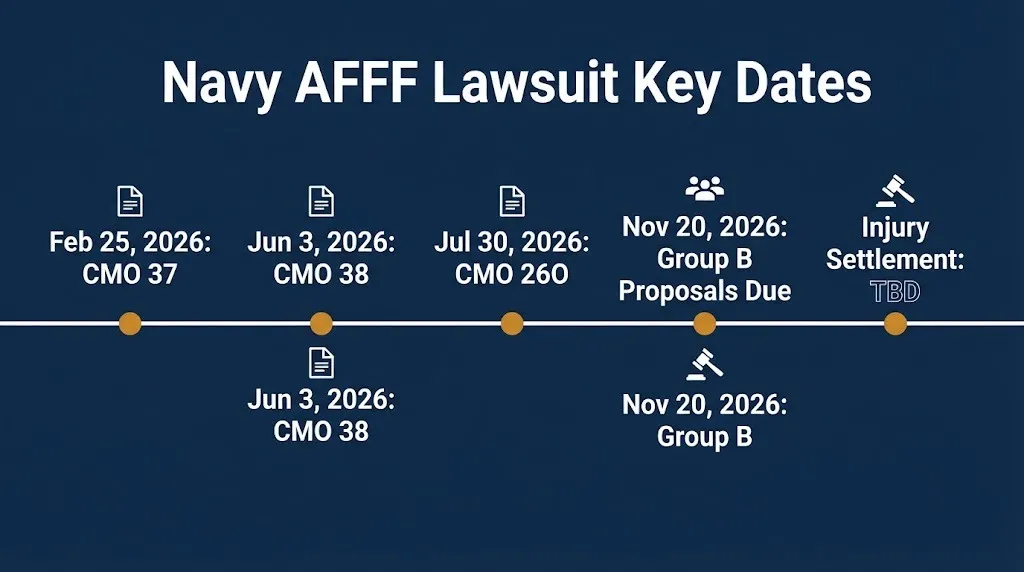
Here’s the 2026 sequence:
| Date | Event |
|---|---|
| Feb. 25, 2026 | CMO 37 sets cure process for missing fact sheets and diagnosis records |
| Jun. 3, 2026 | CMO 38 requires one action per personal injury plaintiff |
| Jun. 10, 2026 | A tracker confirms no global personal injury settlement |
| Jul. 30, 2026 | CMO 26O sets Group B bellwether schedule |
| Sep. 10, 2026 | North Carolina water-claims settlement, not an injury deal |
| Nov. 20, 2026 | Group B proposals and expert discovery proposals due |
The pattern is clear. The court is cleaning up filings and building more test-case tracks.
That could mean pressure on defendants rises over time. A bad bellwether verdict could lift the value of thousands of claims, one tracker notes. Right now, though, there’s no trial on the calendar.
Key Takeaway: The 2026 AFFF docket is about paperwork rules and bellwether scheduling, not payouts.
When will AFFF personal injury payments start?
Not yet confirmed. No payment date exists. There’s no settlement to pay from.
Experts and attorneys have predicted a global deal for a while. Earlier articles pointed to 2025 or early 2026. That didn’t happen. Current commentary now says a personal injury resolution could come in 2026 or 2027.
Treat those predictions the way you’d treat a delayed tax refund timeline. “Soon” isn’t a date.
Even after a deal, money doesn’t arrive fast. Typical steps include:
- Court approval of the framework
- A claims process and administrator
- Review of each claimant’s proof
- Resolution of medical liens and attorney fees
- Payment waves, often months apart
The three pressure points to watch are a new bellwether trial date, major Daubert rulings on expert testimony, or a formal settlement framework. When one lands, timelines usually get easier to read.
How were Navy recruits exposed to AFFF at boot camp?
Navy recruits may have been exposed through firefighting drills at Recruit Training Command. Law-firm summaries describe hands-on training with live fuel fires and foam.
The Navy began using AFFF around the 1960s, after jet fuel fires caused heavy losses. By the late 1960s it was standard on carriers and at naval bases and air stations, per law-firm accounts.
Exposure routes described by attorneys include:
- Direct skin contact during drills
- Inhaling foam mist or vapor
- Foam runoff into soil and groundwater
- Contaminated water on ships or bases
PFAS contamination at Great Lakes has been described in legal investigations. Those pages date the primary AFFF source to the 1970s. We didn’t verify base test results from a government source, so check Navy and EPA records if that matters to your claim.
Recruit training is short, and exposure stories get fuzzy over decades. That’s why dated records beat memory.
Why are 3M and DuPont the defendants in Navy AFFF cases?
3M, DuPont and other manufacturers are defendants because they made or sold the foam. Plaintiffs allege they knew PFAS risks and failed to warn users.
Named defendants across the MDL include 3M, DuPont, BASF, Tyco Fire Products and Johnson Controls. One suit cited in tracker coverage alleges the companies kept promoting AFFF after internal studies and regulatory pressure flagged harm.
The Navy matters to the story because it wrote the specifications. Military AFFF was made to detailed federal standards. That’s why the government contractor defense keeps coming up.
For you, the legal point is simple. Your case isn’t against the Navy as your employer. It’s against the companies whose products you say harmed you.
PFAS stands for per- and polyfluoroalkyl substances. They’re called “forever chemicals” because they don’t break down easily. That persistence is a core part of the allegations.
Key Takeaway: Manufacturers, not the Navy, are the main defendants, and their federal-contractor defense is a major hurdle.
What happens next in the Navy AFFF lawsuit?
The next few months are about scheduling, expert work and settlement pressure. Here’s the expected path:
November 20, 2026: Group B bellwether proposals (thyroid disease and ulcerative colitis) and expert discovery proposals are due.
Expected, date not set: The court sets a new personal injury bellwether trial date. None exists today.
Expected, date not set: Rulings on expert testimony that could shape every injury claim.
Expected 2026 to 2027, per commentary: A possible global personal injury settlement framework. Not confirmed.
After any deal: Court approval, claims review and payments, likely over months.
Frequently Asked Questions
Can I join a Navy AFFF lawsuit if I only did boot camp?
You may be able to, but your claim is harder if boot camp was your only exposure.
Attorneys look at how often you handled foam and what illness you developed.
Bring training records and your diagnosis.
Do I have to pay to file a Navy AFFF lawsuit?
Many injury attorneys work on contingency, but you should confirm the terms in writing.
Settlement claim forms in real class settlements are free to file.
Never pay someone who promises a guaranteed payout.
Does the Navy still use AFFF?
The Navy and other services have been phasing out PFAS foam.
One law-firm summary says installations can request waivers to keep using AFFF until October 2026.
Not yet confirmed from a Department of Defense source.
What if my illness isn’t one of the six conditions?
The MDL focuses on kidney cancer, testicular cancer, thyroid cancer, thyroid disease, liver cancer and ulcerative colitis.
Other conditions may still be investigated by attorneys.
They sit outside the court’s current priority tracks.
Can family members file if the veteran died?
Wrongful death claims are part of the AFFF litigation.
Eligibility depends on diagnosis, exposure and state law.
An attorney can review the specifics.
Is there a per-person Navy AFFF settlement amount?
No. Per-person amounts are not yet determined.
No personal injury settlement fund exists as of October 3, 2026.
Dollar ranges online are projections, not court figures.
Will I get a text or email about Navy AFFF money?
You shouldn’t get a payment text from a court or administrator right now.
Messages promising money are likely lead-generation or scams.
Check the court’s MDL portal for real notices.
You don’t need to wait for a settlement to start gathering proof. Pull your diagnosis records, service history and any training documents now.
Then mark November 20, 2026 on your calendar. That’s the next verified date in the case, and it’s about the Group B bellwether, not a claim cutoff.