Experian Lawsuit 2026: CFPB Case Status, Class Actions and Your Options
Quick Answer
- Yes, it’s real: the CFPB sued Experian in January 2025 over credit report dispute handling.
- Payout per person is not yet determined. No settlement fund exists.
- No claim deadline exists. Treat pages listing mid-2026 Experian deadlines with suspicion.
The Experian lawsuit people are searching for is real, but it isn’t a settlement. The Consumer Financial Protection Bureau sued Experian on January 7, 2025, and the case is still pending.
It affects anyone who has disputed an error on an Experian credit report. No money is available to claim today. No court-approved fund, administrator or claim form exists for this case.
This guide sorts the four Experian cases now in the news and what each one means for you. One surprise: some pages list 2026 claim deadlines that I couldn’t match to any court record.
| The Facts | |
|---|---|
| Case | Consumer Financial Protection Bureau v. Experian Information Solutions, Inc., No. 8:25-cv-00024 (C.D. Cal.) |
| Status | Pending. Discovery and pretrial stage. No settlement |
| Fund Size | Not yet confirmed (no settlement exists) |
| Est. Per Person | Not yet determined |
| Claim Deadline | None. No claim process exists |
| Administrator | Not yet appointed |
| Proof Needed | Check claim form if one is ever approved. Keep dispute letters and credit reports now |
Is there an Experian lawsuit in 2026?
Yes, there are several, and they aren’t the same case. The biggest is a federal enforcement action by the CFPB, filed January 7, 2025, in the Central District of California.
The case is Consumer Financial Protection Bureau v. Experian Information Solutions, Inc., No. 8:25-cv-00024. The judge is Michelle Williams Court. The claims arise under the Fair Credit Reporting Act, known as the FCRA, and the Consumer Financial Protection Act.
Three other matters turn up in searches:
- Davis v. Experian (N.D. Cal., No. 4:25-cv-04819): a proposed class action over phone numbers in “trigger leads.” Filed June 6, 2025.
- Pham v. Equifax, Experian and others (Texas federal court): a proposed class action over settled accounts. Filed June 9, 2026.
- Closed settlements from earlier years, whose claim windows ended long ago.
Most “Experian settlement” headlines blend these together. That’s how readers end up chasing a deadline that doesn’t exist. Each case has its own court, its own status and its own rules.
Is the Experian settlement real or a scam?
The lawsuits are real, but I found no open Experian settlement in 2026. That’s the key fact to hold onto when a headline or email says otherwise.
Some pages list Experian claim deadlines in mid-2026, including dates in June, August and September. I couldn’t tie any of those dates to an official settlement website, a court order or a named administrator. Treat them as unverified.
Here’s a quick filter:
- Real notices come by mail or from a named administrator, and they cite a case name and number.
- Real settlements have a court-approved fund and a final approval hearing date.
- Real claim forms are free to file and never ask for a fee.
- Red flags include “limited time,” payment requests and links in unsolicited texts.
Our own March 2026 coverage reached the same conclusion about breach claims. No new Experian settlement was open for claims then, and I found none open now.
Is there an Experian class action settlement open right now?
No. No Experian class action settlement could be confirmed as open for claims as of October 3, 2026. The active cases are still in litigation.
A class action settlement has clear signs. A court grants preliminary approval. A notice goes out. A claim deadline appears. A final approval hearing follows. None of those exist for the active Experian cases.
| Case | Type | Settlement? |
|---|---|---|
| CFPB v. Experian | Government enforcement | No, pending |
| Davis v. Experian | Proposed class action | No, pending arbitration ruling |
| Pham v. Equifax and Experian | Proposed class action | No, early stage |
The CFPB case isn’t a class action at all. The Bureau sues on behalf of the public, not on behalf of a defined class. If it ends in a settlement or judgment, any consumer redress would be set by the court or the agreement.
Key Takeaway: The Experian lawsuit headlines are real cases, but none has produced a settlement, a claim form or a deadline.
How much could you get from an Experian lawsuit?
Not yet determined. No settlement fund exists, so there’s no per-person figure to report.
The CFPB asked the court to stop the alleged violations, require FCRA compliance and recover money for affected consumers. It didn’t set a fixed dollar amount. What consumers might receive depends on a verdict or a negotiated deal.
Some trackers cite the FCRA’s statutory damages range of $100 to $1,000 per willful violation. That’s the statute’s range for individual suits. It isn’t a payout promise for any Experian case.
| What shapes any future amount | Why it matters |
|---|---|
| Court outcome | A verdict or deal sets the pool |
| Redress rules | The CFPB case may or may not produce consumer payments |
| Class definition | Only matters if a class is certified |
| Your documentation | Records support claims in any process |
Think of it like a speeding ticket hearing. The maximum fine is in the statute, but the judge sets yours after hearing the facts. Until then, any number is a guess.
Have past Experian settlements paid out?
Yes, several past Experian class actions settled and closed. None is open today.
| Past settlement | Amount | Claim or registration deadline |
|---|---|---|
| Experian data breach (2015 breach) | $22 million | April 11, 2019 |
| Incorrect residential information (Fraud Shield) | $22 million | January 30, 2023 |
| Experian and T-Mobile breach | $16 million (Experian $13.67 million) | May 6, 2023 |
| Smith v. Experian (CashCall accounts) | Not confirmed here | No claim form, final hearing Nov. 9, 2020 |
All of these are closed. If you missed a deadline, there’s generally no way to file late.
The residential-information deal gave cash only to the Money Class, who had to file a claim. The Policy Change Class got business changes, not payments. That detail matters because “settlement” doesn’t always mean “check.”
Use these examples as a pattern. A real Experian payout comes with a named case, an administrator and a hard date.
Reality Check: Nobody can text you Experian settlement money first, because no open fund exists. Filing a claim in a real settlement is always free. Anyone charging a “claim fee” or asking for your login is running a scam.
Who may qualify for the Experian lawsuits?
Nobody can claim money today, but your situation may fit one of the active cases. Eligibility rules would only matter if a settlement or class is approved.
Here’s how the cases are defined:
- CFPB case: targets Experian’s dispute handling for consumers generally. No claim step exists.
- Davis case: the proposed class covers people whose phone number Experian disclosed to a lender in connection with a firm credit offer, from June 6, 2023 to the present.
- Pham case: concerns settled accounts that allegedly kept showing balances after payment.
Proposed classes aren’t certified classes. Membership in a proposed class doesn’t guarantee anything.
You may be in the Davis group if you applied for credit and then got a flood of lender calls. You may relate to the Pham facts if a settled account still shows a balance owed.
Either way, don’t assume you qualify. Gather documents and watch the court record.
Key Takeaway: No Experian case has a claim process, so “who qualifies” only matters once a court approves a class or settlement.
How do you dispute an Experian error and build a record?
You can dispute an error directly with Experian, and it’s worth doing now. A clean paper trail helps in any future claim or complaint.
The FCRA requires bureaus to reinvestigate disputes, generally within 30 days. The CFPB case alleges Experian falls short at several steps of that process.
Think of it like returning a product without a receipt. You can try, but your odds rise when you bring proof.
Here are the steps:
- Pull your Experian credit report and mark each error.
- Write a dispute letter naming the account and why it’s wrong.
- Attach proof, such as payoff letters or settlement agreements.
- Send it by certified mail and keep the receipt.
- Note the date Experian responds.
- Check whether the error was removed or reinserted later.
- File a CFPB complaint if the problem persists.
- Save everything in one folder.
Law Compensate isn’t a law firm. This is the process as reported, not legal advice.
What is the Experian lawsuit claim deadline?
There’s no Experian claim deadline because no claim process exists. Any page that gives you a date to file is describing something I couldn’t verify.
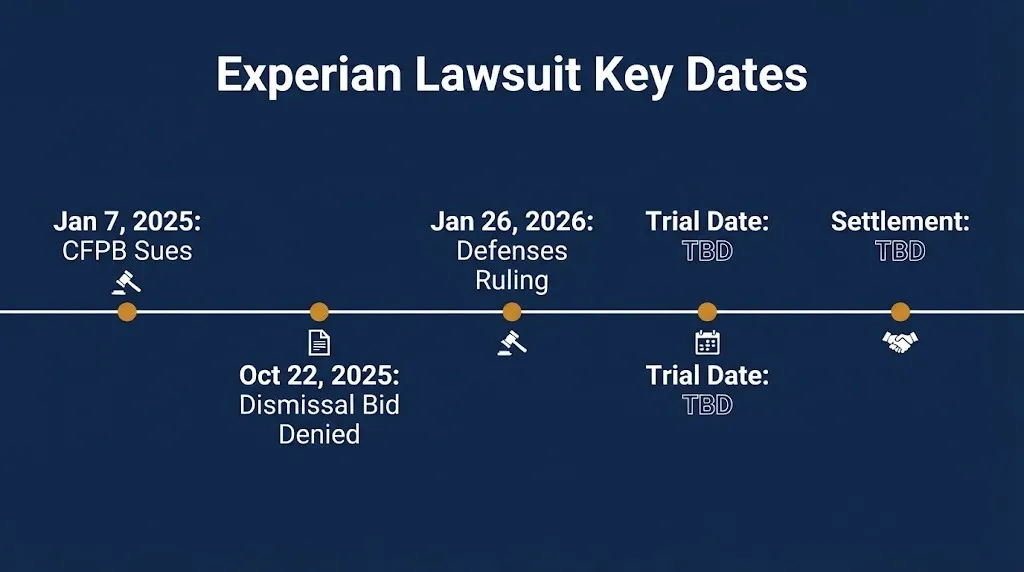
The dates that do exist belong to the court schedule, not consumers. An earlier scheduling order in the CFPB docket lists a settlement conference deadline of July 3, 2026. It also lists a final pretrial conference on September 11, 2026, and a jury trial on September 21, 2026.
Those are court dates. They don’t affect your ability to file anything.
The deadlines that may matter to you are personal ones. Statutes of limitation can limit your own FCRA claim. An attorney can tell you how they apply to your situation.
I can’t verify whether the scheduled trial date still holds. The most recent filing I could find was dated July 24, 2026. A September 2026 case summary still describes the case as pretrial.
How do you tell whether an Experian notice is real?
A real notice names the case, the court and the administrator. If any of those are missing, treat it as unverified.
Legitimate class settlement notices usually arrive by mail or from a named administrator. They give a case number and a hard date. They never ask for payment.
Use this checklist:
- Find the case name and court on the notice.
- Search the case number in the court’s public docket.
- Confirm a settlement website exists and matches the notice.
- Check that the administrator’s name appears in court filings.
- Never enter your Social Security number on a link from a text.
- Call the number printed on the notice, not one from a search ad.
Past Experian settlements used named administrators. Kroll handled the Experian and T-Mobile registration, for example.
If you can’t verify a notice, don’t click. Contact the court clerk or an attorney instead.
Key Takeaway: Verify every Experian “settlement” notice against a court docket before you share any personal information.
What is the latest in CFPB v. Experian?
The CFPB case is still pending, and the latest rulings favor the case moving forward. Discovery has been ongoing since early 2026.
Here’s the court record in order:
| Date | Event |
|---|---|
| Jan. 7, 2025 | CFPB files suit in C.D. Cal. |
| May 5, 2025 | Court lets claims about ongoing dispute practices proceed |
| Aug. 6, 2025 | Court dismisses certain 2018 to 2021 counts as untimely, with leave to amend |
| Aug. 22, 2025 | CFPB files second amended complaint |
| Oct. 22, 2025 | Court denies Experian’s bid to dismiss those counts |
| Jan. 26, 2026 | Court rules on CFPB motion to strike defenses, granted in part, denied in part |
| Feb. 25, 2026 | Mediation date set in docket |
Some headlines said the case was “dismissed.” That refers to the August 2025 ruling, which gave the Bureau a chance to amend. The core reinvestigation claims were never dismissed.
The CFPB’s page lists the case as pending litigation. A mediation date and a settlement conference deadline appeared in the schedule, but I found no announced deal.
Is there a trial date in the CFPB Experian lawsuit?
Not yet confirmed. An earlier scheduling order set a jury trial for September 21, 2026, but I couldn’t confirm it went forward.
The docket listed these court dates:
- June 12, 2026: last date to hear motions
- July 3, 2026: deadline to complete the settlement conference
- September 11, 2026: final pretrial conference
- September 21, 2026: jury trial
The latest filing I found was dated July 24, 2026. A September 2026 summary still called the case pretrial. That doesn’t match a trial starting on September 21.
So the dates may have moved. Check the court docket for the current schedule before you rely on any date.
A trial isn’t a payout date either. Even a verdict would likely be followed by post-trial motions and possible appeals. Money, if any, would come well after.
What happened in the Davis trigger leads case?
The court granted Experian’s motion to compel arbitration, according to an order in the record. That sends the dispute out of open court and into arbitration.
Davis v. Experian was filed June 6, 2025, in the Northern District of California. It’s No. 4:25-cv-04819. The plaintiff alleges Experian sold or disclosed consumers’ phone numbers to lenders as part of “trigger leads.”
A trigger lead happens when you apply for credit and your information gets sold to other lenders. The suit says the FCRA permits limited sharing for firm offers of credit, but not phone numbers.
I couldn’t confirm the date of the arbitration order. Some pages describe the case as in the class certification phase. That conflicts with an order sending it to arbitration, so treat those claims carefully.
Experian claims its trigger lead sales are fully compliant, according to the complaint. The case has no settlement, no certified class and no claim form.
Key Takeaway: The Davis case has been sent toward arbitration, so a classwide payout looks distant and uncertain.
What is the Pham credit report errors class action?
Pham v. Equifax and Experian is a proposed class action filed June 9, 2026, in Texas federal court. It’s early-stage and has no settlement.
Plaintiff Angelica Pham alleges Equifax and Experian kept reporting balances on three settled accounts. She says she found the errors around March 19, 2026. She mailed dispute letters in April 2026, with proof of payment.
The suit says settled accounts should carry a “Code 64” Metro 2 status showing a zero balance. It alleges the bureaus kept them as “Charged Off” with balances owed.
Synchrony Bank and Midland Credit Management are also named.
An allegation isn’t a finding. The defendants haven’t been found liable.
Still, the facts show why documentation matters. Proof of payment and dated dispute letters are the backbone of this kind of claim. If your own account looks wrong, keep the same records.
What is the CFPB suing Experian over?
The CFPB says Experian ran “sham” investigations of credit report disputes. It alleges violations of the FCRA and the Consumer Financial Protection Act.
The complaint says Experian fails consumers at each stage of the dispute process. Here are the specific allegations:
- Experian “routinely and uncritically” accepts the data furnisher’s response, even when it looks improbable.
- Experian doesn’t forward all relevant information to furnishers.
- Experian doesn’t give consumers adequate or accurate notice of dispute results.
- Experian misses the FCRA’s reinvestigation timeline in a significant number of disputes.
- Experian refuses to investigate hard inquiry disputes.
- Experian reinserts deleted inaccurate tradelines because it fails to match new data to deleted records.
Then-CFPB Director Rohit Chopra said Experian conducted sham investigations rather than properly reviewing disputes. The Bureau says the errors threaten access to credit, jobs and housing.
These are the CFPB’s allegations. The court hasn’t ruled on the merits.
What does Experian say, and what do critics say?
Experian says the CFPB lawsuit is “completely without merit” and says it will prevail. That was its response when the suit was filed in January 2025.
Critics point to recent data. A ProPublica investigation reported that Experian and TransUnion have dismissed a larger share of consumer complaints without relief since the CFPB’s enforcement slowed. CFPB records it reviewed showed Equifax provided relief while Experian and TransUnion did not.
That’s a pattern worth noting, and the company’s confident public line doesn’t settle it. The court record, not the press statement, will decide the case.
ProPublica also reported that the Experian case remains active. It said a new CFPB legal adviser who previously represented Experian has recused herself from it.
The wider backdrop matters. The CFPB dismissed other enforcement actions, including a case against TransUnion. The Experian case stands out because it has survived multiple motions.
Key Takeaway: Experian calls the case meritless, but the court has let the core dispute-handling claims proceed.
What happens next in the Experian lawsuit?
The next stages depend on the court’s calendar, and several dates aren’t confirmed. Here’s the expected path:
Now through Q4 2026: Discovery and pretrial work continue in CFPB v. Experian. Check the docket for any new scheduling order.
Date not confirmed: The jury trial. An earlier order listed September 21, 2026, but I couldn’t confirm it held.
Expected, date not set: Any ruling on arbitration or class issues in the Davis and Pham cases.
If a deal emerges: Court approval, then a notice, then a claim process with a deadline. Not yet announced.
Frequently Asked Questions
Is there an Experian class action settlement I can claim?
No open Experian settlement could be confirmed as of October 3, 2026.
The active cases are still in litigation.
Past settlements have closed.
How much will I get from the Experian lawsuit?
The amount is not yet determined.
No settlement fund exists in the CFPB, Davis or Pham cases.
Dollar figures online are unverified.
Is the CFPB case against Experian still active?
Yes. The CFPB lists it as pending litigation.
It’s No. 8:25-cv-00024 in the Central District of California.
Discovery has been ongoing in 2026.
Can I sue Experian myself over a credit report error?
You may have individual rights under the FCRA.
Statutory damages of $100 to $1,000 apply to willful violations under the statute.
An attorney can tell you whether your facts fit.
How do I dispute an error on my Experian report?
Send a written dispute with proof to Experian and keep a certified mail receipt.
The FCRA generally requires a reinvestigation within 30 days.
If the problem persists, file a CFPB complaint.
What if Experian removed an error and it came back?
Reinsertion of deleted information is one of the practices the CFPB alleges.
Dispute it again and keep your earlier records.
Document each date.
Will I get a text about Experian settlement money?
You shouldn’t, because no open fund exists.
Real notices come by mail or from a named administrator.
Never click links in unexpected texts.
Start by pulling your Experian credit report and saving dispute records in one folder. That paperwork helps whether you file a complaint, join a future class or talk to an attorney.
Then check the court docket for CFPB v. Experian, No. 8:25-cv-00024, before trusting any date you read online. Right now, no Experian claim deadline exists.