TransUnion Lawsuit: 2026 Class Action Settlement, Payout Status, and Claim Updates
Quick Answer:
- TransUnion lawsuits are real, with verified settlements already distributing payments to affected consumers.
- Payouts have ranged from under $100 to over $1,000 depending on the specific case and harm proven.
- Deadlines vary by case, and several matters still lack a claim deadline or final approval.
The TransUnion lawsuit landscape is broader than a single case. Consumers searching this term usually mean one of several legal actions against the credit reporting agency, each with its own timeline, class definition, and payout potential.
If you received a notice about a TransUnion settlement, your first job is figuring out which case it references. The company has faced Fair Credit Reporting Act claims, data breach litigation, and regulatory enforcement actions in recent years.
This article maps the major TransUnion legal matters as of 2026, what they pay, which ones are still open, and how to avoid confusing one settlement with another. One verified fact stands out: a recent TransUnion settlement paid consumers for claims involving inaccurate credit reports, with checks already mailed.
The Facts
| Item | Detail |
|---|---|
| Case | Multiple, including FCRA class actions and regulatory settlements |
| Status | Some settled and paying, others in active litigation |
| Fund Size | Varies by case, not a single global fund |
| Est. Per Person | Reported range from under $100 to over $1,000 |
| Claim Deadline | Varies by case, some passed, others TBD |
| Administrator | Depends on the specific settlement |
| Proof Needed | Varies, often requires evidence of credit report harm |
Is the TransUnion Lawsuit Legit?
Yes, the TransUnion lawsuits are real legal matters. Multiple verified settlements and active cases exist in federal courts and through regulatory agencies.
The confusion comes from the number of cases. TransUnion has been sued repeatedly over credit reporting accuracy, data security, and consumer notification practices. Each case is separate.
A settlement notice you received is likely real if it names a specific case number, court, and administrator. Scam notices tend to be vague about all three.
Key Takeaway: Verify any TransUnion notice against the official settlement website or federal court docket before acting.
What Is the TransUnion Class Action Lawsuit About?
The TransUnion class action lawsuits generally allege violations of the Fair Credit Reporting Act, known as the FCRA. That federal law requires credit reporting agencies to maintain accurate information and investigate consumer disputes.
Some cases focus on specific failures: mixing consumer files, reporting outdated debts, failing to remove disputed items, or mishandling identity theft claims. Each case has its own alleged facts and class period.
Other TransUnion litigation involves data security. A breach or unauthorized access to consumer data can support claims that the company failed to protect sensitive information.
How Much Is the TransUnion Settlement Per Person?
Per-person payouts depend on the specific TransUnion case. Reported amounts range from small consumer payments to larger awards for proven financial harm.
In one settled TransUnion matter, individual payments reached several hundred dollars for consumers who documented specific credit report errors. In another regulatory settlement, consumers received less because the harm was more widely distributed.
No single average exists across all TransUnion cases. Your payout, if any, depends on which case covers your situation and what the claims administrator verifies.
| Case Type | Reported Payout Range | Status |
|---|---|---|
| FCRA inaccurate reporting class action | $100 to $1,000+ | Some paying |
| Regulatory settlement | Under $100 to several hundred | Distribution ongoing |
| Data breach litigation | Not yet determined | Active litigation |
| Mixed file class action | Not yet determined | Pending certification |
Reality Check: A settlement notice in the mail is not a guarantee of payment. You still must file a valid claim and meet the class definition. The administrator verifies each claim.
What Is the TransUnion Class Action Payout Date?
Payout dates are case-specific. Some TransUnion settlements have already mailed checks. Others have not reached the payment stage.
A settlement that received final approval in 2024 or 2025 may be in the distribution phase now. If the administrator is still reviewing claims, payments may take months.
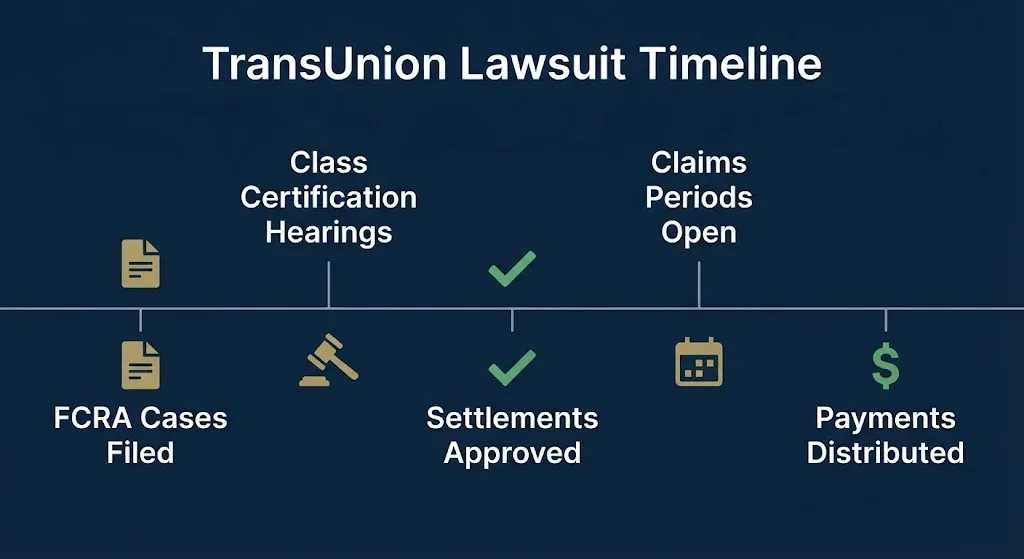
For cases still in litigation, no payout date exists. The court must first certify the class, approve any settlement, and open the claims period.
- Identify which TransUnion case your notice references.
- Check the official settlement website for that specific case.
- Look for a distribution schedule or payment status page.
- Contact the claims administrator only through verified channels.
- Do not rely on third-party sites that guess at dates.
How Do I File a TransUnion Class Action Claim?
Filing a claim depends entirely on which TransUnion case covers your situation. Each settlement has its own claim form and deadline.
For a settled case, the notice you received should include a claim form and instructions. You can typically file online or by mail through the settlement administrator.
For cases still in litigation, no claim form exists yet. Your job now is to keep records that may support a future claim.
- Read any notice carefully to identify the case name and number.
- Visit the official settlement website for that case.
- Gather documents that prove your interaction with TransUnion: credit reports, dispute letters, and correspondence.
- Confirm the claim deadline before it passes.
- Submit your claim through the administrator’s official channel.
- Save your confirmation number or submission receipt.
- Watch for any follow-up requests from the administrator.
Key Takeaway: Deadlines are firm in class actions. A missed deadline means no payment, regardless of how valid your claim is.
What TransUnion Lawsuit Settlements Are Currently Paying in 2026?
Several TransUnion-related settlements have reached the payment phase. The exact list changes as cases close and new ones open.
One FCRA settlement resolved claims that TransUnion failed to properly investigate consumer disputes. That case distributed payments to class members who filed valid claims.
Another matter, resolved through a regulatory action, required TransUnion to pay into a fund distributed to affected consumers. The administrator for that action has processed claims in batches.
If you filed a claim in a TransUnion settlement and have not received payment, check the official administrator portal for your case. Payment timing can vary by claim volume and verification speed.
Is There a TransUnion Data Breach Lawsuit?
Yes, data breach litigation involving TransUnion or entities affiliated with it has been filed. Some cases are still in early stages.
A data breach claim typically alleges that the company failed to protect consumer information, leading to exposure of personal data. Consumers affected by such a breach may have standing to sue under state or federal law.
The status of any specific TransUnion data breach case should be confirmed through the relevant court docket. Not all data breach lawsuits survive early motions.
What Is the Fair Credit Reporting Act and How Does It Apply to TransUnion?
The Fair Credit Reporting Act is the federal law that governs how credit reporting agencies handle consumer information. TransUnion, as one of the three major credit bureaus, must comply with its requirements.
The FCRA gives consumers the right to dispute inaccurate information on their credit reports. The credit bureau must investigate the dispute and correct or remove unverified data.
When TransUnion fails to do so, affected consumers may have a private right of action. That is the basis for most TransUnion class action lawsuits.
- Obtain your free credit report from the official annual credit report source.
- Review every entry for accuracy.
- Dispute any error directly with TransUnion in writing.
- Keep copies of your dispute letters and TransUnion responses.
- If the error is not corrected, consult an attorney about FCRA remedies.
What Is the TransUnion Class Action Settlement Deadline?
Each TransUnion settlement has its own deadline. Some have passed. Others have not been set yet.
A settlement that received final approval in 2025 may have a claim deadline in 2026. Check the specific case website for the exact date.
For active litigation, no claim deadline exists. Do not assume a general TransUnion deadline applies to all cases.
Reality Check: Third-party websites sometimes publish old or generic deadlines for TransUnion cases. Always verify the date on the official settlement site or the court docket.
What Happened With the TransUnion Class Action Lawsuit Over Credit Reports?
The credit reporting class action alleged that TransUnion violated the FCRA by failing to maintain accurate consumer files. The case progressed through class certification and eventually resolved.
The settlement terms included a monetary fund for class members and changes to TransUnion’s business practices. The injunctive relief, or non-monetary terms, often matters as much as the cash.
For consumers, the practical result is a process for checking whether their reports contained errors during the class period and filing a claim if they did.
How Do I Know If I Am Part of a TransUnion Class Action?
You may be a class member if you meet the definition in a specific TransUnion case. The class notice, if one was issued, describes exactly who is included.
Common class definitions include consumers who disputed an item on their TransUnion report during a certain period and did not receive a timely or adequate investigation.
If you did not receive a notice, you might still be included. Check the case website for the class definition and see whether your situation matches.
- Find the case name and class period from the official settlement site.
- Determine whether your interaction with TransUnion falls within that window.
- Check for the specific conduct alleged, such as an unresolved dispute.
- Gather records showing your dispute and TransUnion’s response.
- File a claim if you meet the definition and the deadline has not passed.
What Is the TransUnion Regulatory Settlement?
Regulatory settlements differ from class actions. They arise from enforcement actions by agencies like the Consumer Financial Protection Bureau or state attorneys general.
A regulatory settlement may require TransUnion to pay civil penalties and compensate consumers. The distribution process for consumer relief often runs through a separate administrator.
One such matter, resolved through the CFPB, addressed allegations of deceptive marketing practices. Consumers affected by that conduct received payments through the agency’s redress process.
Key Takeaway: Regulatory settlements can pay consumers even without a class action. If you received a notice from the CFPB or a state attorney general, it may relate to a different TransUnion matter than the one you saw in court headlines.
What Are the TransUnion Class Action Requirements to Join?
To join a TransUnion class action, you generally must fall within the class definition and file a timely claim if a settlement is reached.
You do not need to sign up in advance. In a class action, you are automatically included if you meet the definition, unless you opt out.
Your job is to watch for the notice, confirm your eligibility, and follow the claim instructions exactly. Missing a document or a deadline can disqualify your claim.
What Is the TransUnion Lawsuit Update for 2026?
As of January 2026, multiple TransUnion matters are at different stages. Some settlements are distributing funds. Some cases are in discovery. Some are awaiting class certification decisions.
The credit reporting industry continues to face litigation over accuracy and data handling. TransUnion is not the only bureau defending these claims, but its case volume is significant.
If you are tracking a specific TransUnion case, the most reliable update is the official court docket. The docket shows every filing, order, and hearing date.
What Happens Next With the TransUnion Lawsuits?
Expected first quarter 2026: Some TransUnion settlements will complete their distribution phases and close.
Expected mid 2026: Active litigation cases may reach class certification decisions or settlement talks.
Expected late 2026: New FCRA filings may emerge based on 2024 and 2025 dispute handling.
Expected 2027: Any cases certified in 2026 could enter claim periods or settlement approval.
These projections are based on typical federal class action timelines. Specific cases may move faster or slower.
Frequently Asked Questions
Is the TransUnion lawsuit real?
Yes, multiple real lawsuits and settlements exist against TransUnion in federal courts and through regulatory agencies.
How much will I get from the TransUnion class action?
Your payout depends on the specific case and your documentation. Reported amounts range from under $100 to over $1,000.
Has anyone received a TransUnion settlement check?
Yes, consumers have received payments from several TransUnion-related settlements.
What is the deadline to file a TransUnion claim?
Each case has its own deadline. Some have passed. Check the specific settlement website for your case.
Do I need a lawyer for a TransUnion class action claim?
No, you can file a claim on your own through the settlement administrator. A lawyer may help if you have a separate individual FCRA claim.
Can I still file a TransUnion claim if I lost my notice?
Yes, visit the official settlement website for your specific case and use the online claim form if it is still open.
Is the TransUnion data breach settlement real?
Some data breach cases are pending. Verify any notice against the court docket before acting.
Will I owe taxes on a TransUnion settlement payment?
Possibly. Settlement payments may be taxable depending on the nature of the claim and your individual tax situation.
The TransUnion lawsuit landscape is not one case. It is a set of legal actions at different stages, with different deadlines and different payout ranges. Your first job is identifying which matter applies to you.
The single most important date is the claim deadline in your specific case. Find it, write it down, and file before it passes.