TransUnion Settlement 2026: Claim Status, Payment Amounts, and What You Need to Know
Quick Answer
- TransUnion has faced multiple class actions over credit reporting errors, tenant screening, and data handling.
- No single TransUnion settlement covers all consumers, and payout amounts vary widely by case.
- Some claim deadlines have passed, while newer cases have not yet set filing windows.
The TransUnion settlement landscape in 2026 is fragmented. You are not looking at one case with one claim form. You are looking at several separate legal actions against the same company, each with its own timeline, eligibility rules, and payout structure.
Some of those cases have already paid claims. Others are still winding through courts. A few may never produce consumer payouts.
This article separates the verified settlements from the pending cases and the outright scams. It tells you which deadlines matter and which ones have already closed.
The Facts
| Fact | Detail |
|---|---|
| Company | TransUnion LLC and subsidiaries |
| Active Settlements | Multiple, including tenant screening and data accuracy cases |
| Combined Fund | Varies by case, no single unified amount |
| Est. Per Person | Varies widely, some flat, some pro rata |
| Claim Deadlines | Multiple, some passed, some not yet set |
| Administrator | Case-specific, not unified |
| Proof Needed | Varies by settlement and claim type |
Is the TransUnion Settlement Real or a Scam?
The TransUnion settlements are real for specific verified cases, but scam messages also circulate widely.
Real settlement notices arrive by mail or email from a court-appointed settlement administrator. They name a specific case, a specific court, and a specific deadline. They never ask for payment.
Fake messages claim you are owed money from a TransUnion settlement and ask for your bank details or a processing fee. No real settlement works that way. Filing a claim is always free.
The confusion is understandable. TransUnion has faced enough lawsuits that scammers can reference a real-sounding case name. That does not make their message real.
Key Takeaway: Multiple TransUnion settlements are real and some have paid claims, but fake payout messages are common and should be ignored.
How Much Can You Get From a TransUnion Settlement?
The amount depends entirely on which settlement applies to you.
Some TransUnion settlements produced small flat payments. A data accuracy case might pay $50 to $500 per claimant depending on the documented harm. A tenant screening case might pay more for people who were denied housing based on inaccurate reports.
Other settlements used a pro rata structure. The fund was divided among all valid claims. If more people filed than expected, each check was smaller.
Still other cases are pending and have no payout amount at all. No court has approved a fund. No administrator has calculated payments.
| Settlement Type | Typical Payment | Status |
|---|---|---|
| Data accuracy | $50 to $500 flat or pro rata | Some paid, some closed |
| Tenant screening | Varies, potentially larger | Some active |
| FCRA violations | Statutory damages up to $1,000 | Case-specific |
| Data breach | Varies by documented loss | Varies |
What Is the TransUnion Class Action About?
TransUnion class actions cover several distinct legal claims. The common thread is inaccurate or mishandled consumer data.
The most significant cases involve:
- Credit report errors that TransUnion failed to correct after disputes
- Tenant screening reports with inaccurate eviction or criminal records
- Mixed files where one person’s data appeared on another’s report
- Data breaches that exposed consumer information
- Alleged violations of the Fair Credit Reporting Act
Each case has a different class definition. Being a TransUnion customer or having a TransUnion credit report does not automatically make you part of any class.
Key Takeaway: TransUnion class actions cover distinct claims, and eligibility depends on the specific case, not on being a TransUnion consumer generally.
What Is the TransUnion Tenant Screening Settlement?
The tenant screening settlement resolved claims that TransUnion’s tenant screening reports contained inaccurate information that led to rental denials.
Plaintiffs alleged that TransUnion failed to maintain reasonable procedures to ensure the accuracy of eviction and criminal records included in tenant screening reports. Those errors, the lawsuits claimed, cost people housing opportunities.
The settlement produced payments for eligible class members. The claim deadline for that case has passed.
If you were denied rental housing based on a TransUnion tenant screening report and believe the report contained errors, that specific settlement may have applied to you. If you did not file a claim, the window has closed.
What Is the TransUnion Data Accuracy Settlement?
TransUnion faced claims that it failed to correct inaccurate information on credit reports after consumers filed disputes.
The Fair Credit Reporting Act requires credit bureaus to investigate disputes and correct errors. Plaintiffs alleged TransUnion did not always do that, leaving inaccurate negative items on reports for months or years.
Settlements in these cases typically provide modest payments to affected consumers. The amount depends on the harm shown. A denied credit application because of an error is worth more than a simple reporting mistake.
Claim deadlines for the older data accuracy settlements have passed. If you did not file, you cannot now claim those settlements.
What Is the Deadline for a TransUnion Settlement Claim in 2026?
There is no single deadline because there is no single settlement.
Older TransUnion settlements have closed. Their claim deadlines passed. No late claims are being accepted except in rare circumstances.
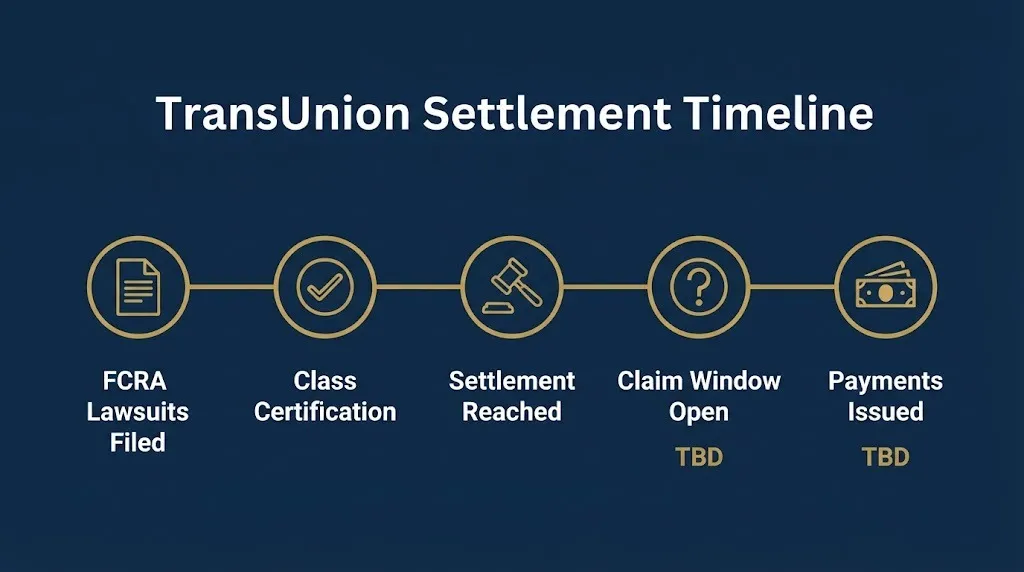
Newer cases have not yet set deadlines. Some are still in the class certification stage. Others are in settlement negotiations. Until a court grants preliminary approval and publishes a claim form, there is no deadline to meet.
If you received a settlement notice with a specific deadline, that deadline applies to that case only. Missing it means losing that specific claim.
Reality Check: Real settlement administrators never charge you to file a claim. Filing is always free. Anyone asking for money to process your TransUnion settlement claim is running a scam.
How Do You File a TransUnion Settlement Claim?
Filing a claim depends on which settlement is open.
Step 1: Identify the specific settlement. Look at the notice you received or search the case name.
Step 2: Visit the official settlement website for that case.
Step 3: Review the class definition to confirm you qualify.
Step 4: Complete the claim form online or by mail.
Step 5: Provide any required documentation, such as dispute letters or denial notices.
Step 6: Submit before the deadline.
Step 7: Save your confirmation number and check your status periodically.
If no settlement is currently open for your situation, there is nothing to file. Watch for future notices from court-appointed administrators.
How Do You Check Your TransUnion Claim Status?
Checking your status requires knowing which settlement you filed under.
The settlement administrator’s website for that specific case has a status tool. You need your claim number or the email address you used to file.
If you cannot find the settlement website, search the case name plus “settlement administrator.” The official site should appear.
Do not rely on third-party sites that claim to check your status. They often collect your information for marketing or worse.
What Is the TransUnion FCRA Lawsuit?
The Fair Credit Reporting Act, or FCRA, is the federal law that governs credit bureaus. TransUnion has faced multiple FCRA lawsuits.
The FCRA requires credit bureaus to maintain reasonable procedures for accuracy, investigate consumer disputes, and provide consumers access to their files. Violations can result in statutory damages of up to $1,000 per violation, plus actual damages and attorneys’ fees.
Individual FCRA claims are different from class actions. If TransUnion failed to correct an error on your report after a dispute, you may have an individual claim. Those claims are pursued in federal court, often with an attorney.
Class action FCRA settlements resolve claims for large groups. Individual FCRA lawsuits resolve one person’s claim.
Key Takeaway: FCRA violations can support individual claims with statutory damages, separate from any class settlement.
What Should You Do If You Got a TransUnion Settlement Text?
Delete it. Do not click anything. Do not respond.
Real settlement notices arrive by mail or email from a court-appointed administrator. They do not arrive as unsolicited text messages.
Text messages claiming you are owed a TransUnion settlement are phishing attempts. They are designed to steal your personal information or your money.
If you want to verify whether a real settlement exists, search the case name in federal court records. If no settlement is listed, the text is fake.
What Are the Most Common TransUnion Settlement Scams in 2026?
Scammers use the TransUnion name because nearly every adult in the United States has a credit report. That makes the potential victim pool enormous.
Common scams include:
- Texts claiming you are pre-approved for a TransUnion payout
- Emails with fake claim forms asking for your Social Security number
- Calls demanding a processing fee to release settlement funds
- Websites that mimic official settlement sites but steal your data
- Social media ads promising easy money from TransUnion lawsuits
All share one trait. They ask for something a real settlement never asks for: payment or sensitive information before you receive anything.
What Is the Current Status of TransUnion Litigation in 2026?
TransUnion continues to face new lawsuits while older settlements wind down.
The company has settled some cases and continues to fight others. New FCRA claims are filed regularly. Some become class actions. Most settle before trial or are dismissed.
The legal pressure on credit bureaus has not gone away. Data accuracy remains a recurring issue. Tenant screening remains a recurring issue. Each new case creates the potential for another settlement.
But potential is not the same as a current claim window. As of September 2026, no major TransUnion settlement has an open claim form.
Key Takeaway: TransUnion litigation continues, but no open settlement claim window exists for consumers right now.
What Documents Do You Need for a TransUnion Claim?
The documents depend on the claim type.
For a credit report error claim, you need:
- A copy of your credit report showing the error
- Your dispute letter to TransUnion
- TransUnion’s response to your dispute
- Any denial letters from creditors citing the error
For a tenant screening claim, you need:
- The tenant screening report
- The rental denial letter referencing the report
- Evidence that the report contained inaccurate information
For a data breach claim, you need:
- Notice of the breach
- Evidence of identity theft or fraudulent accounts
- Expenses for credit monitoring or identity theft protection
Keep everything. Documentation is the difference between a paid claim and a denied one.
Can You Sue TransUnion Individually?
Yes. The FCRA allows individual lawsuits against credit bureaus for violations.
If TransUnion failed to correct an error after a proper dispute, you may have an individual claim. Statutory damages are available even without proof of actual financial harm.
Individual FCRA cases are handled by consumer protection attorneys. Many take cases on contingency, meaning you pay nothing upfront.
The advantage of an individual case is that you control it. You are not waiting on a class settlement that may take years. The disadvantage is that your case requires proving the violation, which takes time and evidence.
What Is the Statute of Limitations for a TransUnion Claim?
The FCRA has a two-year statute of limitations from the date you discovered the violation, or five years from the date of the violation, whichever is earlier.
That is the federal rule. State consumer protection laws may have different deadlines.
If you discovered a credit report error in 2024 and TransUnion failed to fix it, your federal FCRA window may close in 2026. Do not wait for a class action to solve your problem.
What Happens Next in TransUnion Settlements?
The litigation landscape keeps moving.
Current phase: Older settlements are paid or closed. Newer cases are in pre-settlement stages.
Expected late 2026: Possible preliminary approvals for pending TransUnion cases.
Expected 2027: If new settlements are approved, claim windows will open.
Watch for: Official notices from court-appointed administrators, which arrive by mail, not text.
Key Takeaway: The next TransUnion settlement claim window depends on court approvals that have not happened yet.
Frequently Asked Questions
Is there a TransUnion settlement in 2026 I can file for?
No open TransUnion settlement claim window exists as of September 2026.
Older settlements have closed, and newer cases are still pending.
How much can I get from a TransUnion settlement?
Payout amounts vary by case, from under $100 to over $1,000 depending on the claim type.
No single amount applies to all TransUnion settlements.
What is the TransUnion class action about?
TransUnion class actions involve credit report errors, tenant screening mistakes, and data handling violations.
Each case has its own class definition and eligibility rules.
Can I sue TransUnion for a credit report error?
Yes, the Fair Credit Reporting Act allows individual lawsuits for uncorrected errors.
Statutory damages of up to $1,000 per violation are available.
What is the deadline to file a TransUnion claim?
No open deadline exists because no settlement claim window is currently active.
Check specific case dockets for future deadlines.
Are TransUnion settlement text messages real?
No, real settlement notices arrive by mail or email from court-appointed administrators.
Text messages claiming you are owed money are scams.
What proof do I need for a TransUnion claim?
Proof varies by claim type but typically includes credit reports, dispute letters, and denial notices.
Keep all documentation related to your TransUnion report.
How do I check my TransUnion settlement claim status?
Visit the specific settlement administrator’s website and use the status tool.
You need your claim number or the email used to file.
What You Should Do Right Now
Check your credit report. If you find errors, dispute them in writing with TransUnion. That starts the process that could lead to an FCRA claim if the errors are not corrected.
Do not wait for a class settlement. Individual rights under the FCRA are stronger than most class payouts, and the clock is running.
The single most important fact: filing a claim is always free, and no real settlement administrator will ever ask you to pay.