Chase Class Action Lawsuit 2026: Every Active Case, Real Status, and What You Can Actually Do Right Now
Quick Answer
- Chase faces several real, active class action lawsuits in 2026, but none currently has a court-approved settlement fund paying out claims.
- Total payouts and per-person amounts are not yet determined for any pending Chase case, no matter what some headlines suggest.
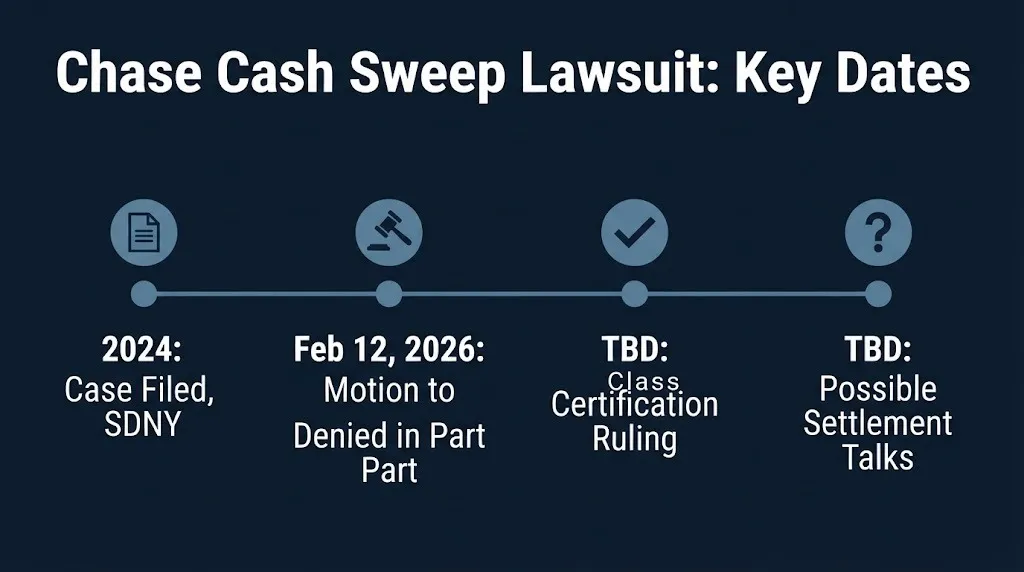
- The most advanced case, over the bank’s cash sweep program, survived a motion to dismiss on February 12, 2026, and is still waiting on class certification.
If you searched “Chase class action lawsuit,” you’re probably reacting to a headline, a text, or a Reddit thread and wondering if there’s money coming your way. Right now, the honest answer is: Chase is fighting several real cases in federal court, but no single “Chase class action” has an open settlement paying claims as of late September 2026.
That matters because several other sites are already publishing specific dollar figures and deadlines for Chase cases that court records don’t yet support. This guide sticks to what’s actually verified in the docket, names every active case by number, and tells you exactly what “watch and wait” looks like in practice.
We cover the cash sweep interest case (the furthest along), the credit card membership fee case, the interest rate price-fixing case, an ERISA tobacco surcharge case, and the First Republic account transition dispute. One detail worth knowing upfront: a federal judge already let the biggest breach-of-contract claim against Chase move forward in February, which is farther than most bank class actions get in their first year.
The Facts
| Category | Verified Status |
|---|---|
| Case | In re JPMorgan Chase Cash Sweep Program Litigation (lead active case; several related suits also pending) |
| Court | U.S. District Court, Southern District of New York |
| Case Number | 1:24-cv-06404-LGS-SN |
| Status | Motion to dismiss denied in part on Feb. 12, 2026; class certification not yet decided |
| Fund Size | Not yet confirmed, no settlement has been reached |
| Est. Per Person | Not yet determined |
| Claim Deadline | Not yet confirmed, no claims process is currently open |
| Administrator | Not yet appointed |
| Proof Needed | Not applicable yet, check official case updates before filing anything |
Is There Really a Chase Class Action Lawsuit in 2026?
Yes, there are several, and they are real federal court filings, not internet rumors. The confusion comes from the fact that “Chase class action lawsuit” isn’t one case, it’s a category covering at least five separate active suits in 2026.
The furthest along is the cash sweep case in the Southern District of New York, where a judge ruled on February 12, 2026 that Chase must face claims it breached deposit account agreements by paying near-zero interest while the federal funds rate stayed above 5%. That same ruling dismissed a separate claim that Chase breached fiduciary duties, so the case survived, but in a narrower form.
Other active filings include a credit card membership fee suit (Sacchi v. Chase, filed September 2025), an ERISA tobacco-surcharge suit (Carmichael v. JPMorgan Chase, filed January 2026), and a multi-bank interest rate price-fixing suit (Normandin v. JPMorgan Chase Bank, filed October 2025 in Connecticut federal court). None of these has settled.
Key Takeaway: Chase is defending real, active class actions in 2026, but “active” means still in litigation, not open for claims.
How Much Money Could I Get From a Chase Class Action?
Right now, the honest answer is: not yet determined, because no Chase case in 2026 has a court-approved settlement fund. Any specific dollar figure you see quoted for a currently open Chase settlement should be checked directly against the official case docket or settlement website before you believe it.
That’s not the same as saying nothing will ever pay out. Chase settled an earlier overdraft fee class action for $110 million, so the bank has a track record of resolving these suits once the litigation matures. The cases below are simply not there yet.
| Case | Reported Fund | Verification Status |
|---|---|---|
| Cash sweep interest (SDNY) | Not yet confirmed | UNCONFIRMED, no settlement filed |
| Credit card membership fees | Reported by some outlets, not confirmed independently | UNCONFIRMED, treat with caution |
| Interest rate price-fixing | Not yet confirmed | UNCONFIRMED, litigation stage |
| ERISA tobacco surcharge | Not yet confirmed | UNCONFIRMED, litigation stage |
| Prior overdraft settlement (already paid) | $110 million | Confirmed, historical, closed |
If a site tells you the exact per-person payout for a case that hasn’t settled, that’s a red flag, not a scoop.
Chase Cash Sweep Lawsuit: How Much Are the Claims Worth?
The cash sweep case does not yet have a confirmed settlement fund or per-person payout figure, despite being the most advanced Chase suit right now. The claims that survived the February ruling involve breach of deposit account agreements and IRA agreements, meaning any eventual recovery would likely be tied to how much interest a customer’s swept cash should have earned.
Plaintiffs allege Chase automatically moved uninvested cash from brokerage and retirement accounts into low-interest deposit accounts at its own bank affiliate, even while the Federal Reserve’s target rate sat above 5%. That’s the financial gap at the center of the case.
Similar cash sweep suits against other firms give a rough sense of scale. Wells Fargo and Bank of America paid a combined $60 million to settle SEC civil charges over comparable conduct, without admitting wrongdoing. Chase’s case is still in the class certification stage, which comes before any settlement talks typically begin.
What Is the Chase Cash Sweep Lawsuit About?
The Chase cash sweep lawsuit claims the bank profited by sweeping customers’ uninvested cash into low-interest accounts instead of paying a competitive rate. The formal case is In re JPMorgan Chase Cash Sweep Program Litigation, Case No. 1:24-cv-06404-LGS-SN, in the Southern District of New York.
Multiple plaintiffs filed similar complaints starting in 2024, including Nancy McNamara, Jamie Canales, and Dan Bodea, and their cases were consolidated. The core claim is that J.P. Morgan Securities had a duty to seek reasonable rates on customer cash and instead kept the “outsized” benefit for the bank and its affiliates.
Chase argued customers instructed the bank to place their uninvested cash in these accounts, essentially agreeing to the arrangement. The judge’s February ruling rejected that defense for the breach-of-contract claims but agreed the fiduciary-duty theory went too far. That mixed outcome is common in early-stage bank litigation and doesn’t predict how the case ultimately resolves.
Key Takeaway: The cash sweep case survived dismissal on contract claims but lost its fiduciary-duty theory, so it’s real litigation with real risk, not a guaranteed win for either side.
What Is the Chase Credit Card Membership Lawsuit About?
The Chase credit card membership lawsuit claims Chase promised automatic credits for certain purchases on specific card products and then failed to deliver them. The case, Sacchi v. Chase, Case No. 1:25-cv-07632, was filed in September 2025 in New York federal court.
Plaintiff John Sacchi alleges this reflects a broader pattern, not a one-time billing error, citing prior consumer complaints raising similar issues. The suit seeks class certification, damages, attorney fees, and a jury trial.
As of the most recent court filings we reviewed, Chase has not publicly responded to these allegations in a way that’s been independently verified, and no settlement has been confirmed on the court docket. Some legal-news sites report a proposed settlement with a claims deadline already accepting filers, but we could not independently confirm those figures against primary sources. If you’ve received a notice from an actual settlement administrator referencing this case, that notice, not a blog post, is your best source.
What Is the Chase Interest Rate Price-Fixing Lawsuit About?
The Chase interest rate lawsuit accuses the bank and several competitors of colluding to keep the WSJ Prime Rate artificially high for three decades. The case is Normandin v. JPMorgan Chase Bank, Case No. 3:25-cv-01749, filed October 16, 2025 in the U.S. District Court for the District of Connecticut.
Chase is named alongside Bank of America, Wells Fargo, Citigroup, U.S. Bancorp, PNC Financial Services, and Truist. Plaintiffs, residents of California and Colorado, allege the banks set prime rates at 300 basis points above the federal funds rate through coordination rather than competition since at least 2021, with some claims reaching back to 1994.
The proposed class covers anyone who made a payment on a WSJ prime-indexed home equity line of credit since October 2021. This is an antitrust claim under the Sherman Act, a different legal theory than the cash sweep or membership fee cases. No settlement talks have been publicly confirmed.
What Is the Chase ERISA Tobacco Surcharge Lawsuit About?
The Chase ERISA lawsuit claims the bank illegally charged employees higher health insurance premiums based on tobacco use in violation of federal benefits law. The case, Carmichael v. JPMorgan Chase & Co., Case No. 1:26-cv-00305, was filed in January 2026 in New York federal court.
Plaintiff Robyn Carmichael alleges Chase’s health plan imposed punitive premium surcharges tied to tobacco status in a way that violates ERISA’s nondiscrimination requirements. This case targets Chase as an employer, not as a bank serving customers, so eligibility would likely be limited to current or former employees enrolled in the affected health plan.
This is the newest of the major 2026 Chase filings, which means it’s also the furthest from any possible settlement. Cases at this stage typically take a year or more before certification is even decided.
Key Takeaway: Three of Chase’s 2026 cases (cash sweep, prime rate, and ERISA) involve entirely different legal theories and different classes of people, so qualifying for one doesn’t mean you qualify for another.
What Happened With the First Republic Account Transition Lawsuit?
The First Republic transition lawsuit claims Chase mishandled the account transfer process after acquiring the failed bank in 2023. Singleton Schreiber filed the case on behalf of plaintiffs Keir Milan and Keirco Inc., alleging Chase promised an automatic, seamless transition of bill pay programs that didn’t work as described.
According to the complaint, former First Republic customers experienced lost interest, unexpected fees tied to low account balances, and bill payments that ran on different schedules than promised. The suit alleges false advertising and violations of consumer protection law.
We were not able to confirm a specific case number or court for this filing in our research, so treat the details above as reported but not independently verified against the docket. If you were a First Republic customer during the 2023 transition and experienced these issues, that’s worth documenting regardless of how this suit resolves.
How Do I Check if I Qualify for a Chase Lawsuit?
You qualify for a specific Chase case only if you fall within that case’s proposed class definition, and right now, none of the 2026 cases has an open claims process to check against. For the cash sweep case, the informal class covers anyone whose uninvested brokerage or IRA cash was automatically swept into a low-interest Chase deposit account.
For the credit card membership case, the proposed class covers cardholders who charged purchases that should have triggered an automatic credit but didn’t receive one. For the ERISA case, eligibility would track current or former Chase employees on the affected health plan who paid a tobacco surcharge.
- Identify which specific case matches your situation.
- Check the case number against official court records if you want to verify it yourself.
- Watch for a notice by mail or email, that’s how real class members are typically informed.
- Do not pay anyone to “check your eligibility.” That step is always free.
- Bookmark the case rather than searching repeatedly, since status changes slowly.
How Do I Join or File a Claim in a Chase Class Action?
You don’t need to do anything to join most of these Chase cases while they’re still active litigation, because there’s no claim to file yet. Class actions work by including everyone in the defined class automatically unless a settlement is reached and a claims process opens, or unless you choose to opt out later.
- Wait for a settlement to be reached and preliminarily approved by a judge.
- Watch for a notice from the settlement administrator, sent by mail or email.
- Confirm the claim form is hosted on the official settlement website, not a third-party site.
- Gather any proof requested, such as account statements or dates of activity.
- Submit the form before the stated deadline, since courts rarely grant extensions.
- Keep a copy of your submission and any confirmation number.
Filing a claim in an actual class action settlement is always free. If anyone asks you to pay to join a Chase lawsuit or “guarantee” a payout, that’s not how this process works.
Reality Check: No legitimate settlement administrator texts you out of the blue asking for a fee to release your payment. Filing a claim is always free, and “claim helper” services charging money for something you can do yourself on the official settlement site are unnecessary at best.
Has Chase Already Settled Any Class Actions in 2026?
Not among the major cases covered in this guide, no. Chase’s most recent confirmed settlement of this scale was an earlier overdraft fee class action that resolved for $110 million, but that predates the current wave of 2026 filings.
Some legal-news sites reference settlements tied to Zelle fraud reimbursement, overdraft practices, or credit card late-fee disclosures as having “settled and paid out in 2024 to 2025.” Those would be separate, already-closed cases, distinct from the active cash sweep, membership fee, price-fixing, and ERISA suits detailed above. If you’re looking for a case you already received a notice about, check the case name on that notice against this guide rather than assuming it’s one of the cases still in litigation.
What’s the Latest Update on the Chase Cash Sweep Case?
The most recent confirmed development is the February 12, 2026 ruling that let the breach-of-contract claims proceed while dismissing the fiduciary-duty theory. As of mid-2026 reporting, plaintiffs were still working toward class certification, a required step before any settlement negotiation typically becomes serious.
Class certification means a judge formally defines who’s included in the class and confirms the case can proceed as a group action rather than individual lawsuits. Until that happens, there’s no confirmed class size, no settlement fund estimate, and no way to know a realistic per-person figure.
Key Takeaway: Class certification, not the motion-to-dismiss ruling, is the next milestone that would actually move this case toward a settlement.
When Will Chase Class Action Settlements Be Announced?
There’s no confirmed date for any Chase settlement announcement in 2026, because none of the active cases has reached that stage. Banking class actions of this size and complexity commonly take one to three years from filing to a resolved settlement, and some take longer if they’re contested through trial.
The cash sweep case, filed in 2024, is roughly two years into that timeline as of late 2026. The ERISA and price-fixing cases, filed more recently, are likely further from resolution. If a settlement is reached, the earliest confirmed signal will be a preliminary approval filing in the relevant court docket, not a social media post or a texted link.
Who Qualifies for the Chase Cash Sweep Lawsuit?
You may fall within the proposed class if you held a Chase or J.P. Morgan Securities brokerage or retirement account with a cash sweep feature during the relevant period, which the case describes as including time since 2018 and again from 2022 onward. This covers customers whose uninvested cash was automatically moved into low-interest deposit accounts at Chase Bank.
Key eligibility signals reported in the case:
- Held a brokerage or IRA account at J.P. Morgan Securities or Chase.
- Had uninvested cash automatically swept into an interest-bearing deposit account.
- Held that account during a period when the Fed’s target rate exceeded 5%.
Because the class hasn’t been formally certified, these criteria could still change before any settlement is finalized. That’s normal at this stage and not a sign the case is falling apart.
What Happens Next
Late 2026 (expected): Continued briefing and a ruling on class certification in the cash sweep case.
Expected 2027: Possible mediation or settlement talks in the cash sweep case, if certification is granted.
Ongoing: Discovery and motion practice continue in the price-fixing, ERISA, and membership fee cases, with no near-term settlement confirmed.
Watch for: A preliminary settlement filing in any of these dockets, which would be the first real signal that claims are coming.
Frequently Asked Questions
Is the Chase class action lawsuit legit?
Yes, several Chase class action lawsuits are real, active federal court cases, not scams.
They’re filed in courts including the Southern District of New York and the District of Connecticut.
None currently has an open settlement paying claims, so be skeptical of anyone claiming otherwise.
How much is the Chase class action settlement worth?
No confirmed settlement fund exists yet for any of Chase’s active 2026 cases.
The bank previously paid $110 million to settle an earlier, separate overdraft fee case.
Any specific number quoted for a currently pending case should be verified against the court docket.
What is the deadline to file a Chase lawsuit claim?
There is no confirmed claim filing deadline right now, because no active Chase case has an open claims process.
A deadline only exists once a settlement receives preliminary court approval.
Watch the official case docket or an administrator’s notice for that date if it’s announced.
Do I need to do anything to join the Chase class action?
Not yet, and possibly not ever unless a settlement is reached.
Class members are usually included automatically unless they choose to opt out.
If a settlement opens, you’ll typically need to file a claim form to actually receive payment.
How do I know if I’m part of the Chase cash sweep lawsuit class?
You may be included if you held a Chase or J.P. Morgan Securities account with automatic cash sweep features since 2018 or 2022.
The exact class definition isn’t finalized until a judge grants class certification.
Watch for an official notice rather than assuming based on general account history.
Has Chase settled any lawsuits recently?
Chase settled an earlier overdraft fee class action for $110 million, but that case predates the 2026 filings covered here.
None of the current cash sweep, credit card, price-fixing, or ERISA cases has a confirmed 2026 settlement.
Some other Chase-related suits may have closed separately; check the specific case name on any notice you received.
Is it safe to give my information to a Chase settlement website?
Only if it’s the official settlement website named in a court-approved notice.
Legitimate settlement administrators never ask for payment to process your claim.
If a site or text asks for a fee first, treat that as a warning sign, not a real settlement process.
Can I still file if I missed a Chase settlement deadline?
Courts rarely grant extensions once a claims deadline passes, and there is currently no open deadline to miss for the active 2026 cases.
If you believe you missed a deadline for an already-closed Chase settlement, check that settlement’s official site for any late-claim provisions.
Extensions are the exception, not the rule, in class action administration.
Bottom Line
Chase is defending real litigation in 2026, but no case covered here has reached a settlement you can actually file a claim against. The next real milestone to watch is class certification in the cash sweep case, expected sometime after late 2026.
Bookmark the official case dockets rather than relying on secondhand payout figures. If a settlement opens, the notice will come from a court-approved administrator, not a random text message.