Is the Wells Fargo $56.85 Million Settlement Real? What California Homeowners Need to Know in 2026
Quick Answer
- This is a real class action, Stoff v. Wells Fargo Bank, N.A., filed in San Diego Superior Court, not a scam text or email.
- Per-person payout is not yet determined. It depends on the final class size after attorneys’ fees and costs are deducted from the $56.85 million fund.
- The objection deadline was March 25, 2026, and the case had its final approval hearing April 17, 2026. No claim form is required.
Wells Fargo agreed to pay $56.85 million to settle claims it mishandled mortgage forbearance reporting during the pandemic. The bank denies wrongdoing but chose to settle rather than keep fighting a five-year-old lawsuit.
The case matters most to California homeowners who paused Wells Fargo mortgage payments under the CARES Act starting March 27, 2020. If your account got flagged as “in forbearance” instead of “current” on your credit report, you could be part of the class.
This article walks through eligibility, what you can expect to get paid, and what still hasn’t been confirmed. One detail worth knowing upfront: you don’t have to file anything. If you qualify, a check is supposed to find you.
The Facts
| Item | Detail |
|---|---|
| Case | Stoff v. Wells Fargo Bank, N.A. |
| Court | Superior Court of California, County of San Diego |
| Case Number | 37-2020-00020808-CU-BT-CTL |
| Status | Final approval hearing held April 17, 2026; outcome not yet confirmed in public reporting |
| Fund Size | $56,850,000 |
| Est. Per Person | Not yet determined (final class size still being calculated) |
| Objection Deadline | March 25, 2026 (passed) |
| Administrator | A.B. Data, Ltd. |
| Proof Needed | None. Payment is automatic for eligible class members |
Is the Wells Fargo $56.85 Million Settlement Real?
Yes. This settlement is a legitimate California class action, not a scam or a phishing scheme built around a viral number.
The case is filed under Case No. 37-2020-00020808-CU-BT-CTL in the Superior Court of California, County of San Diego. Judge Katherine A. Bacal is overseeing it. The official settlement website is CaresActLitigation.com, and the administrator handling payments is A.B. Data, Ltd.
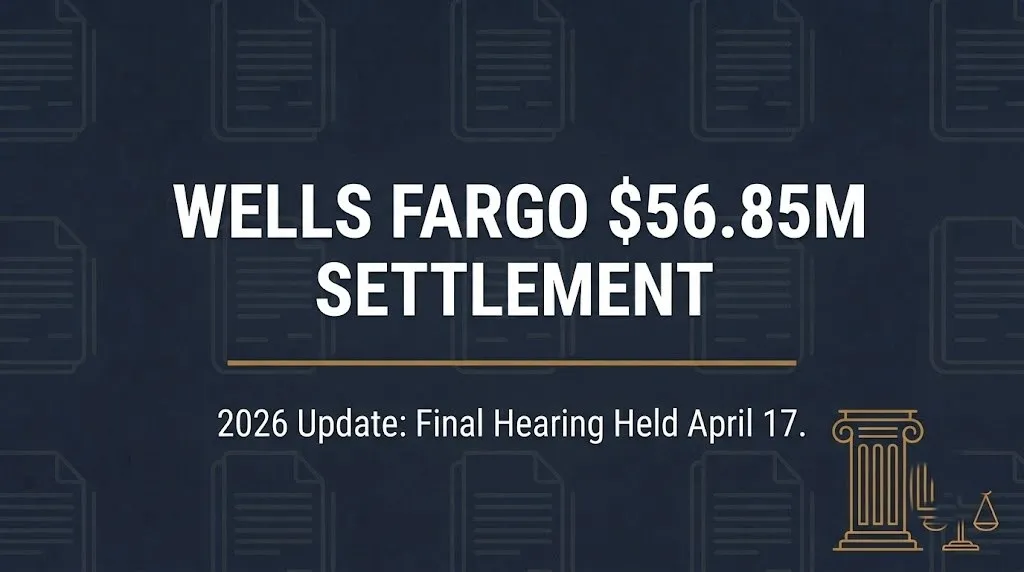
Wells Fargo has not admitted any wrongdoing. It agreed to the $56,850,000 fund to end litigation that started in June 2020, rather than keep paying legal costs on a case it could still lose at trial. That’s a normal move in class action law, not evidence of guilt either way.
If you see a text or email demanding you “claim” this settlement by clicking a link or paying a fee, that’s not how it works. This settlement pays automatically. No action, no fee, no personal information required to get on a list.
Who Is Eligible for the Wells Fargo $56.85 Million Settlement?
You may be eligible if you had a Wells Fargo mortgage on a California property, were current on payments, and entered CARES Act forbearance on or after March 27, 2020.
The class also requires that Wells Fargo reported your account as “in forbearance” (or similar language) to a credit reporting agency, instead of continuing to report it as “current.” That reporting choice is the entire legal claim.
Here’s the eligibility checklist in plain terms:
- Your mortgage was on property located in California.
- Your account was current before you requested forbearance.
- You received a CARES Act forbearance on or after March 27, 2020.
- Wells Fargo reported that account as “in forbearance,” not “current,” to a credit bureau.
If any one of those doesn’t match your situation, you’re likely outside this specific class. Borrowers outside California, or those already behind on payments before forbearance, are not covered here.
How Much Money Could You Get From the Wells Fargo Settlement?
The exact per-person payout is not yet determined. Every eligible class member gets an equal, pro-rata share of what’s left after fees and costs come out of the $56.85 million fund.
That “net settlement amount” gets divided by the number of verified class members. More people in the class means a smaller individual check. Fewer people means a bigger one.
Some legal-news outlets have floated rough estimates, ranging from roughly $100 to $150 per person on the low end, up to “low-to-mid hundreds of dollars” on the higher end. Neither figure is official. Treat both as unconfirmed guesses until the administrator or the court publishes a real number.
| What’s Confirmed | What’s Not Yet Confirmed |
|---|---|
| Total fund: $56,850,000 | Final class member count |
| Payment method: automatic check | Exact per-person dollar amount |
| Check validity window: 90 days to cash | Whether a second distribution will happen |
Key Takeaway: The Wells Fargo settlement is real and automatic, but no one, including this article, can tell you the exact dollar amount you’ll receive until the court finalizes the class size.
Why Isn’t the Per-Person Payout Confirmed Yet?
It’s not confirmed because the fund gets divided only after the court locks in the final class list and approves the fee awards.
Attorneys’ fees, administrative costs, and service awards to the named plaintiff all come out first. What remains is the “net settlement amount” split equally among eligible members.
That math can’t happen until final approval is granted and any appeal window closes. Appeals can add months to a payout timeline even after a judge signs off. So even a strong estimate today could shift once the real numbers are locked in.
How Much Are the Lawyers and Administrator Taking From the Fund?
Class counsel is seeking attorneys’ fees of up to 30 percent of the fund, or roughly $17,055,000, plus expense reimbursement up to $190,000.
Settlement administration costs, covering A.B. Data’s work identifying class members and mailing checks, are estimated around $297,000. Service awards for the people who helped build the case add more, up to a combined $98,000: as much as $90,000 for lead plaintiff Michael Stoff, $2,000 each for two class members who sat for depositions, and $1,000 each for four additional contributors.
None of these figures are final until the court rules on them at or after the approval hearing. A judge can approve less than what’s requested.
Do You Need to File a Claim Form?
No. This settlement does not require a claim form.
Wells Fargo already has the account records needed to identify class members, so payment is automatic for anyone who fits the eligibility criteria and didn’t exclude themselves. That’s different from most class actions, where you have to submit paperwork to get paid.
Think of it like a recall check from a manufacturer: if your account matches the affected batch, the company already knows to send you something. You don’t have to prove you own the product.
How to Update Your Mailing Address Before Your Check Is Mailed
If you’ve moved since your Wells Fargo mortgage, you need to contact the settlement administrator directly to make sure your check doesn’t go to an old address.
Steps to update your address:
- Visit the official settlement website, CaresActLitigation.com.
- Locate the contact section for A.B. Data, Ltd., the settlement administrator.
- Reach out through the listed phone line or email address on the site.
- Provide your current mailing address and any identifying account details requested.
- Confirm the update went through before checks are scheduled to mail.
- Keep a record of when you made the request.
Skipping this step is one of the most common reasons class members never cash their settlement check.
How to Object to the Settlement
The window to formally object has closed. The deadline was March 25, 2026, which was 75 days after the court’s preliminary approval order.
For reference, here’s what that process required, in case similar deadlines come up in future rounds or related cases:
- Write a formal objection stating you object to the settlement in whole or in part.
- Reference the case name and number, Stoff v. Wells Fargo Bank, N.A., 37-2020-00020808-CU-BT-CTL.
- File the objection with the Superior Court of California, County of San Diego.
- Mail a copy to the settlement administrator, class counsel, and Wells Fargo’s counsel.
- Postmark everything on or before the deadline date.
The settlement notice also states the exclusion (opt-out) deadline for this case had already passed before the objection window closed. If you wanted out of the class entirely, that ship has sailed.
How to Check Your Wells Fargo Settlement Status
Checking your status means going straight to the source, not a third-party blog claiming to track it for you.
The official settlement website, CaresActLitigation.com, is the authoritative source for updates on the hearing outcome, payment timing, and any changes to the schedule. The administrator, A.B. Data, Ltd., is the only entity that can confirm your individual status.
Legal-news sites like Top Class Actions and ClassAction.org can be useful for reading the notice in plain English, but they explicitly say they aren’t the administrator and can’t check your claim status for you.
Reality Check: No legitimate settlement administrator will text you first asking you to click a link to “claim” your payment. Filing an objection, checking eligibility, and receiving your automatic check are all free. Anyone charging a fee to “process” your Wells Fargo settlement payment isn’t part of this case.
What Happened at the April 17, 2026 Final Approval Hearing?
A judge in the Superior Court of California, County of San Diego, was scheduled to decide at the April 17, 2026 hearing whether to grant final approval to the settlement.
The hearing took place at the Hall of Justice in downtown San Diego. At that hearing, the court was expected to weigh the fairness of the settlement terms, rule on the requested attorneys’ fees, and consider any objections filed.
As of this writing, a confirmed final approval order or written ruling from that hearing has not appeared in the sources checked for this article. That’s not unusual. Courts sometimes take the matter under submission and issue a written ruling days or weeks later. Anyone tracking this case closely should check the official settlement website directly for the posted order rather than relying on a secondhand date.
Key Takeaway: The hearing that decides whether this settlement becomes final already happened on April 17, 2026, but the written outcome was not yet publicly confirmed as of mid-July 2026.
When Will Wells Fargo Mail the Settlement Checks?
Checks are expected to go out roughly 30 days after final approval becomes effective and any appeal period resolves, but no confirmed mailing date has been published yet.
Some early estimates floated a “late May 2026” mailing window, but those projections were published before the April hearing occurred and should be treated as outdated guesses, not confirmed dates.
If an appeal gets filed after final approval, distribution can be delayed by months while the appeal works through the courts. That’s standard for large class settlements, not a sign anything has gone wrong.
Once checks do go out, class members will have 90 days to cash them. Uncashed checks after that window are voided, and the money returns to the fund for a possible second distribution.
What Happens If You Already Cashed a Check From a Different Wells Fargo Settlement?
This is a separate case from other recent Wells Fargo forbearance litigation, so a check from one settlement doesn’t affect the other.
A related but distinct case, In re Wells Fargo COVID Forbearance Settlement Litigation, filed in federal court in Ohio, already reached final approval in December 2024 and began mailing automatic checks in March 2025. That case covered roughly 300,000 borrowers nationwide who were placed into forbearance without informed consent, backed by an $89 million payment pool.
The $56.85 million Stoff case is narrower. It covers only California mortgagors and focuses specifically on inaccurate credit bureau reporting, not consent to enter forbearance itself. Some borrowers may qualify for both, since the settlement notices state a limited carve-out preserving certain claims between the two cases.
What Is Stoff v. Wells Fargo Bank, N.A.?
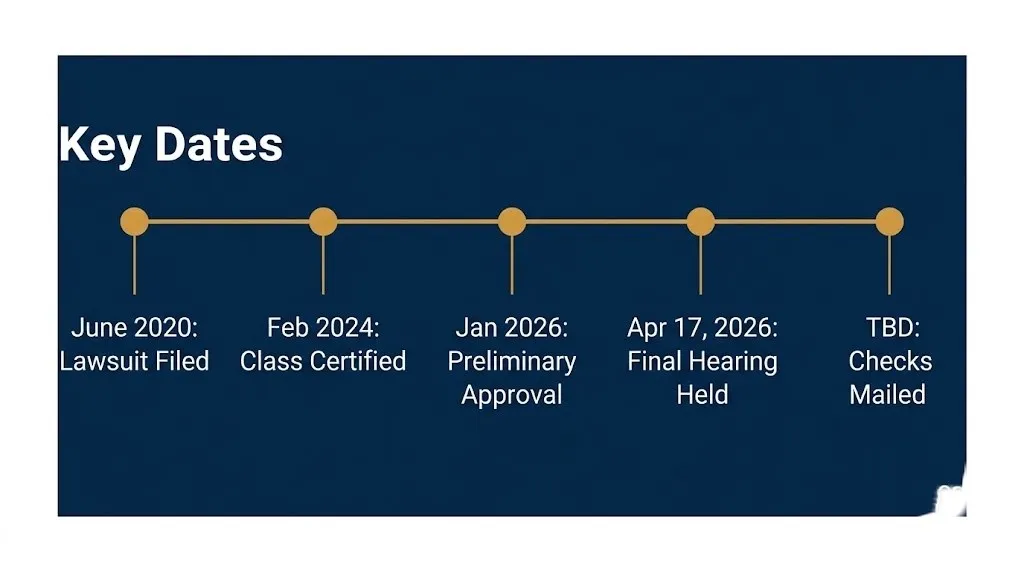
Stoff v. Wells Fargo Bank, N.A. is the class action lawsuit behind this $56.85 million settlement, filed by plaintiff Michael Stoff in June 2020.
The lawsuit accused Wells Fargo of violating the Fair Credit Reporting Act by failing to comply with CARES Act Section 4021, a provision that required mortgage servicers to report current borrowers as “current” to credit bureaus even while those borrowers were in a pandemic forbearance.
The court certified the class on February 5, 2024, nearly four years after filing. Preliminary settlement approval followed on January 9, 2026, after what the settlement notice describes as more than five years of litigation, discovery, and mediation.
Why Did Wells Fargo Agree to Pay Instead of Fighting the Case?
Wells Fargo agreed to settle to avoid the cost, delay, and uncertainty of continuing to litigate a case that had already survived class certification.
That’s a common calculation for large banks facing consumer class actions. Fighting to trial risks a bigger loss, more legal fees, and years of additional exposure. Settling caps the cost at a known number.
A Wells Fargo spokesperson told Newsweek the bank was “pleased to have reached a settlement that, once approved by the court, will resolve this matter.” The company continues to deny it did anything wrong.
Financial commentators quoted by Newsweek were less charitable. One consumer advocate framed it as a pattern: reach a settlement, admit nothing, move on, while critics argue the underlying harm to consumers, like damaged credit scores, doesn’t disappear once a check is cut.
How Is This Different From Wells Fargo’s Other Forbearance Settlement?
The key difference is geography and legal theory: this case is California-only and centers on credit reporting accuracy, while the other major forbearance case was nationwide and centered on consent.
| Feature | Stoff Settlement ($56.85M) | COVID Forbearance Settlement ($185M total) |
|---|---|---|
| Court | CA Superior Court, San Diego | U.S. District Court, Southern Ohio |
| Coverage | California mortgagors only | Nationwide borrowers |
| Core claim | Inaccurate credit bureau reporting | Forbearance without informed consent |
| Status | Final hearing held April 17, 2026 | Final approval Dec. 2024, checks mailed March 2025 |
Key Takeaway: If you already received money from Wells Fargo’s nationwide forbearance settlement, that’s a different case with a different legal theory, and it doesn’t rule you out of this one.
What This Means for Your Credit Score Now
If Wells Fargo did misreport your account status during forbearance, the settlement itself doesn’t automatically fix your credit report.
The settlement resolves the financial claim through a payment, but it doesn’t include a described process for correcting past credit bureau entries as part of this specific case. If you believe your credit report still shows inaccurate forbearance reporting, that’s a separate step through the credit bureaus themselves, similar to disputing any other reporting error.
Think of it like a warranty payout for a defective product you already replaced. The check compensates you for the harm, but you still have to deal with the product itself separately.
What Happens Next
April 17, 2026: Final approval hearing held at the Hall of Justice in San Diego.
Expected, timing not yet confirmed: Court issues a written ruling on final approval, attorneys’ fees, and service awards.
Expected 30 days after effective date, not yet confirmed: A.B. Data begins mailing automatic settlement checks to eligible class members.
Ongoing: 90-day window opens for class members to cash mailed checks once distribution begins.
Expected later in 2026, not yet confirmed: Possible second distribution or transfer of leftover funds to Credit Builders Alliance, depending on remaining balance.
Frequently Asked Questions
Is the Wells Fargo $56.85 million settlement a scam?
No, it’s a real class action settlement pending in the Superior Court of California, County of San Diego.
The official case is Stoff v. Wells Fargo Bank, N.A., and the administrator is A.B. Data, Ltd.
Verify anything you see about it directly on CaresActLitigation.com.
Do I need to file a claim to get paid?
No, this settlement pays automatically to eligible class members.
Wells Fargo’s own account records are used to identify who qualifies.
You only need to act if your mailing address has changed.
How much will I get paid?
The exact amount is not yet determined.
It depends on how many people end up in the final class and how much the court approves for fees.
Some estimates range from around $100 to a few hundred dollars, but none are confirmed.
What if I live outside California?
You’re not part of this specific class if your mortgaged property was outside California.
This settlement is limited to California mortgagors by design.
Borrowers elsewhere may have separate legal options through other Wells Fargo litigation.
Can I still object or opt out?
No, the objection deadline was March 25, 2026, and the exclusion deadline had already passed before that.
Both windows have closed as of this article’s publication.
The case is now in the post-hearing phase awaiting a final ruling.
When will checks actually arrive?
No confirmed mailing date has been published yet.
Distribution is expected roughly 30 days after final approval becomes effective, assuming no appeal delays it.
Check the official settlement website for the most current timeline.
Is this the same as Wells Fargo’s $185 million forbearance settlement?
No, that’s a separate, nationwide case that already finished paying out in 2025.
This $56.85 million case is California-specific and addresses credit reporting accuracy, not consent.
You could potentially be part of both, depending on your situation.
Who do I contact with questions about my specific account?
Contact the settlement administrator, A.B. Data, Ltd., directly through the official settlement website.
News sites covering this case are not able to check your individual claim status.
Keep any correspondence for your records.
Bottom Line
Nothing about this settlement requires you to act right now, aside from updating your mailing address if you’ve moved. The most important thing is watching the official settlement website for confirmation of the final approval ruling and a real mailing date.
Calendar a check-in for late summer 2026, and don’t trust any message asking you to pay or click to “claim” your share.