Student Loans Lawsuit 2026: Borrower Defense Settlement Pays $23 Billion, Navient Checks Are Mailing, and SAVE Is Officially Dead
Quick Answer
- The borrower defense settlement is real and paying: about $23 billion in cancelled debt for nearly 500,000 borrowers who attended fraudulent schools.
- Navient borrowers are receiving checks up to $2,000 from a separate CFPB settlement, mailed automatically starting February 13, 2026.
- The SAVE plan is dead, vacated in March 2026, and more than 7 million borrowers must switch repayment plans.
If you are searching for the student loans lawsuit, you likely received a surprise check, saw a headline about billions in forgiveness, or got an urgent notice that your SAVE plan payments are restarting. Here is the verified truth: three separate legal actions are reshaping student loan repayment in 2026, and they affect completely different groups of borrowers.
The largest involves the borrower defense settlement, now worth roughly $23 billion for nearly 500,000 borrowers who attended schools accused of fraud . The Trump administration tried to delay relief, but the Ninth Circuit rejected that request on July 17, 2026 .
This article covers every active student loan lawsuit and settlement in 2026, who qualifies for each one, how to check your status, why the SAVE plan is finished, and the scams that target borrowers during moments of confusion.
The Facts
| Case | Sweet v. Cardona (borrower defense settlement); CFPB v. Navient; Woods v. U.S. Dept. of Education |
| Status | Borrower defense settlement paying; Navient checks mailing; Woods proposed class action filed |
| Fund Size | Approximately $23 billion in borrower defense relief; $120 million Navient settlement |
| Est. Per Person | Navient checks range from $50 to $2,000; borrower defense relief is debt cancellation, not cash |
| Claim Deadline | No deadline for borrower defense; automatic relief; Navient checks automatic |
| Administrator | Rust Consulting (Navient); Department of Education (borrower defense) |
| Proof Needed | Automatic for both; no claim form required |
Is the Student Loans Lawsuit Real and Paying?
Yes, the student loans lawsuit is real, and relief is actively flowing. The borrower defense settlement, often called Sweet v. Cardona, has now delivered approximately $23 billion in debt cancellation to nearly 500,000 borrowers .
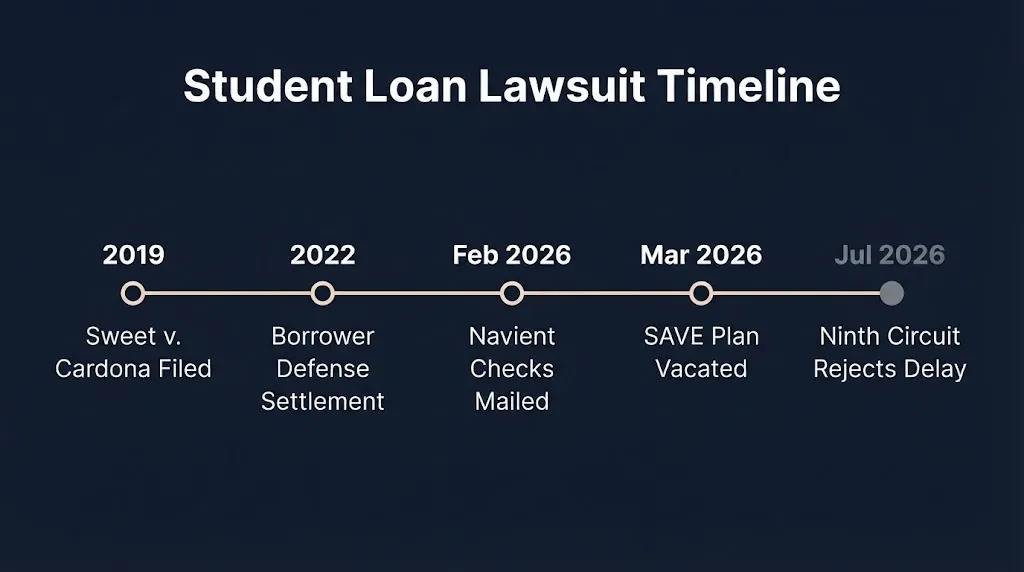
The case dates to 2019, when the Project on Predatory Student Lending sued the Education Department for failing to process borrower defense applications. A 2022 settlement required automatic relief for claims filed before June 22, 2022, if the department missed its processing deadlines.
The Trump administration missed the deadline and asked for 18 more months. A district judge denied that request, and the Ninth Circuit affirmed the denial on July 17, 2026 . That ruling cleared the way for loans to be discharged.
The Navient settlement is separate and involves cash payments, not debt cancellation. The CFPB sued Navient in 2017 for steering borrowers into costly forbearances instead of income-driven repayment. The settlement, finalized in September 2024, required $120 million, with $100 million earmarked for direct payments to affected borrowers .
How Much Can You Get From the Navient Student Loan Settlement?
The Navient settlement pays between $50 and $2,000, depending on how Navient’s conduct affected you. The CFPB began mailing checks on February 13, 2026 .
The payment amount depends on factors the CFPB has not fully disclosed. Borrowers who were steered into multiple forbearances and lost more time toward forgiveness likely receive larger checks.
You do not file a claim. The CFPB identifies eligible borrowers automatically using Navient’s records. That is why checks arrive as surprises, sometimes years after the lawsuit was filed.
If you received a check, it is legitimate. The settlement administrator is Rust Consulting, and the CFPB directs questions to a toll-free number, an email address, and a mailing address in Minnesota .
The payments do not reduce your student loan balance, and they do not affect your credit. They are compensation for Navient’s misconduct, not forgiveness.
Key Takeaway: The Navient settlement pays $50 to $2,000 automatically; checks started mailing February 13, 2026, and no claim form is needed.
Who Qualifies for the Navient Settlement Payment?
You may qualify if your federal student loans were serviced by Navient or Sallie Mae in 2017 or earlier, and you were steered into forbearance instead of an income-driven repayment plan .
Navient was formerly part of Sallie Mae before splitting in 2014. The CFPB alleged that Navient illegally steered borrowers into forbearances, which paused payments but allowed interest to accrue and did not count toward loan forgiveness .
The settlement also covered Navient subsidiary Pioneer Credit Recovery, which the CFPB said gave wrong information to credit reporting companies about some discharged loans .
When the settlement was announced in 2024, Biden officials said hundreds of thousands of borrowers would receive checks. The CFPB has not published an exact eligibility list, and it directs borrowers to the settlement administrator for questions .
If you were serviced by Navient and received a check, you were already identified. If you were serviced by Navient and did not receive a check, you may not have been in the affected group, or your payment may still be processing.
Reality Check: The CFPB and its settlement administrator will never call you demanding payment or personal information to “release” your Navient check. The checks arrive automatically by mail, and Rust Consulting does not charge fees.
How to Check If You Qualify for Borrower Defense Discharge
You may already qualify for borrower defense discharge without filing anything new. The Sweet settlement provides automatic relief to borrowers whose applications were pending before June 22, 2022, and who attended schools the department determined defrauded them .
The Department of Education has been discharging loans in batches. The July 2026 ruling covered more than 170,000 borrowers and roughly $11 billion in the latest wave .
If you filed a borrower defense application before June 22, 2022, and the department did not decide your claim by the required deadline, you should have received relief. If your loans have not been discharged, you can check your status through your Federal Student Aid account at StudentAid.gov.
The Project on Predatory Student Lending, which brought the case, estimates the total impact at over 450,000 people and more than $23 billion in improved personal balance sheets .
This is not a cash payment. It is cancellation of federal student loan debt. The relief removes the balance, but it does not put money in your pocket.
How to File a Claim for Student Loan Lawsuit Relief
You cannot file a claim for the borrower defense settlement or the Navient settlement because both are automatic. Here is what you can do:
- Check your StudentAid.gov account to see if your borrower defense discharge has processed.
- Verify your current mailing address with your loan servicer.
- If you received a Navient check, deposit it within the validity window.
- If you did not receive a Navient check and believe you qualify, call the settlement administrator.
- Keep records of any discharge notices for your tax preparer.
The Navient administrator is Rust Consulting. The CFPB provides a toll-free number and email for questions, though the automated phone service states it is only accepting calls from borrowers who have received a check, and directs others to call back after March 30 .
What Happened to the SAVE Plan Lawsuit?
The SAVE plan is dead. The Eighth Circuit Court of Appeals directed a lower court to vacate the SAVE regulations on March 9, 2026, and the district court entered judgment the next day .
The SAVE plan, or Saving on a Valuable Education, was a Biden-era income-driven repayment plan that offered lower payments and faster forgiveness than other options. It was blocked by litigation in summer 2024, leaving more than 7 million borrowers in an administrative forbearance.
The Education Department and Missouri reached a settlement in December 2025 to end the plan. The district court initially dismissed the case as moot, but the Eighth Circuit reversed that decision and ordered the settlement effectuated .
The result: the SAVE regulations are vacated, the plan is over, and borrowers must move to another repayment plan. The One Big Beautiful Bill Act had already scheduled SAVE’s phase-out by July 2028, but the court action ended it much sooner .
What Happens to Borrowers Kicked Off SAVE?
More than 7 million borrowers must switch to a new repayment plan, and the deadlines are staggered. The Education Department began sending 90-day notices in July 2026, meaning the soonest anyone could be kicked off is late September .
No borrower will be required to move off SAVE before September 29, 2026 at the earliest, according to a department court filing. But the department is transitioning borrowers in waves, so most will get more time .
If you do nothing, your servicer will automatically place you in a Standard Repayment Plan. That plan does not count toward income-driven forgiveness or Public Service Loan Forgiveness, and payments are typically higher than SAVE .
Your options include Income-Based Repayment (IBR), Pay As You Earn (PAYE), and Income-Contingent Repayment (ICR). Under the One Big Beautiful Bill Act, ICR and PAYE will be sunset by July 1, 2028, so IBR is the only permanent IDR option .
IBR is the safest long-term choice. The department recently eliminated the partial financial hardship requirement for IBR, meaning more borrowers can now enroll .
What Is the Woods v. Department of Education Lawsuit?
The Woods lawsuit is a new proposed class action filed on September 24, 2026, alleging that the Education Department still reports cancelled debts on credit reports. The case, Woods v. U.S. Department of Education, was filed in the U.S. District Court for the District of Columbia .
The plaintiffs are borrowers whose federal student loans were discharged between April 2022 and January 2025 because they attended fraudulent schools. They allege the department continues reporting those cancelled debts to Equifax, Experian, and TransUnion as active .
One plaintiff, Jorge Cortes, is a Marine veteran whose ITT Technical Institute loans were forgiven in August 2022. A $21,586 balance remained on his credit report as of summer 2026, he says .
The Project on Predatory Student Lending, which represents the plaintiffs, estimates that the Education Department is still reporting debts for more than 300,000 borrowers .
This case is in its early stages. No settlement exists, and no claims process is open. If you believe your credit report shows cancelled student loans, you can dispute the entries with the credit bureaus and monitor the docket for updates.
What Happens Next for Student Loan Borrowers?
September 29, 2026 and beyond: SAVE borrowers begin receiving 90-day notices in waves; the first borrowers can be moved to new plans.
Expected late 2026: The Woods credit reporting case proceeds through motions and potential class certification.
Expected 2027: Borrower defense discharges continue processing for remaining eligible borrowers.
July 1, 2028: ICR and PAYE plans sunset under the One Big Beautiful Bill Act; IBR remains the primary IDR option.
Frequently Asked Questions
Is the student loan lawsuit settlement real?
Yes. The borrower defense settlement has delivered about $23 billion in debt cancellation, and the Navient settlement is paying checks up to $2,000.
How do I know if I qualify for Navient settlement money?
You may qualify if your loans were serviced by Navient or Sallie Mae in 2017 or earlier and you were steered into forbearance.
Do I need to file a claim for the student loan settlement?
No. Both the Navient settlement and borrower defense relief are automatic. No claim form exists.
When will I receive my Navient settlement check?
Checks started mailing February 13, 2026. If you have not received one and believe you qualify, contact the settlement administrator.
Is the SAVE plan really ending?
Yes. The SAVE plan regulations were vacated in March 2026, and all borrowers must switch to a new repayment plan.
What happens if I do nothing about my SAVE plan?
Your servicer will automatically move you to a Standard Repayment Plan, which is typically more expensive and does not count toward forgiveness.
Can I still get borrower defense forgiveness in 2026?
Yes, the Department of Education continues processing discharges under the Sweet settlement after the Ninth Circuit rejected the administration’s delay request.
What is the Woods v. Department of Education lawsuit about?
It alleges the Education Department still reports cancelled student loan debts on credit reports, harming borrowers’ credit scores and financial opportunities.