Semaglutide Lawsuit 2026: No Settlement Exists, 4,000+ Cases Pending, and a Critical Court Ruling on Stomach Paralysis Claims
Quick Answer
- No semaglutide lawsuit settlement exists in 2026; every dollar figure you see advertised is a projection, not a result .
- Stomach paralysis claims now require a confirmed gastric emptying study, per an August 2025 court order .
- NAION vision loss lawsuits are growing separately, with an MDL established in December 2025 and 146 cases as of August 2026 .
If you are searching for a semaglutide lawsuit, you likely saw a headline about billions in payouts or received a solicitation from a law firm promising compensation. Here is the verified truth: no semaglutide lawsuit has settled, no court has found these drugs caused anyone’s injury, and no claim form exists.
What does exist is a massive, active litigation. More than 4,000 cases are pending in the federal stomach-injury MDL alone, with thousands more in a separate vision-loss MDL and state courts . The critical question of whether the scientific evidence even supports these claims was argued in a Philadelphia courtroom in September 2026.
This article covers the real status of every semaglutide lawsuit, the strict medical proof you need to have a viable claim, why the vision-loss cases are growing, the FDA compounding rules that spawned a side battle, and how to avoid the scams that target desperate patients.
The Facts
| Case | In re: Glucagon-Like Peptide-1 Receptor Agonists Products Liability Litigation (MDL 3094); In re: Semaglutide Products Liability Litigation (NAION) (MDL 3163) |
| Status | Active litigation; no settlement, no verdicts |
| Fund Size | Not yet confirmed (no settlement) |
| Est. Per Person | Not yet determined |
| Claim Deadline | No settlement deadline; individual state statutes of limitations apply |
| Administrator | Not yet appointed |
| Proof Needed | Gastric emptying study for stomach claims; confirmed NAION diagnosis for vision claims |
Is the Semaglutide Lawsuit Real or a Scam?
The semaglutide lawsuit is real, but it is not a class action settlement, and anyone promising you a payout right now is misleading you. This is mass tort litigation, which means thousands of individual lawsuits are consolidated for pretrial proceedings but remain separate claims .
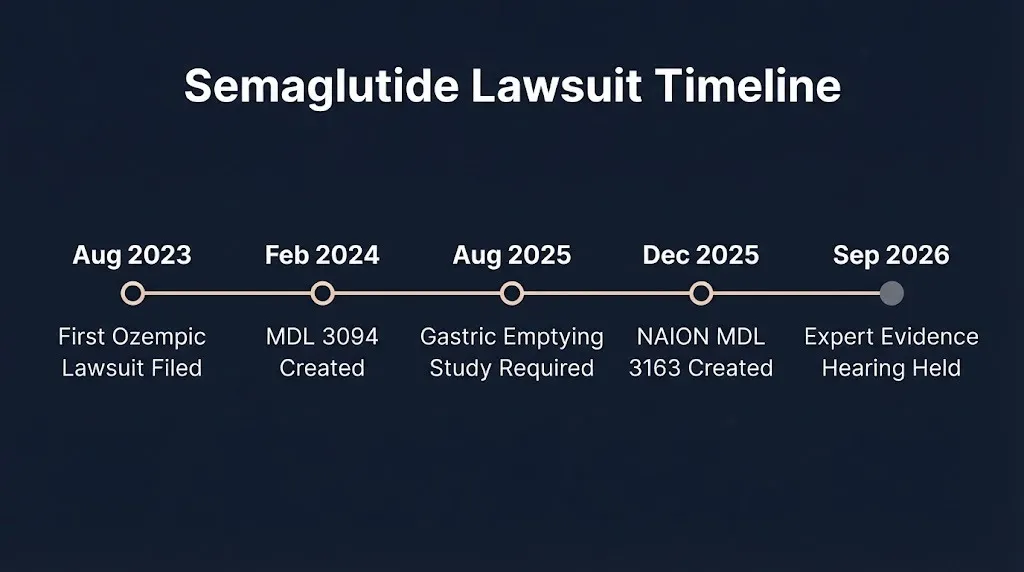
The stomach-injury cases are centralized in MDL 3094 in the Eastern District of Pennsylvania before Judge Karen Spencer Marston . The vision-loss cases were consolidated into a separate MDL, No. 3163, in December 2025 .
The scam risk is significant. Websites promising “semaglutide settlement payouts” or offering claim forms are not describing anything that exists. No settlement administrator has been appointed, no claims period is open, and no judge has approved any payout .
The real litigation is about whether Novo Nordisk and Eli Lilly failed to adequately warn patients and doctors about serious side effects, including gastroparesis (stomach paralysis) and non-arteritic anterior ischemic optic neuropathy (NAION), a form of sudden vision loss .
How Much Can You Get From a Semaglutide Lawsuit?
Not yet determined is the only honest answer. No semaglutide lawsuit has settled, no verdict has been reached, and no court has found that these medications caused anyone’s injury .
Every specific dollar figure you have seen advertised is a projection based on other drug litigations, not a result from this one. Comparable pharmaceutical mass torts have taken three to seven years from consolidation to resolution, and some never resolve favorably for plaintiffs .
If a settlement is eventually reached, the amount would depend on:
- The severity of your injury
- The strength of your medical documentation
- The number of valid claims filed
- The total settlement fund negotiated
For now, $0 has been paid to any semaglutide plaintiff. The litigation is in the pretrial phase, which means the parties are gathering evidence and arguing legal standards.
Who Qualifies for a Semaglutide Stomach Paralysis Claim?
You may qualify for a stomach paralysis claim if you have a confirmed diagnosis of gastroparesis from objective medical testing, not just symptoms. An August 2025 court order requires a gastric emptying study (scintigraphy), a wireless motility capsule, or a gastric emptying breath test .
A doctor’s clinical impression alone is not enough. If your medical records show only symptoms like nausea, vomiting, or bloating without a validated test, your claim faces a serious evidentiary problem .
Additional criteria commonly referenced for stomach paralysis claims include:
- Use of brand-name Ozempic, Wegovy, or Rybelsus (not compounded or generic semaglutide)
- No prior diagnosis of gastroparesis or bowel obstruction before taking the medication
- A hospitalization or emergency room visit related to the symptoms
- Diagnosis made while taking the medication or within about 30 days of stopping
The court also dismissed design defect claims, leaving failure to warn as the main legal theory .
Key Takeaway: A semaglutide stomach paralysis claim requires a gastric emptying study or similar objective test; symptoms alone are not enough to survive in court.
Who Qualifies for the Semaglutide Vision Loss Lawsuit?
You may qualify for a vision loss claim if you were diagnosed with NAION (non-arteritic anterior ischemic optic neuropathy) by an ophthalmologist or qualified medical professional after taking semaglutide or tirzepatide medications .
NAION typically causes sudden, painless vision loss in one eye. It is a rare condition, affecting up to 1 in 10,000 people taking these medications, according to European regulators . European regulators added a warning about NAION to semaglutide labels in June 2025 .
The medications named in vision lawsuits include Ozempic, Wegovy, Rybelsus, Trulicity, Mounjaro, and Zepbound . Some plaintiffs allege they woke up with partial blindness the day after taking their first dose .
The NAION MDL has grown quickly. As of August 2026, it included 146 cases, with attorneys continuing to evaluate new claims . A separate New Jersey state court proceeding, called a multicounty litigation, is also coordinating NAION cases .
Unlike stomach paralysis claims, the court has not imposed the same strict diagnostic testing requirement for NAION cases. What matters is a confirmed diagnosis with conditions that mimic NAION ruled out, and records showing when you started the drug relative to the vision loss .
How to File a Semaglutide Lawsuit
You cannot file a claim through a settlement process because none exists. To pursue an individual lawsuit, you would need to consult a lawyer about filing your own case. Here is the general process:
- Gather your medical records, including the gastric emptying study or NAION diagnosis.
- Collect pharmacy records showing your semaglutide prescriptions.
- Document any hospitalizations, ER visits, or ongoing treatment.
- Consult a product liability attorney licensed in your state.
- Determine your state’s filing deadline (statute of limitations).
- File an individual lawsuit against the manufacturer.
The statute of limitations varies by state, generally two to three years from the date of injury or discovery . There is no class action tolling your deadline while you wait .
Filing is free. If you hire an attorney, most product liability lawyers work on contingency, meaning they take a percentage of any recovery rather than charging upfront.
What Happened at the September 2026 Expert Hearing?
The September 2026 hearing was the most consequential event in the stomach-injury litigation, and almost nobody writing about these lawsuits mentioned it . From September 10 to 18, 2026, the court heard arguments on whether the plaintiffs’ general-causation experts may testify at all .
This is a Daubert hearing, named after the Supreme Court case that governs expert testimony. If the drugmakers win, most of the gastrointestinal MDL likely ends because plaintiffs cannot prove the drugs cause gastroparesis without expert testimony. If the plaintiffs win, the litigation moves toward trials .
The research on causation is genuinely mixed. Several studies found roughly double the risk of gastroparesis among semaglutide users, but at least one large matched study found no significant increase .
A ruling had not been issued as of early October 2026. This decision will shape the entire litigation more than any other single event.
Reality Check: No one will text you a semaglutide settlement check or ask for your medical records and payment upfront to “process your claim.” Settlement administrators contact class members by mail and never charge fees. Any message demanding payment or personal information is a scam .
Why Is Novo Nordisk Suing Other Companies?
Novo Nordisk, the maker of Ozempic and Wegovy, is filing its own lawsuits against compounding pharmacies, telehealth platforms, and even Eli Lilly, in a separate legal battle over compounded semaglutide .
The FDA removed semaglutide and tirzepatide from its drug shortage list, which means compounding pharmacies can no longer mass-produce copies of these drugs . The Fifth Circuit Court of Appeals affirmed the FDA’s decision on August 27, 2026 .
Novo Nordisk has sued telehealth platforms like Invigor Medical for allegedly advertising compounded drugs as equivalent to FDA-approved Ozempic . It also settled a case with an Arkansas clinic over false advertising of compounded semaglutide .
In July 2026, Novo Nordisk sued Eli Lilly for false advertising, alleging Lilly’s ads mislead consumers about the comparative weight-loss effects of Zepbound versus Wegovy .
The Alabama Attorney General reached a settlement with a Cullman clinic that administered research-grade semaglutide and tirzepatide not approved for human use. The clinic was permanently closed, and the owners paid $17,267.50 in damages to consumers plus $7,000 in penalties .
These cases are separate from the patient injury lawsuits, but they show the legal landscape surrounding GLP-1 medications is expanding in multiple directions.
What Happens Next in the Semaglutide Lawsuits?
Expected late 2026: The court’s ruling on the September 2026 Daubert hearing will determine whether stomach-injury claims can proceed to trial .
Expected 2027: If causation experts are allowed, the first bellwether trials could be scheduled. Bellwether trials test how juries respond to the evidence and often drive settlement negotiations .
Ongoing: The NAION MDL continues to grow as new vision-loss cases are filed and evaluated .
Expected 2027-2028: Most pharmaceutical mass torts take three to seven years from consolidation to resolution. Settlement discussions typically intensify after bellwether trials .
Frequently Asked Questions
Is there a semaglutide lawsuit settlement in 2026?
No. No semaglutide lawsuit has settled, no verdict has been reached, and no claims process exists .
How much can I get from the semaglutide lawsuit?
Nothing has been determined. No settlement fund exists, and no court has found these drugs caused any injury .
What proof do I need for a stomach paralysis claim?
You need a gastric emptying study or similar objective test confirming delayed stomach emptying, according to an August 2025 court order .
Do I need a gastric emptying study to file a gastroparesis lawsuit?
Yes. The court ruled that symptoms and clinical judgment alone are not enough to prove drug-induced gastroparesis .
What is NAION and how does it relate to semaglutide?
NAION is a rare form of sudden vision loss. European regulators added a warning to semaglutide labels in June 2025, and lawsuits are now consolidated in MDL 3163 .
Can I still file a semaglutide lawsuit?
Yes, but you must file an individual lawsuit, not a settlement claim. State statutes of limitations apply, generally two to three years from injury or discovery .
What happened at the September 2026 hearing?
The court heard arguments on whether plaintiffs’ expert witnesses can testify about causation. The ruling could determine whether most stomach-injury claims survive .
Is there a class action for semaglutide injuries?
No. This is mass tort litigation, not a class action. Each plaintiff files an individual lawsuit, and cases are consolidated for pretrial proceedings .