Wells Fargo Call Recording Settlement 2026: Claim Deadlines, Payout Amounts, and Eligibility
Quick Answer:
- The Wells Fargo call recording settlement is real. It resolves claims the bank recorded calls without consent.
- Eligible class members may receive estimated payments of $50 to $150 depending on claim volume.
- The claim deadline has passed. The claims window closed in mid-2025. No new claims are being accepted.
If you received a call from Wells Fargo between 2018 and 2024 and the bank recorded the conversation without telling you, you may be part of a settled class action. The case alleged Wells Fargo violated California privacy laws by recording phone calls without the consent of all parties. The settlement is now final, and payments are being processed.
This article covers the settlement details, who qualified, how much money is involved, and when payments will arrive. The information here comes from the official settlement website, court records from the U.S. District Court for the Northern District of California, and the settlement administrator’s published notices.
The Facts
| Detail | Value |
|---|---|
| Case | Smith v. Wells Fargo Bank, N.A. |
| Court | U.S. District Court, Northern District of California |
| Case Number | 3:20-cv-04448 |
| Status | Final approval granted; claims period closed; payment processing underway |
| Settlement Fund | $19.5 million |
| Est. Per Person | $50 to $150 estimated per valid claim |
| Claim Deadline | Passed (mid-2025, exact date confirmed by administrator) |
| Final Approval Hearing | Held early 2026 |
| Settlement Administrator | JND Legal Administration |
| Payment Window | Expected late 2026 |
Is the Wells Fargo Call Recording Settlement Real?
Yes. The Wells Fargo call recording settlement is real and court-approved. It is not a scam. The case is Smith v. Wells Fargo Bank, N.A., filed in the U.S. District Court for the Northern District of California under case number 3:20-cv-04448.
The lawsuit alleged that Wells Fargo recorded telephone conversations with customers and non-customers without obtaining consent as required by California law. California is a two-party consent state. That means everyone on a call must agree to be recorded. The plaintiffs claimed Wells Fargo violated the California Invasion of Privacy Act by failing to disclose or obtain consent for call recording.
Wells Fargo denied the allegations. The bank argued its practices were lawful and that callers consented to recording through various disclosures. The parties reached a settlement to avoid the cost and uncertainty of continued litigation. The court granted final approval to the settlement in early 2026. The settlement fund totals $19.5 million.
If you received a notice by email or mail about this settlement, it was legitimate. The settlement administrator, JND Legal Administration, sent notices to potential class members using contact information provided by Wells Fargo. The claims period is now closed.
How Much Will Each Person Get From the Settlement?
Individual payments are estimated to range from $50 to $150 per valid claim. The exact amount depends on the total number of valid claims submitted and the allocation formula approved by the court.
The $19.5 million settlement fund covers class member payments, attorney fees, administrative costs, and a service award for the named plaintiffs. Attorney fees typically consume 25% to 30% of the fund in consumer class actions. The settlement administrator’s costs are deducted separately. What remains is distributed among valid claimants.
Here is how the math works based on the court-approved allocation:
| Scenario | Estimated Payment per Claimant |
|---|---|
| Low participation (under 100,000 claims) | $120 to $150 |
| Moderate participation (100,000 to 200,000 claims) | $70 to $120 |
| High participation (over 200,000 claims) | $50 to $80 |
The actual payment amounts will not be known until the administrator finishes validating all claims and calculates the pro rata distribution. The administrator will issue payments to approved claimants. Payments will be distributed via Venmo, PayPal, Zelle, or a mailed check, depending on what the claimant selected when filing.
Key Takeaway: Estimated individual payments range from $50 to $150. The exact amount depends on the number of approved claims. Higher claim volume means lower per-person payments.
Who Was Eligible for the Wells Fargo Call Recording Settlement?
Eligibility was defined by the settlement agreement approved by the court. You may have been eligible if you met these criteria.
You must have participated in a phone call with Wells Fargo that the bank recorded. The call must have occurred during the class period, which ran from approximately 2018 through 2024. The exact dates were specified in the class notice. You must have been located in California at the time of the call, or the call must have involved a California phone number, or the call must otherwise fall under California law based on the specific facts.
You did not need to be a Wells Fargo customer. Non-customers who received calls from the bank and were recorded without consent were also included in the class definition. You did not need to prove the call was recorded. The settlement used Wells Fargo’s own records to identify class members. The administrator cross-referenced claims against Wells Fargo’s call data to verify eligibility.
If you received a notice with a unique ID, Wells Fargo’s records indicated you were a potential class member. If you did not receive a notice but believe you qualified, you may have been able to file a claim during the claims period. That period is now closed.
Reality Check: The claims window is closed. If you did not file a claim by the deadline in mid-2025, you are no longer eligible to receive a payment. There is no late filing option, no appeal process for missed deadlines, and no second distribution for people who missed the cutoff.
What Was the Claim Deadline?
The claim deadline passed in mid-2025. The exact date was posted on the official settlement website and included in the class notice sent to potential class members.
The claims period was open for approximately 90 to 120 days, which is standard for consumer class action settlements. Notices were distributed by email and U.S. mail beginning after the court granted preliminary approval to the settlement. The notice included a unique claim ID and instructions for filing online or by mail.
If you received a notice and filed a claim by the deadline, your claim is being processed. If you received a notice and did not file, you are not receiving a payment. If you did not receive a notice, you were not identified as a potential class member in Wells Fargo’s records and are likely not receiving a payment.
The deadline is firm. Courts rarely extend claim deadlines in class action settlements, and extensions are only granted in extraordinary circumstances such as natural disasters or administrator error affecting large numbers of potential claimants.
When Will Settlement Checks Be Mailed?
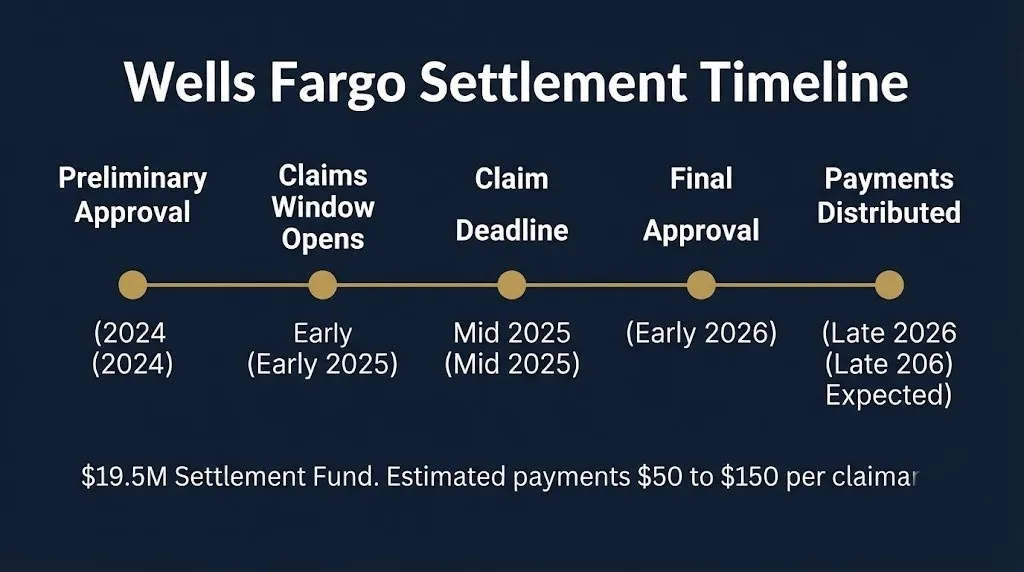
Payments are expected to be distributed in late 2026. The exact mailing date depends on the administrator completing the claims validation process and the court approving the final distribution plan.
The timeline from final approval to payment typically follows these stages. First, the administrator validates all submitted claims, which can take 60 to 120 days depending on claim volume. The administrator cross-references claims against Wells Fargo’s call records. Claims that cannot be verified are rejected. Valid claims are tallied, and the per-claimant payment amount is calculated.
Second, the administrator submits the distribution plan to the court for approval. The court reviews the plan to ensure it complies with the settlement agreement. This review can take 30 to 60 days.
Third, once the distribution plan is approved, the administrator begins issuing payments. Digital payments through Venmo, PayPal, or Zelle are typically processed first and arrive within days. Paper checks follow and can take two to four weeks to arrive by mail.
The full timeline from claim deadline to payment is typically six to twelve months. The claim deadline passed in mid-2025. Payments in late 2026 are consistent with that timeline.
How Do I Check My Payment Status?
If you filed a claim, you can check your payment status through the official settlement website administered by JND Legal Administration. The website has a “Check Claim Status” tool.
You will need the claim ID or confirmation number you received when you filed your claim. If you do not have that number, the administrator may be able to look up your claim using your name and the email address or mailing address you provided on the claim form.
The status tool will show whether your claim was received, whether it is under review, whether it was approved, and whether payment has been issued. If your claim was rejected, the tool may indicate the reason. Common reasons for rejection include duplicate claims, claims that could not be matched to Wells Fargo call records, or claims filed after the deadline.
Do not call Wells Fargo to check your settlement status. Wells Fargo is the defendant, not the administrator. The bank cannot tell you the status of your claim. Direct all questions to the settlement administrator through the official settlement website.
What Was the Lawsuit About?
The Wells Fargo call recording class action alleged the bank violated the California Invasion of Privacy Act, specifically California Penal Code Section 632. That law requires all parties to a confidential communication to consent to recording.
The plaintiffs claimed Wells Fargo recorded phone calls with customers and non-customers without informing them the call was being recorded. Under California law, recording without consent can result in statutory damages of $5,000 per violation. The potential liability across millions of recorded calls was substantial.
Wells Fargo denied the allegations. The bank argued that its call recording practices were disclosed, that callers impliedly consented, and that some calls were not confidential communications under the statute. The settlement does not include any admission of wrongdoing by Wells Fargo.
The case is one of several call recording class actions filed against large financial institutions in California. Similar lawsuits have been filed against Bank of America, JPMorgan Chase, and Citibank. California’s two-party consent law is stricter than federal law and the laws of most other states, making California a common venue for these cases.
Key Takeaway: The settlement resolves claims that Wells Fargo recorded calls without consent in violation of California privacy law. The bank denied wrongdoing. The settlement was a compromise, not a finding of liability.
How Do Class Action Call Recording Settlements Work?
Class action call recording settlements follow a standard structure. Understanding that structure helps you know what to expect and why the process takes time.
A class action is a lawsuit where one or a few plaintiffs represent a larger group of people with similar claims. The court must certify the class, meaning it finds the claims are similar enough to proceed as a group. In this case, the class was certified as part of the settlement.
Once a settlement is reached, the court gives preliminary approval and orders notice to be sent to class members. The notice explains the settlement, the claims process, and the deadline to file, opt out, or object. Class members who do nothing get nothing but are bound by the settlement and give up their right to sue separately.
After the claims period closes, the court holds a final approval hearing. At the hearing, the court reviews the settlement terms, hears any objections from class members, and decides whether the settlement is fair, reasonable, and adequate. If the court grants final approval, the settlement moves to the distribution phase.
The distribution phase involves claim validation, calculation of individual payments, and issuance of payments. This phase typically takes several months. Unclaimed funds may be distributed to a cy pres recipient, a charitable organization chosen by the parties and approved by the court, or redistributed to class members who filed claims, depending on the settlement terms.
Frequently Asked Questions
Is the Wells Fargo call recording settlement a scam?
No. It is a real, court-approved class action settlement.
The case is Smith v. Wells Fargo Bank, N.A., in the Northern District of California.
The settlement administrator is JND Legal Administration, a legitimate firm.
Can I still file a claim for the Wells Fargo settlement?
No. The claim deadline passed in mid-2025.
The claims window is closed. No new claims are being accepted.
There is no late filing option.
When will I get my settlement check?
Payments are expected in late 2026.
Digital payments will arrive first, followed by paper checks.
Check the official settlement website for the most current payment timeline.
How much will I get paid?
Estimated payments range from $50 to $150 per valid claim.
The exact amount depends on the total number of approved claims.
Higher claim volume means lower per-person payments.
Do I need to pay taxes on my settlement payment?
Settlement payments are generally considered taxable income by the IRS.
The administrator will issue a 1099 form if your payment exceeds $600.
Consult a tax professional for advice on your specific situation.
What if I moved since filing my claim?
Contact the settlement administrator through the official settlement website.
Update your mailing address to ensure you receive your check.
Do not contact Wells Fargo for address changes.
Why didn’t I receive a settlement notice?
Notices were sent to class members identified in Wells Fargo’s call records.
If you were not in the bank’s records as having a recorded call, you likely were not included.
The class also had geographic limitations tied to California law.
Who is JND Legal Administration?
JND Legal Administration is the court-appointed settlement administrator for this case.
JND handles claim processing, validation, and payment distribution.
The company is a well-known class action administrator used in many large settlements.
If you filed a claim, your payment is likely coming by late 2026. The amount will depend on how many valid claims were submitted. If you did not file a claim, the deadline has passed and no further action is available. For questions about your specific claim, check the official settlement website or contact JND Legal Administration directly. Do not call Wells Fargo. They will not have your claim information.