Portfolio Recovery Associates Lawsuit 2026: Settlement Status, Claim Deadlines, and Who May Qualify
Quick Answer
- Is it legit? Yes, Portfolio Recovery Associates faces real lawsuits. The company is a debt buyer the CFPB called a repeat offender.
- How much? No active PRA settlement is paying right now. Previous settlements ranged from $16.75 account credits to $5,750 individual payouts.
- Deadline? The last confirmed PRA-related claim deadline was July 7, 2025, for a Wisconsin debt-letter case. That window is closed.
If you searched for a Portfolio Recovery Associates lawsuit settlement expecting a claim form and a payout date, here is the honest answer: nothing nationwide is open for filing today. What exists instead is a patchwork of state-level settlements, closed claim windows, and active litigation filed throughout 2026 that has not yet reached a payout stage.
That matters because PRA is one of the largest debt buyers in the country. It files thousands of collection lawsuits each year, and the Consumer Financial Protection Bureau has already labeled it a repeat offender for illegal collection practices. You may have received a letter, a call, or even a court summons from PRA, and the legal landscape around that contact is shifting in real time.
This article covers what is actually confirmed as of September 2026: which settlements have closed, which lawsuits are active, what the Colorado Supreme Court just ruled, and what you can realistically expect if PRA is pursuing you.
Is the Portfolio Recovery Associates lawsuit settlement legit or a scam?
The settlements are real, but the claims windows are mostly closed. That combination is exactly what scam artists exploit.
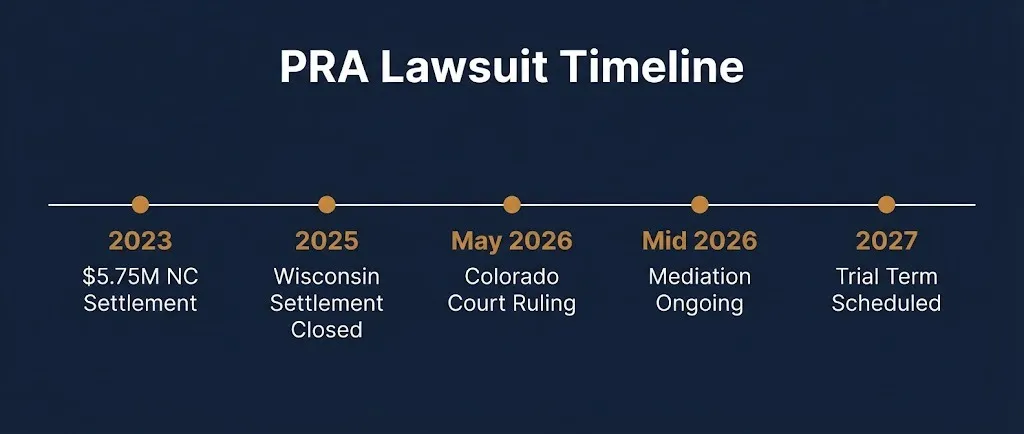
Portfolio Recovery Associates has paid out real money in multiple class actions. A North Carolina settlement produced $5.75 million for roughly 18,000 people, with individual payments exceeding $5,000 for some class members . A Wisconsin settlement in 2025 offered a pro rata share of $75,000 plus automatic $16.75 account credits for eligible residents . In 2016, PRA paid $18 million to settle TCPA claims covering approximately 7.4 million people .
Those are all verified, court-approved settlements. None of them are currently accepting new claims.
The scam risk comes from the gap between “PRA settles cases” and “a PRA settlement is open right now.” Third-party sites may still advertise “file your PRA claim” to collect your personal information. If a website asks for your Social Security number or a fee to “process” a PRA settlement claim that closed months or years ago, that is a red flag.
Reality Check: No legitimate settlement administrator texts you first asking for bank details. Filing a claim is always free. If someone charges you to submit a claim or promises a guaranteed payout, walk away and report it.
How much could you get from a Portfolio Recovery Associates settlement?
Payout amounts depend entirely on which settlement you were part of and when it closed. There is no single per-person figure for PRA cases.
The verified ranges from recent settlements show wide variation:
| Settlement | Fund Size | Per-Person Amount | Status |
|---|---|---|---|
| Wisconsin debt-letter case (2025) | $75,000 | Pro rata share plus $16.75 credit | Closed July 2025 |
| North Carolina collection practices (2023) | $5.75 million | Over $5,000 for some members | Closed |
| TCPA autodialer case (2016) | $18 million | $24 to $60 estimated | Closed |
| TransUnion data-sharing case (2025) | $2.5 million | At least $40 | Closed 2025 |
The Wisconsin settlement illustrates how small some class payments can be. The $75,000 fund was split among all valid claimants, and the automatic account credit was set at just $16.75 . The larger North Carolina settlement produced bigger individual payments because the class size was smaller relative to the fund, roughly 18,000 people sharing $5.75 million .
For active 2026 PRA lawsuits, no settlement amount has been proposed. The cases filed this year are in early stages: motions, mediation conferences, and scheduling orders. You cannot calculate a payout from a case that has not settled.
What is the claim deadline for the current PRA settlement?
There is no open claim deadline for any Portfolio Recovery Associates settlement as of September 2026.
The most recent PRA-related settlement with a confirmed deadline was the Wisconsin debt-letter case, which required claims by July 7, 2025 . That deadline has passed.
The TransUnion settlement, which involved PRA’s data being shared after it asked TransUnion to stop, had an opt-out deadline of November 4, 2025, and a final fairness hearing on December 15, 2025 . That settlement did not require a claim form for eligible class members; payments were automatic.
If you received a postcard about either settlement and are wondering whether you can still file, the answer is no. The courts have moved past those deadlines.
New PRA lawsuits filed in 2026, including cases in Ohio, Kentucky, California, and Florida, are in active litigation . None has reached a settlement approval stage. There is no claim form to file and no deadline to calendar.
Key Takeaway: If a website tells you a PRA settlement deadline is “still open” in 2026, verify it against court records before handing over any personal information.
How do you file a Portfolio Recovery Associates settlement claim?
You cannot file a claim for any PRA settlement right now because no claims window is open. When one does open, the process follows a standard pattern you can prepare for now.
Here is how class action claims typically work when a PRA settlement is approved:
- Receive a postcard or email notice. The settlement administrator mails or emails you a notice with a Class Member ID and instructions.
- Check the official settlement website. The notice will name the administrator, usually Kroll or a similar firm.
- Locate your Class Member ID. This is on the postcard. You cannot file without it.
- Complete the online claim form or download the PDF. The form asks for basic contact information and your Class Member ID.
- Submit before the deadline. Late claims are rejected. Mail claims must be postmarked by the deadline date.
- Wait for the final approval hearing. The court must approve the settlement before any money moves.
- Receive your payment. Checks typically mail within 30 to 60 days after final approval.
The Wisconsin settlement used this exact structure. Claims could be filed online or by mail to Kroll Settlement Administration, and proof of identity came from the Class Member ID on the mailed notice .
If you want to be ready for a future PRA settlement, keep your address updated with any company that might have your data, and watch for postcards from settlement administrators. They are easy to mistake for junk mail.
When will Portfolio Recovery Associates settlement checks mail?
No payment date exists for any current PRA lawsuit because none has settled. For closed settlements, the payment timelines followed a standard pattern.
In the Wisconsin case, payments were scheduled within 51 days of final approval, which occurred on July 30, 2025 . That means checks would have mailed by mid-September 2025.
The TransUnion settlement stated that payments would issue approximately 45 days after the court entered final approval, which happened in December 2025 . Checks would have mailed in early 2026.
For active 2026 lawsuits, you can estimate timelines based on case stages. A lawsuit filed in February 2026 might reach mediation by mid-2026, settlement approval by late 2026 or 2027, and payment after that. The Ohio case in the Northern District of Ohio held a settlement conference in June 2026 and the parties agreed to material terms, but the dismissal entry and final approval have not yet been confirmed in the docket .
Debt collection litigation moves slowly. A delayed tax refund is frustrating, but at least you know it is coming. A class action settlement that has not been approved is more like a store return without a receipt: the outcome depends on what the other side agrees to, and you cannot force it.
What is the Portfolio Recovery Associates lawsuit about?
The lawsuits against PRA fall into two categories: collection practices cases and data-handling cases. Both allege that PRA broke consumer protection laws.
The collection practices cases claim PRA sued people on debts it could not prove it owned. A North Carolina class action alleged PRA failed to verify debt ownership and itemize balances before filing suit, violating the Fair Debt Collection Practices Act . The CFPB fined PRA more than $24 million in 2023 for similar conduct, specifically noting that PRA “filed lawsuits even when it lacked documentation about the debt” .
The data-handling cases are different. The TransUnion settlement alleged that TransUnion kept sending consumer data to collection agencies through its “Triggers for Collection” product even after PRA asked it to stop . That case was about data accuracy, not debt collection itself.
The legal theory behind the collection cases is straightforward. Before a debt buyer can file suit, it must prove it owns the specific account and that the balance is accurate. PRA buys debt portfolios in bulk, often for pennies on the dollar, and the paperwork chain from original creditor to PRA to the courthouse can have gaps. When those gaps exist, collection lawsuits become legally vulnerable.
Who is affected by Portfolio Recovery Associates lawsuits?
You may be affected if PRA has contacted you, sued you, or reported a debt to credit bureaus. The class definitions vary by case, but the general categories are broad.
You may be part of a PRA-related class if you:
- Received collection letters from PRA that you believe were misleading
- Were sued by PRA on a debt you did not recognize or could not verify
- Had PRA report a collection account to TransUnion or other credit bureaus
- Received autodialed calls from PRA without consent (older TCPA cases)
The Wisconsin settlement was limited to state residents who received specific letter types within a defined date range . The TransUnion settlement covered people whose data was shared after PRA requested removal . The North Carolina case covered residents sued by PRA on debts it could not properly document .
If PRA is currently pursuing you, you are not part of a class action just by being sued. Collection lawsuits are individual cases. Class actions arise when a pattern of conduct affects many people, and an attorney files on behalf of the group.
What did the Colorado Supreme Court just rule about PRA?
The Colorado Supreme Court ruled against PRA in a May 2026 decision that tightens documentation rules for debt buyers filing lawsuits in that state.
In Wright v. Portfolio Recovery Associates, LLC, the court held that a debt buyer must attach a non-affidavit writing to its complaint proving ownership of the specific debt at issue . An affidavit claiming ownership is not enough. The bill of sale PRA submitted did not reference the specific account being sued, and the court found that fatal to PRA’s case.
The ruling has implications beyond Colorado. It reinforces a principle that consumer attorneys have argued for years: debt buyers must prove they own your specific account, not just that they bought a portfolio of accounts. If you are sued by PRA in a state with similar documentation requirements, this case gives your attorney a stronger argument.
The Receivables Management Association International, a debt collection industry group, filed an amicus brief supporting PRA. The court rejected that position unanimously.
How do you check the status of a Portfolio Recovery Associates lawsuit against you?
If PRA has sued you, you can check the case status through the court where it was filed. Most collection lawsuits are filed in state or county courts, not federal court.
Here is how to find your case:
- Find the case number on your summons. It is usually at the top of the first page.
- Identify the court. The summons names the court, often a Justice of the Peace, County Court, or District Court.
- Search the court’s online docket. Most courts have a public case search portal.
- Enter the case number or your name. The docket shows all filings and scheduled hearings.
- Check the response deadline. This is the most critical date. Missing it can result in a default judgment.
A Texas Justice of the Peace case filed in February 2026 against a consumer shows the kind of judgment PRA seeks when unchallenged: $6,880.87 awarded to PRA, plus court costs . That did not have to be the outcome. Filing a written answer within the response window, usually 14 to 30 days depending on the state, forces PRA to prove its case .
If you are being sued, the single most important action is answering on time. The next is asking PRA to validate the debt, which requires it to show ownership and the correct balance.
Key Takeaway: A default judgment against you is worth thousands to PRA and costs you the chance to challenge the debt. File an answer even if you are not sure what to say.
What happens next in the 2026 Portfolio Recovery Associates lawsuits?
The active 2026 cases are moving through early litigation stages. Here is the expected timeline based on court dockets.
Mid to late 2026: Mediation conferences and settlement negotiations in the Ohio and Florida cases. The Ohio case already recited material settlement terms in June 2026, with a joint dismissal entry expected . The Florida case held mediation scheduling in November 2026 .
Late 2026 to early 2027: If settlements are reached, preliminary approval motions and class notices would follow. No class has been certified in these cases yet.
2027: Final approval hearings and payment distribution, if settlements proceed without complications. The Florida case has a jury trial term scheduled for October 2027, which signals the court’s expectation if no settlement is reached .
No confirmed claim deadlines exist for any of these cases. Watch for postcard notices if a class is certified and a settlement administrator is appointed.
Frequently Asked Questions
Is the Portfolio Recovery Associates settlement real or a scam?
The settlements are real, but no nationwide PRA settlement is open for claims in September 2026. Real settlements have court-approved funds and named administrators. Scams ask for fees or personal information before any settlement exists.
How much is the Portfolio Recovery Associates settlement paying per person?
There is no current per-person payout because no active settlement is open. Past payouts ranged from $16.75 account credits to more than $5,000 for individual class members in the North Carolina case. Amounts depend on the fund size and how many people file claims.
Can I still file a claim for the Portfolio Recovery Associates Wisconsin settlement?
No. The claim deadline for the Wisconsin debt-letter settlement was July 7, 2025. The final approval hearing was July 30, 2025. Any claim filed now would be rejected as late.
What should I do if Portfolio Recovery Associates sued me in 2026?
Read the summons and find your response deadline, usually 14 to 30 days from service. File a written answer before that date. Ask PRA to validate the debt and prove it owns your specific account. Consider consulting a consumer attorney, especially if the debt is old or you do not recognize it.
Does Portfolio Recovery Associates have to prove it owns my debt?
Yes. As a debt buyer, PRA must show it owns the specific account it is collecting and prove the balance. The Colorado Supreme Court ruled in May 2026 that an affidavit alone is not enough; PRA must attach documentation establishing an unbroken chain of ownership.
Can I be part of a class action against PRA if I was sued individually?
Being sued individually does not automatically make you part of a class action. Class actions require certification by a court and a class definition that covers your situation. If PRA has a pattern of suing people without proper documentation, a class action may eventually cover you, but you would receive notice if that happens.
How do I know if I am eligible for a future PRA settlement?
The class definition in each case determines eligibility. Past settlements covered people who received specific letters, had data shared with TransUnion, or were sued on undocumented debts. If you receive a postcard from a settlement administrator naming PRA, that is the notice that you may be a class member.
The Bottom Line for PRA Consumers in 2026
No money is waiting for you right now from a Portfolio Recovery Associates class action settlement. The claim windows that existed have closed, and the lawsuits filed in 2026 have not reached settlement.
What you can do is protect yourself. If PRA is calling you, you have the right to ask for written validation. If PRA sued you, answer the complaint before the deadline. And if a “settlement” website asks for your Social Security number or a processing fee, close the tab.
The most important date is the one on your own court summons, not a class action deadline that may never apply to you. Check that date today.