Same Day Pre-Settlement Loans in 2026: What They Really Cost Before You Sign
Quick Answer
- Same day pre-settlement loans are real, non-recourse cash advances against a pending lawsuit, not bank loans.
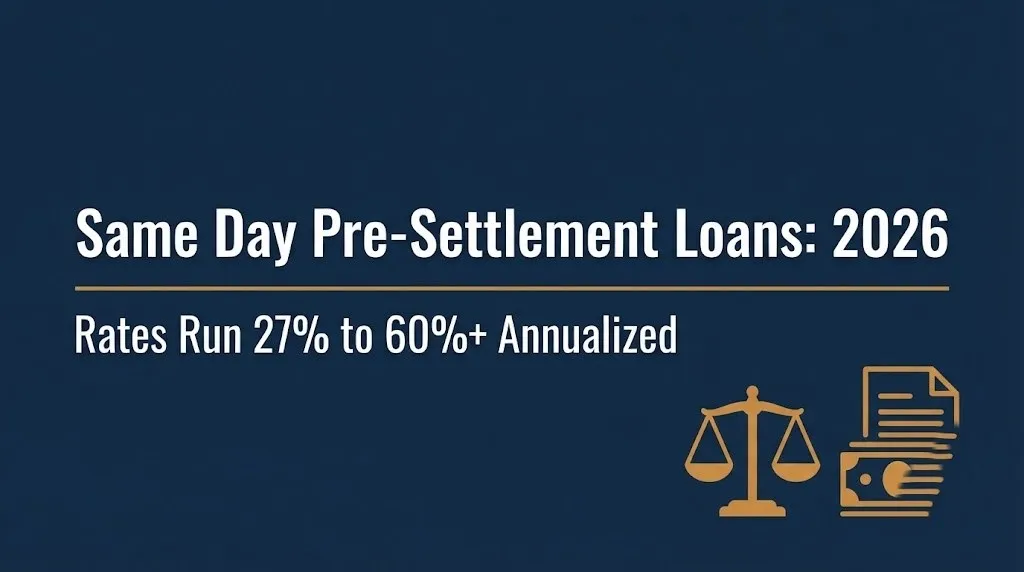
- Costs run high: typically 2% to 5% monthly, or 27% to 60%+ annualized, some contracts exceed 150% APR.
- New York now caps consumer litigation funding fees at 25% of gross recovery, effective June 17, 2026.
You’re searching “same day pre-settlement loans” because bills are piling up while your case drags on, and someone promised you cash today. Here’s the direct answer: these products exist, funds often arrive within 24 to 48 hours of approval, but the true cost is almost always higher than the marketing suggests.
This affects personal injury plaintiffs nationwide, and the single number that matters most is the total repayment amount at the time your case actually settles, not the monthly rate quoted upfront. New York’s new law caps funder recovery at 25% of your gross settlement, but that protection didn’t exist until this year and doesn’t apply everywhere.
This guide breaks down what these advances actually cost, which states regulate them, and the red flags separating a fair contract from one that eats your entire settlement. One detail most sites skip: a $10,000 advance at a common 3% monthly compounding rate can grow to roughly $19,000 after just two years.
The Facts
| Product type | Non-recourse cash advance against a pending lawsuit, not a traditional bank loan |
| Typical funding speed | 24 to 48 hours after approval, per multiple funding companies |
| Typical monthly rate | 2% to 5% per month, compounding or simple |
| Typical annualized cost | 27% to 60%+, with some contracts exceeding 150% APR |
| Typical advance amount | 10% to 20% of expected case value |
| New York cap (as of June 17, 2026) | 25% of gross recovery, per the Consumer Litigation Funding Act |
| States with new disclosure laws in 2025 to 2026 | Arizona, Colorado, Kansas, Georgia, Montana, Oklahoma, Tennessee, New York |
| Repayment trigger | Only owed if you win or settle your case |
Where rates vary by company and case, this table reflects the ranges multiple industry sources confirm, not a single fixed number.
Are Same Day Pre-Settlement Loans Legit or a Scam?
Same day pre-settlement loans are a legitimate financial product, not a scam, but the industry remains lightly regulated in most states. Reputable companies operate legally and disclose terms in writing before funding.
The bigger risk isn’t fraud, it’s cost. Because these are structured as non-recourse advances rather than traditional loans, most states don’t apply standard lending laws or interest rate caps to them.
Key Takeaway: These products are real and legal, but “legal” doesn’t mean “cheap.” The lack of a rate cap in most states is the actual risk, not the legitimacy of the industry itself.
How Much Do Same Day Settlement Loans Actually Cost?
Same day settlement loans typically cost 2% to 5% per month, which translates to roughly 27% to 60% or more annualized. Some contracts, according to a 2022 Duke FinReg Blog academic study, carried APRs exceeding 150%.
| Rate Type | Typical Range | Notes |
|---|---|---|
| Monthly simple rate | 2.5% to 5% | Flat fee on the original advance |
| Monthly compounding rate | 2.5% to 4.5% | Grows faster than simple rate over time |
| Annualized equivalent | 27% to 60%+ | Varies by company and case risk |
| High-end outlier contracts | 100% to 150%+ APR | Documented in academic research |
Here’s a real-world example using industry-published math: a $10,000 advance at a common 3% monthly compounding rate grows to roughly $19,000 after two years. That’s before attorney fees and case costs come out of your settlement.
Reality Check: No legitimate funding company texts you out of the blue promising instant settlement cash. If you’re contacted unprompted with a guaranteed approval before anyone reviews your case, treat that as a red flag, not an opportunity.
How Fast Do Same Day Pre-Settlement Loans Really Get Funded?
Same day funding claims typically mean money arrives within 24 to 48 hours after your application is approved, not the same day you apply. Approval itself usually takes longer than the funding transfer.
The approval process depends on:
- Your attorney submitting case documentation to the funder
- The funding company reviewing case strength, not your credit
- An offer being generated based on expected settlement value
- You and your attorney reviewing the contract terms
- Signing the agreement and confirming banking details
- Funds transferring, often via wire, within 24 to 48 hours of signing
Approval is based on the strength of your legal claim, not your credit score or employment history, since there are no monthly payments to underwrite against.
What Are Settlement Funding Companies and How Do They Differ?
Settlement funding companies are private firms that purchase a contractual right to part of your future settlement in exchange for upfront cash. They compete on speed, rate, and which case types they’ll fund.
The market has grown substantially. Industry research from The Business Research Company estimated the pre-settlement funding market reached $19.62 billion in 2025, growing at roughly 12% annually.
Some well-known names in the space, including Tribeca Lawsuit Loans, Baker Street Funding, and others, operate nationally but with meaningfully different rates, funding caps, and case-type restrictions. Tribeca, for instance, is headquartered in Los Angeles with additional offices, and advertises funding decisions within 24 to 48 hours, though independent reviews of specific companies vary and should be checked directly through the Better Business Bureau before signing anything.
Key Takeaway: Shopping at least two or three funding companies before signing is standard advice across nearly every independent source, since quoted rates on the same case can vary significantly.
What Types of Lawsuits Qualify for Pre-Settlement Loans?
Personal injury lawsuits are the most common qualifying case type, though many funders also cover workers’ compensation, wrongful death, and employment disputes. Case type alone doesn’t guarantee approval.
Common qualifying case types include:
- Personal injury and motor vehicle accident claims
- Medical malpractice cases
- Workers’ compensation disputes
- Premises liability claims
- Employment and wrongful termination cases
- Mass tort and multidistrict litigation claims
Funders evaluate the strength of liability, insurance coverage available, and how close the case is to resolution. Weak or highly contested cases are more likely to be declined or offered smaller advances.
How Do You Apply for a Personal Injury Settlement Loan?
You apply for a personal injury settlement loan by having your attorney submit case details directly to the funding company for underwriting review. Applying without your attorney’s involvement typically isn’t possible, since funders need case documentation only your lawyer can provide.
- Contact a funding company and request an application, often free.
- Provide your attorney’s contact information, since they’ll need to participate.
- The funder requests case files, medical records, or liability documentation from your attorney.
- An underwriter reviews case strength and estimated settlement value.
- You receive a funding offer detailing the advance amount and repayment terms.
- Your attorney reviews the contract before you sign anything.
- Once signed, funds typically transfer within 24 to 48 hours.
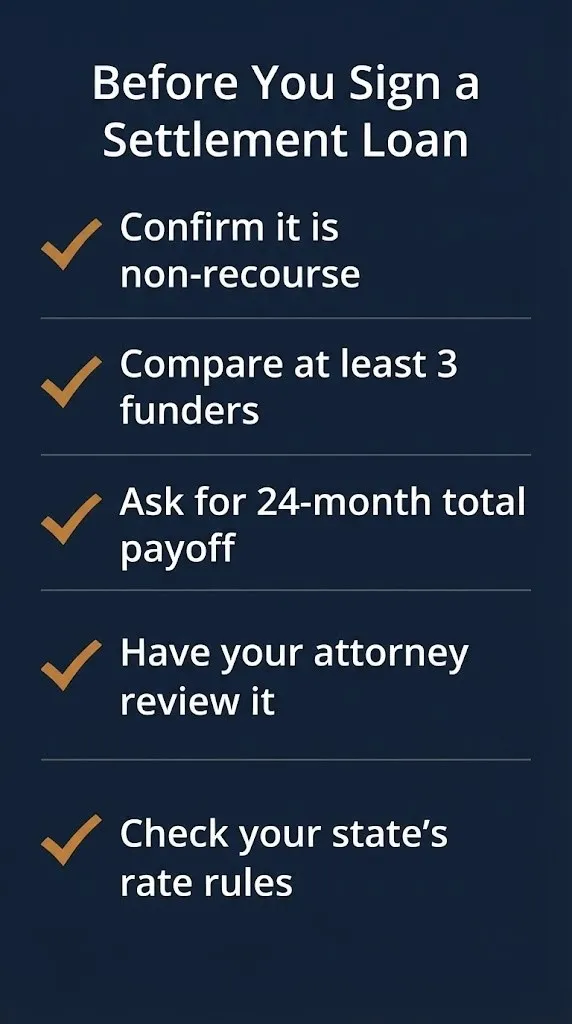
Never sign a funding agreement your attorney hasn’t reviewed first. This is standard advice across every credible industry source, not just caution for caution’s sake.
Is a Pre-Settlement Loan the Same as a Personal Injury Lawsuit Loan?
Yes, “pre-settlement loan” and “personal injury lawsuit loan” describe the same non-recourse product, just marketed under different names. Other common names include lawsuit cash advance, legal funding, and litigation funding.
Regardless of the name used, the defining legal feature stays the same: repayment is contingent on winning or settling your case. If your case is dismissed or you lose at trial, you generally owe the funding company nothing.
Think of it less like a bank loan and more like selling a small stake in your future recovery, similar to how a business might sell equity rather than take on debt. The funder absorbs the risk of a loss in exchange for a larger return if you win.
Which States Regulate or Restrict Settlement Loans in 2026?
At least 11 states have enacted some form of restriction on litigation funding as of 2026, ranging from disclosure requirements to outright bans on certain third-party funding arrangements. The regulatory landscape shifted meaningfully this year.
| State | 2025 to 2026 Action |
|---|---|
| New York | Consumer Litigation Funding Act, effective June 17, 2026, caps consumer funder recovery at 25% of gross recovery |
| Georgia | Requires funder registration with the Department of Banking and Finance |
| Kansas | Requires disclosure of funding agreements within 30 days |
| Arizona, Colorado, Montana, Oklahoma, Tennessee | New disclosure or registration laws enacted in 2025 |
| North Carolina | Enacted a broad ban on third-party litigation investment, effective June 22, 2026 |
North Carolina’s law is described as the first outright state ban on third-party litigation funding, though its precise application to individual consumer pre-settlement advances versus commercial litigation investment is still being clarified by legal commentators. If you’re in North Carolina, confirm current status directly with a local attorney before assuming any specific product is or isn’t covered.
New York’s new cap is the most concrete consumer protection so far: total charges cannot exceed 25% of your gross recovery, prepayment penalties are banned, and you get a 10-business-day right to cancel the contract without penalty.
Key Takeaway: Where you live and where your case is filed can significantly change what a funding company is legally allowed to charge you.
What Happens If Your Case Settles for Less Than You Owe?
If your case settles for less than the advance balance, a true non-recourse agreement means you only pay what the settlement actually produces. You are not personally liable for any shortfall beyond your recovery.
Some agreements now include repayment caps, limiting the funder’s total return to a set multiple of the original advance regardless of how long the case drags on. These capped agreements, increasingly common in 2026, are considered more plaintiff-friendly than open-ended compounding contracts.
Before signing, get explicit written confirmation that your agreement is non-recourse. Any language suggesting personal liability beyond your case proceeds is a serious red flag.
What Happens Next
June 17, 2026: New York’s Consumer Litigation Funding Act substantive provisions, including the 25% recovery cap, are already in effect.
February 13, 2027: New York funding company registration and reporting requirements take effect under the same act.
June 22, 2026: North Carolina’s litigation investment ban is already in effect for qualifying civil proceedings and contracts.
Ongoing: Additional states, including California, Colorado, and Illinois, are actively considering new litigation funding restrictions.
Frequently Asked Questions
How fast can I actually get a same day settlement loan?
Funds typically arrive 24 to 48 hours after your contract is signed, not literally the same day you apply.
Approval depends on how quickly your attorney can provide case documentation.
Some companies advertise faster turnaround, but confirm the actual timeline before relying on it for an urgent bill.
Do I have to pay back a pre-settlement loan if I lose my case?
No, legitimate pre-settlement funding is non-recourse, meaning you owe nothing if you lose or your case is dismissed.
The funding company absorbs that loss under the agreement’s terms.
Always get this confirmed explicitly in writing before signing any contract.
What’s the real difference between a settlement loan and a personal loan?
A settlement loan is repaid only from your case proceeds, while a personal loan follows your credit regardless of any lawsuit outcome.
Settlement loans typically don’t require credit checks or monthly payments.
Personal loans usually carry lower interest rates but require repayment no matter what happens with your case.
Is my attorney required to be involved in a settlement loan application?
Yes, in almost every case, since funders need your attorney to verify case details and documentation.
Your attorney also has a professional duty to review the funding contract before you sign.
Applying without attorney involvement generally isn’t possible for a real personal injury claim.
How much of my settlement will a funding company take?
The amount depends on your state, the advance size, and how long your case takes to resolve.
In New York, total charges are now capped at 25% of your gross recovery as of June 2026.
In states without a cap, the total owed can grow substantially the longer a case takes to settle.
Can I get a pre-settlement loan on a workers’ compensation case?
Some funding companies do offer advances for workers’ compensation claims, though not all funders cover this case type.
Availability and terms vary significantly by company and by state law.
Confirm case-type eligibility directly with a specific funder before applying.
What questions should I ask before signing a funding contract?
Ask for the total repayment amount projected at six, twelve, and twenty-four months, not just the monthly rate.
Confirm in writing that the agreement is strictly non-recourse.
Ask whether the rate is simple or compounding, since compounding grows the balance significantly faster over time.
Are pre-settlement loans available in every state?
No, availability and terms vary by state, and some states have recently added restrictions or bans on certain funding arrangements.
North Carolina enacted a broad restriction on third-party litigation funding in June 2026.
Check your specific state’s current rules before assuming a product is available or unrestricted where you live.
Bottom Line
Before signing anything, ask for the total repayment figure at multiple future dates, not just the monthly rate quoted upfront. Have your attorney review every contract, and compare at least two or three funding companies first.
New York’s 25% recovery cap took effect June 17, 2026, but most states still have no hard ceiling on what you can be charged. Confirm your specific state’s current rules before you sign.