Pre Settlement Funding California 2026: What the New State Law Changes and What It Costs
Quick Answer
- Pre-settlement funding in California is legal and now regulated under the California Consumer Legal Funding Act.
- Costs are not capped by state law, but contracts must now disclose the total repayable amount on a schedule.
- You have five business days to cancel the contract without penalty if you return the funds.
If you are waiting on a California personal injury settlement and the bills are stacking up, pre settlement funding california options have changed in 2026. A new state law now governs how these advances work, and it gives you rights you did not have a year ago .
The California Consumer Legal Funding Act took effect on January 1, 2026. It requires funders to give you a written contract in plain English, itemize every charge, and show you exactly what you will owe at six-month intervals for the first three years .
Most California advances range from $500 to $25,000, and funding companies rarely advance more than 10% to 15% of your case’s estimated value . That ceiling exists because the funder wants to make sure it gets paid even if your case settles low.
This article covers what the new law requires, what these advances actually cost, who may qualify, and what to watch out for before you sign anything.
The Facts
| Item | Details |
|---|---|
| Regulation | California Consumer Legal Funding Act (AB 931), effective Jan. 1, 2026 |
| Legal Status | Legal and regulated in California |
| Typical Advance Range | $500 to $25,000 for most California cases |
| Advance Ceiling | Usually 10% to 15% of estimated case value |
| Rate Cap | None. California does not cap charges |
| Cancellation Right | 5 business days, no penalty |
| Referral Fees | Prohibited between funders and attorneys |
| Proof Needed | Pending case with attorney representation |
Is Pre Settlement Funding in California Legitimate or a Scam?
Pre-settlement funding in California is legitimate and legal, and as of January 1, 2026, it is formally regulated under the California Consumer Legal Funding Act . The law sets rules for how funders must disclose costs and prohibits certain practices that used to be common.
That does not mean every company is trustworthy. The new law gives you tools to separate legitimate funders from ones cutting corners.
Legitimate funders follow these rules:
- They give you a written contract in plain English
- They itemize every charge, including any fees labeled as something other than interest
- They show you the total amount you would owe at six-month intervals for three years
- They never ask your attorney for a referral fee or kickback
- They never try to control your case or force you to settle
If a company refuses to put its terms in writing, pressures you to sign immediately, or promises “guaranteed” approval before reviewing your case, walk away. The California Department of Financial Protection and Innovation (DFPI) oversees consumer financial products in the state, and the Attorney General can pursue unfair or deceptive practices .
Key Takeaway: Pre-settlement funding is legal in California, but the new law only protects you if you actually read the disclosures and use the cancellation window.
How Much Can You Get from Pre Settlement Funding in California?
Most California pre-settlement advances fall between $500 and $25,000, and funders typically will not advance more than 10% to 15% of what your case is estimated to be worth . A case expected to settle for $100,000 might support an advance of roughly $10,000 to $15,000.
The amount depends on several factors that a funder reviews before making an offer:
- Liability strength. If the other driver was clearly at fault, the funder has more confidence.
- Medical documentation. Emergency room records, imaging, and treatment notes show the injury is real.
- Policy limits. If the defendant carries a $25,000 policy and your bills are $40,000, the case value is capped by that policy.
- Your attorney’s assessment. Funders rely heavily on what your lawyer says the case is worth.
High Rise Financial, a California-based funder, reports its advances range from $500 to $500,000, with an average of $5,000 per plaintiff . That average is far lower than the maximum, which tells you most people borrow only what they need to bridge a specific gap.
USClaims advertises funding from $500 to $1,000,000 for California plaintiffs, with a “2X Cap” that limits total repayment to twice the advance regardless of how long the case takes . That kind of cap is not universal. Many contracts have no ceiling at all.
Estimated Payout Impact
| Advance Amount | Payoff at 12 Months (3% monthly compounding) | Payoff at 24 Months |
|---|---|---|
| $2,000 | $2,852 | $4,067 |
| $5,000 | $7,130 | $10,168 |
| $10,000 | $14,260 | $20,336 |
Assumes 3% monthly compounding, a common industry rate. Actual terms vary by funder and case.
The numbers above are illustrative, not quotes. The point is simple: time is the biggest driver of cost. The same advance costs roughly twice as much at 24 months as at 12 in a compounding contract .
What Do Pre Settlement Loans in California Actually Cost?
Pre-settlement funding in California typically carries effective annual costs of 30% to 60%, and California law does not cap what funders can charge . The rate you are quoted is the product of negotiation and competition, not a legal ceiling.
The new disclosure law helps you compare offers. Before AB 931, a funder could bury costs in vague language. Now the contract must show the total repayable at six-month intervals for three years .
Here is what drives the cost up or down:
- Monthly rate and compounding frequency. A 3% simple monthly rate costs $360 per year per $1,000 advanced. The same rate compounding monthly costs $426 and accelerates every month after .
- Time to resolution. A case that settles in 12 months costs far less than one that drags to 36.
- Fees added to principal. Application, origination, and administration fees are often added to the balance, meaning you pay charges on the fees too.
- Repayment cap. Some funders cap total payoff at two or three times the advance. A contract with no cap has no ceiling.
The legislative analysis behind AB 931 recounted a constituent who ended up repaying 100% of his financing in charges on top of the amount financed . That is one anecdote, not an industry average, but it shows why the disclosure rule exists.
One BBB complaint against Rockpoint Legal Funding in Los Angeles illustrates the frustration plaintiffs can face. A reviewer claimed she borrowed $11,000 and was told she owed $47,000 at payoff. The company responded that it strives for transparency and offered to discuss the specifics .
Reality Check: Pre-settlement funding is not a loan. You do not owe anything if your case loses. But if you win, the payoff comes off the top of your recovery, before you see a dollar. A $5,000 advance that costs $14,000 to retire is not unusual. It is the product working as designed .
How Does AB 931 Protect California Plaintiffs?
AB 931 creates the California Consumer Legal Funding Act and imposes specific requirements on every funding contract signed on or after January 1, 2026 .
The law requires:
- Plain-English contracts. The agreement must be written so the average consumer can read and understand it.
- Itemized charge disclosure. The funder must list the funded amount, every charge, the maximum total you could owe, and the repayment schedule.
- Predetermined amounts. Repayment must be a set amount tied to time intervals, not a percentage of whatever your case settles for.
- Five-day cancellation right. You can cancel without penalty within five business days if you return the money.
- No referral fees to attorneys. Funders cannot pay your lawyer for sending you their way. Your attorney must sign an acknowledgment confirming no referral fee changed hands.
- No control over your case. The funder cannot direct strategy, veto a settlement, or require you to change lawyers.
If a funder violates these rules, the contract can be voided, and the funder can be liable for statutory damages up to $10,000 per violation or three times your actual damages, whichever is greater .
The law does not cap rates. An earlier bill, SB 581, would have capped charges at 36% annually, but it died in committee in February 2024 . California plaintiffs still negotiate rates in a free market, which is why shopping at least two or three funders matters.
Who May Qualify for Pre Settlement Funding in California?
You may qualify for pre-settlement funding in California if you have a pending personal injury claim, you are represented by an attorney, and your case has enough estimated value to support an advance .
Funding companies underwrite based on case strength, not your credit score. There is no credit check because repayment depends on your case outcome, not your personal guarantee .
The typical profile of a funded plaintiff looks like this:
- You were injured in a car accident, slip and fall, or other negligence incident in California
- You are treating with a doctor or have documented medical records
- You have hired a personal injury attorney working on contingency
- Your case has clear or strong liability
- You need cash for rent, medical bills, or living expenses while the case resolves
Who May Qualify
- Pending California personal injury case
- Attorney representation required
- Documented injury and treatment
- Liability is clear or strong
- Case value supports the advance amount
One important exception applies to uninsured drivers. Proposition 213, codified at Civil Code § 3333.4, bars uninsured drivers from recovering non-economic damages like pain and suffering, even if the other driver was entirely at fault . If you were uninsured at the time of the accident, your case value may be limited to economic damages only, which makes funding harder to get and smaller in amount.
MICRA caps non-economic damages in medical malpractice cases. The cap started at $350,000 in 2023 and escalates by $40,000 per year for non-death cases, reaching $750,000 .
How to Get Pre Settlement Funding in California: Step by Step
Getting pre-settlement funding in California takes five to eight steps, and most of the work happens between your attorney and the funder.
- Confirm you have a pending case with an attorney. Funders will not work with unrepresented plaintiffs.
- Ask your attorney if they have worked with funders before. They may have a short list of companies they trust.
- Gather your case documents. Police reports, medical records, and bills help the funder evaluate your claim.
- Apply with two or three funders. Comparing offers is the single best way to avoid overpaying.
- Review the disclosure page carefully. The law requires the total repayable at six-month intervals for three years.
- Ask for the payoff in dollars at 6, 12, 24, and 36 months. This tells you more than any advertised rate.
- Sign only if the numbers work for your case timeline. If your case may take three years, know what that costs.
- Remember your five-day cancellation right. You can walk away without penalty if you return the funds.
Your attorney must sign an acknowledgment confirming no referral fee was paid . If your lawyer seems evasive when you ask whether they have a financial interest in the funder, pay attention to that.
What Happens If Your Case Loses or Settles Low?
If your case loses, you owe nothing. Pre-settlement funding is nonrecourse, which means repayment depends entirely on your case producing a recovery .
If your case settles for less than expected, the funder gets paid from what is available. Attorney fees, case costs, and medical liens come first in the payment stack. The funder’s payoff comes next. You receive what remains .
A concrete example helps. A case settles for $100,000 pre-suit. The attorney’s contingency fee at 33.3% is $33,300. Case costs are $2,000. Negotiated medical liens total $18,000. That leaves roughly $46,700. If you took a $5,000 advance 24 months earlier at 3% monthly compounding, the payoff is about $10,164. Your net drops to roughly $36,500 .
You received $5,000 in cash and gave up more than $10,000 of your recovery for it. That tradeoff might still make sense if it kept your lights on. But you should make it with clear eyes.
What Are the Alternatives to Pre Settlement Funding in California?
Most injured Californians can avoid funding companies through lien-based medical care, negotiated bill deferrals, and litigation tools that speed up settlement .
Here are the three most common alternatives:
- Lien-based medical care. Many California physicians and imaging centers treat injury plaintiffs on a lien, meaning they get paid from the settlement and you pay nothing while the case runs. This solves the biggest expense in most cases without borrowing a dollar.
- Negotiated deferrals. An attorney’s letter confirming representation and a pending claim persuades most providers and collectors to pause billing until resolution. Deferral costs you nothing.
- Speed the case up. A well-timed offer to compromise under Code of Civil Procedure section 998 puts real cost-shifting risk on the insurer for refusing a reasonable number. That pressure often moves stalled negotiations .
Talk to your attorney before signing a funding contract. In many cases, that conversation surfaces med-pay coverage, wage benefits, or a lien deferral you did not know existed.
What Happens Next for California Pre Settlement Funding?
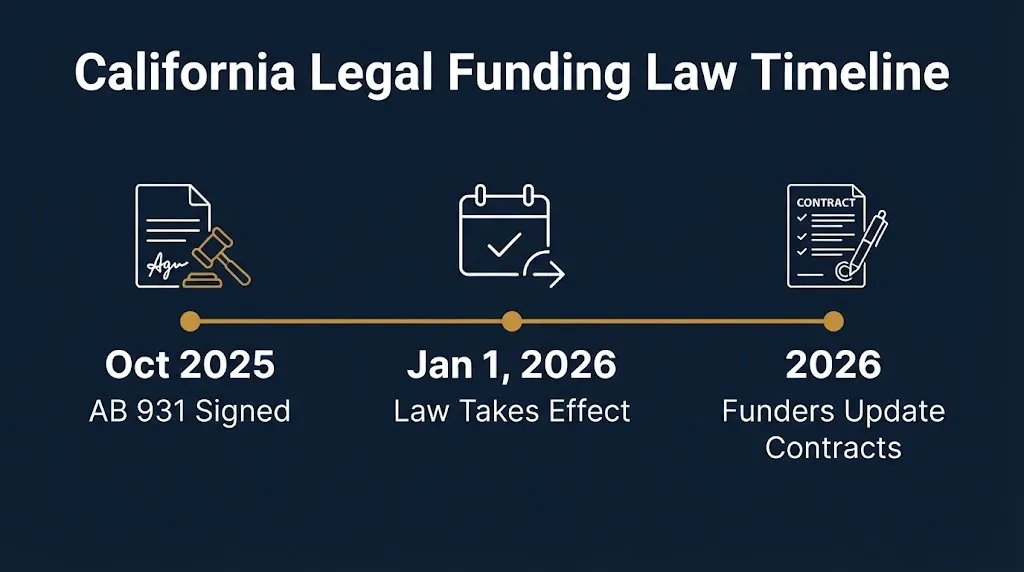
January 1, 2026: AB 931 took effect and now governs all new funding contracts in California.
Throughout 2026: Funders are updating their contracts to comply with the disclosure and cancellation requirements.
Expected late 2026: Early court challenges to AB 931 may clarify how strictly the disclosure rules are enforced.
Ongoing: California remains one of the largest pre-settlement funding markets in the country, with no rate cap in place.
Watch for: Any new legislation that proposes rate limits or additional licensing requirements for funders.
Frequently Asked Questions
Is pre-settlement funding legal in California?
Yes, pre-settlement funding is legal and regulated in California. AB 931 created the California Consumer Legal Funding Act effective January 1, 2026.
How much can I get from pre settlement funding in California?
Most advances range from $500 to $25,000. Funders typically will not advance more than 10% to 15% of your case’s estimated value.
What does pre settlement funding cost in California?
Effective annual costs typically run 30% to 60%, and California does not cap these charges. The new law requires funders to disclose the total repayable at six-month intervals.
Do I need good credit to get pre-settlement funding?
No. Approval is based on the strength of your case, not your credit score. There is no credit check.
Can I cancel a pre-settlement funding contract in California?
Yes. You have five business days to cancel without penalty if you return the funds you received.
Can my attorney receive a referral fee from a funding company?
No. AB 931 prohibits funders from paying referral fees to attorneys, and your attorney must sign an acknowledgment confirming no fee changed hands.
What happens if I lose my case after taking funding?
You owe nothing. Pre-settlement funding is nonrecourse, meaning repayment only happens if your case produces a recovery.
Are there cheaper alternatives to pre-settlement funding in California?
Yes. Lien-based medical care, negotiated bill deferrals, and faster litigation strategies can bridge the gap without borrowing against your settlement.
Waiting on a settlement is hard, and the bills do not pause. The new California law gives you better tools to understand what you are signing before you commit. Ask for the dollar payoff at 6, 12, 24, and 36 months. Compare at least two funders. And talk to your attorney first, because the cheapest funding is often no funding at all.