Capital One ERISA Settlement 2026: How Much You Could Get and When
Quick Answer
- The Capital One ERISA settlement is real: a $9.6 million fund resolving a 401(k) forfeiture lawsuit, court-supervised in the Southern District of New York.
- Individual payouts are not yet determined; amounts depend on how long you participated in the plan during the class period.
- No claim form is required. Payments are automatic and will start only after the court grants final approval, which is pending confirmation past the June 25, 2026 hearing.
You participated in Capital One’s 401(k) plan at some point, and now you’re seeing headlines about a $9.6 million settlement. The short answer: yes, it’s real, and no, you don’t have to file anything.
This affects anyone who had an account in the Capital One Financial Corporation Associate Savings Plan between November 11, 2018 and January 13, 2026. The number that matters most right now isn’t a payout amount, it’s the fairness hearing date of June 25, 2026, since payments can’t start until the court signs off.
This article covers what the lawsuit alleged, who qualifies, how payment amounts get calculated, and what’s still pending. One detail worth knowing upfront: this is a non-opt-out class action, meaning you can’t remove yourself from it even if you wanted to.
The Facts
| Case | Singh, et al. v. Capital One Financial Corporation, et al., No. 1:24-cv-08538-MMG |
| Court | U.S. District Court for the Southern District of New York |
| Status | Preliminarily approved January 13, 2026; fairness hearing held June 25, 2026; final approval outcome not yet confirmed |
| Fund Size | $9,600,000 |
| Est. Per Person | Not yet determined; depends on plan participation length and net fund after fees |
| Claim Deadline | None. Payments are automatic, no claim form required |
| Administrator | Analytics Consulting LLC |
| Proof Needed | None. Eligibility is determined from Capital One’s own plan records |
Is the Capital One ERISA Settlement Legit?
Yes, this is a legitimate, court-supervised class action settlement, not a scam or phishing attempt. The case is publicly filed as Singh, et al. v. Capital One Financial Corporation, et al., case number 1:24-cv-08538-MMG, in the U.S. District Court for the Southern District of New York.
Judge Margaret M. Garnett granted preliminary approval on January 13, 2026. The official settlement website, CapitalOneERISASettlement.com, is registered to Analytics Consulting LLC, a court-appointed claims administrator, not a third-party marketing operation.
Class Counsel is the law firm Capozzi Adler, P.C. Defense counsel is Morgan, Lewis & Bockius LLP, representing Capital One.
Reality Check: No legitimate settlement administrator will ever call, text, or email you asking for a fee to “release” your payment. This settlement requires no claim form and no payment from you, so any message asking for money or account credentials tied to this case is not from the real administrator.
How Much Will You Get From the Capital One ERISA Settlement?
Individual payout amounts are not yet determined, because they depend on a Plan of Allocation the court has not finalized. This is one of the most honest gaps in this case: nobody, including the settlement administrator, can quote you a number yet.
Here’s what is confirmed about how the math will work.
The settlement administrator will determine the final payment amount by the number of years each class member had a positive account balance and the total number of eligible class members during the class period. That means longer plan participation generally means a larger share.
The Net Settlement Amount will not be known until taxes, court-approved costs, fees, and expenses, including attorneys’ fees and Class Representative case contribution awards, are quantified and deducted from the $9.6 million fund. Only after that net figure is set does the per-person allocation formula run.
| Payment Detail | Status |
|---|---|
| Total settlement fund | $9,600,000 (confirmed) |
| Net settlement amount (after fees) | Not yet confirmed |
| Individual payout formula | Based on years of positive account balance during class period |
| Minimum payout threshold | Former participants owed $5 or less will not receive a distribution |
Key Takeaway: The $9.6 million fund is real and court-confirmed, but your individual share depends on a Plan of Allocation the court has not yet finalized.
Do You Need to File a Claim?
No. This is an automatic-payment settlement, and filing a claim form is not required or even possible for this case.
If you have an active Plan account, your share will be deposited directly. If you are a former participant with a valid address on file, you will receive a check after the court grants final approval. There’s nothing to submit and no portal to log into.
This is different from most class actions, where you have to prove eligibility. Think of it less like a rebate you have to mail in receipts for, and more like a tax refund that gets deposited automatically once processing finishes.
Steps for class members to take:
- Confirm you’re covered by checking if you had a Capital One Associate Savings Plan account between November 11, 2018 and January 13, 2026.
- Do nothing else if you’re currently an active plan participant; your payment deposits into your existing account.
- Update your mailing address with the plan or Class Counsel if you’re a former participant and may have moved.
- Watch for a check from the Settlement Administrator, which stays valid for 180 days from the date it’s issued.
- Contact the administrator directly at 888-687-6708 or by email if you have questions about your status.
- Ignore any request for payment tied to this settlement, since legitimate distributions require no fee from you.
Why Is Capital One Being Sued Over This 401(k) Plan?
The lawsuit concerns “forfeitures,” the unvested employer matching contributions that employees who leave before the two-year vesting period lose. Plaintiffs claim Capital One should have used those forfeited funds to pay plan administrative expenses instead of using them to fund matching contributions for other participants.
Plaintiffs allege this violated ERISA’s fiduciary duties of prudence and loyalty, ERISA’s anti-inurement clause, and a duty to monitor other plan fiduciaries. This is a fairly common type of ERISA lawsuit filed against large employers with 401(k) plans in recent years.
Capital One denies all allegations and argues, among other defenses, that the practice complies with over sixty years of legal guidance permitting forfeitures to offset employer contributions. The company agreed to settle to avoid the cost and uncertainty of continued litigation, not as an admission of wrongdoing.
Who Qualifies for the Capital One ERISA Settlement?
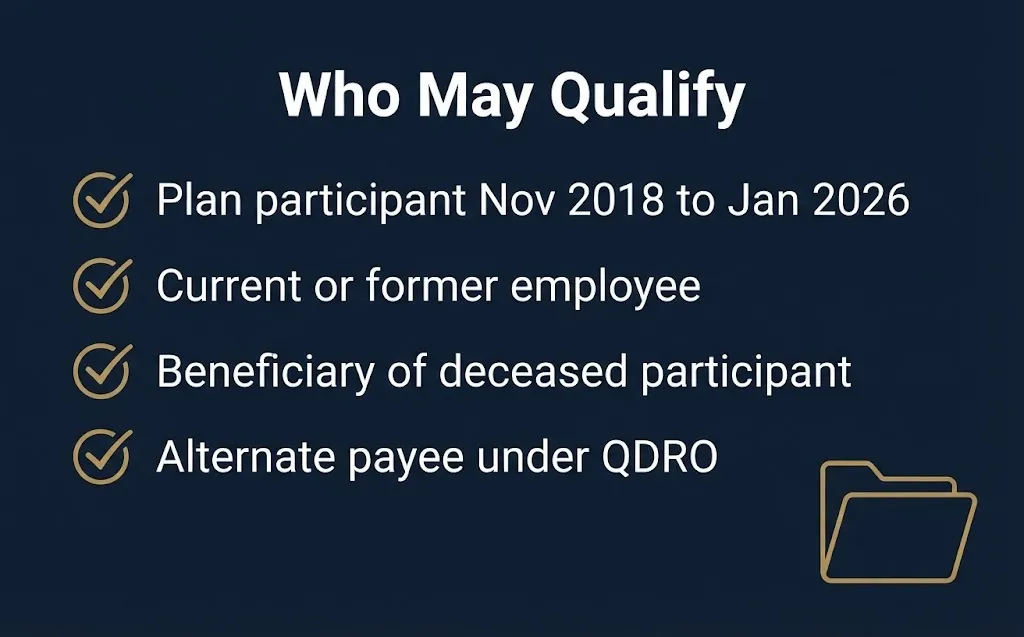
You qualify if you participated in the Capital One Financial Corporation Associate Savings Plan at any point between November 11, 2018 and January 13, 2026. This includes several groups beyond just active employees.
Eligible class members include:
- Current employees with an active plan account during the class period
- Former employees who had a plan account at any point during that window
- Beneficiaries of a deceased participant who was in the plan during the class period
- Alternate payees under a Qualified Domestic Relations Order (QDRO) tied to a participant’s account
The settlement is certified as a non-opt-out class action under Federal Rule of Civil Procedure 23(b)(1), meaning class members cannot exclude themselves and will be bound by the settlement’s terms. If you’re covered and you do nothing, you’re automatically included.
Key Takeaway: Eligibility is based entirely on Capital One’s own plan records, so there’s no application process where you could accidentally miss out by not applying.
When Will Capital One ERISA Settlement Checks Be Mailed?
No distribution date has been set, and payments cannot legally begin until after final court approval and resolution of any appeals. As of the most recent public update, no checks had been issued.
Automatic payments will be made only after the court grants final approval at or after the June 25, 2026 fairness hearing and any appeals are resolved. That’s a meaningful qualifier: even after a judge approves the deal, an appeal could push the payment date further out.
This mirrors what happened with a separate, larger Capital One settlement over 360 Savings account interest rates. That $425 million settlement was initially supposed to send payments around July 21, 2026, but an appeal seeking to rescind the settlement substantially delayed that timeline. It’s a useful reminder that “approved” and “paid” aren’t the same milestone.
What Was the Fairness Hearing on June 25, 2026?
The fairness hearing is the court proceeding where the judge decides whether to grant final approval to the settlement. At that hearing, the court considers whether the settlement is fair, reasonable, and adequate, rules on any objections, and decides motions for attorneys’ fees, expense reimbursement, and Case Contribution Awards for the named plaintiffs.
The outcome of the June 25 hearing is not yet confirmed in public settlement-tracking sources as of this writing. The parties themselves stated they did not know how long the court’s decision would take or whether appeals would be filed.
If you want to check the current status, the official settlement website posts updates directly, and that’s the most reliable source since third-party trackers can lag.
How Do You Object to the Capital One ERISA Settlement?
You can formally object if you disagree with the settlement terms, though the deadline to do so has already passed for most class members. Written objections had to be received by the Clerk of the Court no later than May 26, 2026, along with copies sent to both Class Counsel and Defense Counsel.
Because this is a non-opt-out class, objecting is different from excluding yourself. Since the settlement is certified under Rule 23(b)(1), it’s not possible for any Settlement Class member to exclude themselves from the settlement, regardless of whether they object.
Will You Be Taxed on Your Settlement Payment?
Payments are structured as retirement plan restorative payments, and tax treatment depends on your individual situation. All payments are intended to be “restorative payments” in accordance with Internal Revenue Service Revenue Ruling 2002-45, which generally governs how corrective 401(k) contributions are taxed.
Each class member who receives a payment is fully responsible for any federal, state, or local taxes attributable to that payment. Since specifics vary by whether the money lands in an active plan account versus arriving as a check to a former participant, a tax professional can clarify your individual liability.
What Happens Next
- June 25, 2026 (held): Fairness hearing took place in the Southern District of New York.
- Pending: Final approval ruling from Judge Garnett. Not yet confirmed as of this writing.
- Pending: Resolution of any appeals, which must clear before payments can start.
- Expected after final approval: Net Settlement Amount and Plan of Allocation get finalized, setting individual payout amounts.
- Expected after that: Automatic deposits to active plan accounts and checks mailed to former participants, valid for 180 days from issue.
Frequently Asked Questions
Is the Capital One ERISA settlement real?
Yes, it’s a court-filed class action settlement in the Southern District of New York.
The case is Singh, et al. v. Capital One Financial Corporation, No. 1:24-cv-08538-MMG.
The official site is administered by Analytics Consulting LLC, a court-appointed claims administrator.
How much money will I get from the Capital One ERISA settlement?
Individual payout amounts are not yet determined.
Your share depends on how long you had a positive account balance in the plan during the class period, November 11, 2018 to January 13, 2026.
Former participants owed $5 or less will not receive a payment.
Do I need to file a claim for the Capital One ERISA settlement?
No, this settlement pays automatically with no claim form required.
Eligibility and payment amounts come directly from Capital One’s own plan records.
Current participants get a deposit into their account; former participants get a mailed check.
When will Capital One ERISA settlement payments be sent?
No distribution date has been announced yet.
Payments can only begin after the court grants final approval and any appeals are resolved.
The fairness hearing took place June 25, 2026, but the final outcome is not yet confirmed in public records.
Can I opt out of the Capital One ERISA settlement?
No, this is a non-opt-out class action certified under Federal Rule of Civil Procedure 23(b)(1).
If you’re a member of the settlement class, you’re automatically bound by its terms.
You could object to the settlement, but the objection deadline was May 26, 2026.
What did Capital One do wrong in this lawsuit?
The lawsuit alleged Capital One misused forfeited, unvested employer 401(k) contributions.
Plaintiffs claimed those forfeitures should have paid plan administrative expenses instead of funding other participants’ matching contributions.
Capital One denies any wrongdoing and settled to avoid further litigation costs and risk.
Who is eligible for the Capital One ERISA settlement?
Anyone who participated in the Capital One Associate Savings Plan between November 11, 2018 and January 13, 2026 is eligible.
This includes beneficiaries of deceased participants and alternate payees under a Qualified Domestic Relations Order.
Current and former employees are both covered as long as they had plan activity during that window.
Will I owe taxes on my Capital One ERISA settlement payment?
Possibly, since payments are structured as retirement plan restorative payments under IRS Revenue Ruling 2002-45.
Each class member is responsible for any taxes attributable to their own payment.
A tax professional can clarify how your specific payment method, deposit versus check, affects your liability.
If you had a Capital One 401(k) account any time since late 2018, you’re likely covered and don’t need to do anything. The one thing worth doing now is confirming Capital One has your current mailing address, especially if you’ve left the company since 2018.